ABM ROI Measurement: How to Prove Account-Based Marketing Works
Master ABM ROI measurement with proven metrics, formulas, and frameworks that connect account-based marketing to real revenue outcomes.
Your account-based marketing program looks impressive on paper. Personalized campaigns. Targeted accounts. Sales and marketing alignment. But here's the uncomfortable question: Can you prove it's actually working?
ABM ROI measurement separates strategic marketing from expensive guesswork. It's the discipline of connecting account-based marketing investments to actual revenue outcomes—and most B2B teams struggle to do it well.
According to ITSMA research, 87% of B2B marketers report that ABM delivers higher ROI than other marketing approaches. Yet fewer than half can accurately calculate that ROI. They know ABM feels effective, but they can't prove it with numbers that satisfy the CFO.
This guide breaks down exactly how to measure ABM ROI—from foundational metrics to advanced attribution approaches that reveal the true impact of your account-based strategy.
What is ABM ROI Measurement?
ABM ROI measurement is the systematic process of calculating the financial returns generated by account-based marketing programs relative to their costs. Unlike traditional demand generation metrics, ABM measurement focuses on specific target accounts rather than aggregate lead volume.
The basic formula looks familiar:
ABM ROI = [(Revenue from ABM Accounts - ABM Program Cost) / ABM Program Cost] × 100%
Here's a practical example: Your ABM program generated $750,000 in revenue from target accounts. Total program costs (technology, content, advertising, personnel) hit $150,000. Your ABM ROI equals 400%—a 4:1 return.
Simple math, but measuring it accurately? That's where things get complicated.
The challenge with ABM ROI measurement:
- Long B2B sales cycles (6-18 months) delay revenue recognition
- Multiple stakeholders within accounts create attribution complexity
- Offline activities (events, direct mail) resist digital tracking
- Brand effects influence accounts that never touched your campaigns
Understanding marketing ROI analysis fundamentals provides essential context for tackling ABM-specific measurement challenges.
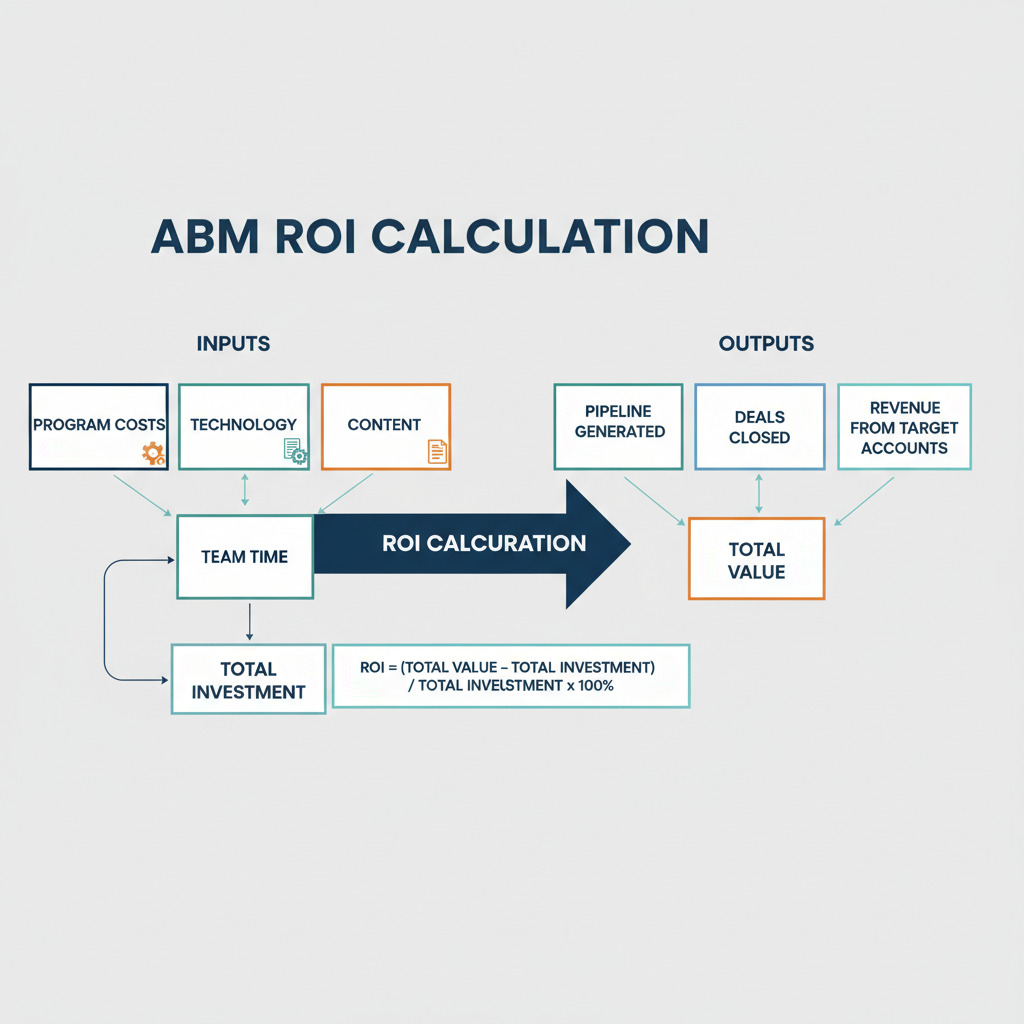
ABM ROI connects program investments to revenue from target accounts
Why Traditional Metrics Fail for ABM
ABM fundamentally differs from traditional demand generation. Traditional marketing optimizes for volume—more leads, more MQLs, more opportunities. ABM optimizes for quality and depth within specific accounts.
Metrics that mislead in ABM:
| Traditional Metric | Why It Fails for ABM |
|---|---|
| Lead volume | ABM targets fewer, higher-value accounts |
| Cost per lead | CPL increases when targeting specific accounts (but deal value should too) |
| Website traffic | Traffic from non-target accounts doesn't matter |
| Email list growth | List size means nothing if targets aren't engaging |
Research from Gartner confirms that companies measuring ABM with traditional demand gen metrics undervalue their programs by 30-50%. They're using the wrong ruler.
Effective ABM measurement requires account-level thinking. You're not asking "how many leads did we generate?" You're asking "how deeply have we penetrated our target accounts, and what revenue resulted?"
The ABM Metrics That Actually Matter
Stop drowning in dashboards. These are the ABM metrics that connect directly to business outcomes—and the ones your executive team actually cares about.
Tier 1: Revenue Metrics
Revenue metrics answer the ultimate question: Is ABM making us money?
1. Revenue from Target Accounts
Total revenue generated from your defined ABM account list. This is the metric that matters most. Track it quarterly and annually, comparing ABM accounts against non-ABM accounts.
2. Average Deal Size
Compare average contract value for ABM-influenced deals versus other pipeline. According to Demandbase research, ABM programs typically increase deal sizes by 171% because personalized engagement builds stronger relationships.
Your media budget optimization should account for these higher deal values when allocating resources to ABM versus broad-reach campaigns.
3. Customer Lifetime Value (CLV)
ABM's personalized approach builds deeper relationships that extend beyond initial purchase. Track CLV for ABM-acquired customers versus other acquisition channels. Higher CLV compounds ABM's ROI advantage over time.
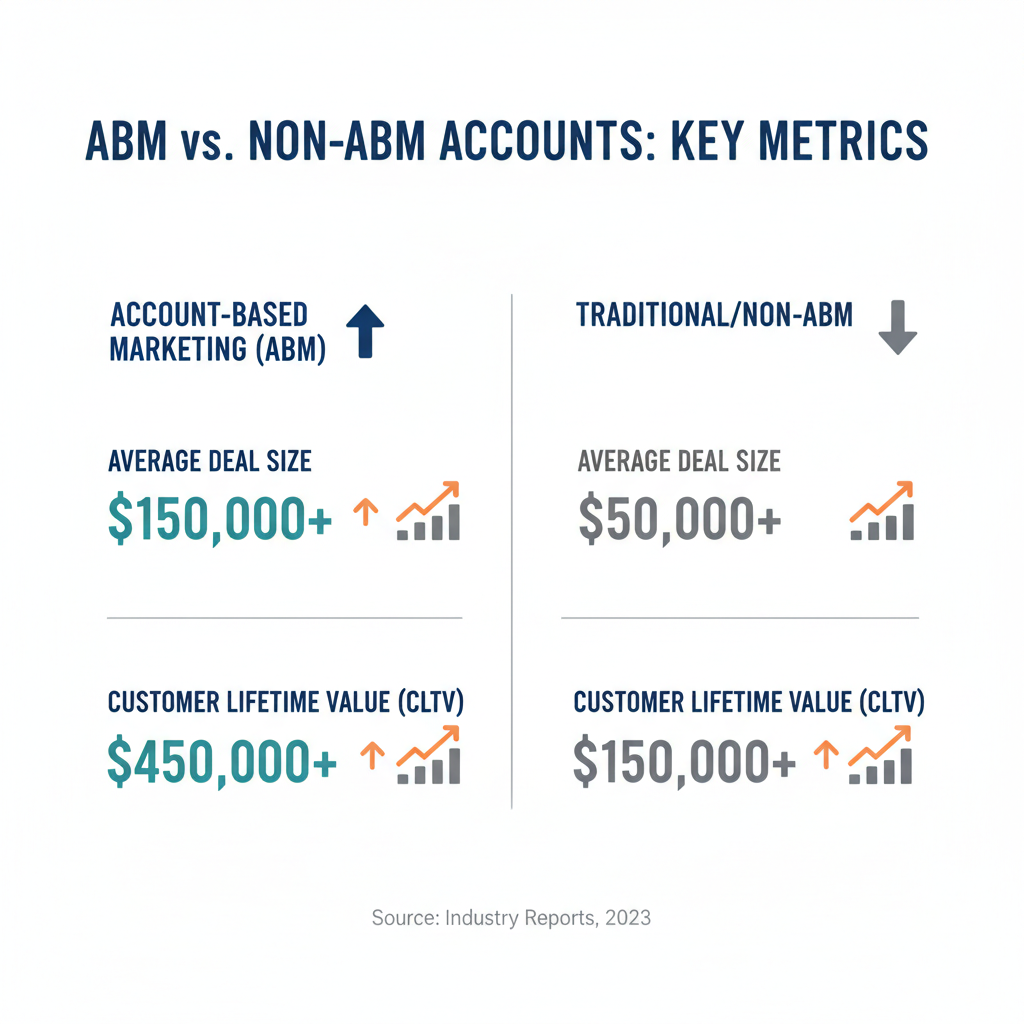
ABM accounts consistently deliver larger deals and higher lifetime value
Tier 2: Pipeline Metrics
Pipeline metrics reveal whether ABM is generating future revenue opportunities.
4. Pipeline Generated from Target Accounts
Total dollar value of sales opportunities created within ABM accounts. This leading indicator predicts future revenue before deals close—essential for programs with long sales cycles.
5. Account Progression Rate
The percentage of target accounts moving through pipeline stages. Track how many accounts progress from:
- Unaware → Engaged
- Engaged → Marketing Qualified Account (MQA)
- MQA → Sales Qualified Opportunity
- Opportunity → Closed Won
Low progression rates reveal funnel bottlenecks. Understanding funnel stage dynamics helps diagnose where ABM campaigns need strengthening.
6. Sales Cycle Length
Compare time-to-close for ABM accounts versus traditional pipeline. ABM typically shortens sales cycles because buying committees receive relevant information earlier. Salesforce research shows ABM can reduce sales cycles by 20-30%.
Tier 3: Engagement Metrics
Engagement metrics indicate relationship health before revenue materializes.
7. Account Engagement Score
A composite metric combining multiple engagement signals:
- Website visits from target accounts
- Content downloads and consumption
- Email opens and clicks
- Event attendance
- Ad impressions and clicks
- Social media interactions
Engagement scores predict future pipeline. High-engagement accounts convert at 2-3x the rate of low-engagement accounts, according to Terminus data.
8. Account Penetration Rate
The percentage of key stakeholders within each account that your marketing has reached. Enterprise deals involve 6-10 decision makers. If you've only engaged two, your penetration rate is 20-33%—and your win probability drops accordingly.
Track which titles and roles you've contacted. Effective ABM reaches across the buying committee, not just the obvious contacts.
9. Share of Voice
What percentage of the target account's attention in your category are you capturing? Monitor:
- Brand search volume from target accounts
- Competitive mentions in conversations
- Content consumption relative to competitors
Our marketing effectiveness measurement guide covers how to calculate share of voice and connect it to pipeline outcomes.
How to Calculate ABM ROI: Step-by-Step
Calculating ABM ROI requires systematic cost tracking and revenue attribution. Here's the framework.
Step 1: Define Your ABM Costs
Most teams undercount costs, inflating perceived ROI. Include everything:
Direct Program Costs:
- ABM platform/technology fees
- Advertising spend on target accounts
- Content creation for ABM campaigns
- Direct mail and gifts
- Events and experiences
- Agency fees
Indirect Program Costs:
- ABM team salaries (prorated for ABM work)
- Sales time on ABM accounts (prorated)
- Marketing operations support
- Data and enrichment services
- Training and enablement
The MMM readiness checklist on our site includes a cost tracking template applicable to ABM program accounting.
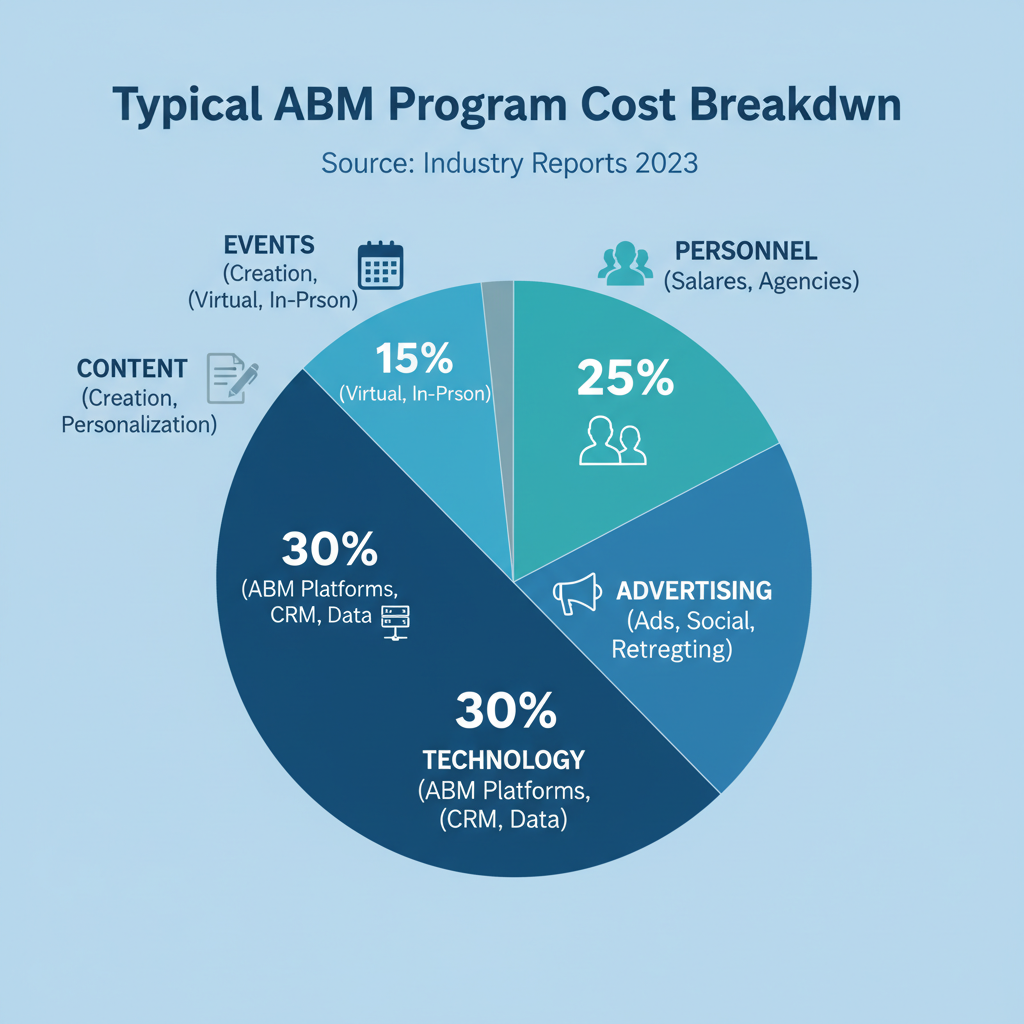
Understanding total program cost is essential for accurate ROI calculation
Step 2: Attribute Revenue to ABM
This is where measurement gets contentious. Which revenue should ABM claim credit for?
Conservative approach: Only count revenue from deals where ABM was the primary driver (target account, ABM engagement before opportunity creation).
Moderate approach: Include all revenue from target accounts that engaged with ABM programs, regardless of which touchpoint created the opportunity.
Aggressive approach: Include all revenue from target accounts, assuming ABM contributed to brand awareness even without tracked engagement.
Most organizations use the moderate approach, which Forrester research validates as reasonably accurate for mature ABM programs.
Multi-touch attribution for ABM:
Account-based deals involve dozens of touchpoints across multiple stakeholders. Simple first-touch or last-touch attribution misses most of the picture. The MTA vs MMM comparison article explains why blended approaches work better for complex B2B journeys.
Step 3: Calculate and Contextualize
Apply the formula:
ABM ROI = [(Attributed Revenue - Total ABM Costs) / Total ABM Costs] × 100%
But don't stop at a single number. Contextualize your ROI:
- Compare to non-ABM marketing ROI
- Trend over time (is ROI improving?)
- Segment by account tier (do Tier 1 accounts deliver higher ROI?)
- Break down by ABM tactic (which activities drive returns?)
According to SiriusDecisions benchmarks, mature ABM programs typically achieve 200-400% ROI. Programs under 12 months old often show lower returns due to longer B2B sales cycles.
ABM Attribution: Solving the Multi-Stakeholder Challenge
The hardest part of ABM ROI measurement is attribution. Multiple people at multiple companies interact with multiple campaigns over many months. Who deserves credit?
Account-Level Attribution Models
Traditional attribution tracks individuals. ABM attribution should track accounts.
Account engagement scoring model:
- Assign point values to engagement activities
- Aggregate points across all contacts at an account
- Set threshold for "ABM-influenced" status
- Attribute revenue share based on engagement timing
Example scoring framework:
| Activity | Points |
|---|---|
| Target ad impression | 1 |
| Website visit | 5 |
| Content download | 10 |
| Email click | 10 |
| Webinar attendance | 25 |
| Demo request | 50 |
| Meeting held | 75 |
Accounts exceeding 100 points before opportunity creation qualify as ABM-influenced.
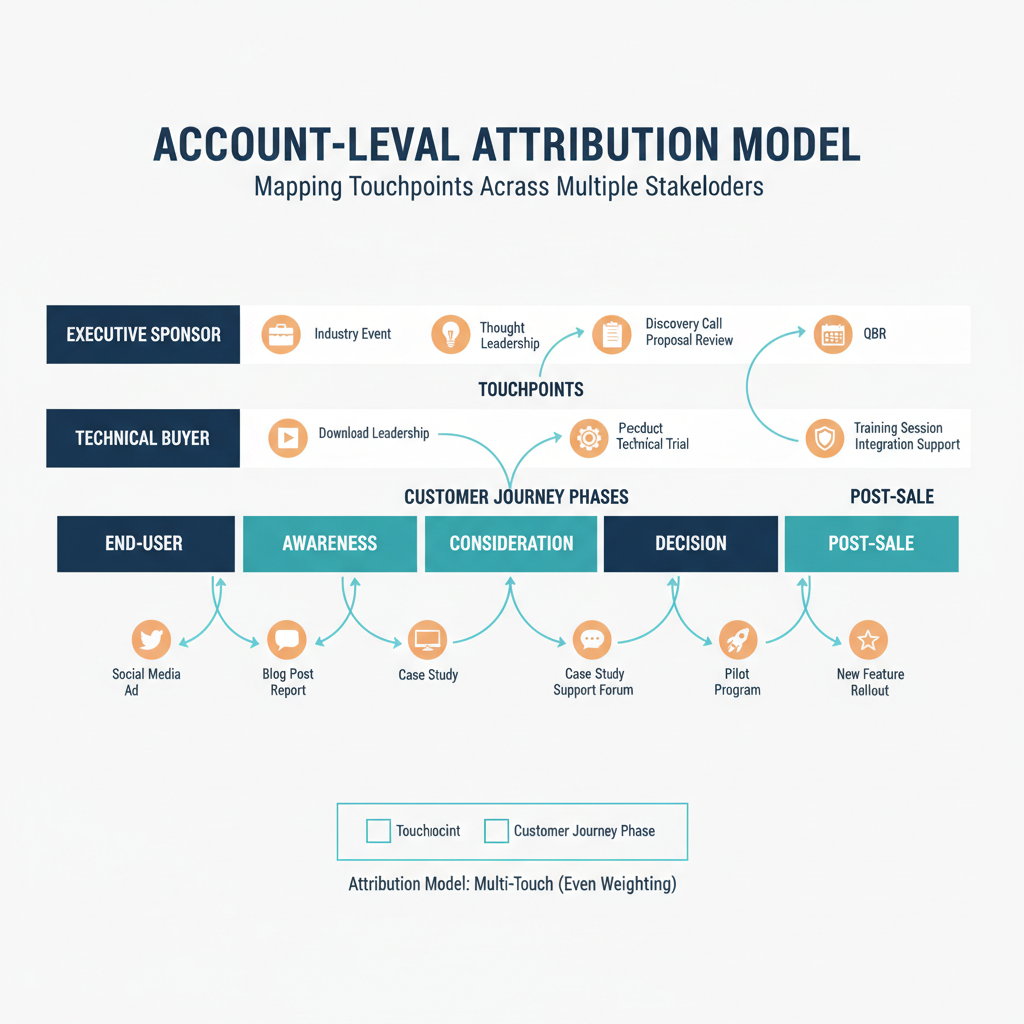
Account-level attribution aggregates engagement across all contacts within target accounts
Incrementality Testing for ABM
The gold standard for proving ABM impact is incrementality testing—measuring what would have happened without ABM.
Holdout testing approach:
- Randomly select a portion of target accounts as a control group
- Run ABM programs only on the test group
- Compare conversion rates, deal sizes, and velocity between groups
- Calculate incremental lift attributable to ABM
This approach reveals true causation, not just correlation. For guidance on designing incrementality tests, explore the media mix modeling guide, which covers experimental design for marketing measurement.
Media Mix Modeling for ABM
Media mix modeling provides a complementary measurement approach that captures ABM's full impact—including effects that touchpoint attribution misses.
MMM analyzes aggregate relationships between marketing activities and business outcomes. For ABM, this reveals:
- How ABM advertising drives brand search within target accounts
- The lag effect of content marketing on pipeline creation
- Interactions between ABM and other marketing channels
- Diminishing returns at different spend levels
While touchpoint attribution shows which accounts engaged, MMM shows whether ABM spending actually drove incremental results.
Common ABM Measurement Mistakes
Mistake 1: Measuring Too Early
ABM takes time. B2B sales cycles span 6-18 months. Judging ABM ROI after 90 days guarantees disappointing numbers—and premature program cuts.
Fix: Set realistic measurement windows. Evaluate engagement and pipeline metrics monthly. Reserve ROI calculations for quarterly reviews after at least 6 months of program operation.
Mistake 2: Ignoring Account Baselines
Without baselines, you can't prove ABM made a difference. Were target accounts already progressing before ABM launched?
Fix: Document account status before ABM activation. Track engagement levels, pipeline stage, and relationship depth. Compare post-ABM metrics against these baselines.
Mistake 3: Counting Vanity Metrics
Email opens and ad impressions feel good but don't pay the bills. Over-indexing on engagement without connecting to revenue creates false confidence.
Fix: Always ladder engagement metrics to revenue metrics. High engagement with flat pipeline means your content reaches accounts but doesn't move them. Our preparation tips cover how to build measurement frameworks that connect activities to outcomes.
Mistake 4: Siloed Measurement
Marketing measures ABM differently than sales. Finance uses a third methodology. Conflicting numbers destroy credibility.
Fix: Align on measurement definitions before launching ABM. Get sales, marketing, and finance agreement on cost accounting, revenue attribution, and reporting cadence.
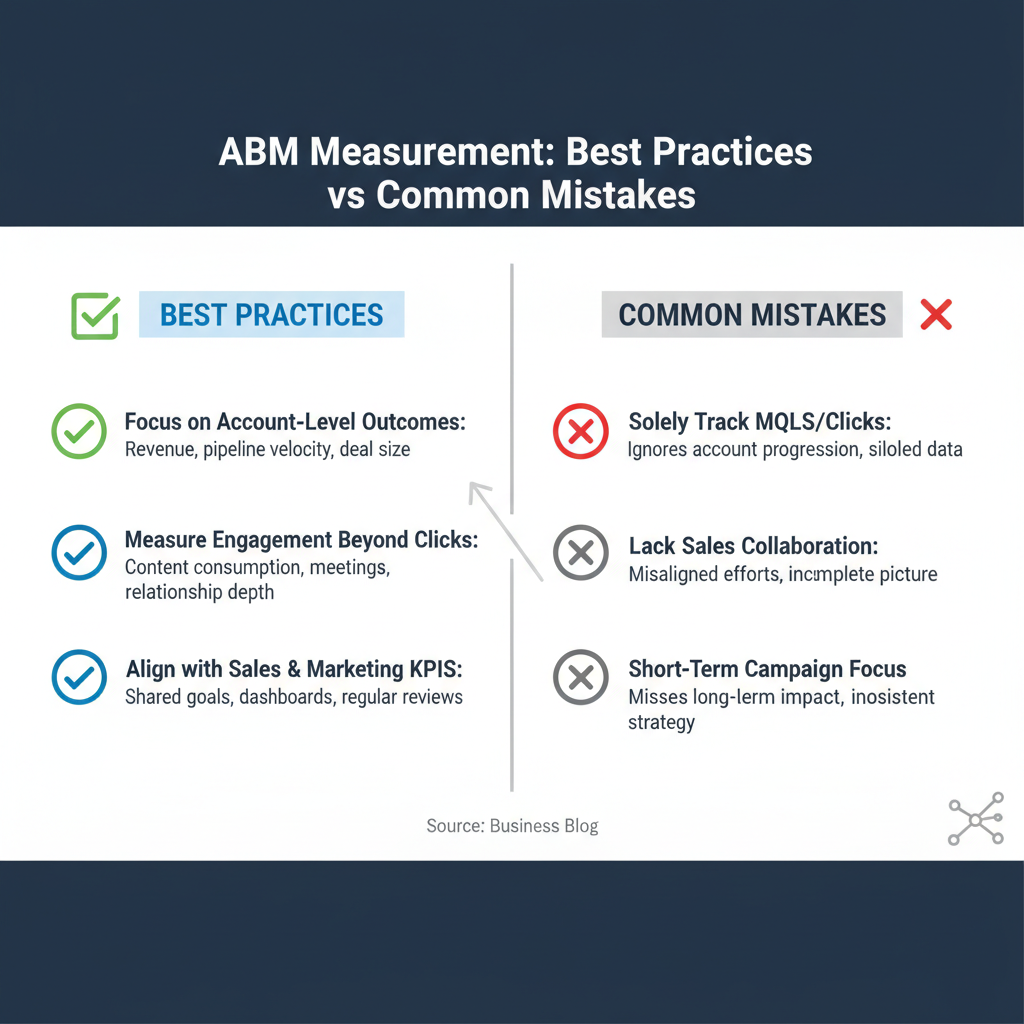
Avoiding measurement mistakes ensures accurate ROI calculation and program credibility
Building Your ABM Measurement Dashboard
Effective ABM measurement requires systematic tracking. Here's the dashboard structure that works.
Executive Summary View
| Metric | Target | Actual | Trend |
|---|---|---|---|
| ABM ROI | 300%+ | — | — |
| Revenue from ABM Accounts | $X | — | — |
| Pipeline from ABM Accounts | $Y | — | — |
| Average Deal Size (ABM) | $Z | — | — |
Account Health View
Track individual account metrics:
- Engagement score
- Pipeline stage
- Key contacts reached
- Last activity date
- Estimated deal value
Campaign Performance View
For each ABM campaign:
- Accounts reached
- Engagement generated
- Pipeline influenced
- Cost per engaged account
Integrating these views requires solid data infrastructure. The MMM readiness checklist assesses whether your current tech stack can support comprehensive ABM measurement.
Frequently Asked Questions
What is a good ABM ROI benchmark?
Mature ABM programs typically achieve 200-400% ROI, according to SiriusDecisions research. However, programs under 12 months old often show lower returns due to B2B sales cycle length. Compare your ABM ROI against your non-ABM marketing ROI rather than external benchmarks—industry contexts vary significantly.
How long does it take to see ABM ROI?
Expect 6-12 months before meaningful ROI data emerges. Early indicators (engagement, account penetration) appear within 90 days, but revenue attribution requires time for deals to close. Our marketing effectiveness guide covers setting appropriate measurement timeframes for different program types.
Should I measure ABM separately from other marketing?
Yes—but also measure ABM's interaction with other channels. ABM doesn't operate in isolation. Brand campaigns, SEO, and demand gen all influence target accounts. The best measurement approaches track both ABM-specific metrics and cross-channel effects on target accounts.
Which ABM metrics matter most to executives?
Revenue from target accounts and ABM ROI—period. Executives care about financial outcomes. Lead with revenue impact, then support with pipeline metrics and engagement trends that predict future revenue. Engagement metrics alone rarely satisfy CFO scrutiny.
How do I prove ABM caused revenue versus correlation?
Incrementality testing provides the strongest proof. Run holdout experiments where some target accounts don't receive ABM campaigns. Compare results between test and control groups. Without holdouts, you're measuring correlation, not causation—which leaves room for skepticism.
Can media mix modeling measure ABM?
Yes. Media mix modeling captures ABM's aggregate impact, including effects that touchpoint attribution misses. MMM reveals whether ABM spending drives incremental results at the portfolio level, complementing account-level measurement.
Conclusion
ABM ROI measurement isn't optional—it's the difference between a strategic program and an expensive experiment. Without rigorous measurement, you're flying blind on one of your largest marketing investments.
Key takeaways:
- Focus on revenue metrics first, pipeline second, engagement third
- Use account-level attribution that aggregates across stakeholders
- Set realistic measurement windows (6+ months before judging ROI)
- Run incrementality tests to prove causation, not just correlation
- Align sales, marketing, and finance on measurement methodology
The companies that master ABM measurement don't just prove ROI—they systematically improve it. They know which accounts to target, which tactics work, and how to allocate resources for maximum return.
Start with honest assessment. Use the MMM readiness checklist to evaluate your current measurement infrastructure. Identify gaps in cost tracking, attribution, and reporting. Build the foundation that makes accurate ABM ROI measurement possible.
Your ABM program deserves better than "we think it's working." Measure it properly.
Ready to improve your ABM measurement? Take our readiness assessment to understand your current measurement capabilities, or explore our guide to marketing ROI analysis for frameworks that extend beyond ABM to your entire marketing portfolio.
Stay in the loop
Get updates on new posts and resources.