Account-Based Marketing Attribution: How to Measure ABM Impact
Master account-based marketing attribution with proven frameworks for measuring ABM campaign effectiveness across buying committees and complex B2B sales cycles.
Your ABM campaigns are working. You think. The target accounts are engaging, pipeline is moving, deals are closing. But which touches actually drove the outcome—and which were just noise?
Account-based marketing attribution is the discipline of measuring how marketing activities influence target accounts throughout the buying process. Unlike traditional lead-based attribution that tracks individuals, ABM attribution evaluates collective engagement from entire buying committees and connects it to revenue outcomes.
According to LinkedIn's B2B marketing research, 87% of B2B marketers report that ABM initiatives outperform other marketing investments in ROI. But here's the catch—most can't actually prove it. Without proper attribution, you're making multi-million dollar budget decisions on intuition.
This guide breaks down how to build account-based marketing attribution that actually works—from selecting the right models to measuring what matters across complex B2B buying journeys.
What is Account-Based Marketing Attribution?
Account-based marketing attribution measures the impact of marketing efforts on specific target accounts rather than individual leads. It evaluates how sequences of touches influence account-level outcomes like pipeline progression, deal acceleration, and closed revenue.
The fundamental shift from traditional attribution is perspective. Lead-based attribution asks: "Which touchpoint converted this person?" ABM attribution asks: "Which activities influenced this account to buy?"
That difference matters enormously in B2B contexts.
Why Traditional Attribution Fails for ABM
Traditional multi-touch attribution was built for consumer journeys—one person, one device, linear path to purchase. B2B buying looks nothing like that.
B2B reality includes:
- Multiple stakeholders: Average B2B purchase involves 6-10 decision makers, according to Gartner research
- Extended timelines: Enterprise sales cycles run 3-18 months
- Diverse touchpoints: Mix of marketing, sales, content, events, and peer influence
- Non-linear progression: Accounts move backward, stall, and restart throughout the journey
Traditional attribution sees Sarah from Company X clicking your ad and credits that channel. It misses that Mike from the same company downloaded your whitepaper last month, Jennifer attended your webinar, and the CEO saw your booth at a trade show. The purchase happened because the account was influenced—not because of any single touchpoint.
Understanding marketing effectiveness measurement at the account level requires fundamentally different methodology.
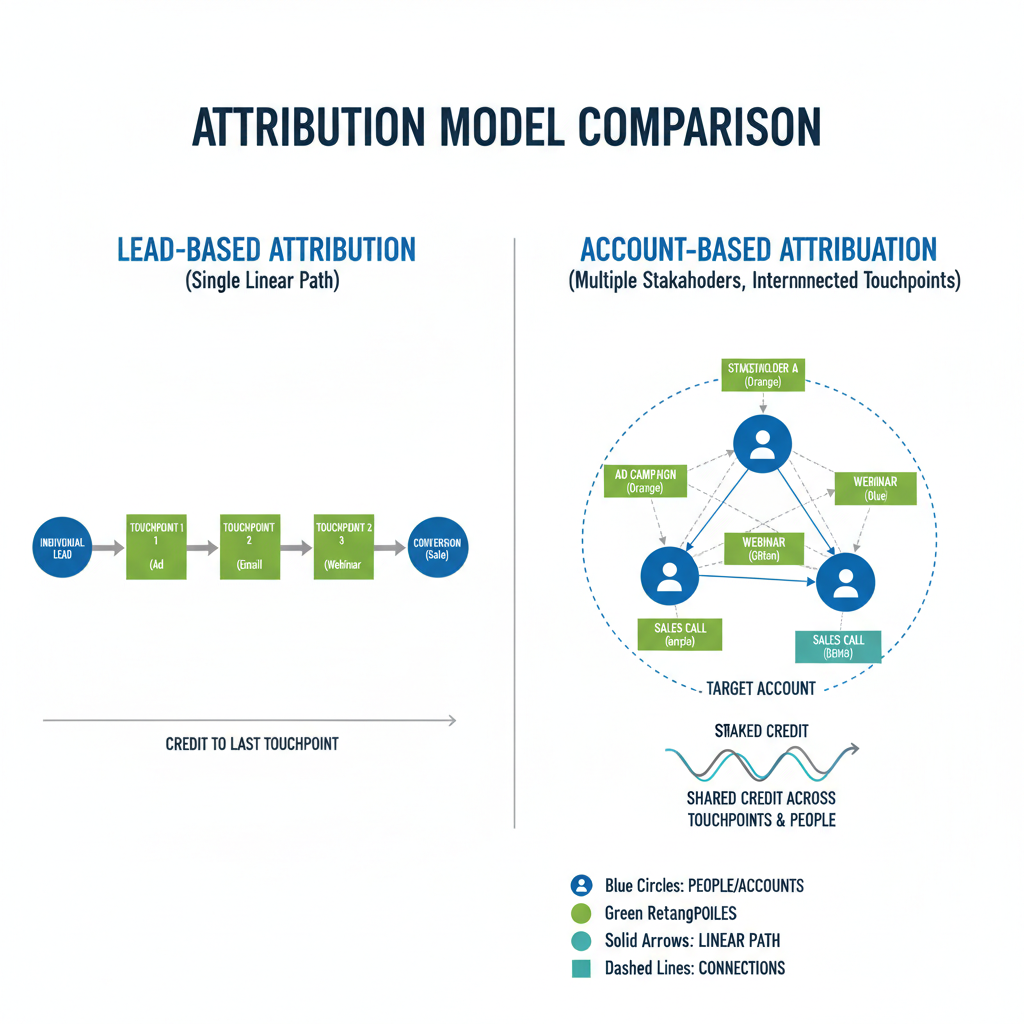
ABM attribution tracks influence across entire buying committees, not individual leads
The Account-Based Attribution Framework
Effective ABM attribution connects three components:
- Account identification: Mapping all contacts and interactions to unified account records
- Engagement tracking: Capturing touchpoints across all channels and stakeholders
- Outcome measurement: Connecting engagement patterns to revenue results
This framework reveals which activities actually influence accounts—not just which generate vanity metrics. The difference between "this account engaged 47 times" and "these 12 touches drove pipeline progression" separates data from insight.
ABM Attribution Models Explained
Choosing the right attribution model determines whether your data reveals truth or creates fiction. Different models tell different stories from the same underlying data.
Single-Touch Models (And Their Limitations)
Single-touch attribution assigns all credit to one moment in the journey.
First-touch attribution credits the initial interaction. Good for understanding which channels build awareness with target accounts. Terrible for understanding what actually closes deals.
Last-touch attribution credits the final pre-conversion touchpoint. Reveals what triggers action but ignores everything that created readiness. Sales gets credit; marketing becomes invisible.
For complex B2B purchases with 50+ touchpoints across 6+ stakeholders, single-touch attribution borders on fiction. It answers the wrong question entirely.
Multi-Touch Attribution Models for ABM
Multi-touch attribution distributes credit across multiple interactions, providing a more complete picture of account influence.
Linear attribution gives equal credit to every touchpoint. Democratic but naive—assumes all interactions matter equally, which they don't.
Time-decay attribution weights touches closer to conversion more heavily. Captures recency effects but undervalues early awareness-building that makes later touches possible.
U-shaped (position-based) attribution allocates 40% to first touch, 40% to conversion touch, 20% distributed across middle interactions. Balances awareness and conversion but uses arbitrary percentages.
W-shaped attribution adds weight to the opportunity-creation moment—when marketing-qualified leads become sales-accepted opportunities. Particularly valuable for B2B where that transition matters.
| Model | Best For | Limitation |
|---|---|---|
| First-touch | Measuring awareness generation | Ignores nurture impact |
| Last-touch | Conversion optimization | Hides marketing contribution |
| Linear | Simple implementation | Treats all touches equally |
| Time-decay | Understanding recency effects | Undervalues brand building |
| U-shaped | Balanced view | Arbitrary weight distribution |
| W-shaped | B2B pipeline focus | Complexity in implementation |
Research from Forrester indicates that companies using multi-touch models see 50% better correlation between attribution data and actual revenue outcomes.
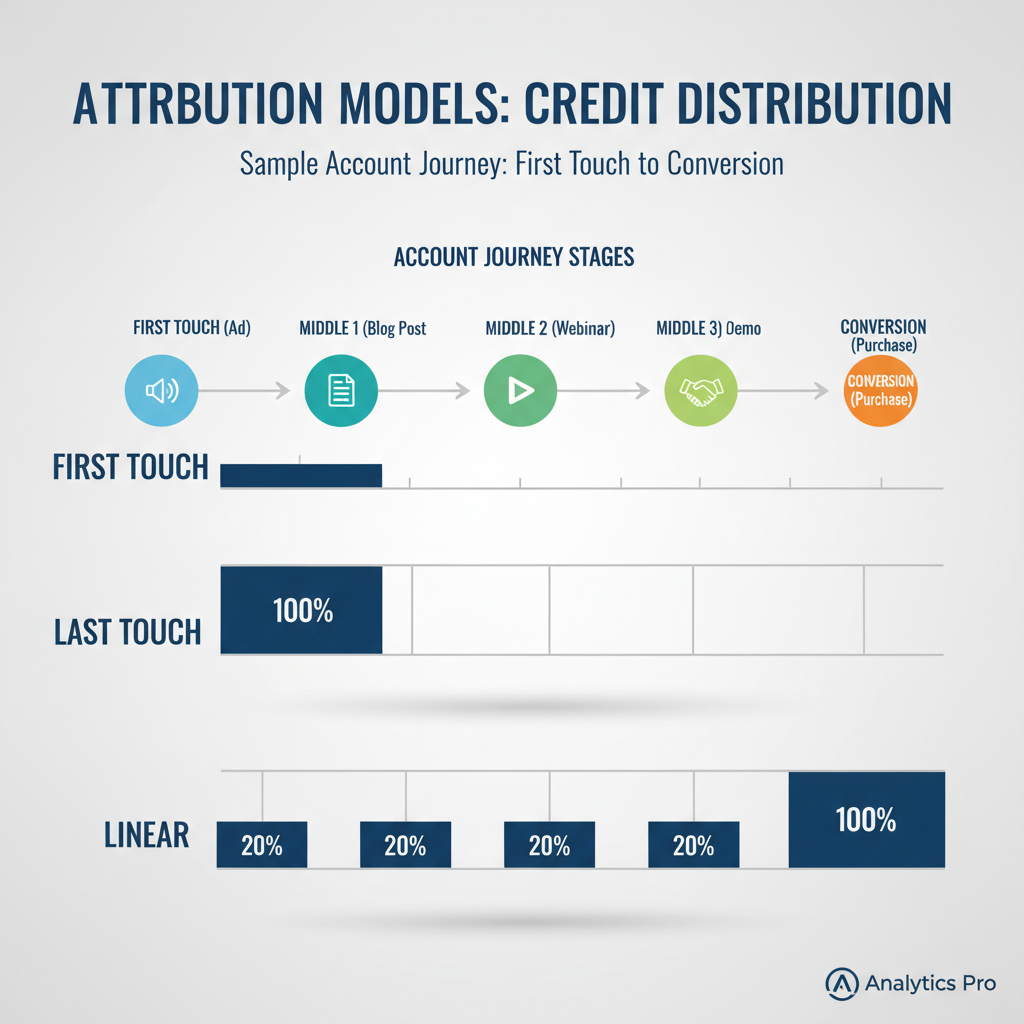
Different models tell dramatically different stories from the same account journey
Data-Driven Attribution for ABM
Data-driven attribution uses machine learning to determine optimal credit distribution based on actual conversion patterns. Rather than applying fixed rules, the model learns which touchpoints statistically influence outcomes.
Advantages of data-driven ABM attribution:
- Credits touches based on observed impact, not assumptions
- Adapts as buying behaviors evolve
- Identifies counterintuitive influence patterns
- Reduces human bias in model selection
The catch? Requires substantial data volume. If you're running ABM targeting 50 accounts, you likely don't have enough conversions to train reliable models. Data-driven approaches work best for scaled ABM programs with hundreds or thousands of target accounts.
For strategic ABM with small account lists, W-shaped or custom-weighted models often perform better despite their theoretical limitations.
Building Your ABM Attribution System
Moving from attribution concept to operational reality requires systematic infrastructure across data, process, and technology.
Step 1: Establish Account-Level Data Foundation
Attribution quality cannot exceed data quality. Most B2B organizations have contacts scattered across multiple systems without unified account mapping.
Required data elements:
- Consistent account identifiers: CRM account ID, domain, DUNS number—pick one and enforce it everywhere
- Contact-to-account mapping: Every contact linked to their company account
- Comprehensive touchpoint capture: Marketing automation, ad platforms, CRM activities, event attendance
- Timestamp precision: When did each interaction occur?
The MMM checklist provides detailed guidance on data infrastructure requirements that apply equally to ABM attribution.
Step 2: Integrate All Touchpoint Sources
ABM touches happen everywhere—and siloed data creates invisible blind spots.
Sources to integrate:
- Marketing automation platforms (email, nurture campaigns)
- CRM activities (sales calls, meetings, proposals)
- Advertising platforms (programmatic display, LinkedIn, paid search)
- Content engagement (website visits, downloads, video views)
- Event systems (webinar attendance, conference meetings)
- Direct mail tracking (if applicable)
- Intent data providers (Bombora, G2, etc.)
According to attribution research, organizations that integrate all key systems see 30-40% more complete attribution data than those with partial integration.
Step 3: Define Account Journey Stages
Attribution needs destination points to measure progress. Map your account journey into measurable stages.
Common ABM stages:
| Stage | Definition | Attribution Milestone |
|---|---|---|
| Target | Identified as ideal-fit account | Account added to ABM program |
| Aware | Account shows recognition signals | First engagement from account |
| Engaged | Multiple stakeholders interacting | 3+ contacts from account active |
| Marketing Qualified (MQA) | Engagement threshold reached | Account meets qualification criteria |
| Sales Accepted | Sales confirms opportunity | Opportunity created in CRM |
| Pipeline | Active deal in process | Deal stage progression |
| Closed Won | Deal completed | Revenue booked |
Each stage transition becomes an attribution event. Your model distributes credit for touches that influenced progression between stages.
Understanding funnel stage budget allocation helps align attribution insights with investment decisions.
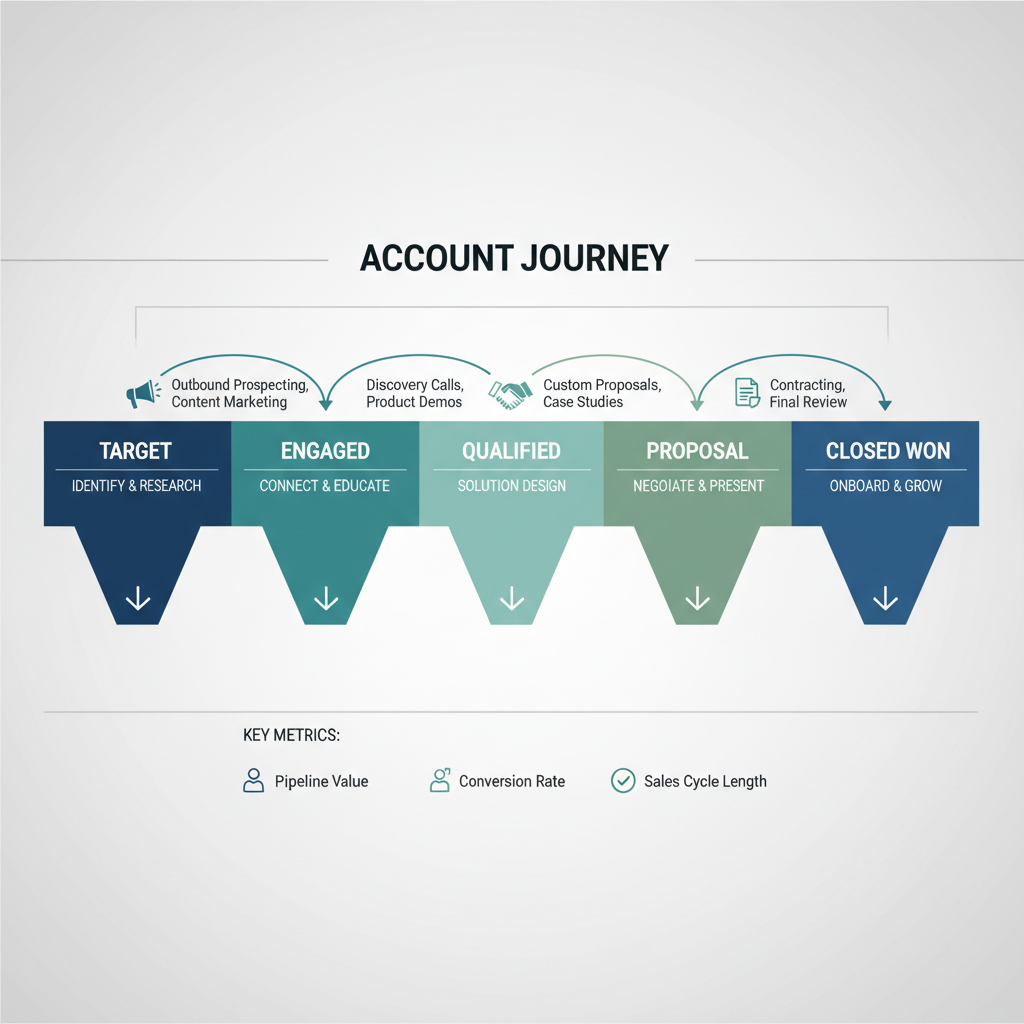
Effective attribution measures influence on stage-to-stage progression
Step 4: Select and Configure Attribution Model
With infrastructure in place, configure your attribution model.
For most B2B organizations, start with:
- W-shaped model as default (balances awareness, opportunity creation, and close)
- Account-level aggregation (credit flows to accounts, not individual contacts)
- 90-180 day lookback window (longer than typical B2C windows)
- Decay function for very old touches (engagement from two years ago matters less)
Calibrate your model against known outcomes. Take closed deals and verify the attribution data makes intuitive sense. If your model credits a single webinar with 80% of a $500K deal while ignoring months of sales engagement, something's misconfigured.
Measuring What Actually Matters
Attribution data creates insight only when connected to meaningful metrics. Vanity metrics (impressions, clicks, contacts reached) don't reveal business impact.
Pipeline Influence Metrics
Pipeline influence measures how marketing activities contribute to sales opportunities.
Key metrics:
- Influenced pipeline: Total pipeline value where target accounts engaged with marketing before opportunity creation
- Sourced pipeline: Pipeline from opportunities marketing directly created (first-touch on opportunity)
- Pipeline velocity: Time reduction for accounts with heavy marketing engagement vs. light engagement
- Stage acceleration: Faster progression through stages for marketed accounts
According to ITSMA research, best-in-class ABM programs influence 70%+ of enterprise pipeline. If your attribution shows marketing influencing 20%, either your measurement is broken or your program needs work.
Revenue Attribution Metrics
Ultimately, marketing exists to drive revenue. Your attribution must connect to closed deals.
Revenue metrics:
- Attributed revenue: Closed revenue where marketing influenced the buying journey
- Marketing-sourced revenue: Revenue from deals marketing created (stricter definition)
- Revenue per account: Average deal size for ABM accounts vs. non-ABM accounts
- Win rate lift: Higher win rates for accounts with marketing engagement
Compare attributed revenue against marketing spend for ROI analysis that justifies ABM investment. Leading ABM programs show 3-5x higher ROI than traditional demand generation, according to LinkedIn's marketing research.
Engagement Quality Metrics
Not all engagement indicates buying intent. Quality metrics separate signal from noise.
Quality indicators:
- Buying committee coverage: How many key roles have engaged?
- Engagement depth: Are stakeholders consuming substantial content or bouncing quickly?
- Recency and frequency: Active ongoing engagement vs. one-time visits?
- Content alignment: Engagement with bottom-funnel content vs. top-funnel awareness
The marketing effectiveness measurement guide covers how to distinguish meaningful engagement from superficial metrics.
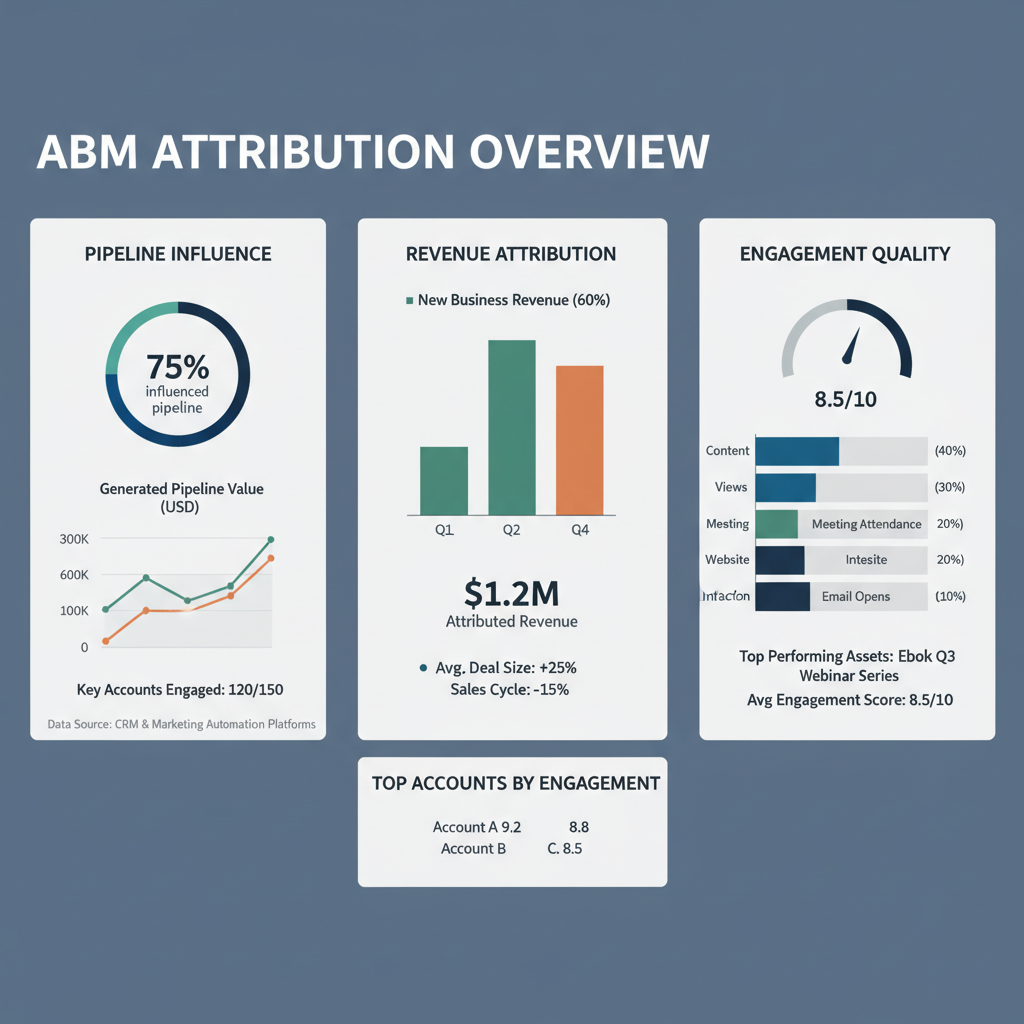
Effective attribution dashboards connect engagement to revenue outcomes
Common ABM Attribution Challenges (And How to Solve Them)
Challenge 1: Sales and Marketing Misalignment
Marketing and sales often disagree about what "influenced" means. Sales claims they closed the deal independently. Marketing insists their nurture campaign created buyer readiness.
Solution: Establish shared definitions before building attribution. What constitutes a "marketing-touched opportunity"? How do sales activities factor into attribution? Joint ownership of metrics reduces political battles over credit.
According to LinkedIn research, 82% of B2B marketers report that ABM improves sales-marketing alignment—but only when both teams share accountability for outcomes.
Challenge 2: Anonymous Account Activity
Visitors browse your website without identifying themselves. You know Company X visited because of IP detection or reverse IP lookup, but you can't attribute that activity to specific contacts.
Solution: Account-level attribution captures anonymous visits at the company level even when contact identity is unknown. Use intent data providers and de-anonymization tools to connect website activity to target accounts. Accept that some activity remains anonymous and build that into your attribution confidence levels.
Challenge 3: Offline and Dark Social Touchpoints
Not everything happens in trackable digital channels. Peer recommendations, internal discussions, industry conferences, and word-of-mouth influence buying decisions but leave no digital footprint.
Solution: This is where media mix modeling complements digital attribution. MMM can measure aggregate impact of offline activities that touchpoint-level attribution misses. For critical offline events (trade shows, dinners), implement manual tracking—scan badges, log meetings, capture business cards into your CRM.
Challenge 4: Long Sales Cycles
Enterprise deals take 12-18 months. Attribution windows need to span that entire period, but older touches become increasingly difficult to connect to outcomes.
Solution: Use extended lookback windows (180 days minimum, 365 for enterprise) with time-decay functions that reduce credit for very old interactions. Segment attribution analysis by sales cycle length—what works for mid-market 90-day cycles differs from enterprise 12-month cycles.
Our preparation tips detail how to structure data for long-cycle attribution analysis.
Challenge 5: Proving Incrementality
Attribution shows which touches existed before conversion. It doesn't prove those touches caused the outcome. Maybe the account would have bought anyway without your marketing.
Solution: Incrementality testing provides causal evidence that attribution alone cannot. Run holdout experiments where similar accounts receive different treatments. Compare conversion rates between marketed and non-marketed groups. The difference reveals true incremental impact.
Read more about MTA vs MMM approaches for understanding how incrementality testing validates attribution models.
Frequently Asked Questions
What's the difference between ABM attribution and traditional marketing attribution?
Traditional marketing attribution tracks individual leads through their personal journey and assigns credit to touchpoints that influenced that person. Account-based marketing attribution tracks engagement from entire buying committees—multiple contacts within a target account—and measures influence on account-level outcomes. ABM attribution aggregates activity across stakeholders rather than isolating individual paths, reflecting how B2B purchasing actually works with 6-10 decision makers involved in average enterprise deals.
Which attribution model is best for B2B account-based marketing?
For most B2B organizations, W-shaped attribution provides the best balance. It gives significant credit to first-touch (awareness), opportunity creation (pipeline), and last-touch (conversion) while distributing remaining credit across nurture touches. However, the "best" model depends on your sales cycle, buying process, and measurement goals. Start with W-shaped and calibrate based on whether outputs match intuition about which activities actually drive results. Media mix modeling can complement touchpoint attribution for holistic measurement.
How do I attribute revenue when multiple marketing and sales touches occur?
Use multi-touch attribution models that distribute credit based on contribution rather than assigning 100% to any single touch. Most B2B deals involve dozens of marketing touches plus extensive sales engagement. Your attribution model should include both marketing and sales activities, weighted appropriately. Organizations often use "influenced revenue" (account engaged with marketing anywhere in journey) alongside "sourced revenue" (marketing created the opportunity) to capture both perspectives.
How long should my attribution lookback window be for enterprise ABM?
For enterprise sales cycles of 6-18 months, use 180-365 day lookback windows. Shorter windows miss early-stage engagement that created awareness and consideration. However, very long windows require decay functions to reduce credit for touches that occurred years before purchase. Most ABM platforms allow configurable windows—start with 180 days and extend if your attribution data seems to miss important early touches. Our MMM checklist covers data retention requirements for long-window analysis.
Can I measure ABM attribution without expensive technology?
Yes, though with limitations. Start with CRM opportunity influence reports that show marketing touches before deal creation. Most marketing automation platforms offer basic account-based reporting. Google Analytics can track website engagement at the company level using IP detection. However, sophisticated multi-touch attribution across integrated channels requires dedicated ABM or attribution platforms. The media budget optimization guide covers how to prioritize measurement investments based on potential ROI improvement.
How do I prove ABM is working to executives who want simple metrics?
Focus on revenue outcomes, not activity metrics. Executives don't care about engagement scores—they care about pipeline and closed deals. Present: (1) total revenue influenced by ABM marketing, (2) comparison of win rates and deal sizes for ABM accounts vs. non-ABM, (3) sales cycle acceleration for accounts with marketing engagement. According to ITSMA benchmarks, well-executed ABM programs show 208% revenue increase—lead with results, not process.
Conclusion
Account-based marketing attribution determines whether your ABM investment is justified or whether you're spending on faith. The complexity of B2B buying—multiple stakeholders, extended timelines, mixed channel influence—requires attribution approaches built for that reality.
Key takeaways:
- Traditional lead-based attribution fails for ABM because B2B purchases involve buying committees, not individuals
- Multi-touch models (especially W-shaped) better capture B2B influence than single-touch approaches
- Data infrastructure matters more than model sophistication—garbage in, garbage out
- Connect attribution to revenue outcomes, not just engagement metrics
- Use incrementality testing to validate that attributed touches actually caused conversions
The organizations that master ABM attribution don't just measure better—they allocate budget more effectively, demonstrate marketing value to executives, and systematically improve program performance over time.
Where to start:
Audit your current state. Can you reliably map all contacts to accounts? Are marketing and sales touches captured in unified records? Do you have defined account journey stages? These foundational elements must exist before sophisticated attribution becomes possible.
Use the MMM readiness checklist to assess your data infrastructure, or take our readiness quiz to identify gaps in your measurement capabilities. For organizations ready to implement comprehensive attribution alongside media mix modeling, BlueAlpha offers integrated measurement solutions designed for B2B marketing complexity.
The accounts are engaging. Now prove which engagement matters.
Stay in the loop
Get updates on new posts and resources.