Funnel Stage Budget: How to Allocate Marketing Spend by TOFU, MOFU, BOFU
Master funnel stage budget allocation with proven frameworks for distributing marketing spend across awareness, consideration, and conversion stages.
Your marketing funnel is starving somewhere. Money's flowing to channels that feel productive while critical funnel stages go underfunded—and you probably don't even know which ones.
Funnel stage budget allocation determines how marketing dollars flow across the awareness, consideration, and conversion stages of your customer journey. Get it wrong, and you'll either build an audience you can't convert or chase conversions from a pipeline that's running dry.
According to Gartner research, marketing budgets have stabilized at around 9.1% of company revenue—but the distribution of that budget across funnel stages varies wildly between high-performers and everyone else. The difference isn't how much they spend. It's where they spend it.
This guide breaks down exactly how to allocate your marketing funnel budget across stages—with frameworks that adapt to your business model, growth stage, and market dynamics.
What is Funnel Stage Budget Allocation?
Funnel stage budget allocation is the strategic distribution of marketing spend across the customer journey—from first touch to final conversion. It answers a critical question: How much money should go toward finding new prospects versus nurturing them versus closing the deal?
The marketing funnel divides into three primary stages:
- Top of Funnel (TOFU): Awareness activities that attract prospects who don't yet know you
- Middle of Funnel (MOFU): Consideration activities that educate and nurture interested leads
- Bottom of Funnel (BOFU): Conversion activities that turn qualified prospects into customers
Each stage requires different tactics, operates on different timelines, and delivers different types of value. Your media budget optimization strategy must account for all three—or risk building a funnel that leaks money at every stage.
According to HubSpot's State of Marketing Report, companies that align budget allocation with funnel stages see 20% higher conversion rates than those using flat distribution across channels.
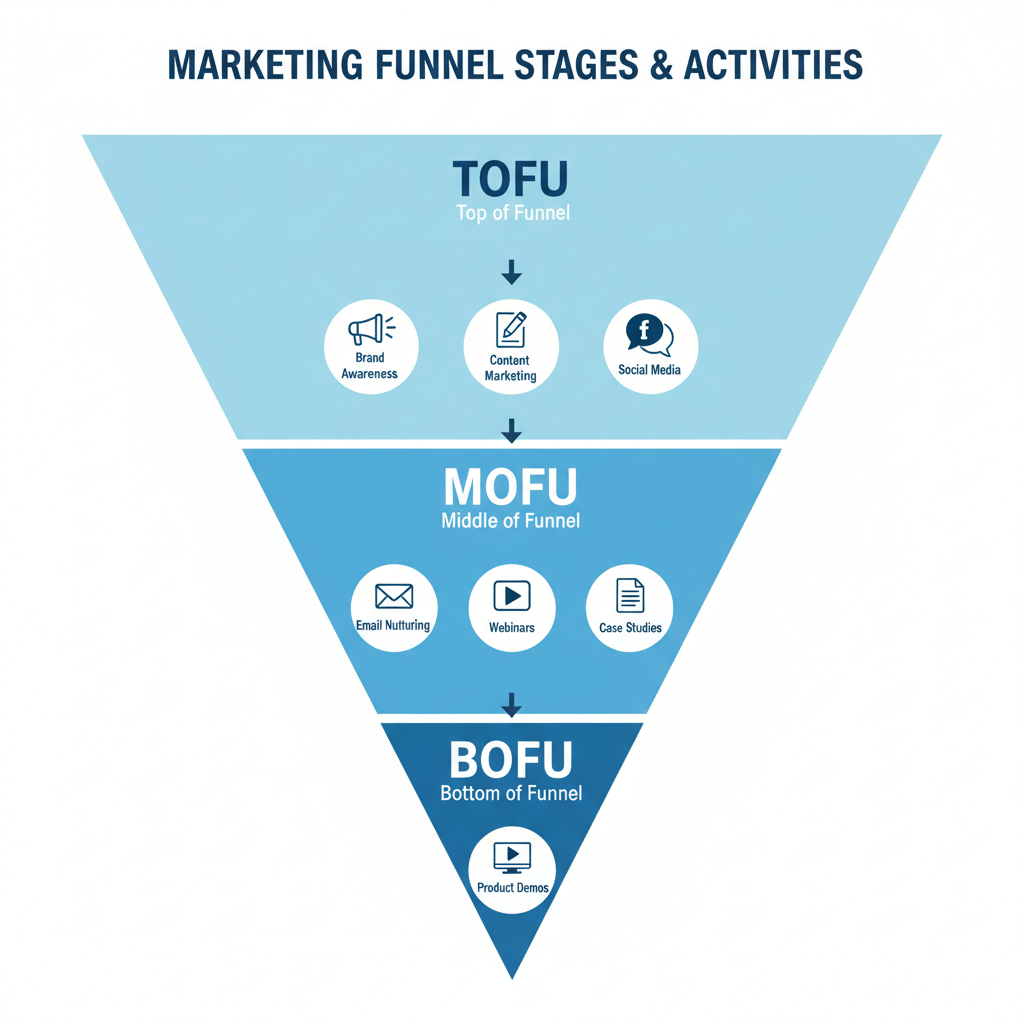
Each funnel stage requires different tactics and budget considerations
Why Funnel-Based Budgeting Matters
Traditional channel-based budgeting (allocating by platform—Google, Meta, LinkedIn) misses a crucial dimension. The same channel can serve multiple funnel stages. A Facebook campaign might drive awareness or retarget warm leads. Google captures both research queries and high-intent searches.
Funnel-based budgeting forces strategic thinking:
- Are you investing enough in building future demand?
- Is your middle funnel strong enough to move leads forward?
- Are conversion activities getting the budget they need to close deals?
Without this lens, marketers optimize locally (improving individual campaign metrics) while failing globally (building a balanced, sustainable growth engine).
The companies that win don't just measure marketing effectiveness—they measure it by funnel stage and allocate accordingly.
The Three Funnel Stages Explained
Before diving into budget allocation percentages, you need to understand what each stage actually accomplishes—and the activities that drive results at each level.
Top of Funnel (TOFU): Awareness Stage
The top of funnel is about reaching people who don't know you yet. They have a problem or need, but they're not actively searching for your solution. Your job is to get on their radar.
TOFU activities include:
- Content marketing (blog posts, guides, industry reports)
- Social media presence (organic and paid awareness campaigns)
- SEO and search visibility for informational queries
- Public relations and earned media
- Industry events and thought leadership
- Podcast advertising and sponsorships
- Display advertising for reach
Key metrics at TOFU:
| Metric | What It Measures |
|---|---|
| Reach | Total unique people exposed to your marketing |
| Impressions | Total times your content was displayed |
| Brand awareness | Recognition and recall in target audience |
| Cost per thousand (CPM) | Efficiency of awareness spending |
| Click-through rate (CTR) | Initial engagement with awareness content |
The challenge with TOFU? It's the hardest stage to connect directly to revenue. Someone sees your content today and buys six months later—attribution models struggle to capture this relationship.
That's exactly why media mix modeling has become essential for brands investing seriously in top-of-funnel activities. MMM can measure the aggregate impact of awareness spending that digital attribution misses.
Middle of Funnel (MOFU): Consideration Stage
Middle funnel targets prospects who know they have a problem and are actively evaluating solutions. They might be on your email list, have visited your site, or engaged with your content. They're interested—but not ready to buy.
MOFU activities include:
- Email marketing and nurture sequences
- Webinars and educational events
- Case studies and customer stories
- Product comparisons and buying guides
- Free tools, calculators, and resources
- Retargeting campaigns for engaged visitors
- Lead scoring and qualification
Key metrics at MOFU:
| Metric | What It Measures |
|---|---|
| Email engagement | Opens, clicks, and conversions from nurture |
| Lead-to-MQL conversion | Progression from lead to marketing qualified |
| Content engagement | Time on page, downloads, video completion |
| Cost per lead (CPL) | Efficiency of lead generation |
| Lead velocity | Speed of movement through the funnel |
MOFU is often the most neglected stage. It's not as exciting as top-of-funnel reach or bottom-of-funnel conversions. But weak middle funnels create a devastating problem: you generate interest you can't capitalize on.
Research from Forrester shows that companies excelling at lead nurturing generate 50% more sales-ready leads at 33% lower cost—proving that MOFU investment directly impacts bottom-line efficiency.
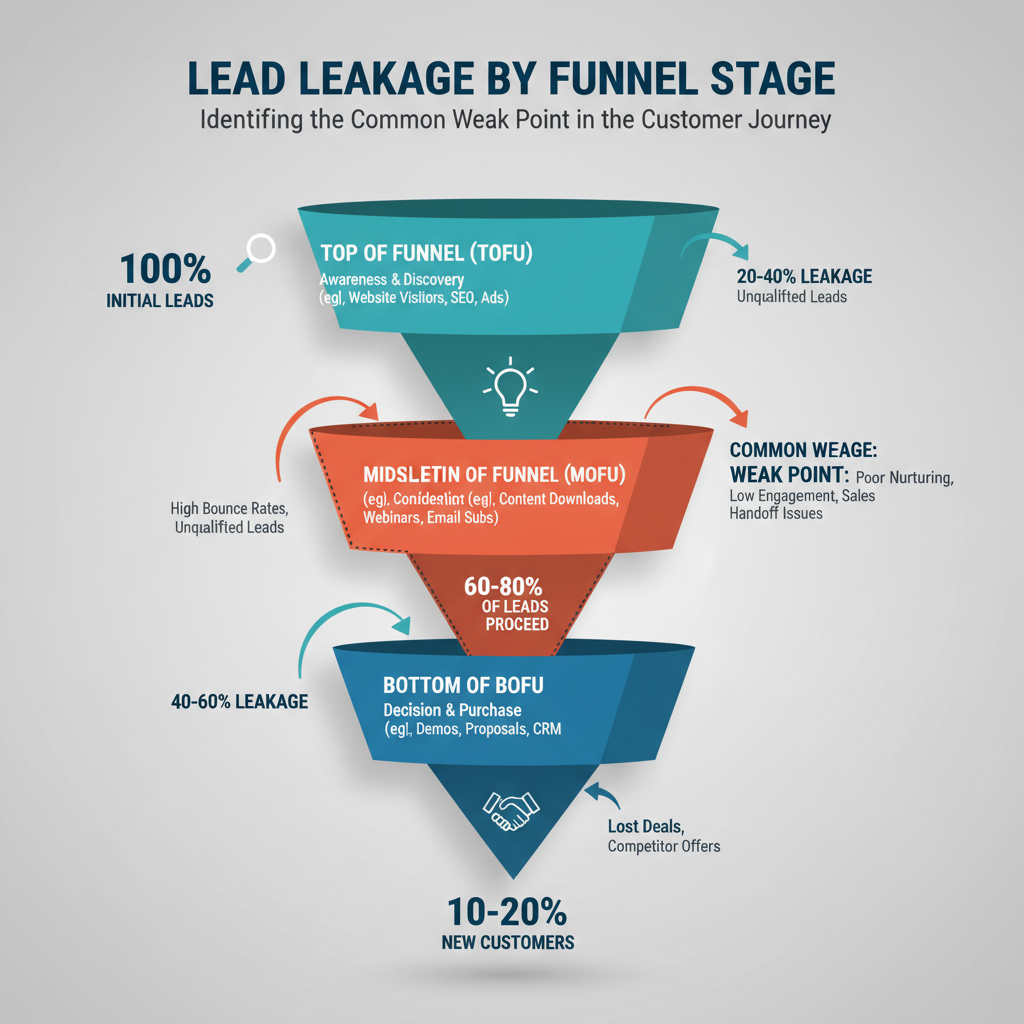
Most funnel leakage happens in the middle—where nurturing is underfunded
Bottom of Funnel (BOFU): Conversion Stage
Bottom funnel focuses on prospects ready to make a decision. They've done their research, understand their options, and need the final push to convert.
BOFU activities include:
- Retargeting campaigns for high-intent users
- Paid search for transactional keywords
- Sales enablement content
- Demo requests and free trials
- Limited-time offers and promotions
- Conversion rate optimization
- Direct response advertising
Key metrics at BOFU:
| Metric | What It Measures |
|---|---|
| Conversion rate | Percentage completing desired action |
| Cost per acquisition (CPA) | Total cost to acquire a customer |
| Return on ad spend (ROAS) | Revenue generated per ad dollar |
| Sales cycle length | Time from qualified lead to close |
| Customer acquisition cost (CAC) | Full cost of winning a customer |
BOFU gets outsized attention because it's easiest to measure. Revenue connects directly to bottom-funnel activities. But this measurability creates a trap: over-investing in BOFU while starving the stages that feed it.
Understanding marketing effectiveness measurement across all stages—not just the conversion point—separates strategic marketers from those chasing short-term metrics.
Funnel Stage Budget Allocation: The Numbers
The million-dollar question: What percentage of your marketing budget should go to each funnel stage?
The honest answer: It depends. But here are research-backed frameworks to start from.
Standard Allocation Framework
For established brands with balanced growth goals, research suggests this distribution:
| Funnel Stage | Budget Allocation | Primary Goal |
|---|---|---|
| TOFU (Awareness) | 30-40% | Build demand pipeline |
| MOFU (Consideration) | 30-40% | Nurture and qualify |
| BOFU (Conversion) | 20-30% | Close and convert |
This balanced approach ensures you're building future demand while capturing current opportunities.
Early-Stage Company Framework
Startups and early-stage companies often need a different approach. Blume Ventures research suggests:
| Funnel Stage | Budget Allocation | Rationale |
|---|---|---|
| TOFU | 0-5% | Limited brand building until product-market fit |
| MOFU | 55-60% | Heavy focus on engaged prospects |
| BOFU | 35-40% | Maximize conversions from warm traffic |
Early-stage companies can't afford pure awareness spending until they've proven they can convert. The middle and bottom funnel focus ensures every dollar works toward immediate growth.
Mature Brand Framework
Established brands with strong market presence often flip the allocation:
| Funnel Stage | Budget Allocation | Rationale |
|---|---|---|
| TOFU | 40-50% | Defend and expand market position |
| MOFU | 30-35% | Maintain lead flow and engagement |
| BOFU | 15-25% | Efficient conversion of built demand |
Mature brands have brand equity doing conversion work for them. Their challenge is maintaining and growing market presence against competitors—requiring heavier TOFU investment.
Les Binet and Peter Field's landmark research found that brands typically optimize at a 60/40 split between brand building (TOFU/MOFU) and activation (BOFU)—though this ratio shifts based on category and business model.
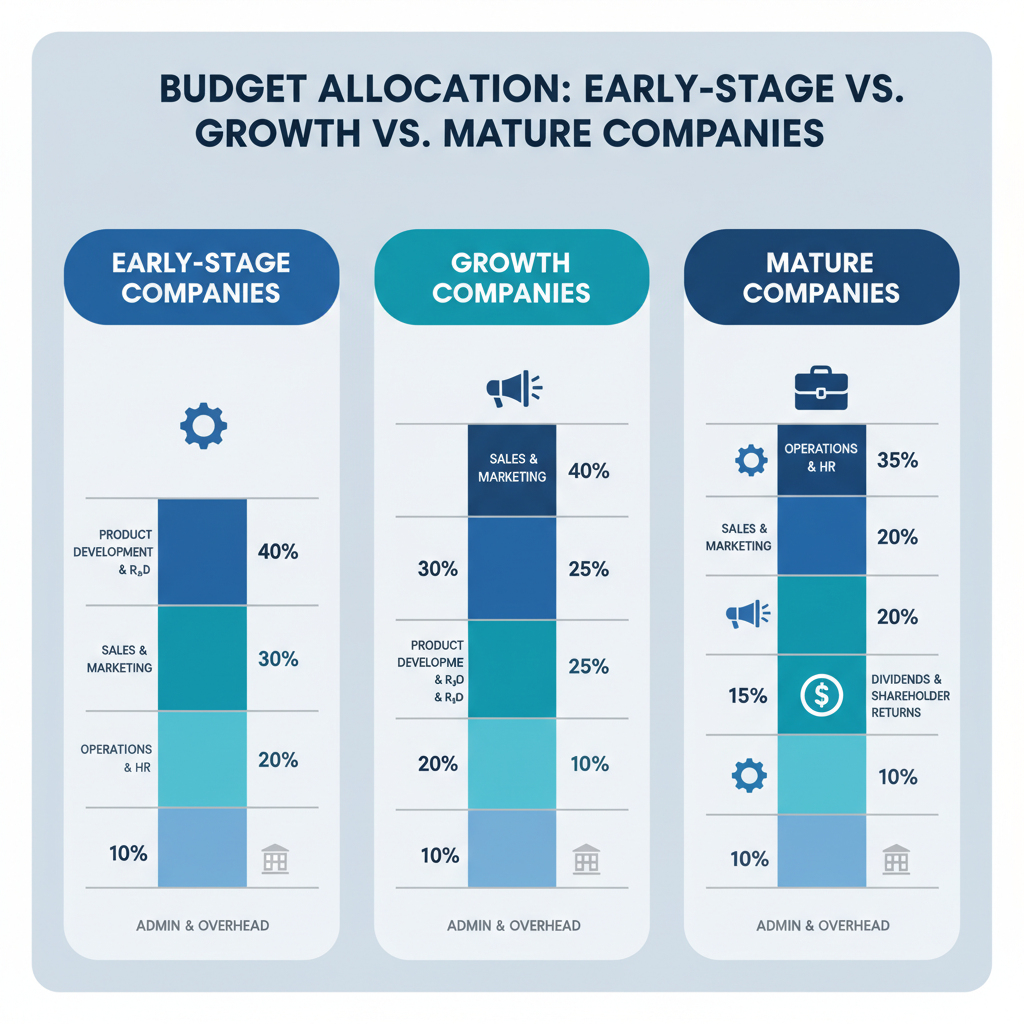
Optimal budget allocation shifts significantly based on company maturity
Factors That Influence Your Funnel Budget Mix
Standard frameworks provide starting points—but your optimal allocation depends on several business-specific factors.
Sales Cycle Length
Long sales cycles require more MOFU investment. If prospects take 6-12 months to buy, you need sustained nurturing to stay relevant throughout their decision process.
Short sales cycle (< 30 days):
- Heavy BOFU allocation (40-50%)
- Direct response focus
- Quick conversion tactics
Long sales cycle (> 90 days):
- Balanced TOFU/MOFU (35-40% each)
- Content-heavy nurturing
- Multiple touchpoint sequences
Our preparation tips cover how to build the tracking infrastructure needed to measure performance across extended sales cycles.
Average Order Value (AOV)
Higher-value products justify more TOFU spending. When each customer is worth $10,000+, investing in awareness makes economic sense—even if attribution is murky.
Low AOV products: Require efficient, bottom-heavy funnels with clear attribution High AOV products: Can support awareness investment with longer payback periods
McKinsey research confirms that high-consideration purchases benefit significantly from extended TOFU exposure—brands that underinvest in early-stage touchpoints see 30% lower conversion rates in complex B2B sales.
Market Awareness
How well does your market understand the problem you solve?
High market awareness:
- Less TOFU education needed
- Focus on differentiation (MOFU)
- Heavy conversion investment (BOFU)
Low market awareness:
- Significant TOFU education required
- Content marketing to build category understanding
- Longer path to conversion
Competition Intensity
Crowded markets require more awareness spending to maintain visibility. If competitors are investing heavily in TOFU, you may need to match them—or risk disappearing.
Less competitive markets allow more efficient BOFU focus, capturing existing demand without the awareness investment.
This is where media mix modeling provides crucial insight. MMM can reveal how competitive spend affects your funnel performance—showing whether awareness investments are building market share or merely maintaining position.
How to Measure Funnel Stage Performance
Allocating budget is step one. Knowing if that allocation is working requires stage-specific measurement.
TOFU Measurement
Challenge: Awareness impact is delayed and indirect. Someone exposed to your brand today might convert months later—through a channel that gets attribution credit.
Solutions:
- Brand lift studies measuring awareness pre/post campaigns
- Search volume correlation tracking brand searches against awareness spend
- Direct traffic growth as proxy for brand recognition
- Share of voice in target keywords and conversations
The MMM readiness checklist on our site helps assess whether you have the data infrastructure for comprehensive awareness measurement.
MOFU Measurement
Challenge: Middle funnel metrics can look good (high engagement) without actually moving people toward purchase.
Solutions:
- Lead scoring accuracy measuring prediction quality
- Stage velocity tracking time between funnel stages
- Content influence on conversion paths
- Lead-to-opportunity rates by source and content
BOFU Measurement
Challenge: Over-attribution to BOFU activities that take credit for work done by earlier stages.
Solutions:
- Incrementality testing measuring true lift from campaigns
- Holdout analysis showing performance with/without BOFU tactics
- Marginal ROAS at different spend levels
- Attributed vs. incremental revenue comparison
Google's research on attribution shows that last-click attribution overvalues BOFU activities by up to 40% in multi-touch journeys—making incremental measurement essential for accurate funnel budgeting.
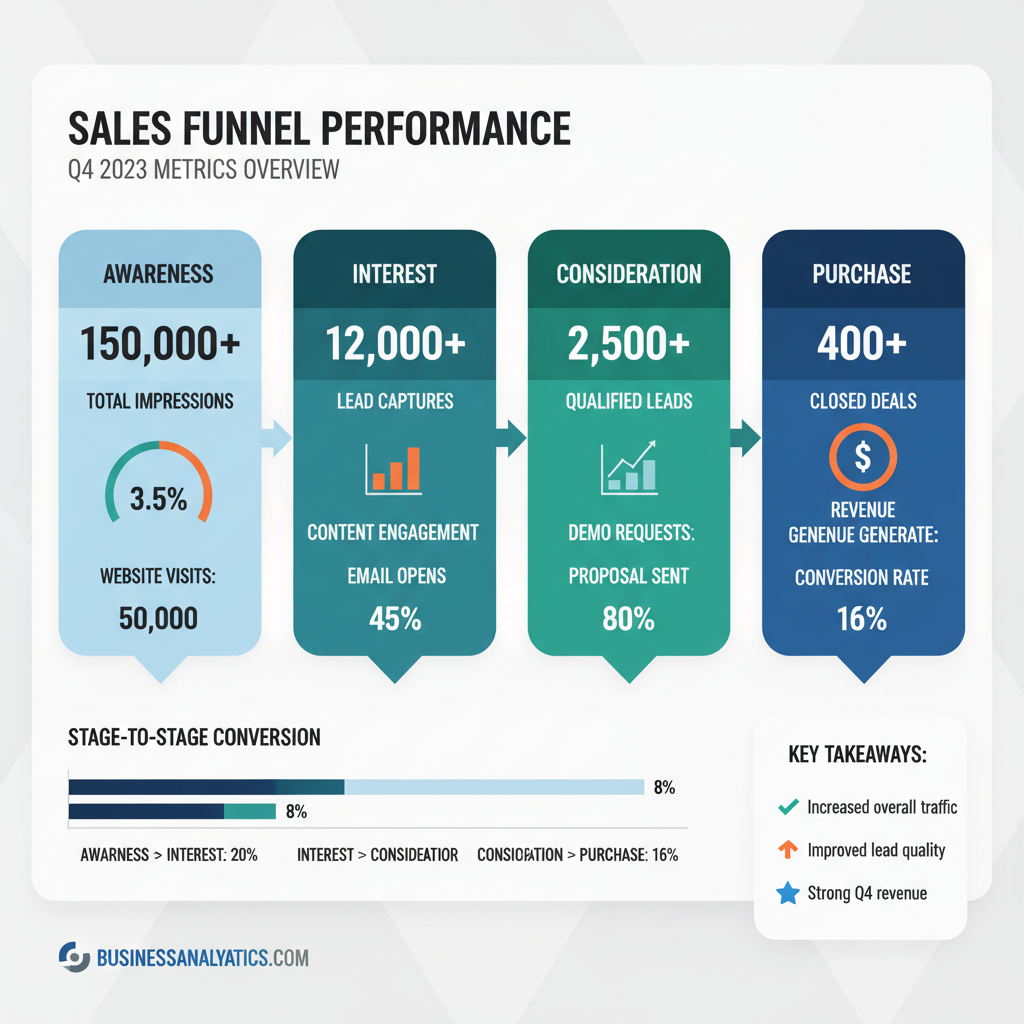
Effective measurement requires stage-specific metrics that reveal true performance
Common Funnel Budget Mistakes (And How to Avoid Them)
Mistake 1: Over-Investing in BOFU
The most common error. Bottom-of-funnel campaigns show clear ROAS, so they get more budget. But you're harvesting demand that TOFU and MOFU created—without replenishing it.
Signs you're over-invested in BOFU:
- Lead volume declining despite stable BOFU performance
- Rising CPAs as you exhaust warm audiences
- Retargeting pools shrinking over time
Fix: Implement mandatory TOFU/MOFU investment minimums. Even when BOFU is performing, maintain upper-funnel spending to build future demand. Our guide to media budget optimization covers how to set these guardrails effectively.
Mistake 2: Ignoring MOFU Entirely
Many brands jump straight from awareness to conversion—and wonder why conversion rates tank. Without middle-funnel nurturing, you're asking people to buy before they're ready.
Signs of MOFU weakness:
- Low email engagement rates
- High lead volume but low MQL rates
- Long gaps between first touch and conversion
- Prospects going dark after initial interest
Fix: Build systematic nurture sequences. Create consideration-stage content. Invest in lead scoring that identifies when prospects are ready for BOFU.
Mistake 3: Static Allocation
Setting funnel budgets once and never adjusting them. Market conditions change. Seasonality affects different funnel stages differently. What worked last quarter may not work now.
Better approach: Monthly reviews of funnel stage performance with flexibility to shift 10-20% of budget based on data.
Mistake 4: Measuring Stages with Wrong Metrics
Judging TOFU by conversions or BOFU by impressions. Each stage has appropriate success metrics—using the wrong ones leads to bad allocation decisions.
Proper metric matching:
- TOFU: Reach, awareness, cost-per-impression
- MOFU: Engagement, progression, cost-per-qualified-lead
- BOFU: Conversions, ROAS, customer acquisition cost
Building a Dynamic Funnel Budget Strategy
The best marketers don't set static funnel allocations. They build systems that adjust based on performance signals.
Step 1: Establish Baseline Metrics
Before optimizing, document current performance at each funnel stage. The MMM readiness checklist can help you assess whether you have the data foundation needed for this analysis.
Document for each stage:
- What percentage of spend goes to each stage?
- What results does each stage produce?
- How do stages connect (TOFU to MOFU conversion, MOFU to BOFU progression)?
Step 2: Set Stage-Specific Targets
Define success metrics for each stage:
- TOFU: Target reach, awareness lift, or cost-per-engaged-visitor
- MOFU: Target MQL volume, engagement rates, or nurture conversion
- BOFU: Target CPA, ROAS, or conversion rate
Step 3: Create Decision Rules
Establish triggers for budget reallocation:
- "If TOFU CPM rises above $X, shift 10% to MOFU"
- "If lead volume drops below Y, increase TOFU by 15%"
- "If conversion rate exceeds Z%, add budget from MOFU"
Step 4: Review and Adjust Monthly
Schedule monthly funnel reviews that examine:
- Performance by stage against targets
- Stage-to-stage conversion rates
- Changes in audience size and quality
- Competitive dynamics affecting each stage
This systematic approach transforms funnel budgeting from annual guesswork into responsive strategy.
According to Ipsos research on marketing effectiveness, companies with dynamic budget allocation achieve 25-35% better marketing ROI than those using static annual budgets—the flexibility to shift resources based on performance data creates compounding advantages over time.
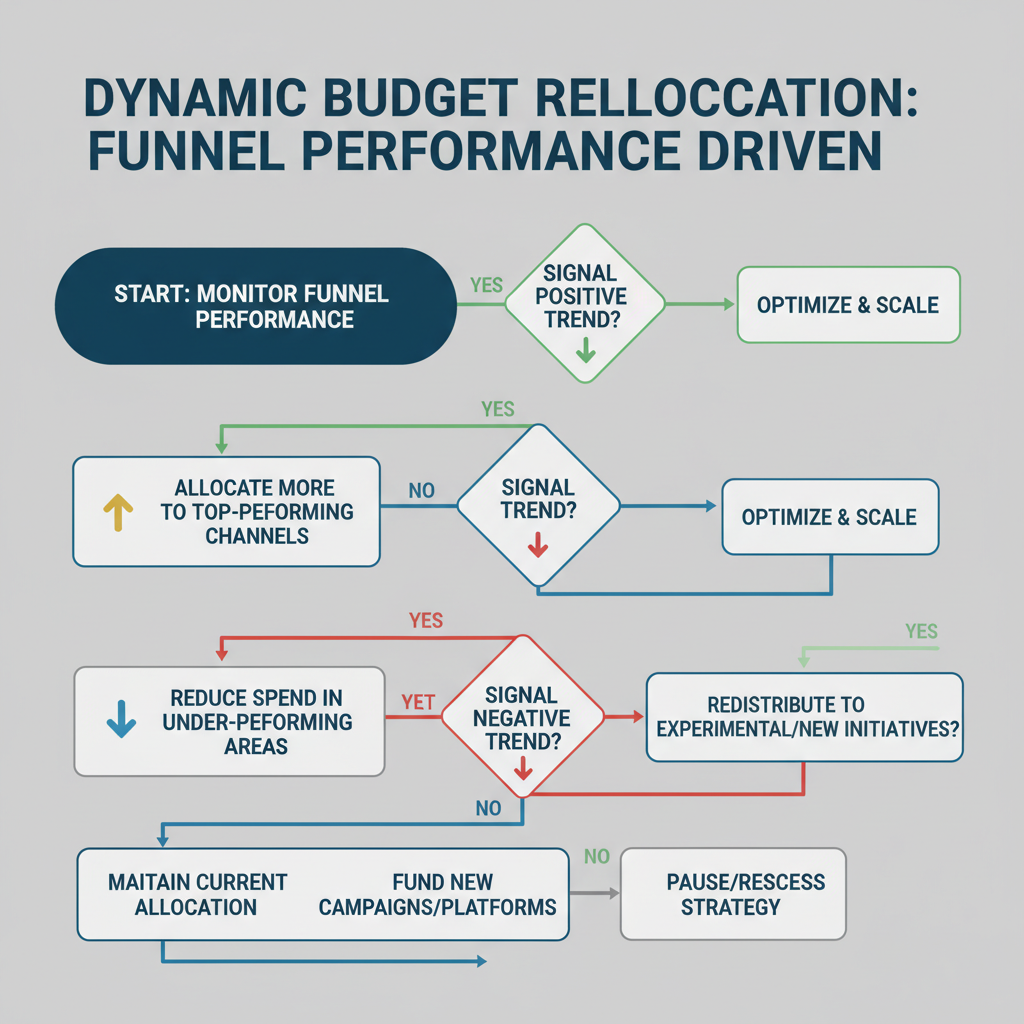
Build decision rules that trigger automatic budget adjustments based on performance
Frequently Asked Questions
What is the ideal marketing funnel budget split for B2B companies?
B2B companies typically benefit from a balanced 35/35/30 split across TOFU/MOFU/BOFU due to longer sales cycles. The extended consideration phase requires significant middle-funnel investment in content, webinars, and email nurturing. However, high-ticket B2B sales may justify even heavier MOFU allocation (up to 40-45%) given the complexity of purchasing decisions. Our preparation tips provide specific guidance for B2B measurement setup.
How often should I adjust my funnel stage budget allocation?
Monthly reviews with quarterly major adjustments work for most organizations. Review performance metrics monthly and make small tactical shifts (5-10% moves). Reserve larger strategic changes (15-20% shifts) for quarterly planning when you have sufficient data to identify trends versus noise. Understanding marketing effectiveness measurement cadences helps establish the right review rhythm.
Can I measure TOFU performance without brand tracking studies?
Yes, through proxy metrics. Track branded search volume growth against awareness spending. Monitor direct traffic trends. Measure share of voice in target keywords. While not as precise as formal brand studies, these proxies reveal whether awareness investment is building recognition. Take our free MMM readiness quiz to assess your current measurement capabilities for TOFU activities.
What's the biggest mistake companies make with funnel budgeting?
Over-optimizing for bottom-funnel performance while starving the top and middle. BOFU campaigns show clear ROAS, which creates a feedback loop of increasing investment—until the pipeline runs dry because upper-funnel stages were neglected. Sustainable growth requires balanced investment across all stages.
How does funnel stage budgeting work with media mix modeling?
Media mix modeling is particularly valuable for funnel stage budgeting because it can measure the delayed and indirect effects of TOFU activities that digital attribution misses. MMM reveals how awareness spending influences consideration and conversion behavior over time—enabling more accurate allocation decisions across the funnel.
Should early-stage startups invest in top-of-funnel marketing?
Generally not until product-market fit is established. Early-stage companies benefit from MOFU/BOFU focus that maximizes learning from engaged prospects. Once conversion mechanics are proven, gradually introduce TOFU investment to scale the pipeline. Starting with heavy awareness spending before you can convert efficiently burns capital without building sustainable growth.
Conclusion
Funnel stage budgeting isn't about finding the perfect percentage split. It's about building a system that allocates resources based on where your growth engine needs fuel.
Key takeaways:
- Match budget allocation to your company stage, not industry benchmarks
- Measure each funnel stage with appropriate metrics (not just conversions)
- Build dynamic reallocation rules rather than static annual budgets
- Resist the temptation to over-invest in bottom-funnel activities
- Use media mix modeling to measure what attribution can't see
The marketers who master funnel stage budgeting build sustainable growth engines. Those who chase short-term ROAS eventually exhaust their pipelines and wonder what went wrong.
Start with honest assessment. Use the MMM readiness checklist to evaluate your current measurement capabilities. Identify which funnel stage is underinvested relative to your growth goals. Make the allocation changes that data supports.
Your funnel will tell you what it needs—if you're measuring the right things.
Ready to optimize your marketing funnel? Take our readiness assessment to understand your current measurement capabilities, or explore our guide to media budget optimization for frameworks that work across channels and funnel stages.
Stay in the loop
Get updates on new posts and resources.