FusePoint vs BlueAlpha: Which Marketing Measurement Solution Is Right for Your Brand?
Comparing FusePoint and BlueAlpha for marketing mix modeling and incrementality testing. Learn which platform fits mid-market brands best in 2026.
You're drowning in marketing data but starving for answers.
Every platform promises measurement clarity. Most deliver spreadsheet chaos. When comparing FusePoint and BlueAlpha, you're looking at two fundamentally different approaches to solving the same problem: understanding what's actually driving your revenue.
FusePoint positions itself as your measurement partner—a consulting team that delivers human expertise. BlueAlpha offers an AI-powered platform that automates marketing mix modeling and incrementality testing. Both use similar methodologies. Both promise clarity. But the execution? Completely different.
Let's cut through the marketing speak and examine what each brings to the table.
What Is FusePoint?
FusePoint is Power Digital's data and strategy consultancy, launched to deliver enterprise-grade marketing intelligence to ambitious mid-market brands. They explicitly state they're "not another SaaS tool."
Instead, FusePoint delivers partnership, calibration, and clarity through human analysts who work alongside your team. Their approach centers on media mix modeling combined with incrementality experiments—specifically Matched Market Tests (MMTs) that isolate marketing's real impact down to the channel and dollar.
The consulting model means you get strategists and data scientists turning numbers into actions. No learning curve. No dev team required. Just plug in and start getting insights from analysts who've seen your challenges before.
FusePoint reports a proven 22% revenue lift versus teams using non-FusePoint measurement systems. They target mid-market brands looking for enterprise capabilities without enterprise complexity.
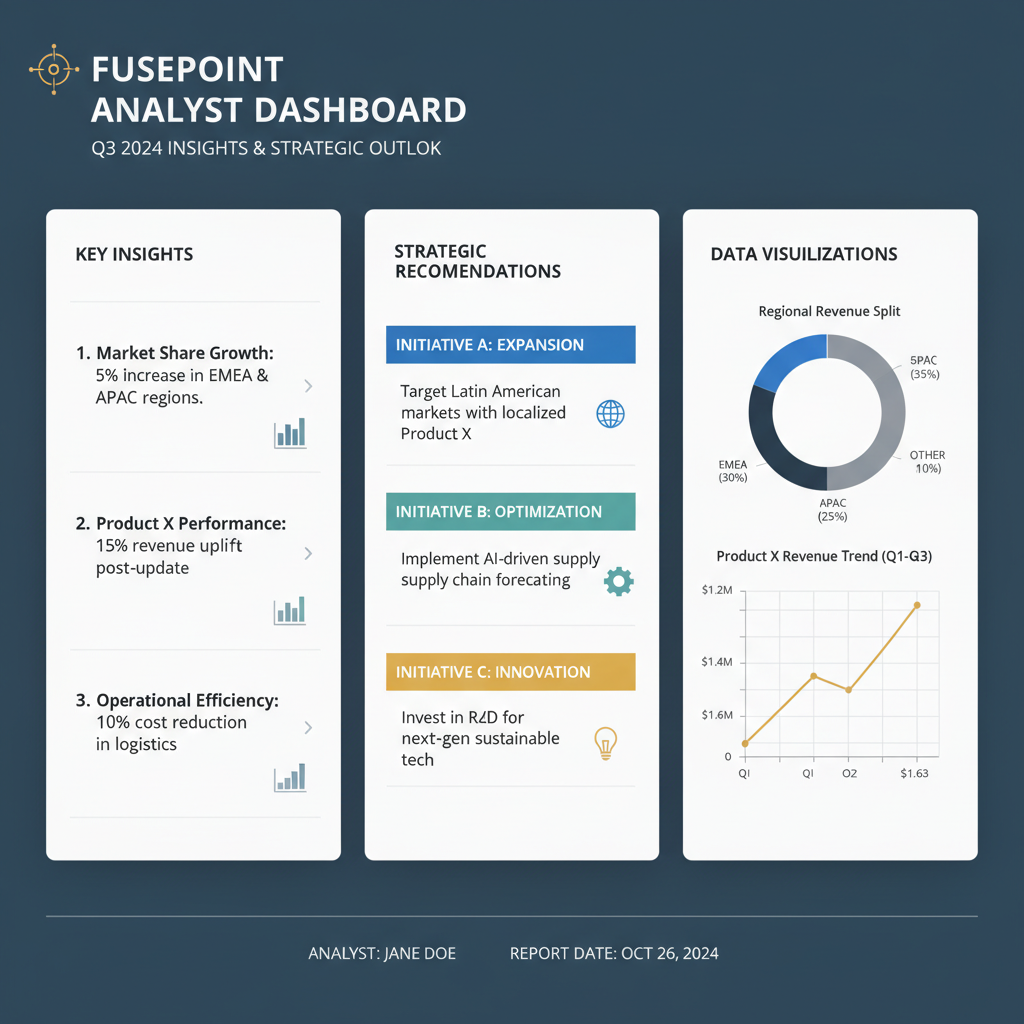
FusePoint delivers analyst-interpreted insights through custom dashboards and strategic guidance
What Is BlueAlpha?
BlueAlpha is an AI-powered marketing measurement platform built by former Tesla data science and global growth leaders. It's designed specifically for lean marketing teams that need enterprise-grade measurement without enterprise-grade complexity.
The platform combines Bayesian marketing mix modeling with automated incrementality testing—but here's the difference: BlueAlpha's AI handles the heavy lifting. The system ingests your marketing data, runs weekly model updates, and surfaces insights through natural language recommendations powered by LLMs.
You're not just getting numbers. You're getting "scale this campaign by 40%" or "pause this channel—it's cannibalizing organic traffic." The AI interprets why performance changed and exactly how to fix it.
BlueAlpha enables pilot launches in three weeks—from data connection to measurable lift. The platform handles data integration, statistical modeling, and visualization automatically. No dedicated data science team required.
Average client results show 15% increase in total sales, 20% improvement in marketing efficiency ratio (MER), and 25% CAC reduction. The platform is purpose-built for mid-market brands that need to scale efficiently.
The Fundamental Difference: Service vs Software
Here's what really separates these two options.
FusePoint sells expertise. You're paying for seasoned analysts, strategists, and data scientists who partner with your team. They build custom models, run experiments, interpret results, and recommend actions. It's hands-on consulting wrapped in measurement methodology.
BlueAlpha sells automation. You're paying for AI-powered software that continuously monitors, measures, and optimizes your marketing. The platform runs the models, executes the tests, generates the insights, and delivers recommendations—all automatically, every single week.
Think of it this way: FusePoint is hiring a measurement team. BlueAlpha is deploying a measurement system.
Neither approach is inherently better. The right choice depends on your organization's structure, resources, and how you prefer to operate.
Business Model: Consulting Partnership vs AI Platform
FusePoint's Consulting Approach
FusePoint's model centers on human expertise. You're not licensing software—you're engaging a team of specialists who become embedded in your measurement strategy. They handle the technical complexity while providing strategic counsel based on Power Digital's operational experience across hundreds of brands.
The consulting structure means flexibility. Your FusePoint team adapts their analysis based on your business questions, priorities shifting throughout quarters, and unique challenges that don't fit pre-built templates. You get custom research, bespoke experiments, and strategic recommendations tailored to your specific market position.
But consulting comes with inherent limitations. Analysis happens in sprints rather than continuously. Insights arrive through scheduled reports and meetings rather than real-time dashboards. You're dependent on your analyst's availability and workload.
BlueAlpha's Automated Platform
BlueAlpha operates as software-as-a-service. You connect your data sources once, and the AI takes over. Models refresh weekly with new data. The system automatically detects performance shifts, runs statistical tests, and surfaces insights through an always-on dashboard.
The platform model means consistency. Your measurement framework doesn't change when an analyst leaves or gets busy with another client. The AI applies the same rigorous methodology every week, comparing current performance against historical patterns and surfacing anomalies that need attention.
You're also getting scalability. As your marketing complexity grows—new channels, additional campaigns, international expansion—the platform scales automatically. No need to renegotiate consulting scope or wait for analyst capacity.
The tradeoff? Less customization for edge cases. While BlueAlpha's AI handles 90% of scenarios brilliantly, highly specialized analyses might require workarounds.
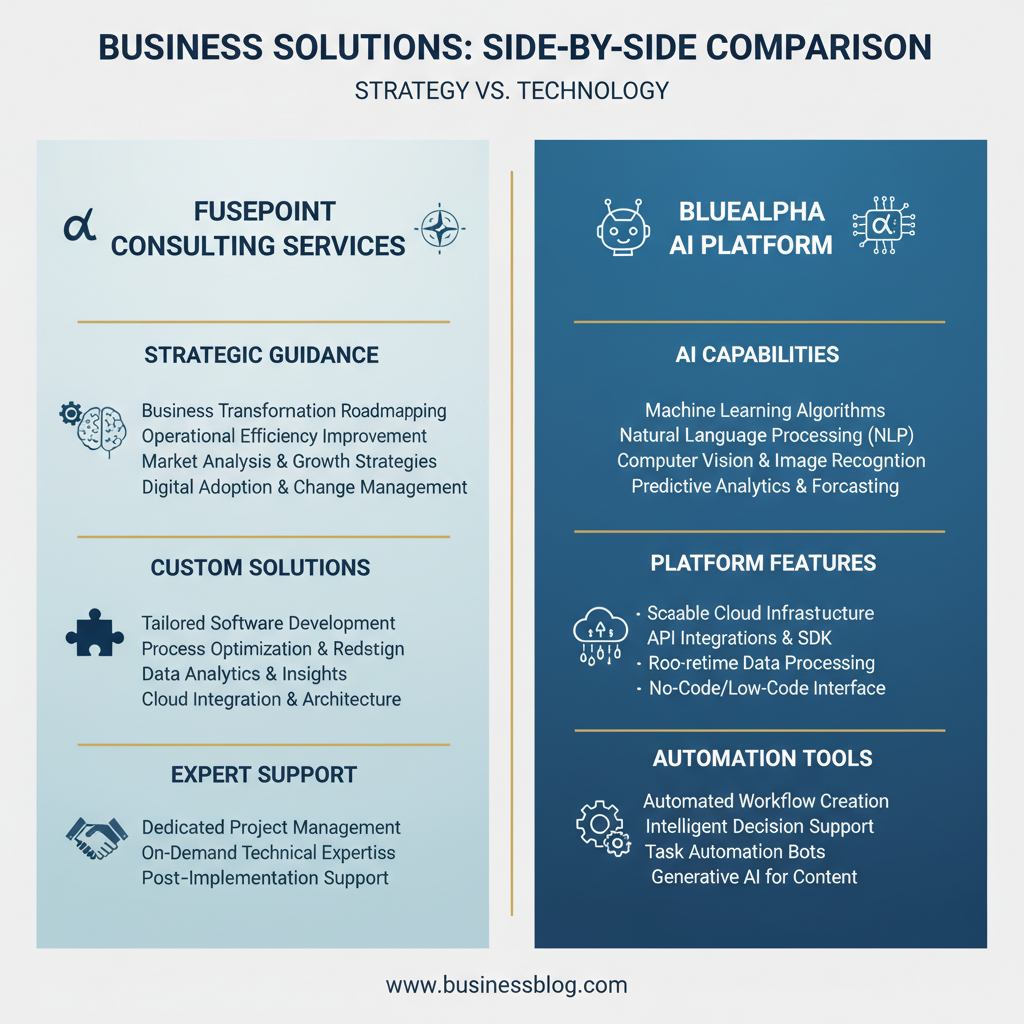
FusePoint delivers human expertise while BlueAlpha provides AI-powered automation—two paths to marketing measurement clarity
Implementation Speed and Resource Requirements
FusePoint's Setup Process
FusePoint emphasizes "no learning curve, no dev team." They plug in fast by handling data integration on their end. Your team provides API access or regular data exports, and FusePoint's analysts take it from there.
Specific timelines aren't detailed publicly, but the consulting model typically requires several weeks for initial data audits, historical analysis, and baseline model calibration. Your first insights arrive after the team has sufficient data to establish patterns and run initial tests.
The advantage: zero technical burden on your side. FusePoint's data engineers do the heavy lifting. Your team participates in strategy sessions and reviews insights, but you're not wrestling with data pipelines or statistical models.
BlueAlpha's Three-Week Launch
BlueAlpha promises pilot use cases in three weeks—from connection to measurable lift. The platform connects directly to your existing marketing tools (ad platforms, analytics, CRM, data warehouses) through pre-built integrations.
Week one: data connection and validation. Week two: model training and calibration. Week three: first insights and recommendations. By week four, you're optimizing based on AI-generated guidance.
The platform is designed for marketing teams without dedicated data science resources. If you can grant API access to your marketing tools, you can deploy BlueAlpha. The AI handles data transformation, feature engineering, and statistical modeling automatically.
That said, data quality matters enormously. If your tracking is broken or your attribution is inconsistent, you'll need to fix those issues before any measurement solution—FusePoint or BlueAlpha—can deliver reliable insights.
Measurement Methodology: MMM + Incrementality
Both FusePoint and BlueAlpha use the same core methodologies: marketing mix modeling combined with incrementality testing. This hybrid approach is now considered best practice in marketing measurement because it balances strategic breadth with causal precision.
Marketing Mix Modeling
MMM analyzes historical data to understand how different marketing channels contribute to sales. It accounts for seasonality, market dynamics, competitive activity, and channel interdependencies. The output is a holistic view of marketing effectiveness over time.
Traditional MMM uses correlation-based statistical techniques. Modern approaches—like those used by both FusePoint and BlueAlpha—incorporate Bayesian methods that handle uncertainty better and update continuously as new data arrives.
Incrementality Testing
Incrementality testing uses controlled experiments (test vs. control) to measure the true causal impact of marketing. By isolating a channel or campaign and comparing exposed groups against holdout groups, you determine what revenue was truly incremental versus what would have happened anyway.
FusePoint specializes in Matched Market Tests (MMTs)—geographic experiments that measure channel impact across similar markets. BlueAlpha automates geo-testing alongside other incrementality methodologies, running multiple experiments simultaneously to validate MMM predictions.
The Combination Advantage
Using MMM and incrementality together addresses the weaknesses of each approach individually. MMM provides strategic direction across all channels, but its correlational nature can miss causal relationships. Incrementality delivers causal proof but can't efficiently test every variable.
Together, they create a complete measurement framework. MMM identifies opportunities and continuously optimizes allocation. Incrementality validates that optimization decisions are based on real causal impact, not just correlation.
Both FusePoint and BlueAlpha understand this synergy. The difference is execution: FusePoint delivers it through analyst-led consulting, while BlueAlpha automates it through AI.
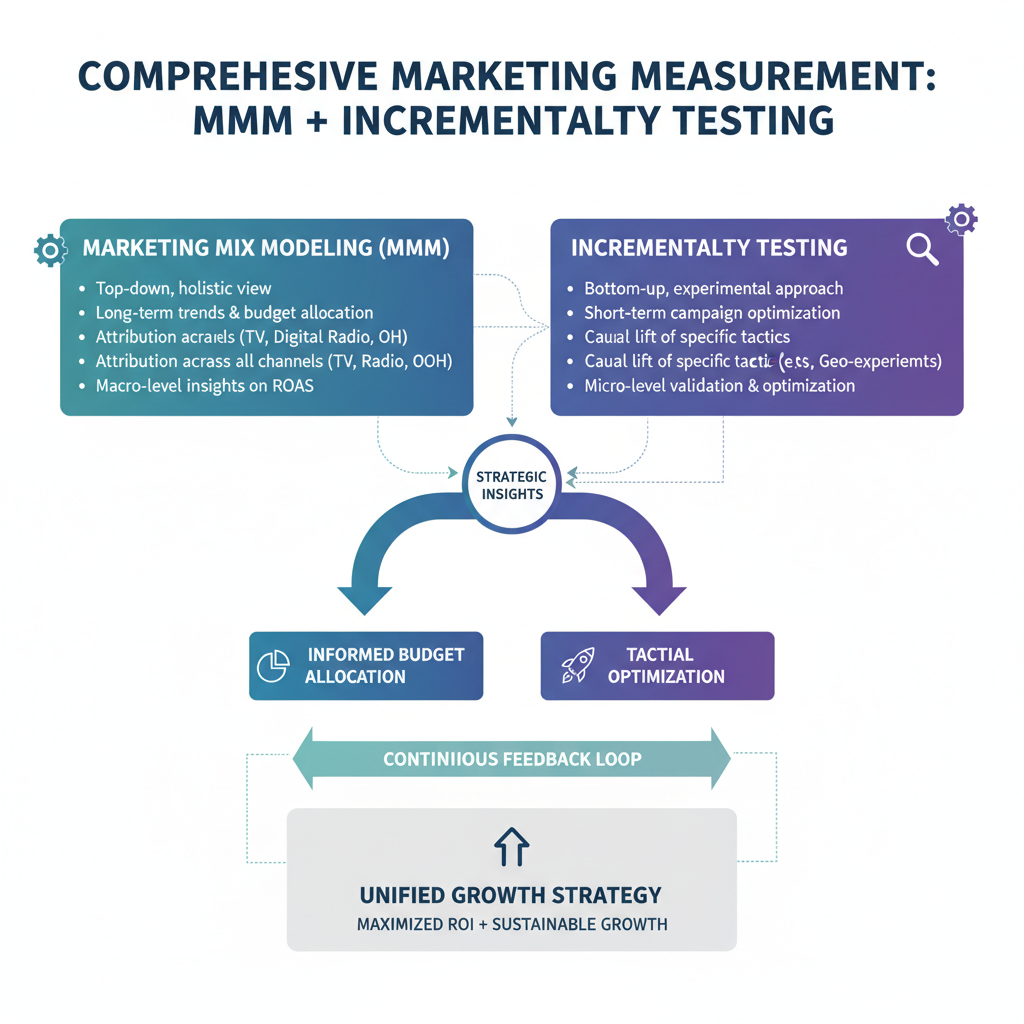
Modern marketing measurement combines MMM's strategic breadth with incrementality's causal precision
Results and Performance Claims
FusePoint's Reported Outcomes
FusePoint reports that brands using their measurement system achieve 22% faster revenue growth compared to teams using alternative solutions. They emphasize cost savings through streamlined marketing efficiency alongside that revenue acceleration.
These results come from their combined approach of custom media mix models, matched market tests, and strategic consulting. The consulting relationship means FusePoint analysts can pivot quickly when they identify underperforming channels or untapped opportunities.
BlueAlpha's Client Results
BlueAlpha publishes more granular outcome data. Average clients see:
- 15% increase in total sales
- 20% improvement in marketing efficiency ratio (MER)
- 25% reduction in customer acquisition cost (CAC)
Specific case studies add detail. Pettable captured $2.12M in annualized savings with 14% blended CAC reduction and zero revenue loss. Beehiiv discovered that Meta's true incremental cost was 345% higher than platform reporting suggested—a finding that completely reshaped their channel strategy.
Comparing the Claims
Both sets of results are impressive. FusePoint's 22% revenue lift is substantial. BlueAlpha's efficiency gains deliver clear financial impact.
The challenge with comparing marketing measurement results is attribution. Did the measurement system drive those gains, or did the brand's underlying marketing improvements drive them? Both solutions help brands make better decisions, which leads to better outcomes—but isolating the measurement tool's specific contribution is tricky.
What matters more: do these solutions help you identify and act on optimization opportunities quickly enough to beat competitors who are flying blind? The answer for both appears to be yes.
Pricing and Investment Considerations
Neither FusePoint nor BlueAlpha publishes transparent pricing on their websites—standard practice for B2B solutions targeting mid-market and enterprise clients.
FusePoint Pricing Model
As a consulting service, FusePoint likely prices based on scope: how many channels you're measuring, how many experiments you're running, how much strategic advisory you need. Expect monthly retainers that scale with engagement depth.
Consulting economics mean you're paying for human time. Senior strategists and data scientists cost real money. The investment reflects that expertise level.
BlueAlpha Pricing Model
As SaaS, BlueAlpha likely uses subscription pricing based on data volume, user seats, or revenue under management. Platform economics mean the cost structure scales more efficiently than consulting—once the software is built, serving additional clients doesn't require linear headcount growth.
You're paying for software access and ongoing AI-powered analysis. No analyst retainers. No billable hours. Just platform fees.
ROI Perspective
The real question isn't "what does it cost?" but "what's the return on measurement investment?"
If FusePoint's measurement partnership helps you reallocate $500K/month in ad spend 15% more efficiently, you've gained $75K/month in value—$900K annually. If that engagement costs $20K/month ($240K/year), your ROI is 275%.
If BlueAlpha's AI platform delivers similar efficiency gains at $10K/month ($120K/year), your ROI is 650%.
These are hypothetical numbers, but the framework applies: measurement solutions justify their cost when they help you capture optimization opportunities worth multiples of the investment.
Which Solution Fits Your Business?
Choose FusePoint If You:
- Prefer human partnership over software. You want analysts who know your business and provide strategic counsel beyond the data.
- Have complex, unusual measurement needs. Your business model, channels, or market position require custom approaches that don't fit standard templates.
- Value flexibility over consistency. You need a team that can pivot their analysis as your questions and priorities evolve.
- Want hands-off technical implementation. You'd rather have consultants handle data complexity than deploy software yourself.
- Already use Power Digital for other services. Integrated consulting across media buying and measurement could provide synergies.
Choose BlueAlpha If You:
- Need continuous, automated insights. You want weekly model updates and real-time dashboards, not scheduled reports.
- Have a lean marketing team. You need measurement capabilities without hiring a full analytics team or retaining consultants.
- Value speed and scalability. You want to launch measurement quickly and scale it as your marketing grows, without renegotiating consulting scope.
- Prefer AI-powered automation. You trust well-designed algorithms to handle statistical modeling and insight generation reliably.
- Want predictable software economics. You prefer subscription pricing over consultant retainers and billable hours.
The Hybrid Option?
Some brands might use both. Deploy BlueAlpha for continuous measurement and optimization, then bring in FusePoint consultants for strategic projects: entering new markets, evaluating major channel shifts, conducting brand studies.
This "platform + advisory" model combines software efficiency with human expertise for high-stakes decisions. It's not necessary for most mid-market brands, but worth considering if you're in hyper-growth and need both ongoing optimization and strategic counsel.
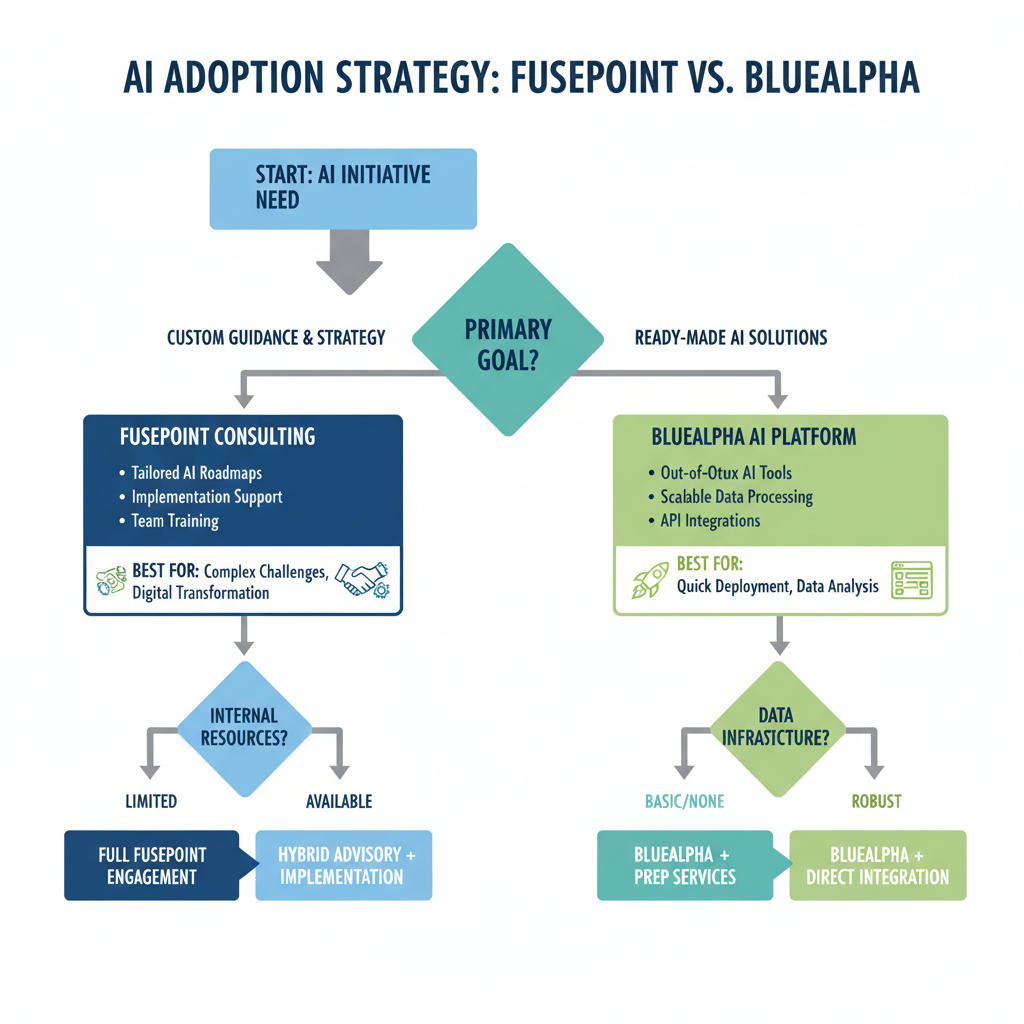
Your business structure, resources, and preferences determine which measurement approach fits best
Frequently Asked Questions
What's the main difference between FusePoint and BlueAlpha?
FusePoint is a consulting partnership delivering measurement through human analysts and strategists. BlueAlpha is an AI-powered software platform automating measurement through machine learning. Both use similar methodologies (MMM + incrementality), but FusePoint delivers through consulting while BlueAlpha delivers through software.
Which is better for mid-market brands?
Both target mid-market brands effectively. BlueAlpha may be more accessible for leaner teams needing self-service capabilities and faster deployment. FusePoint suits brands wanting hands-on strategic partnership and custom analysis. Your preference for software vs. consulting determines the better fit.
How long does implementation take?
BlueAlpha specifies three weeks from connection to measurable lift. FusePoint doesn't publish specific timelines but likely requires several weeks for initial data audits and model calibration, typical of consulting engagements. Both are faster than building in-house measurement capabilities.
Do I need a data science team to use these solutions?
No. FusePoint explicitly states "no dev team required"—their analysts handle technical complexity. BlueAlpha is designed for marketing teams without data science resources, automating the statistical modeling through AI. Both abstract away the technical details.
Can these solutions measure all marketing channels?
Yes. Both FusePoint and BlueAlpha measure across digital (paid social, paid search, display), offline (TV, radio, OOH), and other channels like affiliate marketing or influencer campaigns. The breadth of MMM methodology captures impact across the full marketing mix.
How do they compare to other MMM solutions?
Both are modern MMM platforms that combine statistical modeling with incrementality validation—a best practice approach. Compared to legacy solutions like Nielsen or Analytic Partners (enterprise-focused, longer implementations), both FusePoint and BlueAlpha target mid-market brands with faster, more accessible deployment.
Making Your Decision
The FusePoint vs BlueAlpha choice isn't about better or worse. It's about consulting versus software, human partnership versus AI automation, flexible customization versus scalable consistency.
Both deliver on the core promise: helping you understand what marketing actually drives revenue so you can optimize with confidence. Both use proven methodologies—marketing mix modeling and incrementality testing—that balance strategic breadth with causal precision.
Your decision comes down to how your organization prefers to work.
If you value human expertise, strategic counsel, and custom analysis—and you're comfortable with consulting economics—FusePoint offers a proven partnership model. If you prefer AI-powered automation, continuous insights, and software scalability—and you're comfortable with self-service platforms—BlueAlpha delivers sophisticated measurement capabilities without requiring data science teams.
Here's what we know for certain: brands that measure marketing effectiveness rigorously grow faster than those flying blind. Whether you choose consulting or software, the act of implementing proper measurement will reshape how you allocate budget and where you capture growth.
Stop guessing. Start measuring. The tools exist. The methodologies work. Pick the approach that fits your team and run with it.
Ready to see what AI-powered measurement can do for your brand? Explore BlueAlpha's platform and launch your pilot in three weeks.
Stay in the loop
Get updates on new posts and resources.