Marketing ROI Analysis: How to Measure What Actually Matters
Master marketing ROI analysis with proven frameworks, formulas, and strategies that connect marketing spend to real business outcomes.
Here's a question that keeps CMOs up at night: Is your marketing actually working?
Marketing ROI analysis answers that question with data instead of guesswork. It's the discipline of measuring what your marketing investments return to the business—and it separates companies that grow efficiently from those that bleed money on ineffective campaigns.
According to Gartner's CMO Spend Survey, marketing budgets now average 9.1% of total company revenue. Yet most marketing teams struggle to prove the value of that investment. The result? Budget cuts, stakeholder skepticism, and missed growth opportunities.
This guide breaks down how to conduct proper marketing ROI analysis—from foundational formulas to advanced techniques that reveal the true impact of your marketing spend.
What is Marketing ROI Analysis?
Marketing ROI analysis is the systematic process of measuring the financial returns generated by marketing activities relative to their costs. It answers a deceptively simple question: For every dollar you spend on marketing, how much revenue or profit does it generate?
But simple doesn't mean easy.
The challenge lies in complexity. Modern marketing spans dozens of channels, touchpoints, and time horizons. A customer might see your LinkedIn ad today, receive an email next week, and convert through organic search three months later. Figuring out which activity deserves credit—and how much—requires sophisticated analysis.
Effective marketing ROI analysis involves:
- Calculating accurate returns across all marketing channels
- Understanding which activities drive incremental conversions (not just attributed ones)
- Separating correlation from causation in campaign performance
- Accounting for long-term effects like brand building
- Connecting marketing metrics to actual business outcomes
The brands that master this don't just justify their budgets—they systematically improve them. Research from McKinsey shows companies with advanced marketing measurement capabilities achieve 15-20% higher marketing efficiency than their peers.
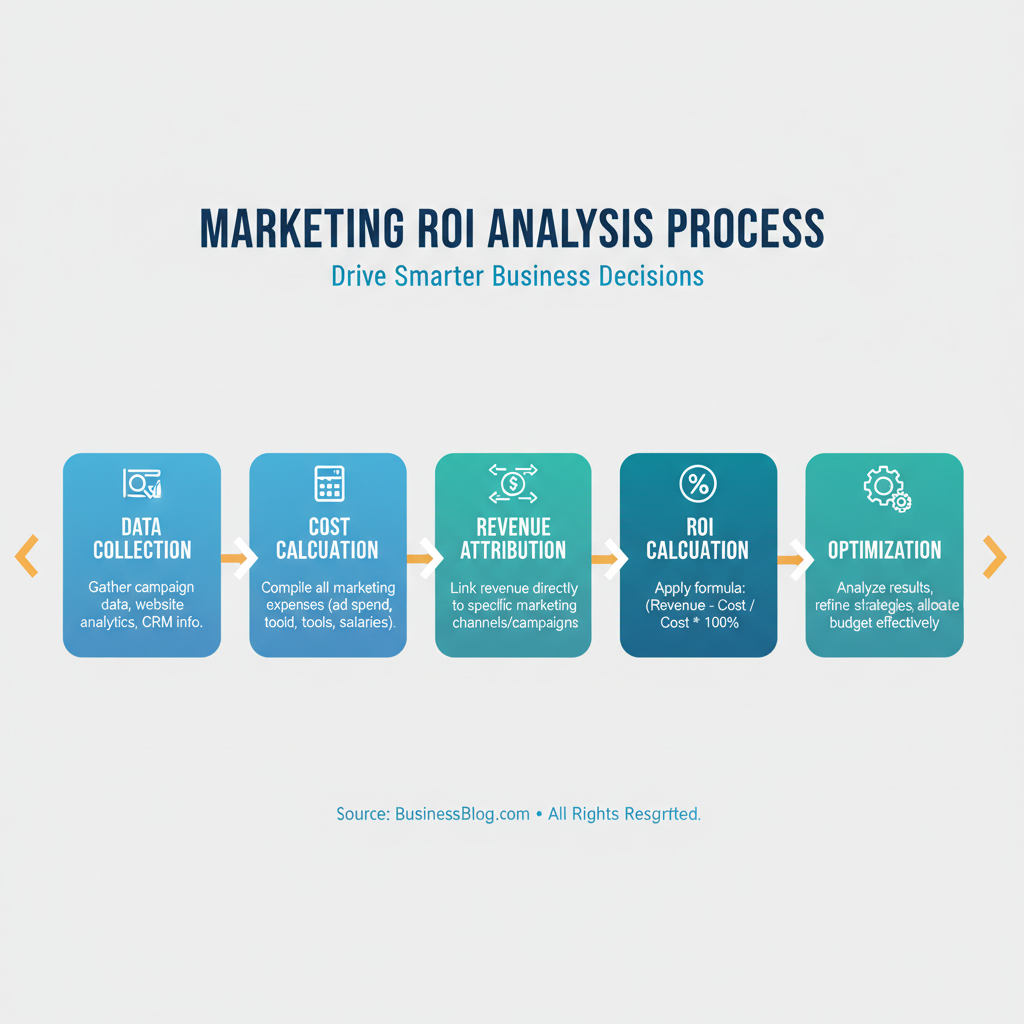
Effective ROI analysis is a continuous cycle, not a one-time calculation
The Marketing ROI Formula (And Why It's More Complex Than You Think)
The basic marketing ROI formula looks straightforward:
Marketing ROI = ((Revenue from Marketing - Marketing Cost) / Marketing Cost) × 100
If you spend $10,000 on a campaign that generates $50,000 in revenue, your ROI is 400%. For every dollar spent, you earned four dollars back.
Simple, right? Not quite.
The Attribution Problem
That $50,000 in revenue didn't appear out of thin air. The customer who converted likely interacted with multiple marketing touchpoints before purchasing. They might have:
- Clicked a paid search ad
- Read a blog post from organic search
- Received a retargeting display ad
- Opened a promotional email
- Finally converted through a direct visit
Which activity gets credit? Last-click attribution gives it all to the direct visit. But would that conversion have happened without steps 1-4?
This attribution problem is why marketing ROI analysis requires more than a calculator. It requires frameworks that account for the full customer journey.
The Incrementality Question
Even accurate attribution doesn't tell you whether your marketing caused those sales. Some customers would have converted anyway—through direct searches, word-of-mouth, or brand recognition built over years.
True marketing ROI analysis measures incremental impact: the sales that happened because of your marketing, not just the sales that your marketing touched.
According to Nielsen's ROI Report, brands overestimate their marketing ROI by an average of 47% when they don't account for incrementality. That's a dangerous gap between perceived and actual performance.
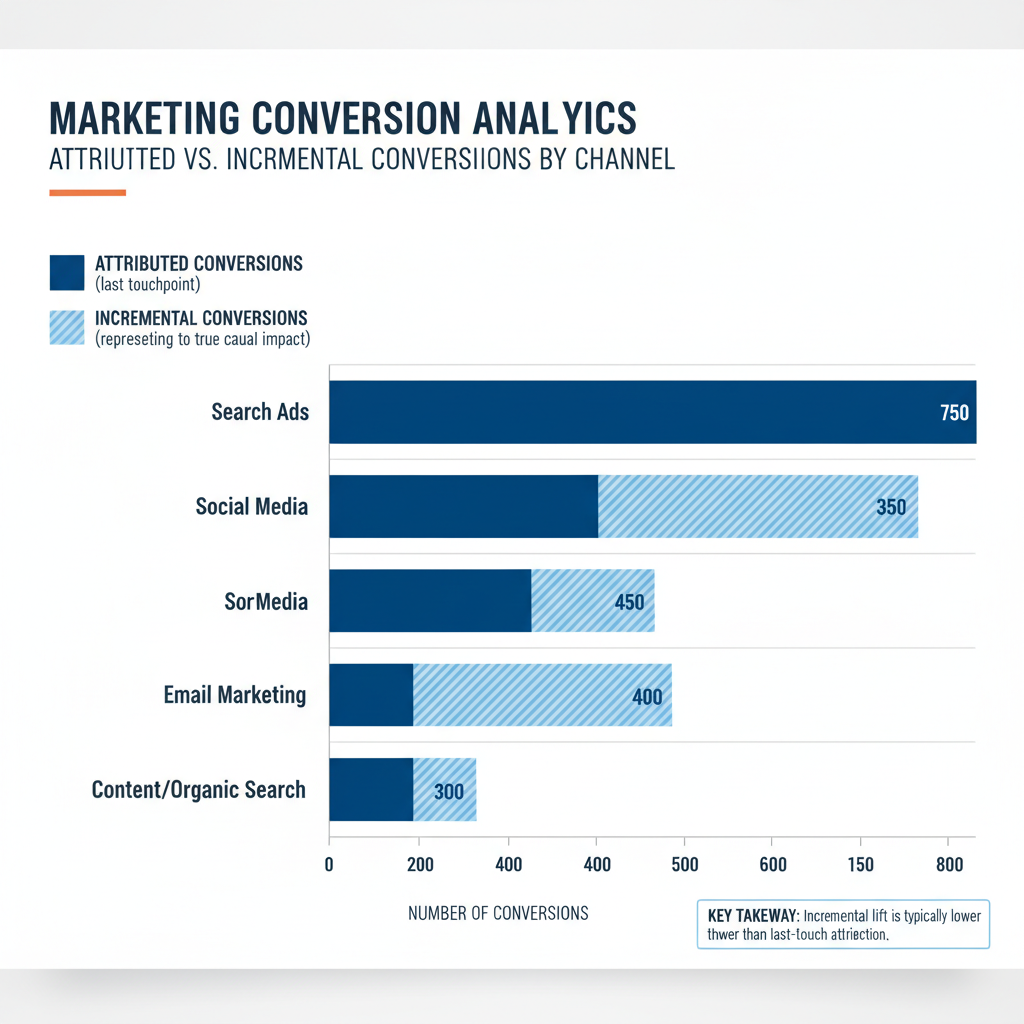
Attributed conversions often overstate true marketing impact by 30-50%
Advanced Marketing ROI Analysis Methods
Basic ROI calculations work for isolated campaigns with clear conversions. But modern marketing requires more sophisticated approaches.
Multi-Touch Attribution Models
Multi-touch attribution distributes conversion credit across all touchpoints in the customer journey. Common models include:
| Model | How It Works | Best For |
|---|---|---|
| Linear | Equal credit to all touchpoints | Understanding full journey |
| Time Decay | More credit to recent touchpoints | Short sales cycles |
| Position-Based | 40% first, 40% last, 20% middle | Balanced view |
| Data-Driven | Algorithmic credit assignment | High-volume data scenarios |
Each model produces different ROI calculations for the same campaigns. A channel that looks unprofitable under last-click might show strong returns with linear attribution. The "right" model depends on your business context and customer journey complexity.
For guidance on selecting attribution models, our marketing effectiveness measurement guide covers the tradeoffs in detail.
Media Mix Modeling for ROI Analysis
Media mix modeling (MMM) takes a fundamentally different approach to marketing ROI analysis. Instead of tracking individual users, MMM analyzes aggregate data to understand how marketing inputs correlate with business outputs over time.
MMM excels at:
- Measuring offline channels like TV, radio, and out-of-home advertising
- Capturing long-term brand effects that attribution misses
- Operating without user-level tracking (privacy-compliant by design)
- Revealing cross-channel interactions and synergies
The tradeoff is that MMM requires 12-18 months of historical data and takes longer to implement. But for companies with substantial offline media investments, it's often the only way to get accurate ROI figures.
Incrementality Testing
Holdout testing provides the gold standard for measuring true marketing impact. By deliberately withholding marketing from a randomized control group, you can measure the difference in outcomes between exposed and unexposed audiences.
Common incrementality testing approaches:
- Geo-lift studies: Compare performance in test markets (with marketing) vs. control markets (without)
- Audience holdouts: Withhold campaigns from a percentage of your target audience
- Matched market testing: Compare similar geographic regions with different marketing treatments
HubSpot's 2024 State of Marketing Report found that only 23% of marketing teams conduct regular incrementality testing—despite it being the most accurate way to measure true ROI. This represents a significant opportunity for competitive advantage.
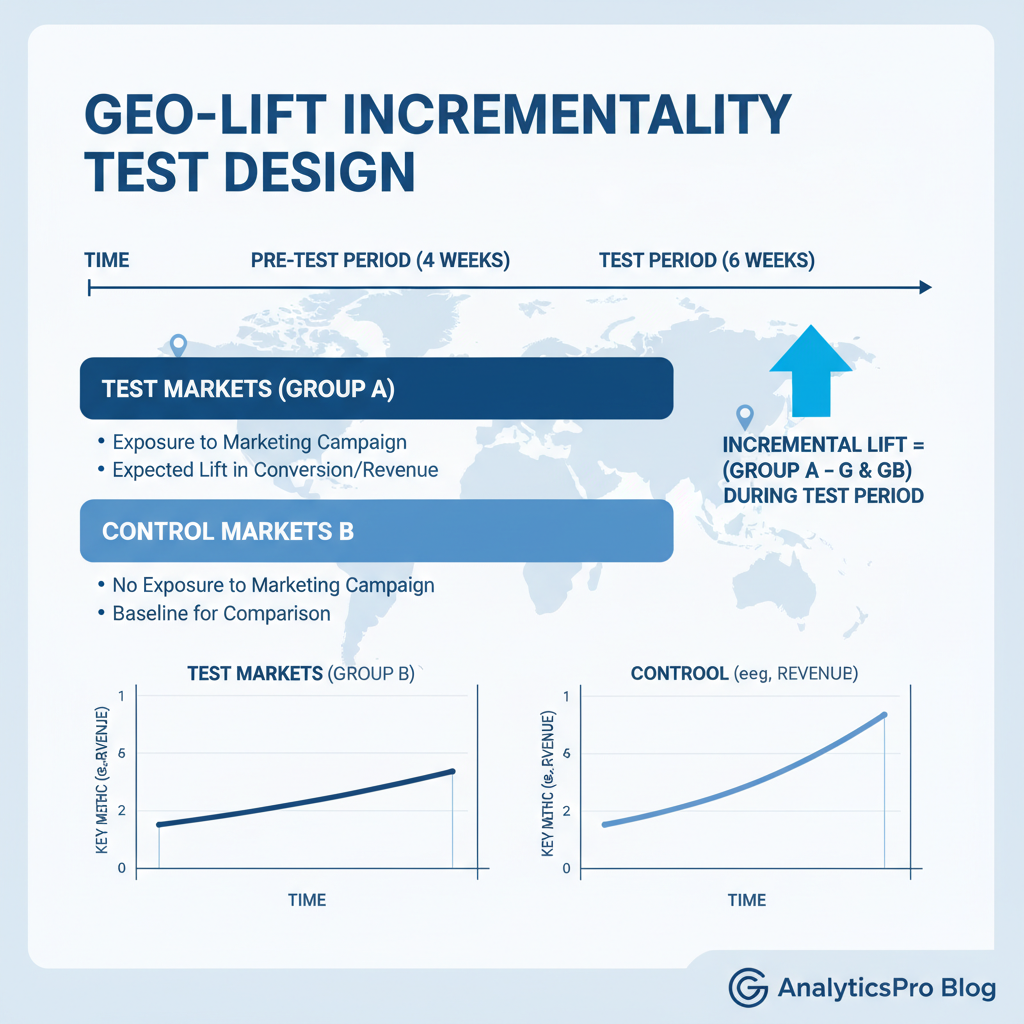
Incrementality testing reveals true lift by comparing exposed vs. unexposed groups
Building Your Marketing ROI Analysis Framework
Step 1: Define What You're Measuring
Not all marketing activities serve the same purpose. Brand campaigns build awareness over months or years. Direct response campaigns drive immediate conversions. Retention marketing prevents churn. Each requires different ROI measurement approaches.
Clarify your measurement objectives:
- What business outcome matters most? (Revenue, leads, brand awareness, retention)
- What time horizon makes sense? (Weekly, monthly, quarterly, annually)
- What costs should be included? (Media spend, creative production, agency fees, technology)
Our MMM readiness checklist walks through the complete data requirements for comprehensive ROI analysis.
Step 2: Establish Accurate Cost Tracking
You can't calculate ROI without knowing what you spent. This sounds obvious, but many organizations struggle with comprehensive cost accounting.
Costs to include:
- Media spend (advertising, sponsorships, paid placements)
- Creative production (design, video, copywriting)
- Technology (analytics platforms, automation tools, data management)
- Personnel (salaries, contractors, agency fees)
- Overhead allocation (office space, management time)
The level of detail depends on your analysis goals. Campaign-level ROI might only need media costs. Portfolio-level ROI should include all marketing expenses.
Step 3: Connect Marketing to Business Outcomes
This is where most ROI analysis breaks down. Connecting marketing activities to revenue requires robust tracking infrastructure and clear attribution logic.
Essential requirements:
- Unified customer IDs across touchpoints
- Consistent conversion tracking and definitions
- Integration between marketing platforms and revenue systems
- Clear rules for handling multi-touch journeys
The preparation tips on our site cover the technical infrastructure needed to connect marketing data to business outcomes.
Step 4: Calculate and Interpret Results
With clean data and clear methodology, ROI calculations become straightforward. But interpretation requires context.
Benchmark questions to ask:
- How does this ROI compare to previous periods?
- How does it compare to industry benchmarks?
- Is this ROI sustainable, or driven by one-time factors?
- What would happen if we scaled this activity?
According to Marketing Evolution research, a 5:1 ROI (earning $5 for every $1 spent) is considered good performance. A 10:1 ratio is exceptional. Below 2:1 may not be profitable after accounting for overhead costs.
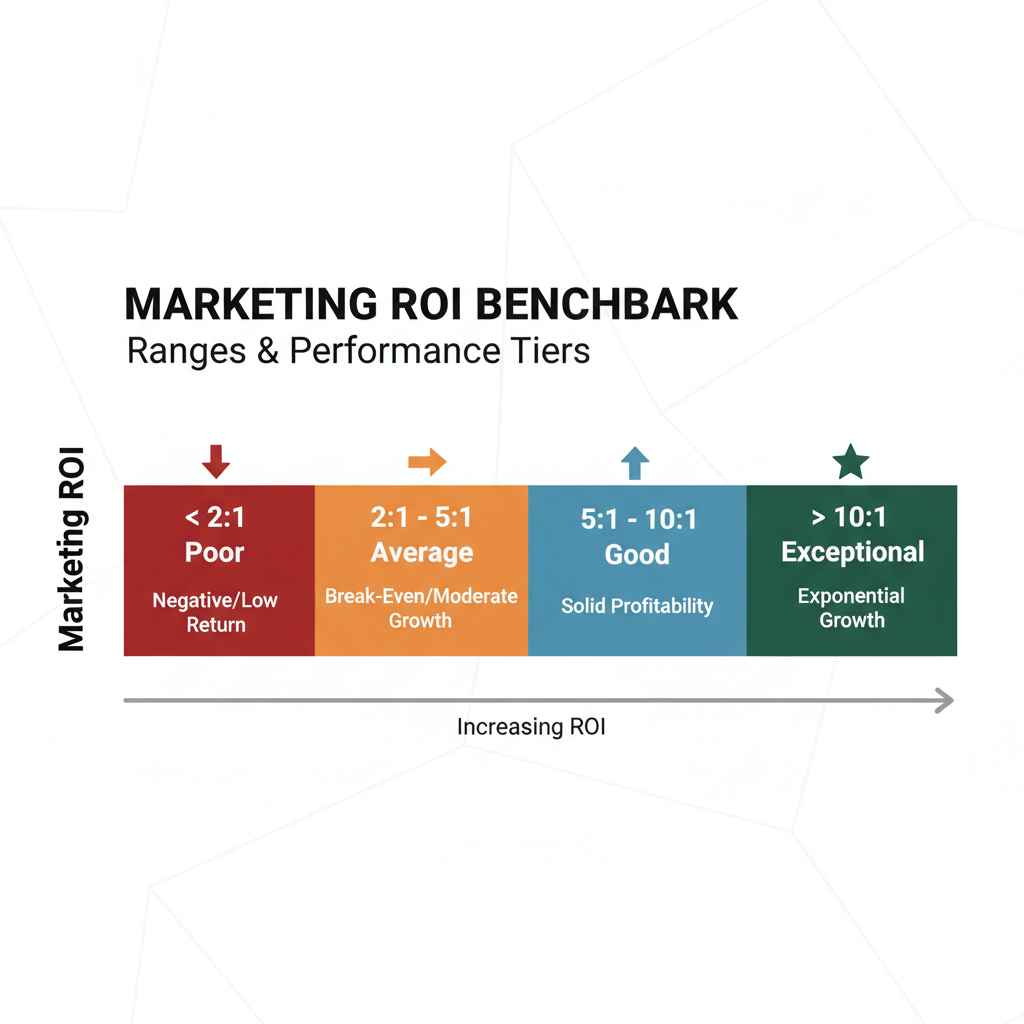
Industry benchmarks help contextualize your ROI performance
Common Marketing ROI Analysis Mistakes
Ignoring Long-Term Effects
Brand marketing doesn't convert immediately. A TV campaign today might influence purchases six months from now. Short-term ROI analysis systematically undervalues awareness-building activities—leading to underinvestment in brand and overinvestment in bottom-funnel tactics.
Confusing Correlation with Causation
Your paid search campaigns might show incredible ROI—but are those customers converting because of the ads, or were they already searching for your brand? Without incrementality testing, you can't separate genuine marketing lift from organic demand capture.
Optimizing Channels in Isolation
Cutting a "low-performing" channel without understanding its influence on other activities is dangerous. That Facebook campaign driving awareness might be why your Google brand search performs so well. Media mix modeling captures these cross-channel effects that single-channel ROI analysis misses.
Using Vanity Metrics as Proxies
Impressions, clicks, and engagement rates are not ROI. They're leading indicators at best. True marketing ROI analysis connects activities to business outcomes—revenue, profit, customer lifetime value—not intermediate metrics.
Forgetting About Customer Lifetime Value
A campaign might lose money on first purchase but generate significant value over the customer lifetime. Marketing ROI analysis must incorporate CLV to avoid rejecting profitable acquisition strategies that look negative in the short term.
Frequently Asked Questions
How often should I calculate marketing ROI?
Monthly ROI reviews work for most organizations, with deeper quarterly analyses for strategic decision-making. Real-time ROI tracking sounds appealing but often introduces noise—marketing effects take time to materialize. Allow sufficient time horizons for signals to emerge before optimizing based on ROI data.
What's a good marketing ROI benchmark?
The standard benchmark is 5:1 (earning $5 for every $1 spent on marketing). Anything above 10:1 is exceptional. Below 2:1 typically isn't profitable after accounting for non-marketing costs. However, benchmarks vary significantly by industry, business model, and marketing objective. Brand campaigns may show lower short-term ROI but build long-term value.
How do I measure ROI for brand awareness campaigns?
Brand awareness campaigns require different measurement approaches than direct response. Use brand lift studies, search volume trends, and media mix modeling to capture long-term effects. Connect brand metrics to downstream outcomes like consideration, preference, and eventually conversion to build a complete ROI picture.
Should I use ROAS or ROI?
Return on Ad Spend (ROAS) measures revenue generated per advertising dollar. ROI measures profit generated per total marketing dollar. ROAS is simpler but ignores profit margins and non-media costs. ROI provides a more complete picture. Use ROAS for campaign-level optimization and ROI for strategic budget decisions.
How do I get executive buy-in for better ROI measurement?
Start with pilot programs that demonstrate clear value. Document methodology transparently. Frame recommendations in business terms (revenue, profit) rather than marketing metrics. When your improved measurement leads to better decisions—and those decisions produce results—credibility follows.
Conclusion
Marketing ROI analysis isn't optional anymore. In a world where every budget line faces scrutiny, the ability to prove marketing value separates thriving organizations from those constantly defending their existence.
Key takeaways:
- Basic ROI formulas are starting points, not endpoints—attribution and incrementality matter
- Different measurement methods suit different scenarios—use multiple approaches
- Long-term effects and cross-channel interactions require sophisticated analysis
- Industry benchmarks (5:1 as good, 10:1 as exceptional) provide context
- Avoiding common mistakes prevents costly misallocation
The gap between companies with strong ROI analysis capabilities and those without is widening. Those who invest in measurement infrastructure today gain compounding advantages as they make better decisions over time.
Start where you are. Use the MMM readiness checklist to assess your current measurement capabilities. Identify the biggest gaps between what you can measure today and what you need to optimize effectively. Build toward data-driven ROI analysis one step at a time.
The marketers who master this don't just survive budget discussions—they lead them.
Ready to improve your marketing ROI analysis? Take our readiness quiz to assess your measurement capabilities, or explore our preparation tips for guidance on building the data infrastructure that makes accurate ROI calculation possible.
Stay in the loop
Get updates on new posts and resources.