MTA vs MMM: Complete Guide to Marketing Attribution Methods
Compare multi-touch attribution (MTA) vs media mix modeling (MMM) to understand which approach delivers better marketing insights for your business.
Here's the question that keeps marketing leaders up at night: How do I know which channels actually drive results?
The MTA vs MMM debate represents two fundamentally different philosophies for answering that question. Multi-touch attribution (MTA) follows individual customer journeys across digital touchpoints. Media mix modeling (MMM) analyzes aggregate data to measure marketing impact at scale.
Both approaches measure marketing effectiveness. Neither is universally "better." The right choice depends on your channels, data capabilities, and what decisions you're trying to make.
According to Gartner's 2024 marketing analytics survey, organizations that use both methodologies together see 20-30% better marketing ROI than those relying on a single approach. The future isn't MTA or MMM—it's understanding when each excels and how they complement each other.
This guide breaks down the MTA vs MMM comparison, explains when to use each approach, and shows you how to build a unified measurement strategy that actually works.
What is Multi-Touch Attribution (MTA)?
Multi-touch attribution tracks individual customer interactions across digital touchpoints and assigns credit to each interaction that contributes to a conversion. It's the microscope of marketing measurement—detailed, precise, and focused on the customer journey.
Think of MTA like following a single customer through your marketing funnel. Sarah sees your Facebook ad on Monday, clicks a Google search ad on Wednesday, opens your email on Thursday, and purchases on Friday. MTA tracks that entire journey and distributes conversion credit across those touchpoints.
How MTA Works
MTA relies on user-level data to connect marketing interactions. When someone clicks an ad, visits your website, or opens an email, tracking pixels and cookies capture that interaction. Attribution platforms then stitch these touchpoints together to reconstruct the customer journey.
Common MTA models include:
- First-touch: 100% credit to the initial interaction (good for measuring awareness)
- Last-touch: 100% credit to the final touchpoint (good for conversion optimization)
- Linear: Equal credit across all touchpoints
- Time-decay: More credit to interactions closer to conversion
- U-shaped (position-based): 40% to first touch, 40% to last touch, 20% distributed across middle
- Data-driven: Machine learning algorithms determine credit distribution
The data-driven approach typically performs best, using statistical modeling to analyze thousands of conversion paths and identify which touchpoints most influence outcomes. Understanding these attribution model fundamentals helps you select the right approach for your business.
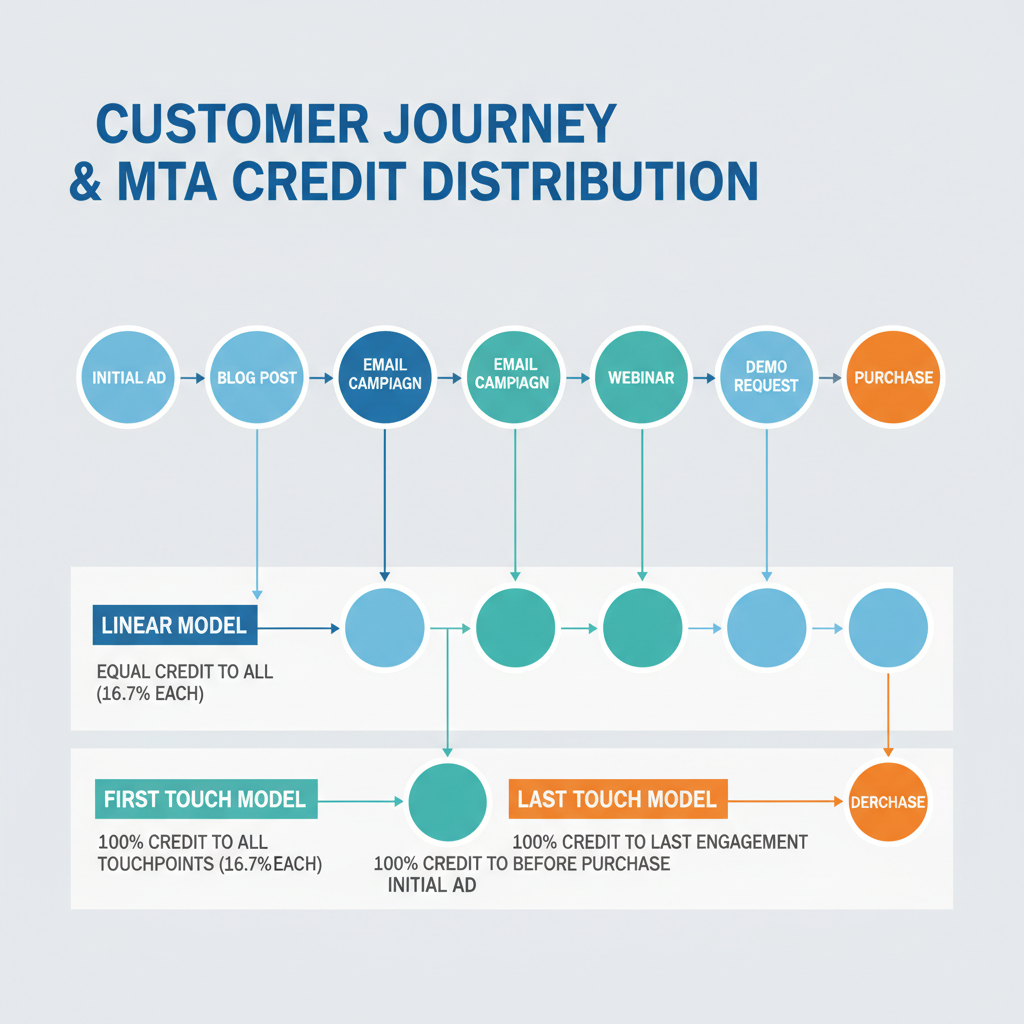
Multi-touch attribution distributes conversion credit across the customer journey
Strengths of Multi-Touch Attribution
Granular insights. MTA tells you exactly which campaigns, ads, and creative executions drive conversions. You can optimize at the keyword, placement, or audience level.
Real-time data. Attribution platforms provide near-instant feedback on campaign performance. You can adjust budgets and tactics within days or hours.
Digital precision. For digital-only businesses, MTA captures the complete customer journey across paid search, social, display, email, and direct traffic.
Individual-level personalization. Because MTA tracks individual users, it enables personalized remarketing and customer segmentation based on actual behavior.
Limitations of Multi-Touch Attribution
Digital blind spots. MTA struggles with offline channels. TV, radio, podcast ads, billboards, and direct mail don't generate trackable clicks. If a customer sees your TV spot and later searches your brand name, MTA credits the search ad—not the TV campaign that drove awareness.
Privacy regulations. GDPR, CCPA, and Apple's App Tracking Transparency have fundamentally disrupted MTA's tracking capabilities. According to AppsFlyer research, opt-in rates for iOS tracking hover around 30-40%, meaning MTA misses most mobile conversions.
Cookie deprecation. With third-party cookies disappearing across browsers, MTA's cross-site tracking ability continues eroding. Google's Privacy Sandbox represents the future, but cookieless attribution remains imprecise.
Short-term bias. MTA measures what it can see—typically 7-30 day attribution windows. Long-term brand building effects that influence purchase decisions months later go undetected.
Walled gardens. Facebook, Google, and Amazon each have their own attribution systems that don't talk to each other. Reconciling cross-platform journeys requires sophisticated identity resolution.
What is Media Mix Modeling (MMM)?
Media mix modeling takes the opposite approach. Instead of tracking individual customers, MMM analyzes aggregate data to understand how marketing activities influence business outcomes at scale.
Think of MMM like a telescope—it reveals the big picture of marketing performance across all channels, including those impossible to track at the user level. Our comprehensive media mix model guide covers the methodology in detail.
How MMM Works
MMM uses regression analysis and econometric techniques to isolate the incremental impact of each marketing channel on sales. By analyzing historical data—typically 2-3 years of weekly or monthly observations—these models identify statistical relationships between marketing inputs and business outputs.
Key components MMM analyzes:
- Marketing spend across all channels (digital and traditional)
- Sales/conversion data as the dependent variable
- External factors: seasonality, economic conditions, competitive activity
- Adstock effects: how advertising impact decays over time
- Saturation curves: diminishing returns at higher spending levels
Modern MMM incorporates Bayesian methods to quantify uncertainty in estimates. Research published by Meta demonstrates that Bayesian approaches produce more reliable insights than traditional regression.
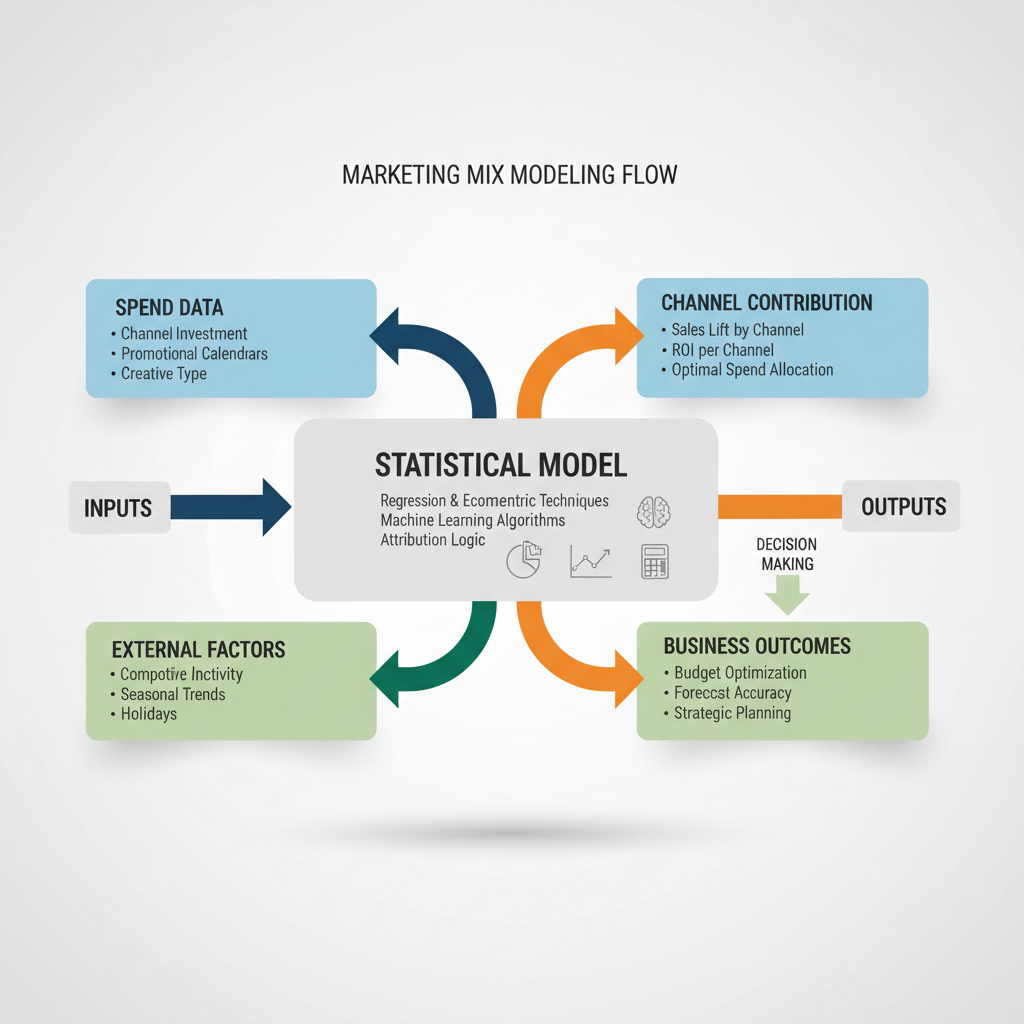
MMM analyzes aggregate data to measure marketing impact across all channels
Strengths of Media Mix Modeling
Holistic measurement. MMM captures all channels—including TV, radio, podcast, outdoor, and sponsorships that MTA can't track. For brands with significant traditional media investment, this matters enormously.
Privacy-compliant. Because MMM works with aggregate data, it doesn't require user-level tracking. No cookies, no consent banners, no privacy concerns. This makes MMM increasingly valuable as privacy regulations tighten.
Strategic perspective. MMM reveals long-term brand building effects that short-window attribution misses. A brand campaign might not drive immediate conversions but significantly increases conversion rates six months later.
Budget optimization. By understanding each channel's marginal ROI and saturation curve, MMM enables optimal budget allocation across your marketing mix.
Incrementality measurement. Done properly, MMM measures incremental impact—what marketing actually caused—rather than correlative activity that might have happened anyway.
Limitations of Media Mix Modeling
Data requirements. MMM needs 2-3 years of historical data to account for seasonality and achieve statistical significance. New brands or those lacking historical records face significant hurdles.
Update frequency. Traditional MMM models are refreshed quarterly or annually. This lag means you can't optimize campaigns in real-time based on MMM insights.
Channel granularity. While MMM reveals that "paid social works," it typically can't tell you which specific campaigns or audiences drive performance. That granularity requires different methods.
Technical complexity. Building valid MMM models requires statistical expertise. Poor model specification leads to misleading results that damage marketing effectiveness.
New channel challenges. MMM struggles with emerging channels that lack historical data. If you just launched TikTok advertising, MMM can't immediately quantify its impact.
MTA vs MMM: Key Differences at a Glance
The MTA vs MMM debate ultimately comes down to different measurement philosophies optimized for different use cases.
| Dimension | Multi-Touch Attribution (MTA) | Media Mix Modeling (MMM) |
|---|---|---|
| Data level | Individual user | Aggregate |
| Channels covered | Digital only | All channels |
| Time horizon | Real-time to weekly | Monthly to yearly |
| Primary use | Tactical optimization | Strategic planning |
| Privacy impact | High (requires tracking) | Low (aggregate data) |
| Historical data needed | 90 days | 2-3 years |
| Granularity | Campaign/ad level | Channel level |
| Technical complexity | Moderate | High |
| Best for | Digital-first brands | Omnichannel marketers |
Neither approach is superior—they answer different questions. Understanding which MMM approach fits your needs helps you build the right measurement foundation.
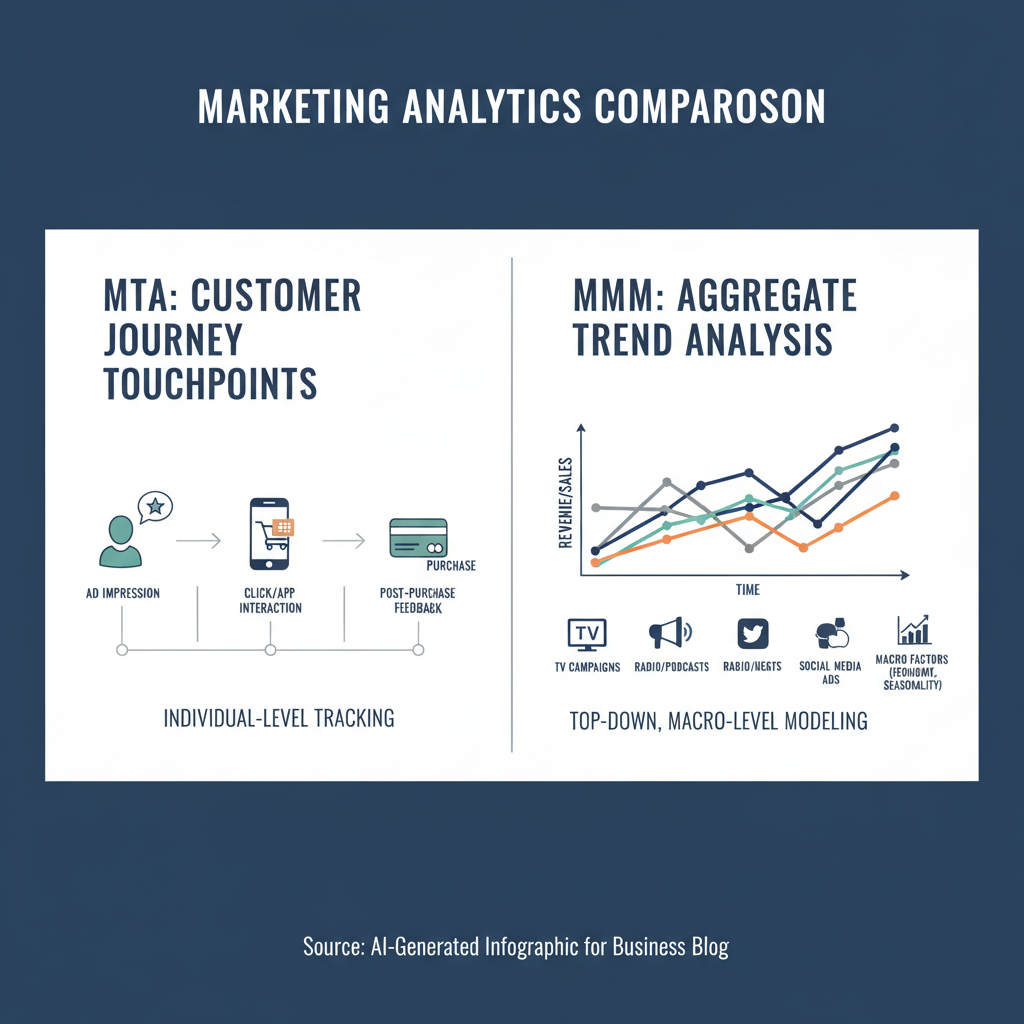
MTA and MMM measure marketing effectiveness from opposite perspectives
When to Use MTA vs MMM
The right approach depends on your specific situation. Here's when each method excels:
Use MTA When:
Your marketing is primarily digital. If 80%+ of your budget goes to trackable digital channels, MTA captures most of your marketing activity effectively.
You need rapid optimization. Launching new campaigns that require quick iteration? MTA's real-time feedback loop enables agile testing and adjustment.
Granularity matters. Optimizing specific ad creative, audiences, or placements requires the campaign-level detail MTA provides.
You're focused on bottom-funnel conversions. For performance marketing where every click matters, MTA helps maximize short-term ROI.
Use MMM When:
You invest in traditional media. TV, radio, podcast, and outdoor advertising require MMM to measure accurately. There's no other way to quantify their impact.
Privacy restrictions limit tracking. Operating in highly regulated industries or regions with strict privacy laws? MMM works without user consent.
You want to understand long-term effects. Brand campaigns influence purchase decisions over months or years. Only MMM captures these delayed effects.
Strategic budget allocation is the goal. Deciding how to distribute next year's budget across channels? MMM provides the strategic framework for optimizing your marketing ROI.
Use Both When:
You're an omnichannel marketer. The majority of sophisticated marketers need both perspectives to make complete decisions.
Accuracy matters most. Cross-validating MTA against MMM results catches errors in both approaches.
You need tactical and strategic insights. MTA optimizes campaigns daily; MMM guides annual planning. You need both time horizons.
Building a Unified Measurement Strategy
Here's what leading marketing organizations have figured out: the MTA vs MMM choice is a false dichotomy. The real answer is unified marketing measurement (UMM) that combines both approaches.
How Unified Measurement Works
Unified measurement integrates MTA and MMM to leverage their complementary strengths:
-
MMM sets the strategic framework. Quarterly MMM analysis determines optimal budget allocation across channels and identifies long-term brand effects.
-
MTA optimizes within channels. Once MMM allocates budget to "paid social," MTA determines which campaigns, audiences, and creative perform best within that allocation.
-
Cross-validation improves accuracy. When MTA and MMM disagree about a channel's performance, that discrepancy triggers investigation. Often, it reveals tracking gaps or model specification errors.
-
Incrementality testing calibrates both. Geo-holdout experiments and randomized controlled trials provide ground truth that validates and improves both MTA and MMM.
According to Nielsen's marketing ROI research, brands using unified measurement see 15-25% improvements in marketing efficiency compared to those relying on single methodologies.
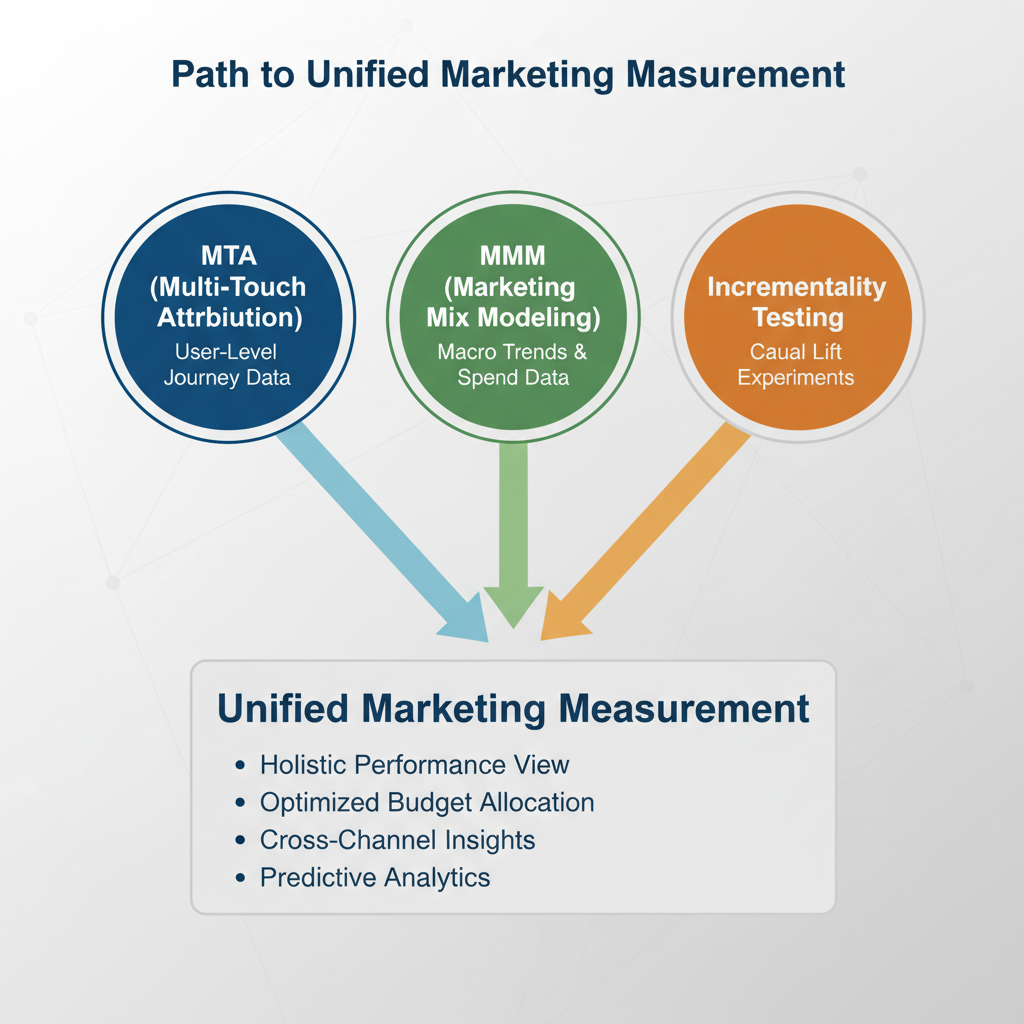
Unified measurement combines multiple methodologies for comprehensive insights
Implementation Roadmap
Phase 1: Foundation (Month 1-3)
- Audit existing attribution capabilities
- Centralize marketing spend data
- Establish data quality standards
- Select measurement partners or build internal capabilities
Phase 2: MMM Development (Month 3-6)
- Collect and prepare historical data
- Build and validate initial MMM models
- Generate baseline channel contribution estimates
Phase 3: MTA Integration (Month 4-7)
- Implement or upgrade attribution platform
- Configure multi-touch models across digital channels
- Establish reporting dashboards
Phase 4: Unification (Month 6-9)
- Reconcile MTA and MMM outputs
- Develop calibration processes
- Design incrementality testing programs
- Train stakeholders on unified insights
Our MMM checklist provides detailed preparation guidance for getting started.
The Privacy-First Future of Marketing Measurement
Cookie deprecation and privacy regulations have permanently shifted the MTA vs MMM calculus toward MMM. Here's why:
MTA's tracking foundations are eroding. Third-party cookies blocked. Apple limiting IDFA access. Consent rates declining. The user-level data MTA requires becomes scarcer every year.
MMM's privacy-compliant design gains importance. Because MMM never tracks individuals, it's immune to privacy restrictions. As regulations tighten globally, MMM's relative value increases.
New hybrid approaches emerge. Privacy-preserving techniques like differential privacy, federated learning, and aggregated measurement APIs (Google's Privacy Sandbox) attempt to bridge the gap. But they sacrifice granularity for privacy.
Marketing Week research indicates that 67% of senior marketers now prioritize privacy-compliant measurement approaches over user-level tracking.
For a deep dive into how MMM addresses privacy concerns while maintaining measurement accuracy, see our marketing effectiveness guide.
Frequently Asked Questions
What's the main difference between MTA and MMM?
MTA tracks individual customer journeys across digital touchpoints and assigns conversion credit to specific interactions. MMM analyzes aggregate data to measure marketing impact across all channels, including offline media. MTA provides granular, real-time optimization insights for digital campaigns. MMM delivers strategic perspective on total marketing performance and long-term brand effects. Most sophisticated organizations use both approaches together for complete marketing measurement.
Can I use MTA without cookies or device IDs?
Increasingly difficult. MTA fundamentally relies on connecting touchpoints to individual users. Without cookies or device identifiers, attribution platforms can't reconstruct customer journeys. First-party data strategies (logged-in users, CRM integration) partially compensate. Probabilistic matching provides estimates but with lower accuracy. The trend favors MMM and aggregate measurement approaches that don't require individual tracking.
How much historical data do I need for MMM?
Minimum 2 years, ideally 3+ years of weekly or monthly data. This timeframe is necessary to capture seasonal patterns, account for year-over-year variation, and achieve statistical significance in your model estimates. With less data, consider Bayesian MMM approaches that incorporate prior information to compensate for sparse observations. Our preparation guide details specific data requirements.
Which approach is more accurate—MTA or MMM?
Neither is inherently more accurate. Accuracy depends on your channels, data quality, and model specification. MTA excels at measuring trackable digital interactions but misses offline channels and faces privacy limitations. MMM captures all channels but lacks campaign-level granularity. The most accurate measurement combines both approaches and validates results with incrementality testing. Research from the Marketing Accountability Standards Board shows unified measurement outperforms single-methodology approaches.
How do I know if my current attribution is working?
Signs your attribution may be misleading: conflicting signals across platforms, performance that doesn't match business results, over-reliance on single models, inability to measure offline channels, declining data availability due to privacy changes. Test your attribution by running controlled experiments (geo-holdouts, incrementality tests) and comparing results to your attribution models. Significant discrepancies indicate measurement problems requiring attention.
Is MMM only for large enterprises?
Not anymore. Traditional MMM required expensive consultants and extensive resources. Modern open-source frameworks (Meta Robyn, Google Meridian) and specialized platforms make MMM accessible to mid-market companies with $1M+ annual marketing spend. The barrier is now data availability and analytical capability rather than budget. Companies spending significant amounts on traditional media particularly benefit from MMM regardless of size.
Conclusion
The MTA vs MMM debate misses the point. Both methodologies solve important but different measurement problems.
MTA delivers:
- Granular insights for digital campaign optimization
- Real-time feedback for agile marketing
- Individual-level data for personalization
- Campaign and ad-level performance measurement
MMM provides:
- Holistic measurement across all channels
- Privacy-compliant insights without user tracking
- Strategic perspective for budget allocation
- Long-term brand effect measurement
The right approach for you depends on:
- Your channel mix (digital-heavy vs. omnichannel)
- Your data capabilities and technical resources
- Your measurement objectives (tactical vs. strategic)
- Your privacy and regulatory constraints
For most marketers, the answer isn't MTA or MMM—it's building unified measurement capabilities that leverage both approaches. Start with the methodology that addresses your most pressing measurement gaps, then expand to cover blind spots.
Where to start:
If you're digital-focused and need immediate optimization insights, strengthen your MTA capabilities first. If you invest significantly in traditional media or face privacy constraints, prioritize MMM implementation.
Either way, the goal is the same: understanding which marketing investments actually drive business results—and having the confidence to act on those insights.
Ready to assess your measurement capabilities? Take our readiness quiz or download our MMM checklist for detailed implementation guidance. For organizations wanting expert support building unified measurement programs, BlueAlpha.ai combines MMM, incrementality testing, and AI-powered optimization into a comprehensive platform designed for marketing teams serious about measurement accuracy.
Stay in the loop
Get updates on new posts and resources.