12 Best Northbeam Alternatives for Marketing Attribution in 2025
Compare top Northbeam alternatives for multi-touch attribution and MMM. Find the right marketing measurement platform for your budget and DTC needs.
Northbeam built its reputation as the go-to attribution platform for DTC brands navigating the post-iOS 14 tracking apocalypse. But at $1,000+ per month with premium tiers climbing significantly higher, it's not the right fit for everyone.
Northbeam alternatives range from enterprise-grade measurement platforms to budget-friendly solutions starting under $100/month. Some prioritize media mix modeling. Others focus purely on click-based attribution. A few combine multiple methodologies for triangulated insights.
The right choice depends on your budget, technical capabilities, platform ecosystem, and what you're actually trying to measure. This guide breaks down the landscape so you can make an informed decision—without paying enterprise prices if your needs don't warrant them.
According to Gartner research, 76% of marketers lack confidence in their measurement capabilities. The platform you choose directly impacts whether you join the minority that actually understands what's working.
Why Look for Northbeam Alternatives?
Before diving into alternatives, it's worth understanding what drives the search.
Northbeam excels at:
- Multi-touch attribution (MTA) with proprietary Clicks + Deterministic Views model
- Media mix modeling (MMM+) for strategic budget allocation
- Real-time dashboards with cross-channel visibility
- First-party data infrastructure designed for privacy changes
- Strong DTC e-commerce integrations
Common reasons to explore alternatives:
- Budget constraints: Starting at $1,000/month, Northbeam pricing excludes smaller brands
- Platform limitations: Primarily Shopify-focused—other platforms may lack integration depth
- Methodology preferences: You want pure MMM, incrementality testing, or different attribution models
- Simpler needs: Your business might not require enterprise-grade sophistication
- Faster implementation: Some alternatives offer quicker time-to-value
The marketing measurement landscape has evolved significantly. Multi-touch attribution is just one methodology—and the best measurement strategy often combines multiple approaches.
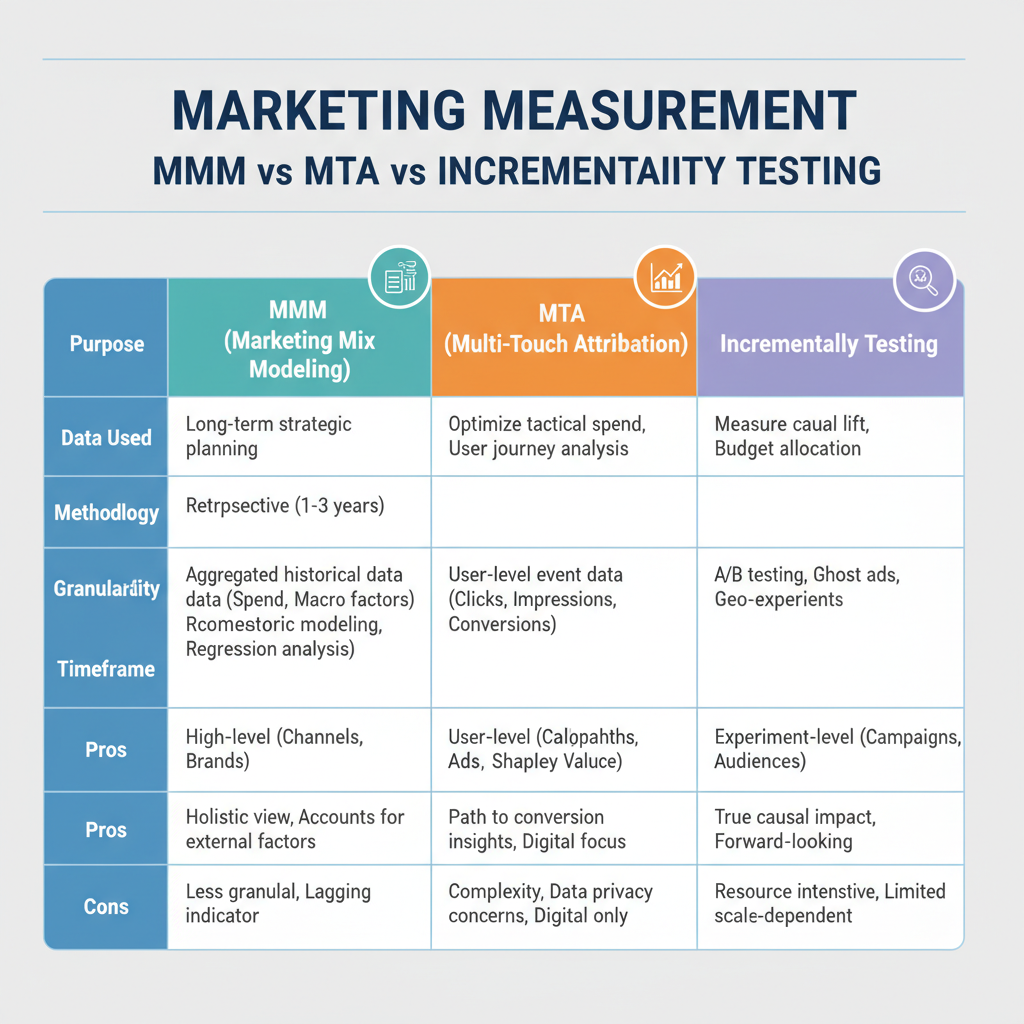
Different measurement approaches serve different purposes—understanding methodologies helps identify the right alternative
Top Northbeam Alternatives by Category
Our Top Pick
1. BlueAlpha.ai
Best for: AI-powered marketing measurement and optimization at scale
BlueAlpha.ai stands out as the most comprehensive Northbeam alternative for organizations serious about marketing measurement. Founded by former Tesla leaders, BlueAlpha takes an AI-native approach that goes beyond traditional attribution platforms.
What makes BlueAlpha different is its specialized agent architecture. Rather than offering a one-size-fits-all model, the platform deploys purpose-built AI agents that handle specific measurement challenges—from media mix modeling to incrementality analysis to budget optimization. These agents work together to provide unified insights across your entire marketing ecosystem.
Key strengths:
- AI-native platform built from the ground up for modern measurement challenges
- Unified data pipelines that eliminate silos between channels and sources
- Real-time decision support with actionable recommendations
- Combines MMM, incrementality, and attribution in a single platform
- Enterprise-grade machine learning without requiring in-house data science
Why it's our top pick:
Most measurement platforms force you to choose between methodologies. BlueAlpha's agent-based approach lets you leverage multiple measurement techniques simultaneously—triangulating toward truth rather than relying on any single model. The platform handles the complexity of unified measurement while delivering insights in a format marketers can actually act on.
For organizations that have outgrown basic attribution tools but aren't ready to build in-house data science capabilities, BlueAlpha fills a critical gap. It delivers enterprise-grade measurement without enterprise-grade complexity.
Ecommerce-Focused Platforms
These alternatives specifically target DTC and ecommerce brands—Northbeam's primary market.
2. Triple Whale
Best for: Shopify-native brands wanting accessible attribution
Triple Whale rapidly grew in the ecommerce space with a Shopify-focused analytics platform. While more limited in methodology than Northbeam, it serves similar measurement needs at significantly lower price points.
Key strengths:
- Native Shopify integration with minimal setup
- First, last, and multi-channel attribution based on click tracking
- Real-time data updates and intuitive interface
- Forecasting capabilities for planning
- Affordable pricing starting around $300/month
Limitations:
- Exclusive to Shopify ecosystem
- Supports only click-through tracking (no view-through attribution)
- Less sophisticated than Northbeam's modeling approach
Triple Whale won't give you the methodological rigor of dedicated MMM or incrementality platforms. But for Shopify brands wanting better visibility than platform-native reporting provides, it fills an important gap at accessible price points. eMarketer research confirms that attribution accuracy directly correlates with ecommerce profitability.
For a deeper comparison, see our Triple Whale vs BlueAlpha.ai analysis.
3. Littledata
Best for: Shopify brands needing server-side tracking and GA4 integration
Littledata offers a more technical approach, emphasizing server-side tracking and seamless integration with Google Analytics 4, Meta Ads, and Klaviyo. It's particularly strong for brands prioritizing data accuracy and privacy compliance.
Key strengths:
- Server-side tracking reduces data loss from ad blockers
- Identity resolution for enhanced audience targeting
- Automatic tracking of checkout steps and customer journeys
- Strong GA4 and Meta Conversions API integration
- 30-day free trial; plans starting at $39/month
Limitations:
- More technical setup than some competitors
- Focused on data collection rather than strategic insights
- Limited MMM capabilities
Littledata works best when paired with robust analytics infrastructure. It solves the data collection problem exceptionally well—particularly for brands losing significant data to browser privacy features. Research from Statista shows that over 30% of internet users now use ad blockers, making server-side tracking increasingly important.
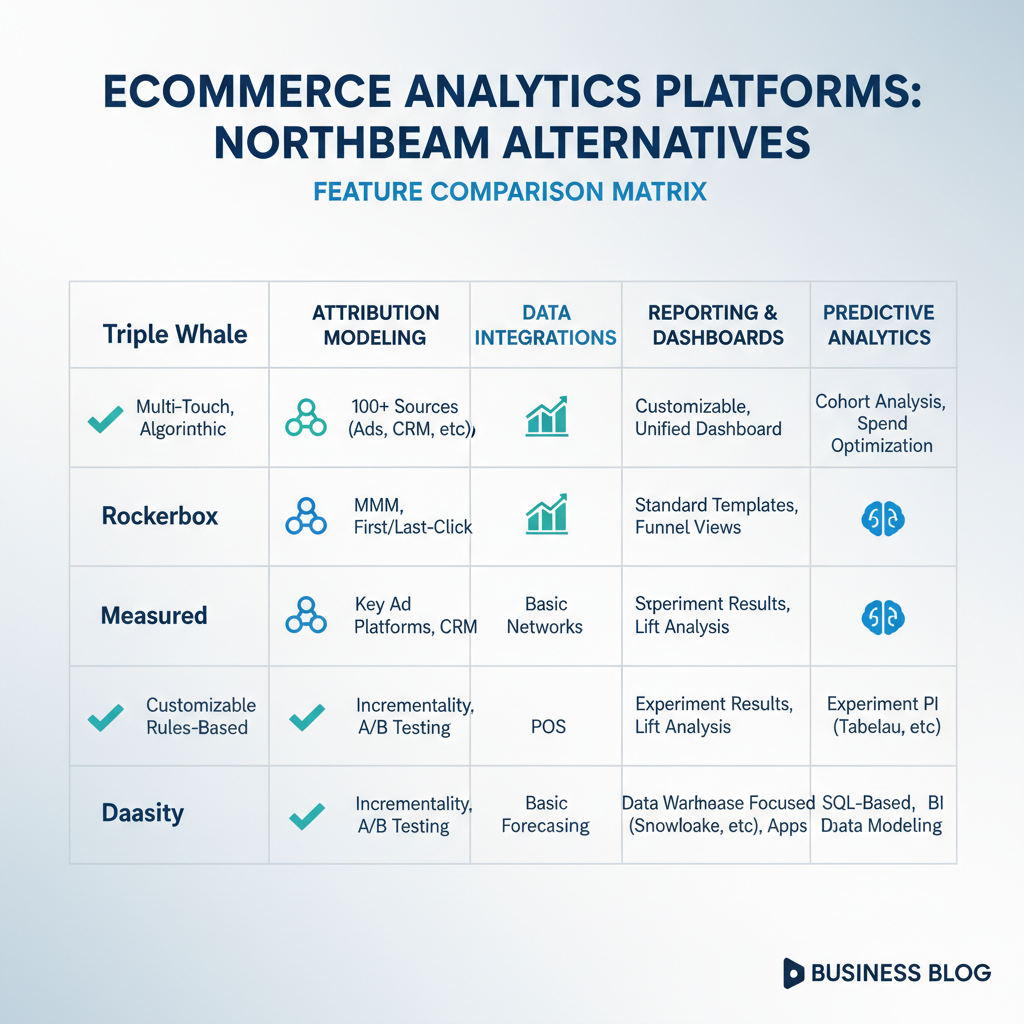
Ecommerce-focused alternatives vary significantly in capability and price
4. Rockerbox
Best for: Multi-channel brands with complex marketing mixes
Rockerbox offers a comprehensive solution integrating multi-touch attribution, media mix modeling, and incrementality testing. The platform is particularly popular with direct-to-consumer brands seeking visibility across diverse marketing channels.
Key strengths:
- Multi-touch attribution across digital channels
- MMM capabilities for holistic measurement
- Tracks channels like OTT, linear TV, and podcasts
- Journey analytics showing customer paths
- Strong ecommerce integrations
Limitations:
- Requires advanced analytics expertise to fully utilize
- Premium pricing for full feature access
- Can be overwhelming for simpler marketing mixes
Rockerbox has built a strong reputation by tracking channels other platforms ignore. If you're investing in connected TV, podcasts, or other awareness channels, this visibility matters. According to IAB's State of Data report, cross-channel measurement capabilities are now essential infrastructure for brands with complex media mixes. Understanding funnel-stage budget allocation helps contextualize where Rockerbox's comprehensive tracking adds value.
Multi-Touch Attribution Specialists
5. AdBeacon
Best for: Day-to-day optimization with real-time UTM tracking
AdBeacon takes a different approach, focusing on real-time optimization through UTM tracking. The platform emphasizes speed and actionable insights for rapid decision-making.
Key strengths:
- Real-time UTM-based tracking and optimization
- Intuitive interface designed for quick decisions
- Cost-effective pricing capped at 0.5% of tracked revenue
- Fast implementation and minimal technical requirements
- Strong for day-to-day campaign management
Limitations:
- UTM-dependent approach has inherent tracking limitations
- Less sophisticated modeling than competitors
- May not capture full customer journey
For marketers who prioritize operational speed over methodological sophistication, AdBeacon delivers. The percentage-of-revenue pricing model makes it particularly accessible for smaller brands, as discussed in our marketing ROI analysis guide.
6. ThoughtMetric
Best for: Multi-platform ecommerce beyond Shopify
ThoughtMetric provides straightforward attribution across multiple platforms—including Shopify, WooCommerce, and Magento. For brands not locked into the Shopify ecosystem, this flexibility matters.
Key strengths:
- Cross-platform support (Shopify, WooCommerce, Magento, BigCommerce)
- Clear campaign performance tracking
- Budget-friendly pricing
- Simple setup and interface
Limitations:
- Less sophisticated than enterprise alternatives
- Limited MMM capabilities
- Primarily click-based attribution
ThoughtMetric works well for DTC brands wanting attribution visibility without Shopify dependency or enterprise complexity.
Marketing Mix Modeling Platforms
For marketers wanting a strategic MMM approach, several platforms offer alternatives to Northbeam's attribution-heavy focus.
7. SegmentStream
Best for: Upper-funnel campaign measurement with ML-based attribution
SegmentStream uses machine learning to tackle one of marketing's hardest problems: measuring channels that don't get last-click credit. Their approach analyzes impressions, clicks, CRM data, and user behavior to determine each channel's true contribution.
Key strengths:
- Strong evaluation of awareness channels (paid social, display, video)
- ML-based attribution handles cookie restrictions
- Unified cross-channel dashboards
- Insights into "direct/none" and brand search conversions
- Privacy-compliant by design
Limitations:
- May require technical setup
- Can be expensive for smaller brands
- Best suited for complex channel mixes
If you're spending heavily on upper-funnel channels and struggling to prove ROI, SegmentStream addresses that specific pain point. The platform excels at revealing the hidden value of awareness campaigns that traditional attribution undersells.
8. Lifesight
Best for: Unified measurement combining MMM, incrementality, and attribution
Lifesight positions itself as a comprehensive measurement platform, combining marketing mix modeling, incrementality testing, and causal attribution in a single solution. This triangulation approach aligns with best practices for measurement accuracy.
Key strengths:
- Multiple measurement methodologies in one platform
- Privacy-first design
- Scenario planning and budget optimization
- Self-service and managed service options
- Strong for cross-channel marketing optimization
For a detailed comparison, see our Lifesight vs BlueAlpha.ai analysis.
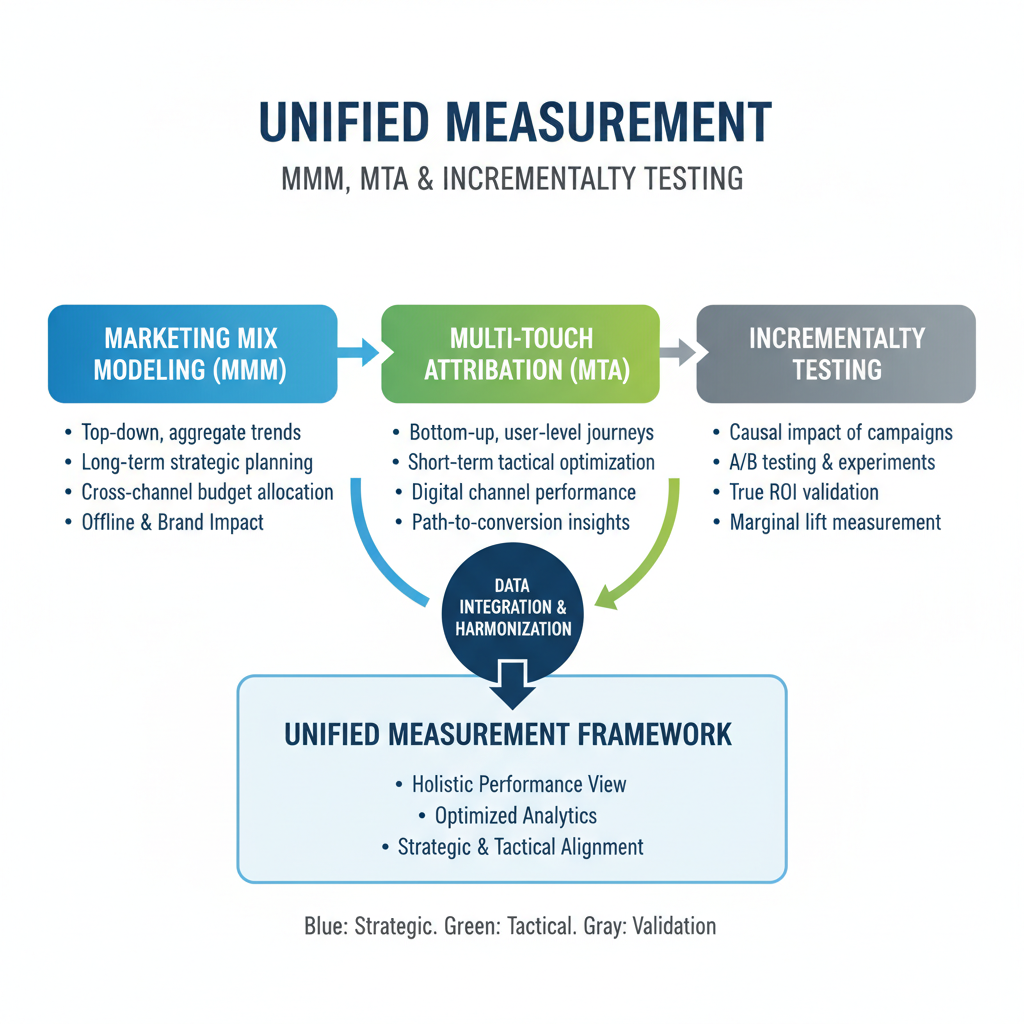
The most robust measurement strategies combine multiple methodologies rather than relying on any single approach
9. Fospha
Best for: View-through attribution and impression measurement
Fospha utilizes an aggregate approach by combining first-party data with statistical modeling of aggregated third-party datasets. This enables measurement of marketing effectiveness including crediting ads that are viewed but not immediately clicked.
Key strengths:
- View-through attribution captures impression impact
- Aggregate modeling handles privacy restrictions
- Strong for display and video campaign measurement
- Doesn't rely on user-level tracking
Limitations:
- Modeling approach requires trust in statistical methods
- Less granular than click-based alternatives
- Premium enterprise pricing
For brands investing heavily in impression-based channels where view-through attribution matters, Fospha fills a gap that click-focused platforms miss. Harvard Business Review research confirms that ignoring view-through impact systematically undervalues upper-funnel channels.
Open-Source and DIY Options
For organizations with data science capabilities, building your own measurement solution is increasingly viable.
10. Google Meridian
Best for: Organizations with data science resources wanting customizable MMM
Google's Meridian framework provides an open-source foundation for building marketing mix models. Released in 2024, it represents Google's latest thinking on MMM methodology.
Key strengths:
- Free and open-source
- Bayesian approach to MMM with uncertainty quantification
- Integrates with Google advertising data
- Customizable to specific business needs
- Active development and Google support
Requirements: Python expertise, statistical knowledge, data infrastructure
For more detail, see our complete guide to Google Meridian.
11. Meta Robyn
Best for: Facebook-heavy advertisers wanting open-source MMM
Meta's Robyn is another open-source MMM solution, focused on making marketing mix modeling more accessible. It includes automated hyperparameter tuning and budget optimization features.
Key strengths:
- Open-source and free
- Automated model selection and calibration
- Budget optimization built-in
- Strong community and documentation
- R-based (accessible to analysts)
Requirements: R programming, statistical understanding
Meta's documentation shows the framework has been adopted by thousands of organizations since its 2021 release. Our Meta Robyn guide covers implementation in detail.
12. Windsor.ai
Best for: Teams wanting attribution plus data integration
Windsor.ai combines multi-touch attribution with ETL capabilities, pulling marketing data into one platform and automating reporting. The platform offers various attribution models from basic (last/first click) to advanced (Markov chains).
Key strengths:
- Multiple attribution models available
- Built-in data integration (ETL functionality)
- Marketing mix modeling capabilities
- More accessible pricing than enterprise platforms
Windsor.ai works well for teams that need both attribution insights and data centralization without managing separate tools.
How to Choose the Right Alternative
Assessment Framework
The right platform depends on your specific situation. Use this framework to evaluate options:
1. Budget reality
- Enterprise platforms (Northbeam, BlueAlpha.ai, Rockerbox): $500-$2,000+/month
- Mid-market solutions (Triple Whale, Lifesight, SegmentStream): $200-$500/month
- Budget options (Littledata, AdBeacon, ThoughtMetric): Under $200/month
- Open-source (Meridian, Robyn): Infrastructure and people costs only
2. Methodology needs
- Do you need multi-touch attribution for tactical optimization?
- Would MMM better serve your strategic allocation questions?
- Is incrementality testing essential for validating results?
- Should you combine multiple approaches for triangulation?
Understanding MTA vs MMM tradeoffs helps clarify methodology priorities.
3. Technical capabilities
- Do you have data scientists for open-source tools?
- Can your team interpret complex model outputs?
- Is your data infrastructure ready for advanced measurement?
4. Platform ecosystem
- Shopify-only? Triple Whale, Littledata, or ThoughtMetric may suffice
- Multi-platform ecommerce? Consider Rockerbox or Windsor.ai
- Complex channel mix with offline? Look at BlueAlpha.ai or Lifesight
Our MMM readiness checklist helps assess whether your organization is prepared for advanced marketing measurement.
Decision Matrix
| If you need... | Consider... |
|---|---|
| Unified AI-powered measurement | BlueAlpha.ai (our top pick) |
| Shopify-native attribution | Triple Whale, Littledata |
| Multi-platform ecommerce | Rockerbox, ThoughtMetric |
| Upper-funnel measurement | SegmentStream, Fospha |
| Combined MMM + attribution | BlueAlpha.ai, Lifesight |
| Budget-friendly starting point | AdBeacon, Littledata, Windsor.ai |
| Open-source/DIY | Google Meridian, Meta Robyn |
| View-through attribution | Fospha, SegmentStream |
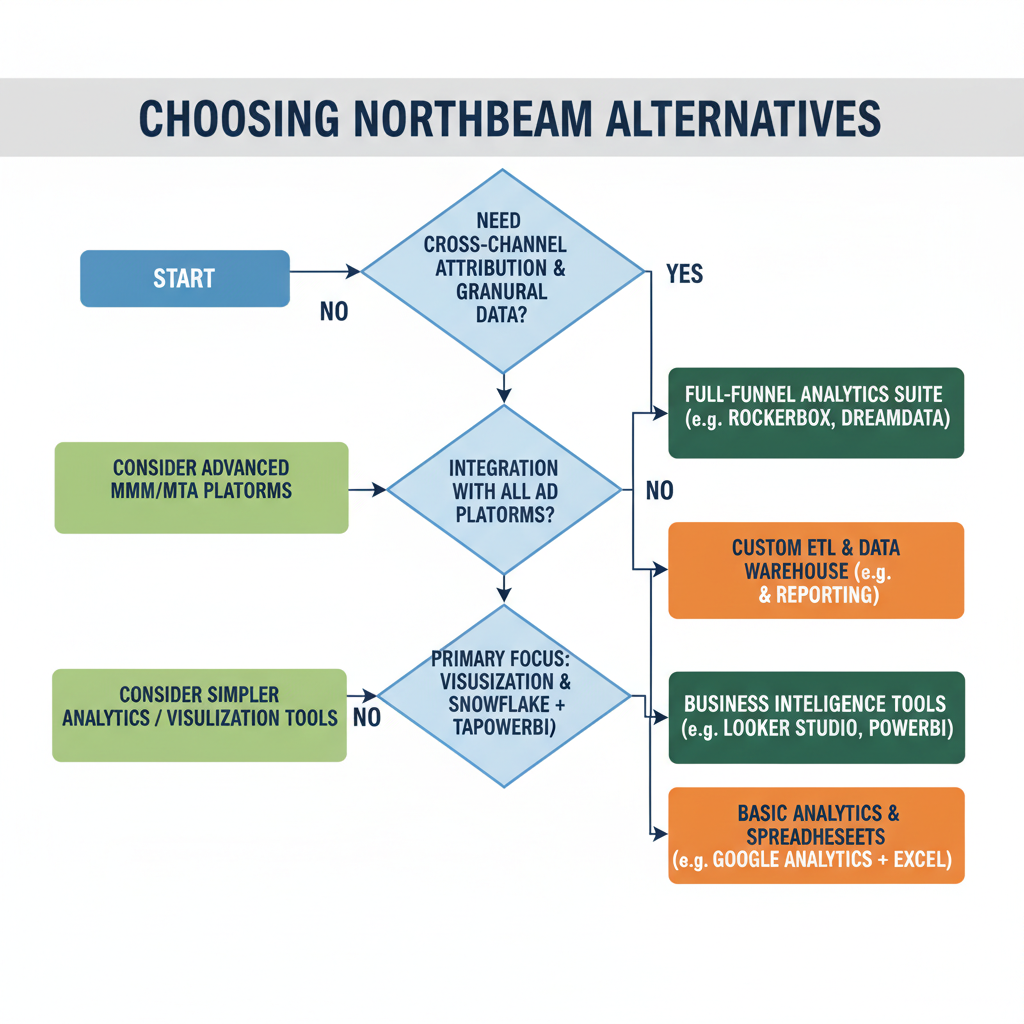
Use this framework to determine which alternative aligns with your measurement needs
Implementation Considerations
Selecting a platform is just the beginning. Successful implementation requires:
Data preparation
- 12-18 months of historical data for MMM (our data preparation guide covers requirements)
- Clean, consistent conversion tracking
- Documented marketing activities and spend
- External factors captured (seasonality, promotions, competitive activity)
Organizational readiness
- Executive buy-in for measurement investment
- Clear ownership of measurement strategy
- Commitment to act on insights
- Realistic timeline expectations
According to McKinsey research, marketing measurement capabilities require sustained investment—expect 2-4 months for initial implementation and 6-12 months to build confidence in outputs.
Frequently Asked Questions
What makes Northbeam different from its alternatives?
Northbeam specializes in combining multi-touch attribution with media mix modeling for DTC e-commerce brands. Their proprietary "Clicks + Deterministic Views" model attempts to maintain accuracy as third-party tracking degrades. Alternatives may emphasize different methodologies—pure MMM for strategic insights, simpler click-based attribution for tactical decisions, or hybrid approaches combining multiple techniques.
How much do Northbeam alternatives typically cost?
Pricing varies significantly. Enterprise alternatives (BlueAlpha.ai, Rockerbox) range from $500-$2,000+/month depending on scale. Mid-market solutions (Triple Whale, Lifesight) typically run $200-$500/month. Budget-friendly options (Littledata, AdBeacon) start under $100/month. Open-source tools are free but require internal data science resources.
Can I use open-source tools instead of commercial platforms?
Yes, if you have data science capabilities. Google Meridian and Meta Robyn provide robust MMM frameworks. However, commercial platforms offer faster implementation, ongoing support, and often better-validated methodologies. The build vs. buy decision depends on your team's capabilities and the value of faster time-to-insight.
Should I choose MTA or MMM for my measurement strategy?
Ideally, both. Multi-touch attribution provides tactical optimization data at the campaign and creative level. Marketing mix modeling provides strategic allocation guidance across your full marketing mix. The methodologies complement each other—MTA shows what's working granularly, MMM guides macro budget decisions.
What's the minimum ad spend to justify a measurement platform?
Generally, measurement platform costs should represent 1-3% of your marketing budget to justify the investment. At $50K+ monthly ad spend, even small allocation improvements from better measurement can yield returns exceeding platform costs. Below $25K monthly, simpler solutions or platform-native reporting may suffice until you scale.
How long does implementation take for these platforms?
Expect 2-4 weeks for basic implementation, with 2-3 months to build confidence in outputs. SaaS platforms with pre-built integrations (Triple Whale, Littledata) deploy fastest. Enterprise solutions requiring custom integration (BlueAlpha.ai, Rockerbox) may take longer but deliver more comprehensive measurement. Open-source implementation varies based on team capability—from weeks to months.
Conclusion
Northbeam built a strong platform for DTC e-commerce attribution. But it's one option in an increasingly diverse landscape—and not always the right fit.
Key takeaways:
- BlueAlpha.ai stands out as our top pick for organizations wanting unified, AI-powered measurement
- The right alternative depends on your budget, methodology needs, and technical capabilities
- Ecommerce-focused platforms (Triple Whale, Littledata, Rockerbox) serve Shopify brands well
- MMM platforms (SegmentStream, Lifesight, Fospha) provide strategic allocation insights
- Open-source tools (Meridian, Robyn) offer enterprise capability at lower cost—if you have data science resources
- The best measurement strategy often triangulates across multiple methodologies
Don't choose a platform based on features alone. Start with clarity on what questions you need answered, then evaluate which approach best addresses those questions within your constraints.
Marketing measurement is a capability that compounds over time. The organizations that start building now will have significant advantages as privacy changes make measurement harder and competition for attention intensifies.
Ready to evaluate your measurement needs? Take our readiness quiz to assess your current capabilities, or explore our preparation tips for guidance on preparing for advanced marketing measurement.
Stay in the loop
Get updates on new posts and resources.