Northbeam vs BlueAlpha.ai: Which Platform Fits Your Needs?
Compare Northbeam vs BlueAlpha.ai for marketing attribution. Learn which platform fits your e-commerce measurement and budget optimization needs.
Marketing attribution has become a battlefield. Third-party cookies are disappearing. iOS privacy changes decimated tracking. And every platform claims they've cracked the code on measuring what actually works.
Northbeam vs BlueAlpha.ai represents a fundamental choice in how you approach marketing measurement. One platform built its reputation on multi-touch attribution for DTC brands. The other emphasizes AI-driven predictive analytics with cross-departmental insights.
This comparison cuts through the marketing speak to help you understand which platform actually fits your business—not which one has better landing page copy.
The Stakes: Why This Decision Matters
The wrong measurement platform doesn't just waste subscription dollars. It systematically misattributes your marketing performance, leading to budget decisions that compound in the wrong direction.
According to Nielsen's research, the average marketing campaign achieves only 50% of its potential ROI due to suboptimal allocation. When your measurement foundation is flawed, every optimization you make potentially pushes you further from truth.
Both Northbeam and BlueAlpha.ai emerged as responses to the post-iOS 14 measurement crisis. Google's deprecation of third-party cookies adds further urgency. But "privacy-compliant attribution" describes a category, not a methodology. The specifics of how each platform approaches measurement differ substantially—and those differences directly impact which insights you receive and how you allocate budget.
For foundational context on why measurement methodology matters, our marketing effectiveness measurement guide covers the core concepts both platforms build upon.
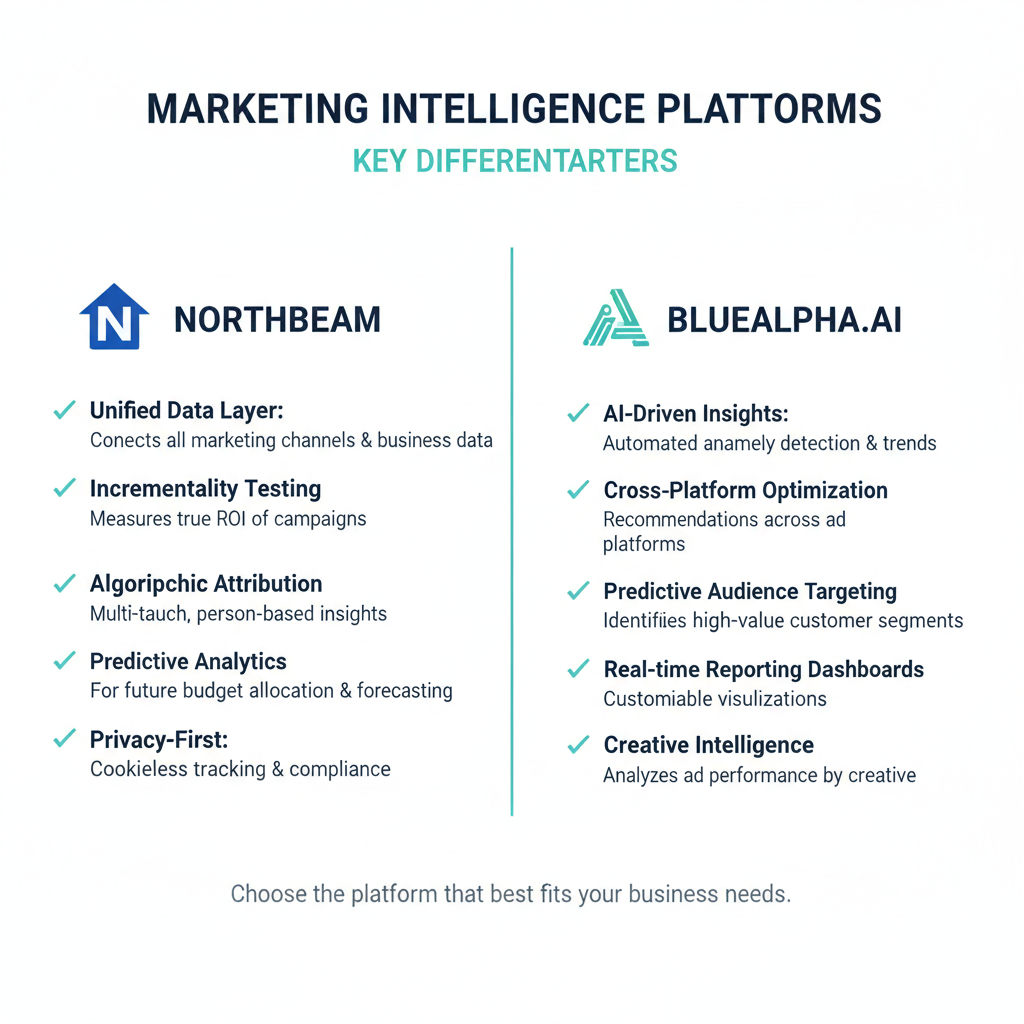
Both platforms solve privacy-compliant measurement through fundamentally different approaches
Northbeam: Deep Dive
Platform Overview
Northbeam built its reputation serving direct-to-consumer e-commerce brands navigating the iOS 14 tracking apocalypse. The platform combines multi-touch attribution (MTA) with media mix modeling (MMM) to provide what they call a unified view of marketing performance.
The company's core thesis: first-party data combined with proprietary machine learning can deliver attribution accuracy that platform-reported metrics simply can't match.
Core philosophy: Track every customer touchpoint using first-party data, then apply ML models to understand the true incremental impact of each channel and campaign.
Key Features
Multi-Touch Attribution (MTA) Northbeam's signature capability tracks customer journeys across touchpoints to attribute conversions. Unlike last-click attribution that credits only the final interaction, MTA distributes credit across the path to purchase. Their proprietary "Clicks + Deterministic Views" model aims to maintain accuracy even as third-party tracking degrades.
This matters because customer journeys rarely follow linear paths. A prospect might discover your brand through TikTok, retarget through Facebook, and convert through a branded Google search. MTA attempts to credit each touchpoint appropriately—a concept our marketing attribution guide explores in depth.
Media Mix Modeling (MMM+) Beyond attribution, Northbeam offers statistical analysis to determine channel effectiveness and suggest budget allocations. Their MMM approach uses historical data to model the relationship between marketing spend and outcomes—without relying on user-level tracking. Research from the Marketing Science Institute confirms that MMM provides valuable macro-level insights that complement granular attribution data.
For deeper context on how media mix modeling works, our MMM marketing attribution guide explains the methodology in detail.
Real-Time Dashboards The platform provides up-to-date analytics rather than the lagged reporting common in traditional measurement. Real-time data enables faster optimization cycles—critical for paid media where conditions shift daily.
First-Party Data Infrastructure Northbeam's architecture centers on first-party data collection, reducing dependence on third-party cookies and platform pixels. This positions the platform well for continued tracking restrictions. The Interactive Advertising Bureau emphasizes that first-party data strategies are now essential infrastructure for sustainable marketing measurement.
Cross-Channel Coverage The platform measures across major advertising channels including Facebook, Google, TikTok, Snapchat, Pinterest, and connected TV—consolidating what would otherwise require checking multiple platform dashboards. eMarketer research shows that the average DTC brand now advertises across 5+ channels, making unified measurement increasingly critical.
Ideal Use Cases
Northbeam works best for:
- DTC e-commerce brands with significant paid media spend
- Organizations needing granular attribution at the campaign and creative level
- Teams with established data practices ready for sophisticated measurement
- Companies spending $50K+ monthly on paid media where measurement improvements compound significantly
The platform requires solid first-party data infrastructure and typically delivers best results when you have clear conversion events and meaningful advertising scale.
Our MMM readiness checklist can help assess whether your organization has the foundations either platform requires.
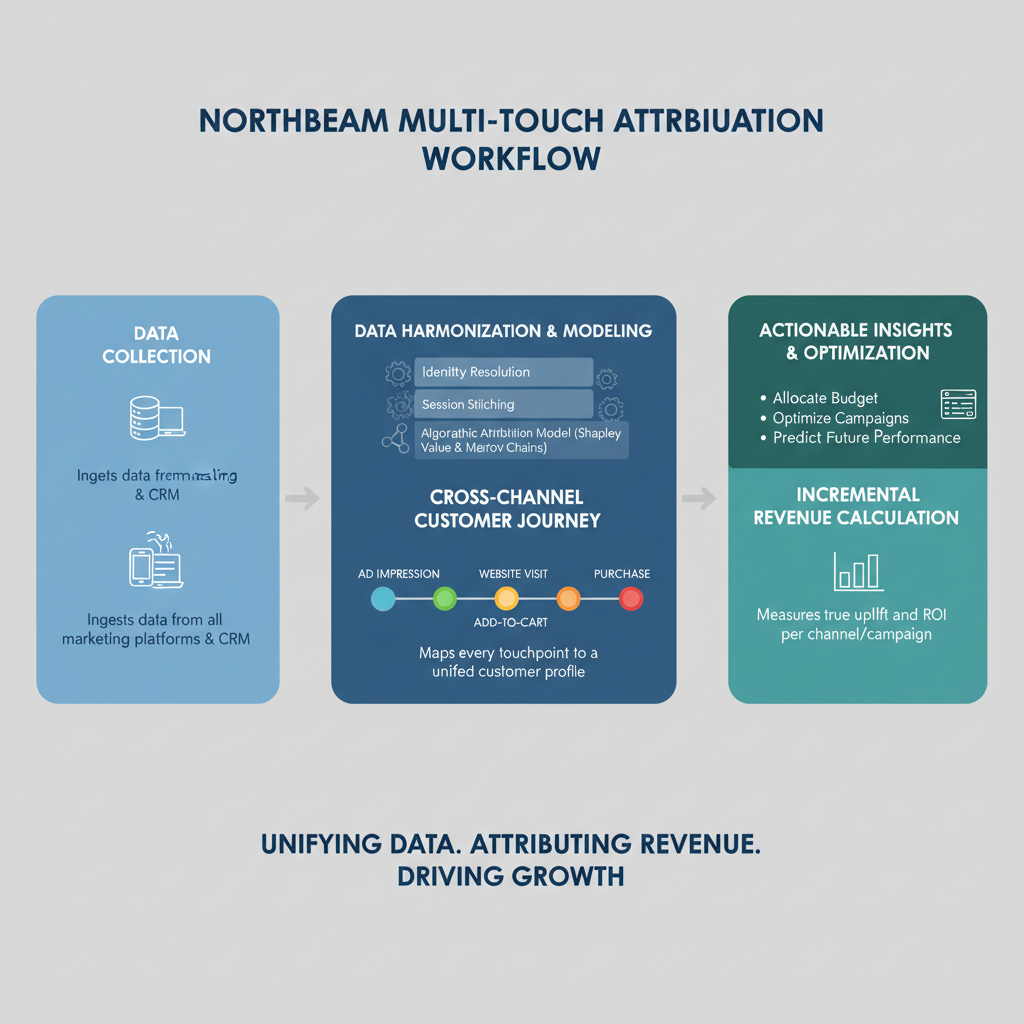
Multi-touch attribution reveals the full path to purchase across channels
BlueAlpha.ai: Deep Dive
Platform Overview
BlueAlpha.ai takes a different approach, emphasizing AI-driven automation and predictive insights over granular touchpoint tracking. The platform's founding team came from growth engineering backgrounds, bringing a speed-and-automation mindset to measurement.
Where Northbeam asks "what happened across the customer journey?", BlueAlpha.ai asks "what will happen if we shift budget, and what should we do about it?"
Core philosophy: Advanced machine learning can deliver actionable predictions faster than traditional attribution, enabling more agile marketing optimization without requiring deep data science expertise.
Key Features
AI-Powered Predictive Analytics BlueAlpha.ai's standout capability is predictive modeling. Rather than just reporting what happened, the platform forecasts what will happen under different budget scenarios. This forward-looking approach helps marketers make decisions about future spend rather than just understanding historical performance.
Automated ROI Insights The platform generates specific budget allocation recommendations automatically. Instead of presenting dashboards that marketers must interpret, BlueAlpha.ai delivers prescriptive guidance—"shift $10K from Channel A to Channel B for projected X% improvement."
This automation addresses a common measurement gap: many organizations collect attribution data but lack the analytical resources to translate it into actionable decisions. According to Gartner, marketing teams cite "translating data into action" as their top analytics challenge.
Bayesian Modeling & Causal Inference BlueAlpha.ai combines Bayesian statistical methods with causal inference techniques. Bayesian approaches excel at incorporating prior knowledge and handling uncertainty—critical in marketing contexts where data is often incomplete or noisy. MIT Sloan research confirms that Bayesian methods provide robust estimates even with limited data.
No-Code Setup The platform emphasizes accessibility with rapid deployment that doesn't require dedicated data engineering resources. For teams without analytics specialists, this removes a significant barrier to sophisticated measurement.
Cross-Departmental Insights BlueAlpha.ai extends beyond marketing to provide insights relevant to sales and finance teams. This broader scope can improve organizational alignment around marketing investment decisions.
Cookie-Less Architecture Like Northbeam, BlueAlpha.ai operates without user-level tracking or third-party cookies. Their statistical modeling approach naturally accommodates privacy constraints.
Ideal Use Cases
BlueAlpha.ai works best for:
- Growth-stage companies prioritizing speed over granular precision
- Teams without dedicated analytics resources needing accessible, automated insights
- Organizations seeking predictive guidance rather than historical reporting
- Companies wanting cross-departmental alignment on marketing performance
- Marketers preferring prescriptive recommendations over raw data exploration
The platform appeals to teams that need actionable recommendations quickly and prefer AI-driven insights over hands-on analysis. Understanding how marketing effectiveness measurement fits into your broader strategy helps contextualize where BlueAlpha.ai's predictive approach adds value.
For context on how different optimization approaches impact results, our guide on funnel stage budget allocation explores the strategic considerations.
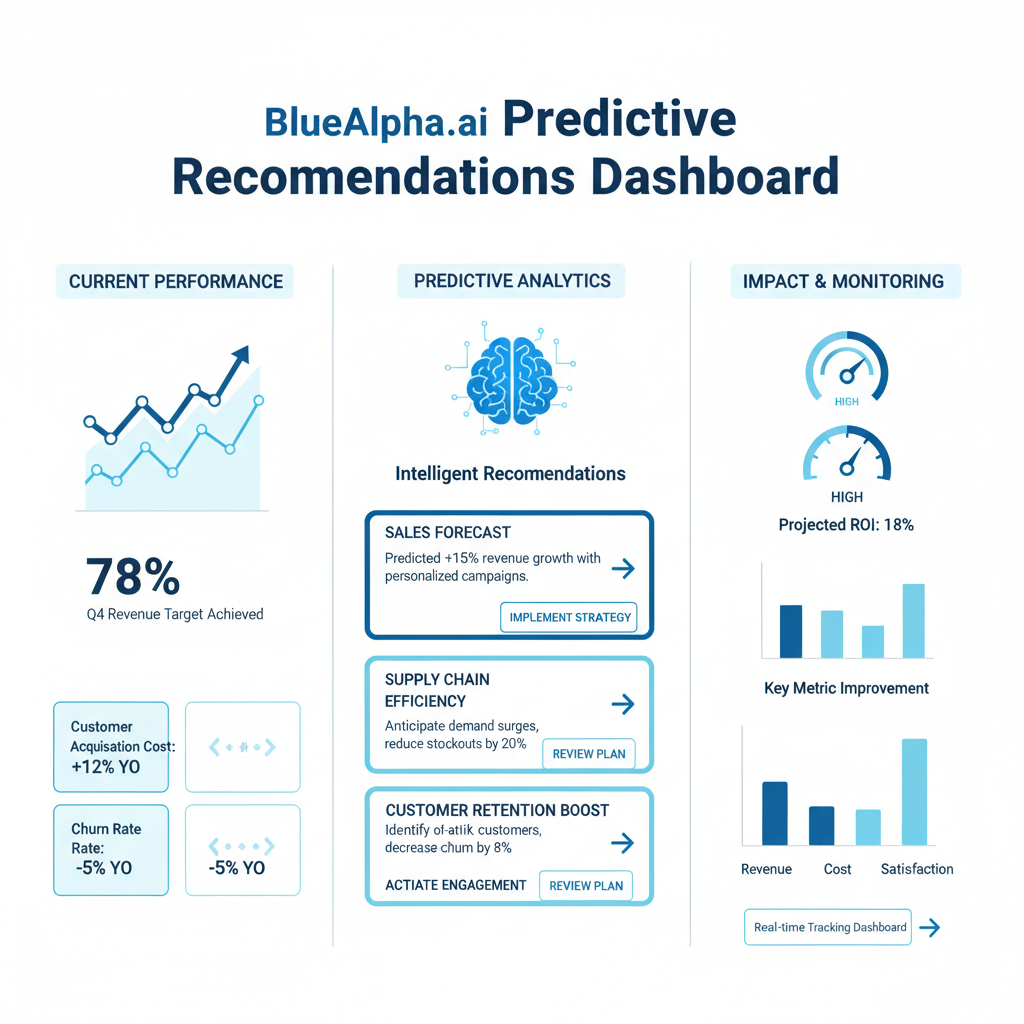
Predictive analytics shift focus from what happened to what should happen next
Head-to-Head Comparison
Methodology: Attribution vs. Prediction
This represents the fundamental difference between platforms.
Northbeam tracks actual customer touchpoints and uses machine learning to model attribution across channels. The approach prioritizes understanding what specifically happened in each conversion path.
BlueAlpha.ai uses statistical modeling and AI to predict marketing outcomes without requiring the same granular touchpoint data. The approach prioritizes actionable recommendations over precise attribution.
Neither methodology is inherently superior. Attribution provides detailed understanding but can become complex to interpret. Prediction delivers actionable guidance but relies on model assumptions. McKinsey's marketing research suggests that sophisticated organizations often need both approaches at different stages of measurement maturity.
| Aspect | Northbeam | BlueAlpha.ai |
|---|---|---|
| Primary Method | Multi-touch attribution + MMM | AI/ML predictive modeling |
| Time to Insights | 1-2 weeks setup | Days (no-code setup) |
| Output Type | Attribution data + dashboards | Prescriptive recommendations |
| Data Requirements | First-party tracking implementation | Marketing spend + outcome data |
| Technical Expertise | Moderate—benefits from analytics capability | Low—designed for self-service |
| Pricing Tier | Premium ($500+/month starting) | Likely more accessible entry points |
For a deeper understanding of how these measurement approaches differ, our guide on media budget optimization explores when each methodology works best.
Target Audience & Company Size
Northbeam explicitly targets DTC e-commerce brands with substantial ad spend. Their platform assumes a certain level of marketing sophistication and data infrastructure maturity. Typical customers have established paid media programs and dedicated marketing teams.
BlueAlpha.ai positions itself as accessible to organizations without deep analytics resources. The AI-driven, no-code approach opens sophisticated measurement to smaller teams that can't justify hiring data scientists.
Integration & Implementation
Northbeam requires implementing first-party tracking across your digital properties—typically a 1-2 week process depending on your tech stack complexity. The platform integrates with major e-commerce platforms like Shopify, plus major ad channels.
BlueAlpha.ai emphasizes rapid deployment through automated data connections. The no-code setup reduces implementation barriers, though the platform may have fewer pre-built integrations than more established competitors.
Ongoing Management
Northbeam provides dashboards and data that marketing teams interpret and act upon. This gives sophisticated users more control but requires analytical capacity to extract value.
BlueAlpha.ai automates more of the insight-to-action pipeline. The platform generates recommendations directly, reducing the interpretive burden on marketing teams.
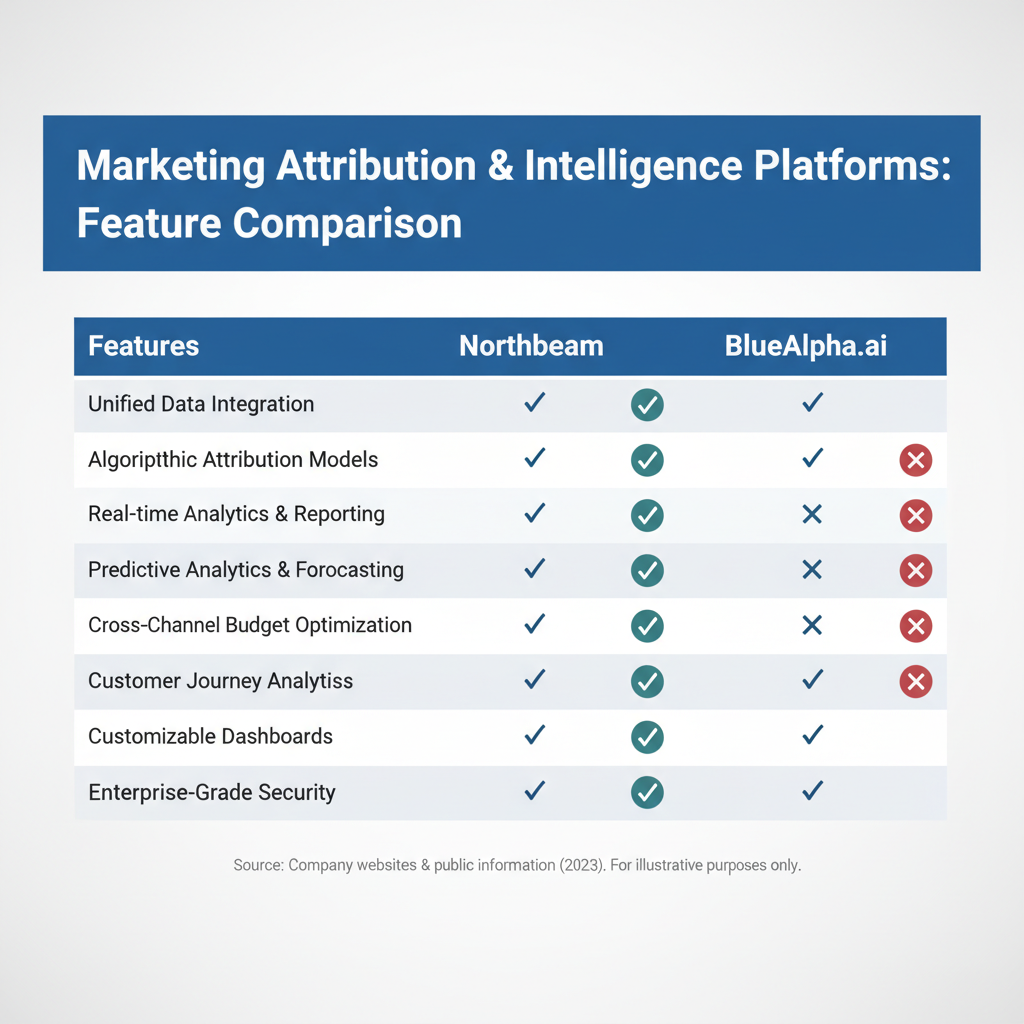
Feature-by-feature comparison reveals where each platform excels
Decision Framework: Which Platform Fits?
Choose Northbeam If:
- You need granular attribution data to understand specific customer journeys and touchpoints
- Your team has analytics capability to interpret dashboards and translate data into decisions
- E-commerce is your business model and you need Shopify/e-commerce platform integration
- You have substantial ad spend ($50K+ monthly) where marketing ROI improvements compound significantly
- Multi-touch visibility matters and you want to see the full conversion path
- You're building comprehensive measurement that combines MTA with media mix modeling
Choose BlueAlpha.ai If:
- Speed to insights matters more than granular attribution precision
- Your team lacks analytics resources and needs accessible, automated recommendations
- You want prescriptive guidance rather than data to interpret
- Budget constraints make premium enterprise solutions impractical
- Cross-departmental alignment on marketing ROI is a priority
- Predictive planning is more valuable than understanding historical attribution
- You want quick wins while building toward more sophisticated MMM capabilities
Consider Alternatives If:
Both platforms may not fit if:
- Your spend is below $25K monthly where measurement platform costs may not justify returns
- You lack first-party data infrastructure necessary for any measurement approach
- You need experimental proof rather than modeled estimates—in which case incrementality testing platforms may suit better
Our preparation tips guide covers how to build the data foundation required for either platform.
Integration With Broader Measurement Strategy
No single platform solves all measurement needs. Both Northbeam and BlueAlpha.ai fit within a broader marketing measurement ecosystem.
Northbeam complements:
- Platform-native reporting (Facebook, Google) for day-to-day optimization
- Media mix modeling for macro budget allocation
- Incrementality testing for causal validation
BlueAlpha.ai complements:
- Traditional analytics for historical understanding
- Platform reporting for tactical decisions
- Finance systems for budget planning alignment
For organizations evaluating their broader measurement strategy, our marketing ROI analysis guide provides framework for how different measurement approaches work together.
Limitations to Consider
Northbeam Limitations
- Implementation complexity requires technical resources for proper setup
- Premium pricing puts it out of reach for smaller organizations
- Attribution model assumptions still require interpretation and validation—Harvard Business Review notes that even sophisticated attribution models can mislead without proper calibration
- E-commerce focus may limit fit for B2B or lead-gen businesses
BlueAlpha.ai Limitations
- Newer platform with less established track record than alternatives
- Model assumptions introduce uncertainty that direct measurement would eliminate
- AI recommendations require validation rather than blind acceptance
- May oversimplify complex multi-channel dynamics
Pricing Considerations
Neither platform publishes transparent pricing—standard for enterprise B2B software.
Northbeam typically starts above $500/month with pricing based on:
- Advertising spend under measurement
- Number of channels and integrations
- Level of support required
BlueAlpha.ai likely offers more accessible entry points given their positioning toward teams without dedicated analytics resources, though specific pricing requires direct inquiry.
For context on ROI from measurement investments, consider that even a 5% improvement in budget allocation on $100K monthly spend yields $60K annual value—easily justifying platform costs if the measurement drives better decisions.
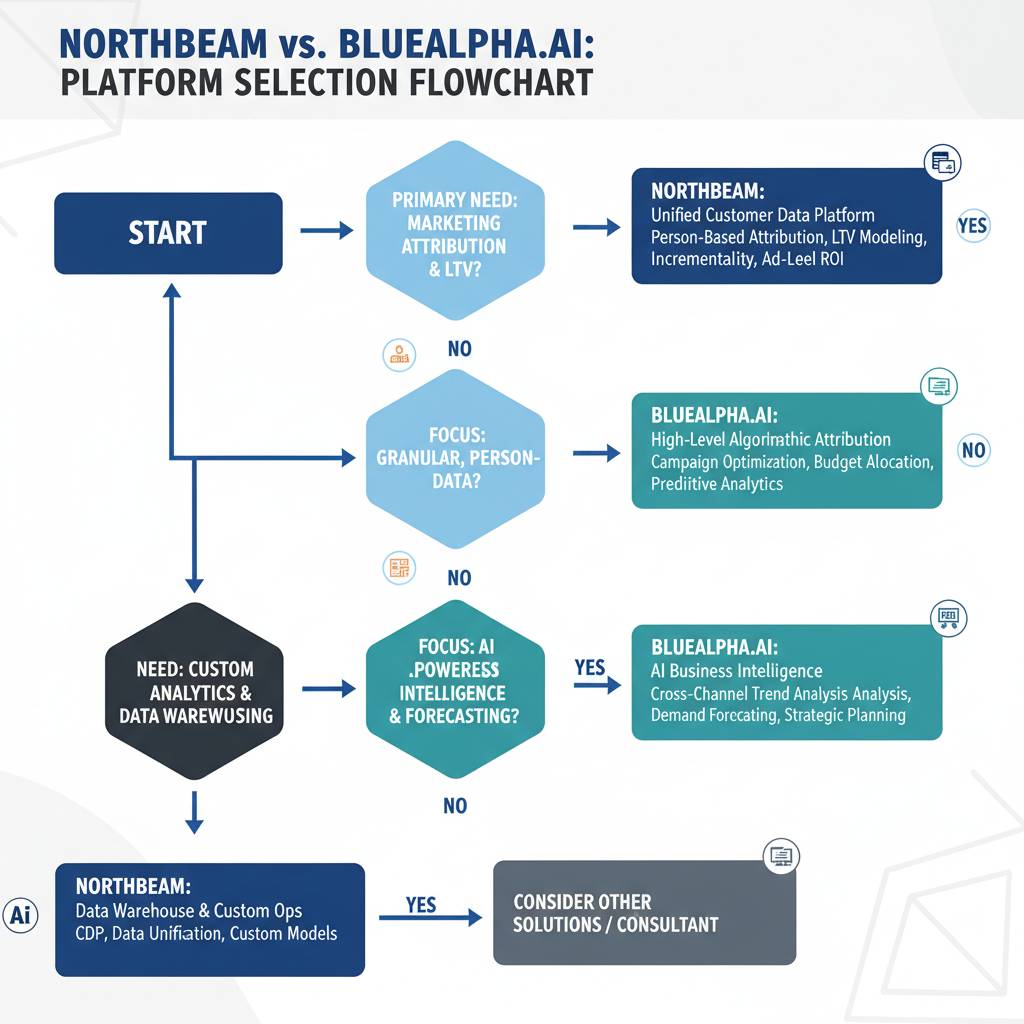
Use this framework to determine which platform aligns with your measurement needs
Frequently Asked Questions
How do Northbeam and BlueAlpha.ai handle iOS privacy changes?
Both platforms address iOS 14+ tracking limitations through first-party data strategies and statistical modeling. Northbeam emphasizes first-party tracking implementation to capture data that platform pixels miss. BlueAlpha.ai uses aggregate modeling approaches that don't depend on user-level tracking. Neither platform requires third-party cookies or IDFA access.
What's the minimum marketing budget for each platform?
Northbeam typically serves organizations spending $50K+ monthly on paid media, where their granular attribution provides meaningful optimization value. BlueAlpha.ai may be accessible at lower spend levels given their no-code, automation-focused approach. Neither publishes minimum requirements publicly.
Can I use both platforms together?
Technically yes, though it's rarely practical. The overlap in functionality would mean paying twice for similar insights. More commonly, organizations pair attribution platforms like Northbeam with complementary measurement approaches (incrementality testing, brand tracking) rather than multiple attribution solutions.
How accurate is AI-driven attribution compared to tracking-based?
Both approaches involve tradeoffs. Tracking-based attribution (Northbeam) captures actual customer interactions but requires robust implementation and still relies on models for cross-device and privacy gaps. AI/ML modeling (BlueAlpha.ai) can generate insights from less complete data but introduces model assumption risk. Forrester research suggests that combining multiple methodologies provides the most robust measurement.
Do these platforms replace Google Analytics or platform reporting?
Neither fully replaces existing analytics. Both complement platform-native reporting (Facebook Ads Manager, Google Ads) by providing cross-channel visibility and more sophisticated attribution than default last-click models. Most organizations run measurement platforms alongside Google Analytics 4 rather than as replacements.
Conclusion
The Northbeam vs BlueAlpha.ai decision ultimately reflects what you value in measurement: granular attribution understanding versus predictive automation.
Key takeaways:
- Northbeam excels at multi-touch attribution and first-party data architecture for DTC e-commerce
- BlueAlpha.ai prioritizes AI-driven predictions and accessible, automated recommendations
- Neither platform is universally better—context determines fit
- Both require solid first-party data foundations to deliver meaningful value
- Consider how each fits your broader measurement strategy and team capabilities
The marketing measurement landscape will continue fragmenting. What matters isn't choosing the "best" platform—it's choosing the one that matches your organization's sophistication level, technical resources, and measurement philosophy. For comparison with other platforms in this space, our guide to marketing measurement alternatives provides additional context.
Before committing to either platform, ensure your organization has the data foundation both require. Our MMM readiness checklist provides a comprehensive assessment framework.
Ready to evaluate your measurement readiness? Take our readiness quiz to assess your current capabilities, or explore our preparation tips for guidance on building the infrastructure both platforms require.
Stay in the loop
Get updates on new posts and resources.