Prescient AI vs Blue Alpha: Which MMM Platform Fits Your Brand?
Compare Prescient AI and Blue Alpha's marketing mix modeling platforms. See features, pricing, implementation timelines, and which solution fits mid-market brands best.
Choosing between Prescient AI vs Blue Alpha isn't just about picking marketing mix modeling software. It's about finding a platform that matches your team size, budget, and speed requirements.
Both platforms promise to solve the same problem: telling you which marketing channels actually drive revenue. But they take fundamentally different approaches. Prescient AI brings enterprise pedigree and significant venture backing. Blue Alpha enters the market with a fresh perspective built specifically for brands that don't have data science teams.
Here's what you need to know about each platform.
What Is Prescient AI?
Prescient AI launched in 2018 as a next-generation marketing mix modeling platform designed to bring MMM technology into the modern era. The Miami-based company has raised $16.6M in funding and employs 43 people focused on revolutionizing how brands measure marketing effectiveness.
The platform positions itself around speed and independence. Prescient claims to deliver actionable insights in less than 36 hours—a stark contrast to the quarterly cadence of traditional MMM vendors. Their daily model refreshes keep data current, allowing marketers to react to performance shifts as they happen rather than weeks later.
Prescient AI won the Predictive Modeling Solution of the Year in the 2025 AI Breakthrough Awards. Their technical approach moves beyond traditional regression analysis to identify cause-and-effect relationships in marketing data.
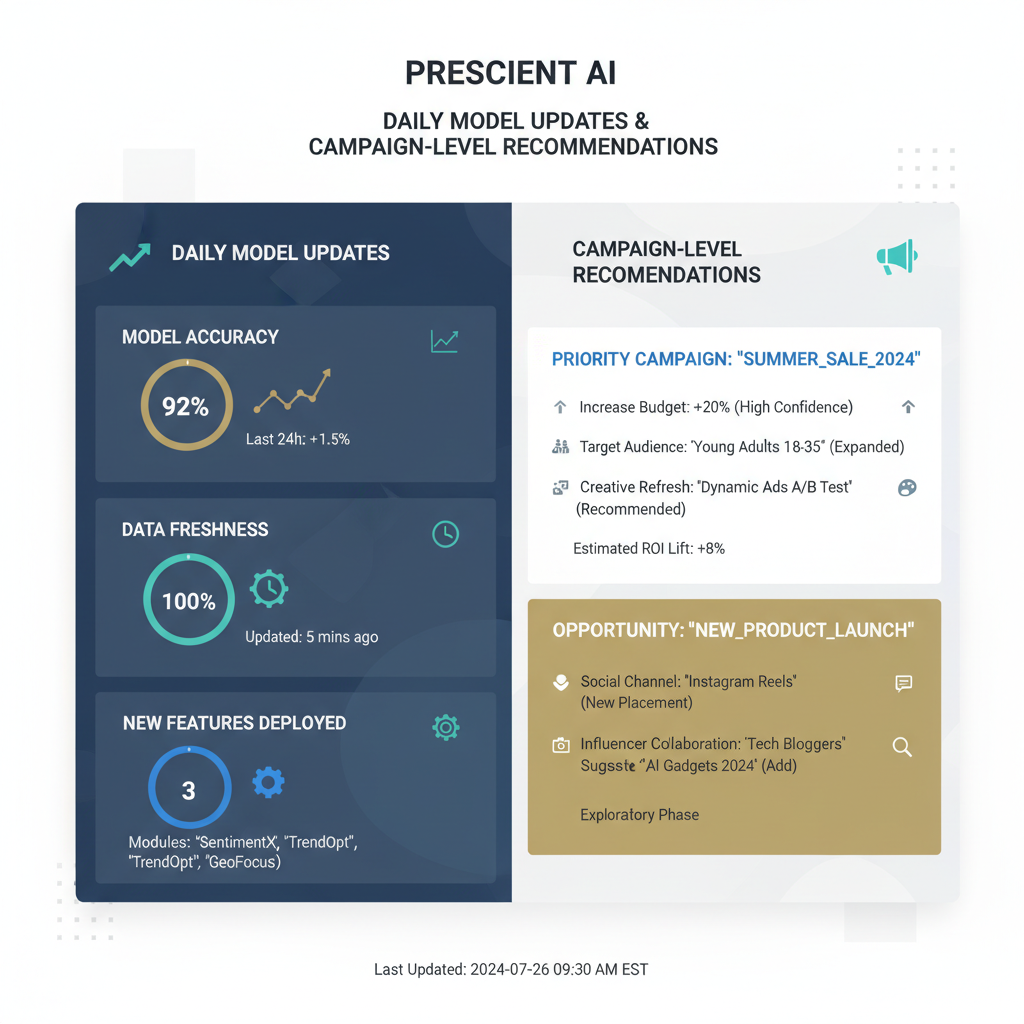
Prescient AI delivers campaign-level insights updated daily for faster optimization decisions
Key Features of Prescient AI
Prescient AI's platform includes several capabilities that differentiate it from legacy MMM providers:
Daily Model Updates: Most marketing mix modeling software refreshes monthly or quarterly. Prescient refreshes daily, giving you near real-time visibility into channel performance shifts.
Halo Effect Attribution: The platform measures indirect marketing impact—how paid campaigns drive organic search, direct traffic, and word-of-mouth growth. This addresses a major gap in marketing attribution where platforms only measure direct conversions.
Saturation Curve Analysis: Prescient shows exactly when each channel hits diminishing returns, helping you avoid overspending in saturated channels while identifying underinvested opportunities.
Platform Integrations: Pre-built connections to Shopify, Amazon, Meta, Google, Snap, TikTok, and CTV platforms speed up data integration. Prescient claims you can connect channels in minutes instead of weeks.
The platform's mathematical foundations differ from traditional approaches. Rather than relying solely on correlation analysis, Prescient uses proprietary methods to establish causation—critical for making confident budget allocation decisions.
What Is Blue Alpha?
Blue Alpha represents a newer entrant to the MMM platform space, founded in 2024 by former Tesla marketing optimization engineers. The Delaware-based company remains bootstrapped with 10 employees, deliberately keeping teams small to maintain agility.
Blue Alpha's core philosophy centers on explainability and speed. Rather than treating MMM as a black box that only data scientists can interpret, Blue Alpha built an LLM-powered system that translates model outputs into plain language recommendations.
The platform integrates incrementality testing directly into its Bayesian modeling framework. This combination allows Blue Alpha to validate MMM predictions against controlled experiments—addressing a common criticism that MMMs show correlation but not causation.
Blue Alpha's approach proved itself at Beehiiv, where the platform discovered Meta's true incremental cost was 345% higher than platform reporting. That finding redirected significant budget to higher-performing channels.
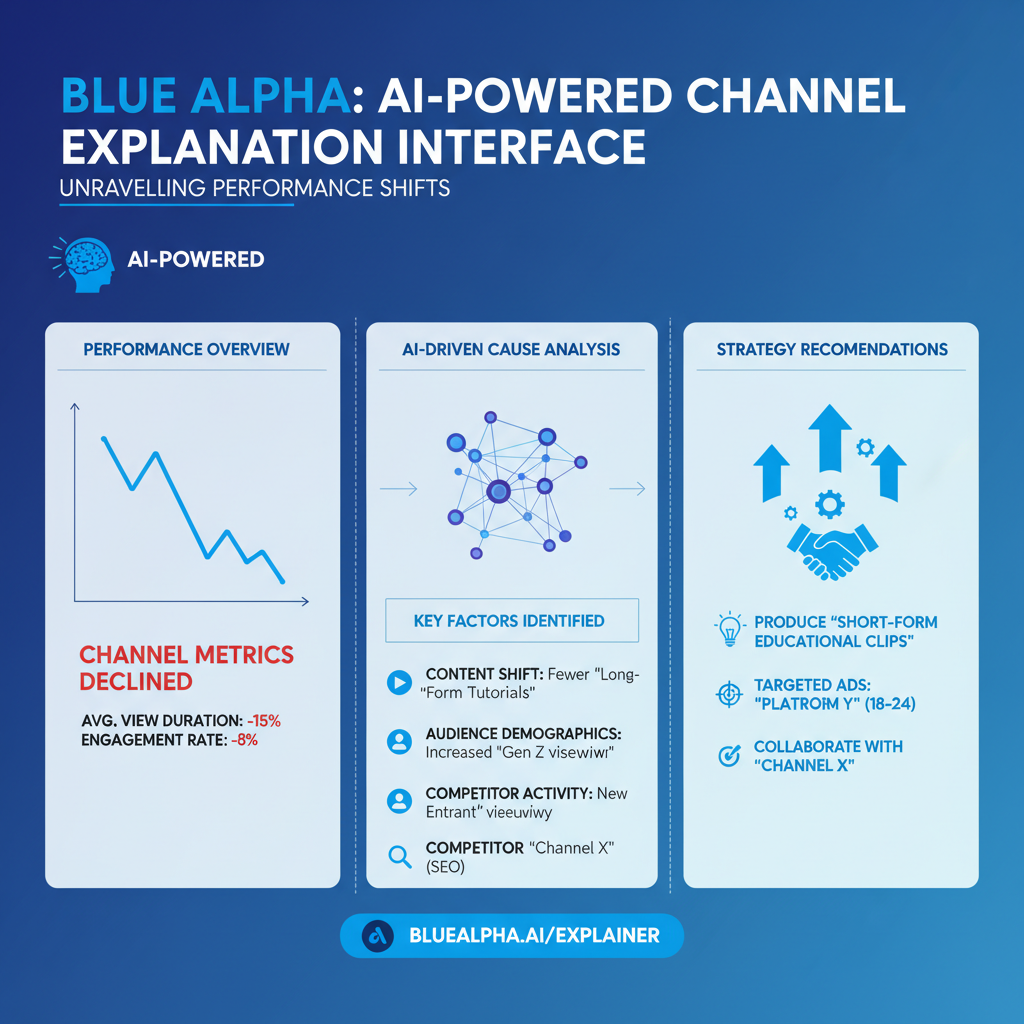
Blue Alpha's LLM translates complex model outputs into actionable recommendations in plain language
Key Features of Blue Alpha
Blue Alpha differentiates itself through integrated testing and automated interpretation:
Bayesian Framework with Flexible Priors: Most media mix modeling tools use rigid statistical assumptions. Blue Alpha's Bayesian modeling approach loosens these constraints, allowing the model to calibrate itself based on your specific data patterns.
Integrated Incrementality Testing: Blue Alpha doesn't just model correlations—it validates findings through controlled experiments. The platform designs and analyzes incrementality tests, then feeds results back into the MMM to improve accuracy.
Time-Varying Coefficients: Channel effectiveness changes over time due to seasonality, competition, and creative fatigue. Blue Alpha's models adapt weekly rather than assuming static relationships across quarters.
Natural Language Explanations: An LLM interprets model outputs and generates written explanations of why performance changed and what to do about it. This eliminates the translation gap between data scientists and marketing teams.
Three-Week Implementation: Blue Alpha handles data integration, cleansing, and model deployment in roughly three weeks—significantly faster than the 6-month timeline typical for in-house MMM builds.
The platform's methodology combines MMM with incrementality testing to deliver what Blue Alpha calls "causal attribution at the channel level with strategic guidance at the portfolio level."
Prescient AI vs Blue Alpha: Direct Comparison
Let's break down how these platforms compare across the dimensions that matter most to mid-market brands.
Company Maturity and Funding
Prescient AI: Founded in 2018, 43 employees, $16.6M raised. Prescient has operated for six years, giving them time to refine their product and build customer support infrastructure. Venture funding provides runway for sustained development.
Blue Alpha: Founded in 2024, 10 employees, bootstrapped. Blue Alpha's newer status means less customer feedback has shaped the product, but also suggests faster decision-making and tighter focus on solving core problems without investor pressure.
The funding difference matters for enterprise buyers who prioritize vendor stability. For mid-market brands that value agility and direct access to founders, Blue Alpha's small team structure could be an advantage.
Technical Methodology
Both platforms move beyond traditional regression-based MMM, but they take different paths:
Prescient AI uses proprietary mathematical foundations that go beyond correlation to establish causation. The company hasn't published detailed methodology papers, positioning their approach as competitive IP. This creates faster insights but less technical transparency.
Blue Alpha combines Bayesian MMM with incrementality testing validation. Their methodology aligns with Google's 2017 research on Bayesian media mix modeling, using experiments to calibrate model priors. This provides both speed and experimental validation.
The key difference: Prescient optimizes for prediction speed, while Blue Alpha optimizes for causal validation through integrated testing.
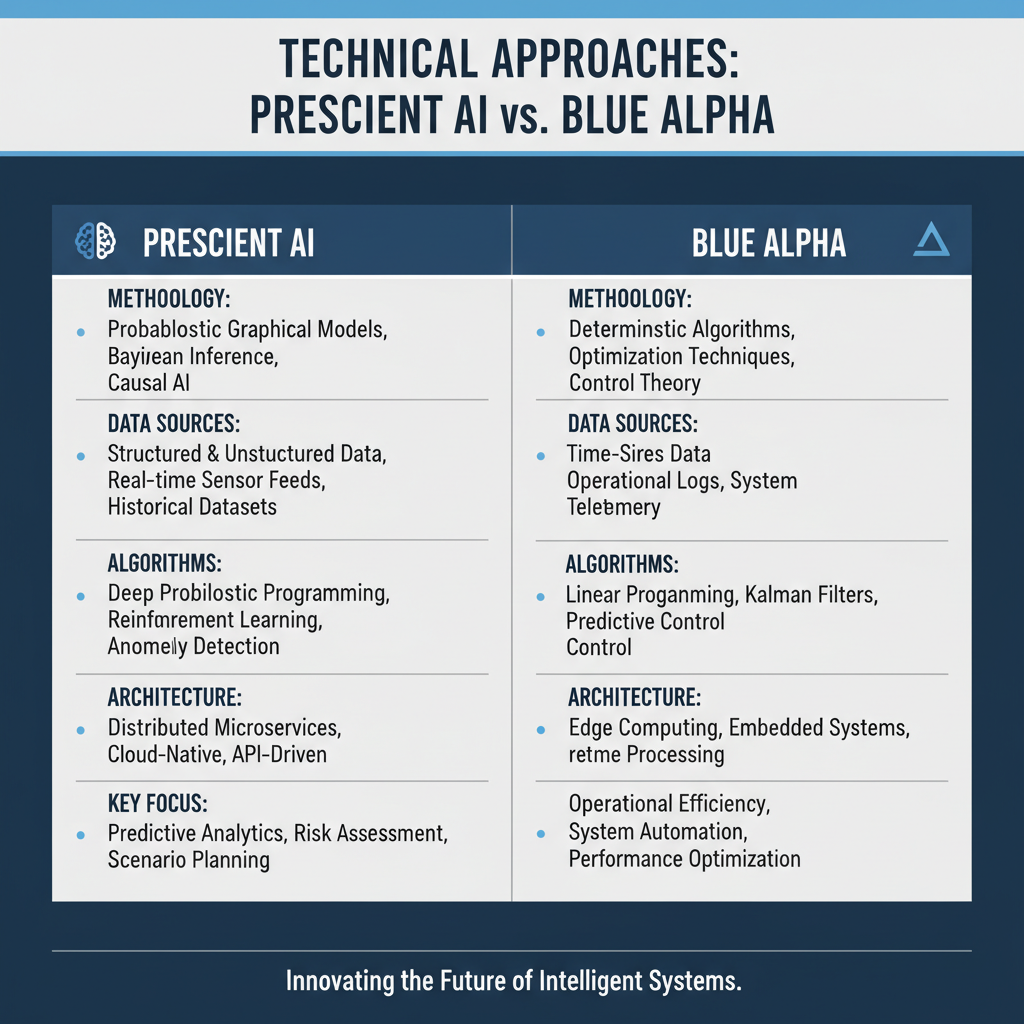
Prescient AI and Blue Alpha take different technical paths to solve attribution challenges
Speed and Update Frequency
Prescient AI: Daily model refreshes provide near real-time insights. Prescient claims 36-hour turnaround from data ingestion to actionable recommendations. This speed suits brands running aggressive test-and-scale campaigns.
Blue Alpha: Weekly model updates with integrated incrementality tests. While slower than daily, weekly updates still far exceed the quarterly cadence of traditional vendors. The trade-off buys experimental validation of model predictions.
For performance marketers who need to scale winning campaigns immediately, Prescient's daily updates provide faster reaction time. For strategic planners who need high-confidence predictions, Blue Alpha's weekly validated insights may justify the slight delay.
Implementation Timeline
Prescient AI: No public timeline disclosed, but pre-built integrations with 100+ platforms suggest faster setup than custom implementations. Typical vendor onboarding takes 4-8 weeks once data requirements are met.
Blue Alpha: Three-week implementation from kickoff to live model. Blue Alpha handles integration, data cleansing, and model deployment without requiring internal data engineering resources.
Both platforms dramatically undercut the 12-24 month timeline for building MMM in-house, making vendor solutions accessible to mid-market brands without dedicated data science teams.
Pricing Structure
Prescient AI: Pricing not publicly disclosed. Contact required for custom quotes. Based on typical SaaS MMM pricing, expect $5,000-$10,000+ monthly for mid-market brands depending on channel complexity and data volume.
Blue Alpha: Custom pricing based on business needs. Blue Alpha positions itself for mid-market brands specifically, suggesting more accessible pricing than enterprise-focused competitors.
Neither platform offers transparent pricing, making direct cost comparison impossible without sales conversations. Both likely fall in the $60,000-$120,000 annual range for mid-market implementations.
Target Customer Profile
Prescient AI: Best for brands with $10M+ annual marketing spend running omnichannel campaigns across 8+ platforms. Prescient's daily updates and broad integration library suit brands with dedicated marketing ops teams who can act on rapid insights.
Blue Alpha: Built specifically for mid-market DTC and B2B brands spending $3M-$20M annually on marketing. The platform's natural language explanations and managed service approach work for lean teams without in-house data scientists.
The technical sophistication differs too. Prescient assumes marketing ops sophistication and technical literacy. Blue Alpha assumes limited data resources and prioritizes ease of interpretation.
Which Platform Should You Choose?
The Prescient AI vs Blue Alpha decision comes down to four factors:
Choose Prescient AI If You:
- Run aggressive test-and-scale campaigns requiring daily optimization decisions
- Have marketing ops teams capable of implementing technical recommendations quickly
- Need broad platform integrations across 10+ marketing channels
- Prioritize prediction speed over experimental validation
- Value vendor maturity and funding stability for long-term partnerships
Prescient AI suits performance-focused brands that need speed above all else. If your competitive advantage comes from reacting to data faster than competitors, Prescient's daily updates provide the edge you need.
Choose Blue Alpha If You:
- Need high-confidence causal attribution validated by incrementality tests
- Lack in-house data science teams to interpret complex model outputs
- Want natural language explanations that bridge the gap between data and strategy
- Value integrated incrementality testing alongside MMM insights
- Prefer working directly with founders during implementation
Blue Alpha fits strategic marketers who need to defend budget allocation decisions to CFOs and boards. The combination of MMM and incrementality testing provides the causal proof that purely correlational models can't deliver.
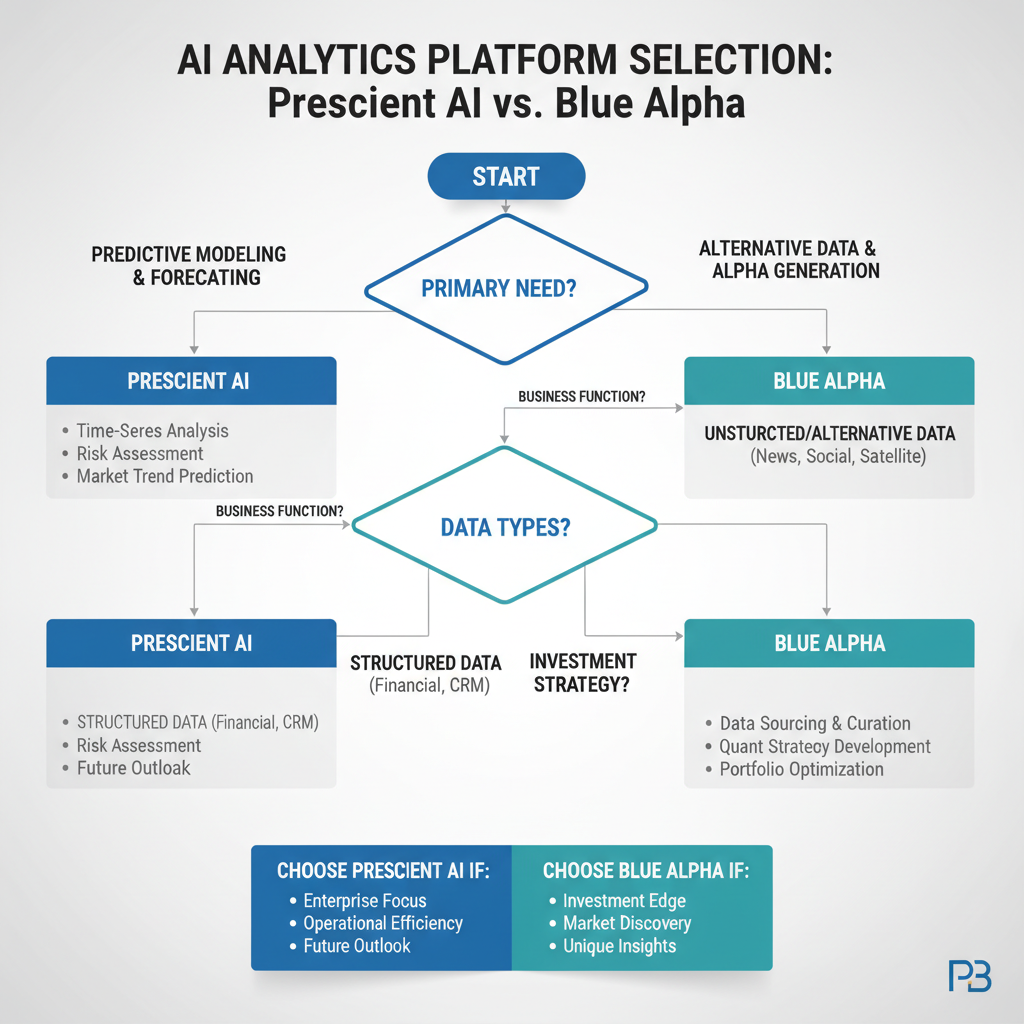
Match your team capabilities and strategic priorities to the right platform
The Broader MMM Platform Landscape
Prescient AI and Blue Alpha represent just two options in an increasingly crowded MMM market. Other platforms worth considering include:
Measured: Rated 4.9/5 across review platforms, Measured combines automated experimentation with MMM. Best for brands seeking fast, incrementality-calibrated insights with weekly model refreshes.
Sellforte: Strong for eCommerce and retail brands, with transparent pricing starting at $3,390/month for performance plans. Sellforte focuses heavily on ROI optimization and detailed channel performance analytics.
Cassandra: Self-service MMM built for mid-sized brands and agencies. Cassandra trades advanced features for simplicity, making it accessible to teams without deep analytics expertise.
The common thread across modern MMM platforms: moving from quarterly consulting engagements to SaaS products with faster refresh cycles, integrated experimentation, and more accessible interpretation.
Frequently Asked Questions
What's the main difference between Prescient AI vs Blue Alpha?
Prescient AI prioritizes speed with daily model updates and rapid implementation, while Blue Alpha emphasizes causal validation by integrating incrementality testing with Bayesian MMM. Prescient suits brands that need fast optimization decisions. Blue Alpha fits teams that need high-confidence attribution validated by experiments.
How long does implementation take for each platform?
Blue Alpha implements in approximately three weeks from kickoff to live model, handling data integration and cleansing. Prescient AI's timeline isn't publicly disclosed, but pre-built integrations with 100+ platforms suggest 4-8 week implementation typical of SaaS MMM vendors.
Which platform works better for mid-market brands?
Blue Alpha explicitly targets mid-market brands with $3M-$20M annual marketing spend, offering natural language explanations that eliminate the need for in-house data scientists. Prescient AI focuses on larger brands with $10M+ spend and dedicated marketing ops teams capable of implementing technical recommendations.
Do these platforms integrate with my existing marketing tools?
Prescient AI offers pre-built integrations with major platforms including Shopify, Amazon, Meta, Google, Snap, TikTok, and CTV networks. Blue Alpha handles custom integrations during the three-week implementation process. Both platforms connect to standard marketing data sources without requiring API development.
How much do Prescient AI and Blue Alpha cost?
Neither platform publishes transparent pricing. Based on typical SaaS MMM pricing, expect $60,000-$120,000 annually for mid-market implementations. Pricing varies based on marketing spend, channel complexity, and data volume. Both require sales conversations for custom quotes.
Can these platforms replace my current attribution solution?
Prescient AI and Blue Alpha complement rather than replace pixel-based attribution. MMM measures aggregate channel impact and is privacy-compliant, while pixel attribution tracks individual user journeys. Most brands run both systems—using attribution for tactical optimization and MMM for strategic budget allocation.
Making Your Decision
The Prescient AI vs Blue Alpha comparison reveals two strong platforms solving the same core problem through different approaches. Neither platform is objectively "better"—the right choice depends on your team capabilities, budget cycle, and strategic priorities.
If you need speed and have the technical resources to implement recommendations quickly, Prescient AI's daily updates provide a clear advantage. If you need causal validation and lack data science teams, Blue Alpha's integrated incrementality testing and natural language explanations offer more accessible insights.
But here's what matters more than platform features: getting started with modern marketing mix modeling at all. Brands still relying on last-click attribution or platform-reported metrics face a significant competitive disadvantage as third-party cookies disappear.
The real comparison isn't Prescient AI vs Blue Alpha—it's modern MMM vs guessing which channels actually work. Both platforms deliver dramatically better ROI measurement than the legacy approaches most brands still use.
Start with a clear-eyed assessment of your team's technical capabilities and strategic needs. Then have conversations with both vendors. The platform that fits your workflow and budget constraints will become obvious through that process.
Ready to see what modern MMM can reveal about your marketing performance? Get a free MMM consultation from Blue Alpha to see which channels are truly driving growth.
Stay in the loop
Get updates on new posts and resources.