11 Best Recast Alternatives for Marketing Mix Modeling in 2026
Looking for Recast alternatives? Compare the top MMM and incrementality testing platforms to find the right marketing measurement solution for your needs.
Marketing teams are drowning in data but starving for insights.
Recast has earned its place as a respected marketing mix modeling platform, offering Bayesian MMM and incrementality testing capabilities. But it's not the only option—and it might not be the right fit for your team's specific needs, budget, or technical requirements.
Whether you're evaluating Recast alternatives due to pricing concerns, seeking different features, or exploring what else exists in the MMM space, this guide breaks down the top platforms that measure true marketing incrementality in 2026. We've analyzed over 25 marketing measurement solutions to bring you the most comprehensive comparison available.
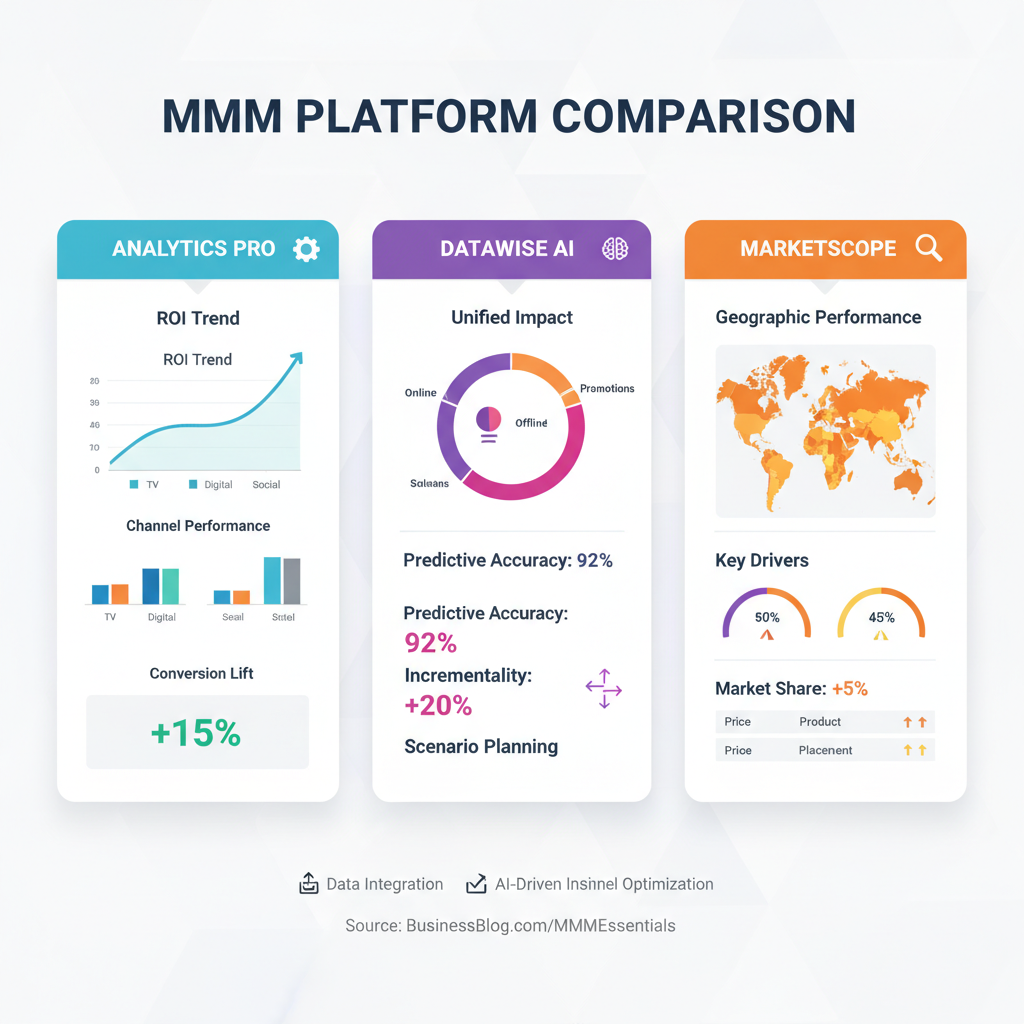
Modern MMM platforms offer varying capabilities from basic modeling to advanced incrementality testing
What Is Recast and Why Look for Alternatives?
Recast is a forecasting-first marketing measurement platform that combines Bayesian marketing mix modeling with incrementality testing. The platform helps marketing, data science, and finance teams measure the true incremental impact of marketing spend across all channels.
The platform's GeoLift tool enables geo-based incrementality experiments to validate MMM outputs. This combination of continuous modeling and periodic testing represents the modern approach to marketing measurement.
But Recast isn't for everyone.
Common reasons teams explore Recast alternatives include:
- Pricing: Average contract values around $35,000 annually (ranging up to $75,000) put Recast out of reach for many mid-market companies
- Feature gaps: Some teams need more granular attribution, faster setup times, or specific integrations Recast doesn't offer
- Technical requirements: Data science teams may want more customization or prefer open-source solutions
- Vendor preference: Organizations already invested in competing analytics ecosystems
The good news? The MMM landscape has exploded with innovation since 2024. Marketing mix modeling has transformed from a niche enterprise tool to an essential platform for any brand spending significantly on marketing.
Top 11 Recast Alternatives for Marketing Measurement
1. Measured – Best for Enterprise Brands Requiring Speed
Measured leads the commercial MMM space with a Gartner #1 ranking and consistent 4.9/5 ratings across G2 and Capterra.
What sets Measured apart:
- Fastest time-to-value: Onboarding in as little as 4 weeks versus 3-6 months for traditional vendors
- Automated incrementality testing integrated directly into MMM workflows
- Cross-channel attribution combined with media mix modeling for complete visibility
- Real-time optimization recommendations rather than quarterly reports
Best for: Enterprise brands and retailers spending $5M+ annually on marketing who need fast implementation and scientifically rigorous measurement.
Pricing: Custom enterprise pricing (typically higher than Recast)
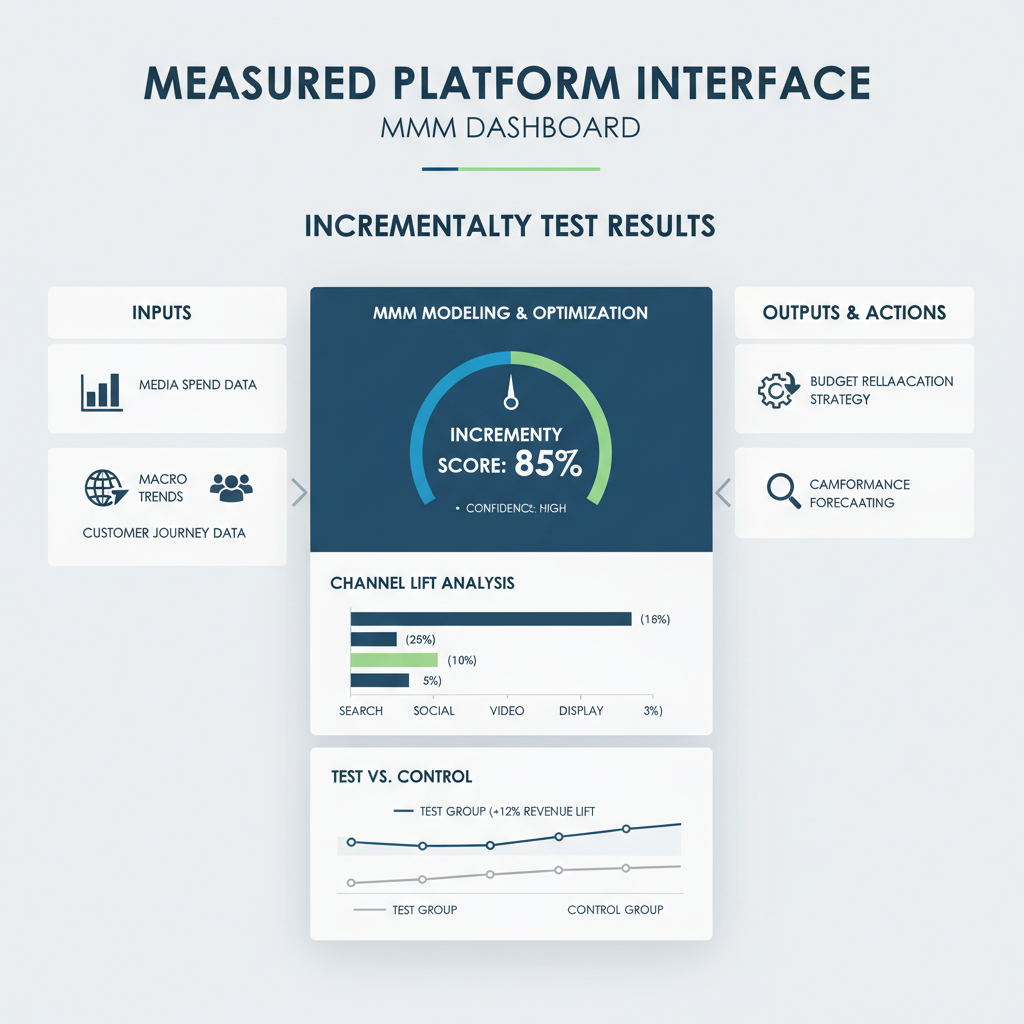
Measured integrates MMM with automated geo-testing for continuous validation
2. Lifesight – Best Unified Measurement Platform
Lifesight offers the most comprehensive measurement suite, combining geo-based incrementality testing, causal MMM, and incrementality-adjusted attribution in one platform.
Key capabilities:
- No-code geo-test design for marketing teams without data science resources
- AI-driven optimization recommendations based on marginal ROI curves
- Scenario planning tools for budget allocation across 200+ channels
- Real-time dashboards showing continuous performance metrics
Unique advantage: Lifesight calibrates attribution models using incrementality test results, ensuring accuracy beyond traditional multi-touch attribution approaches.
Best for: Mid-market to enterprise brands wanting a single platform for all measurement methodologies without juggling multiple vendors.
Pricing: Starting at $2,000/month for core features
3. Haus – Best for Scientific Rigor
Haus positions itself as the incrementality platform built for the highest standards of statistical rigor and methodological transparency.
What makes Haus different:
- GeoLift product using synthetic controls for geographic incrementality testing
- Causal Attribution that adjusts for true incrementality
- Causal MMM with continuous validation against test results
- Placebo testing and extensive diagnostics to validate results
Technical strengths: Haus publishes their methodologies openly and provides detailed documentation on how to choose incrementality testing tools, making it ideal for teams with strong analytical capabilities.
Best for: Data-driven organizations with technical teams who want complete transparency into measurement methodology.
Pricing: Custom pricing based on ad spend and testing volume
4. WorkMagic – Best for Integrated Attribution
WorkMagic bridges the gap between marketing mix modeling, multi-touch attribution, and incrementality testing in a single platform.
Core features:
- Predictive MMM that forecasts performance across channels
- Multi-touch attribution calibrated with incrementality test results
- Unified reporting showing both correlation and causation
- Automated optimization recommendations
Why it matters: Most platforms force you to choose between MTA and MMM. WorkMagic uses incrementality tests to calibrate attribution models, delivering accuracy traditional MTA can't match.
Best for: E-commerce and direct-response brands needing both granular attribution and strategic MMM insights.
Pricing: Available upon request
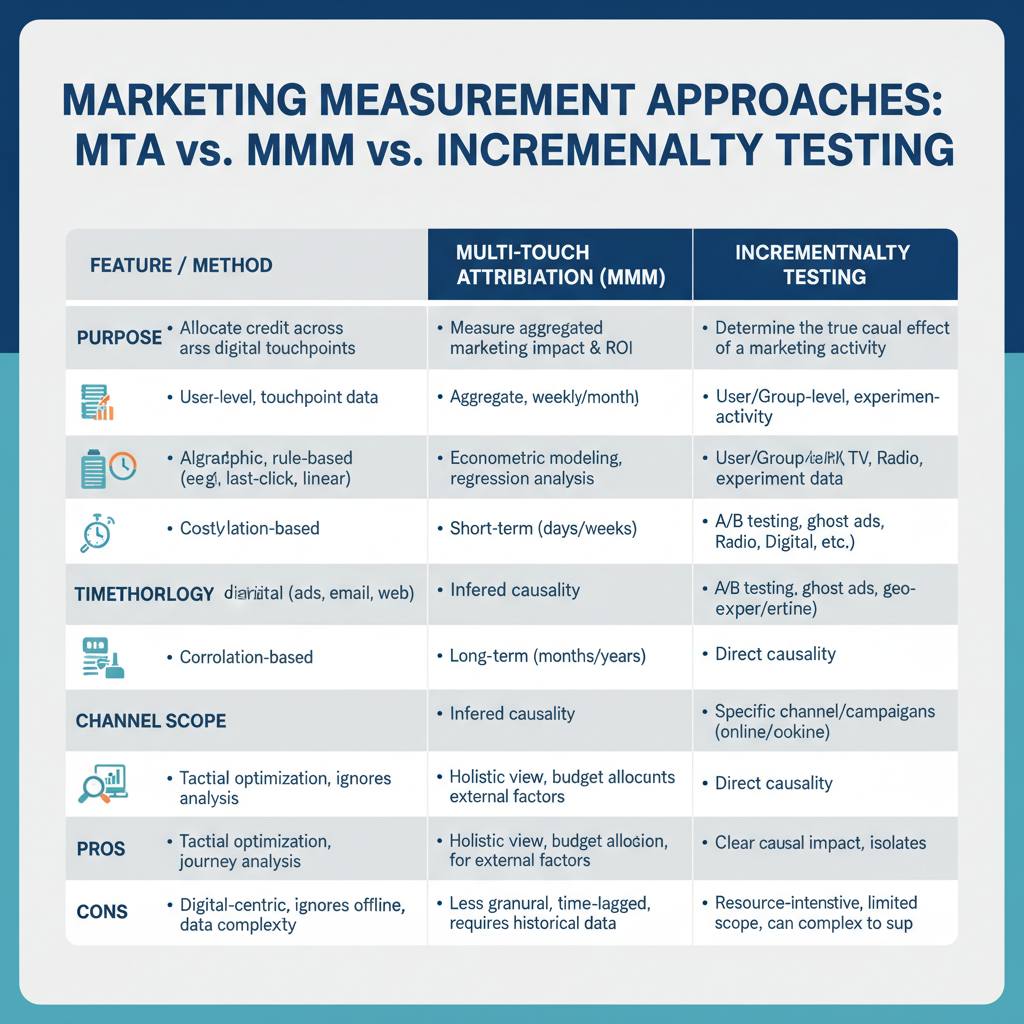
Modern platforms combine multiple methodologies for comprehensive measurement
5. Sellforte – Best for Continuous Incrementality
Sellforte offers Marketing Mix Modeling SaaS with a unique focus on continuous incrementality measurement for each advertising channel and campaign.
Standout features:
- Automated model updates as new data arrives
- Channel-specific incrementality scores updated continuously
- Scenario planning with "what-if" budget allocation tools
- ROI measurement for 100+ marketing channels
The difference: While most platforms measure incrementality through periodic tests, Sellforte's MMM continuously estimates incrementality, providing always-on insights.
Best for: Performance marketing teams who need frequent optimization cycles rather than quarterly planning.
Pricing: Starts at €2,500/month
6. LiftLab – Best for Economic Modeling
LiftLab combines economic modeling principles with media experimentation to improve marketing efficiency and forecasting accuracy.
Key capabilities:
- Econometric modeling that accounts for external factors (seasonality, competitors, macroeconomics)
- Media experimentation framework for testing new channels
- Forecasting tools for budget planning
- Integration with major ad platforms for automated data collection
Why consider it: LiftLab brings an economist's perspective to marketing measurement, making it particularly strong for brands affected by external market forces.
Best for: Brands in volatile markets or with complex business models requiring sophisticated economic modeling.
Pricing: Custom pricing
7. Prescient AI – Best for Multi-Revenue Channel Optimization
Prescient AI focuses specifically on improving paid marketing effectiveness across multiple revenue channels with AI-powered recommendations.
Core strengths:
- AI-driven budget optimization across channels
- Revenue attribution by channel and campaign
- Predictive modeling for future performance
- Automated insights and recommendations
Best for: Brands with multiple product lines or revenue streams needing channel-specific optimization.
Pricing: Contact for custom quote
8. Keen Decision Systems – Best for AI-Powered Automation
Keen Decision Systems brings heavy AI automation to marketing mix modeling, reducing manual work typically required in MMM implementations.
What it offers:
- Automated data preparation and cleaning
- AI-driven variable selection and model iteration
- Self-service optimization tools for marketing teams
- Integration with major marketing and analytics platforms
The automation advantage: Keen reduces implementation time from months to weeks by automating 80% of the manual MMM work.
Best for: Marketing teams without dedicated data science resources who need turnkey MMM solutions.
Pricing: Annual subscription model, contact for pricing
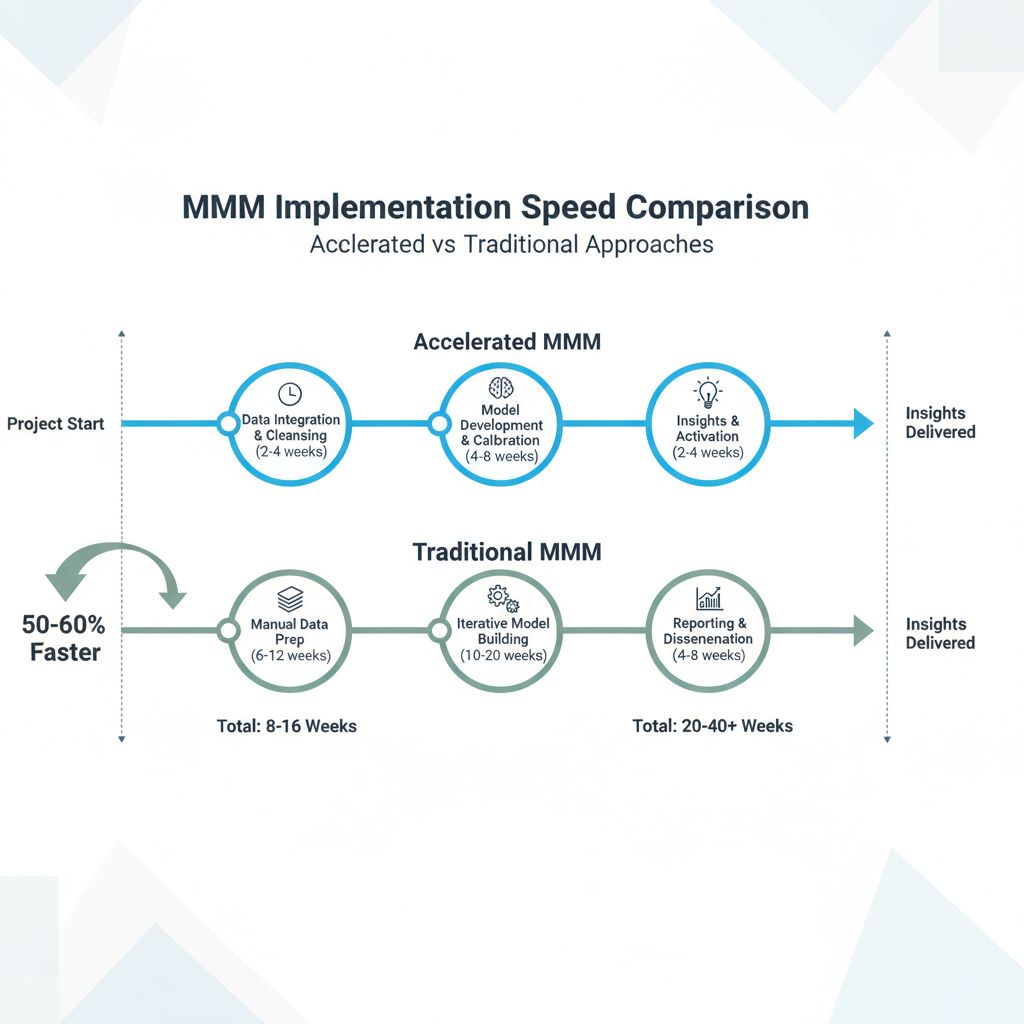
Modern MMM platforms reduce setup time from 6 months to 4-8 weeks through automation
9. Uncover – Best for Media Optimization Focus
Uncover specializes in marketing mix modeling and media optimization with AI-powered forecasting capabilities.
Key features:
- Media investment analysis across all channels
- Performance forecasting for budget planning
- Optimization algorithms for spend allocation
- Integration with marketing data platforms
Best for: Brands primarily focused on media optimization rather than full-funnel measurement.
Pricing: Custom enterprise pricing
10. Google Meridian – Best Free Option
Google launched Meridian as the successor to LightweightMMM, offering a free, open-source MMM tool.
What you get:
- User-friendly interface designed for marketers
- Integration with Google Analytics and Google Ads
- Bayesian modeling framework
- No software licensing fees
The catch: Requires technical setup, ongoing maintenance, and data science expertise to use effectively. You're trading software costs for personnel costs.
Best for: Companies with data science teams willing to maintain an open-source solution, or those just starting with MMM on a limited budget.
Pricing: Free (open-source)
11. Meta Robyn – Best for Customization
Meta's Robyn is an open-source MMM library allowing complete customization for companies with experienced data science teams.
Technical capabilities:
- Fully customizable modeling framework
- Ridge regression with hyperparameter optimization
- Budget allocation optimization algorithms
- Integration with Meta's ad platforms
Technical requirements: Requires R programming knowledge, statistical expertise, and dedicated data engineering resources.
Best for: Large enterprises with data science teams who want maximum control over their MMM implementation.
Pricing: Free (open-source)
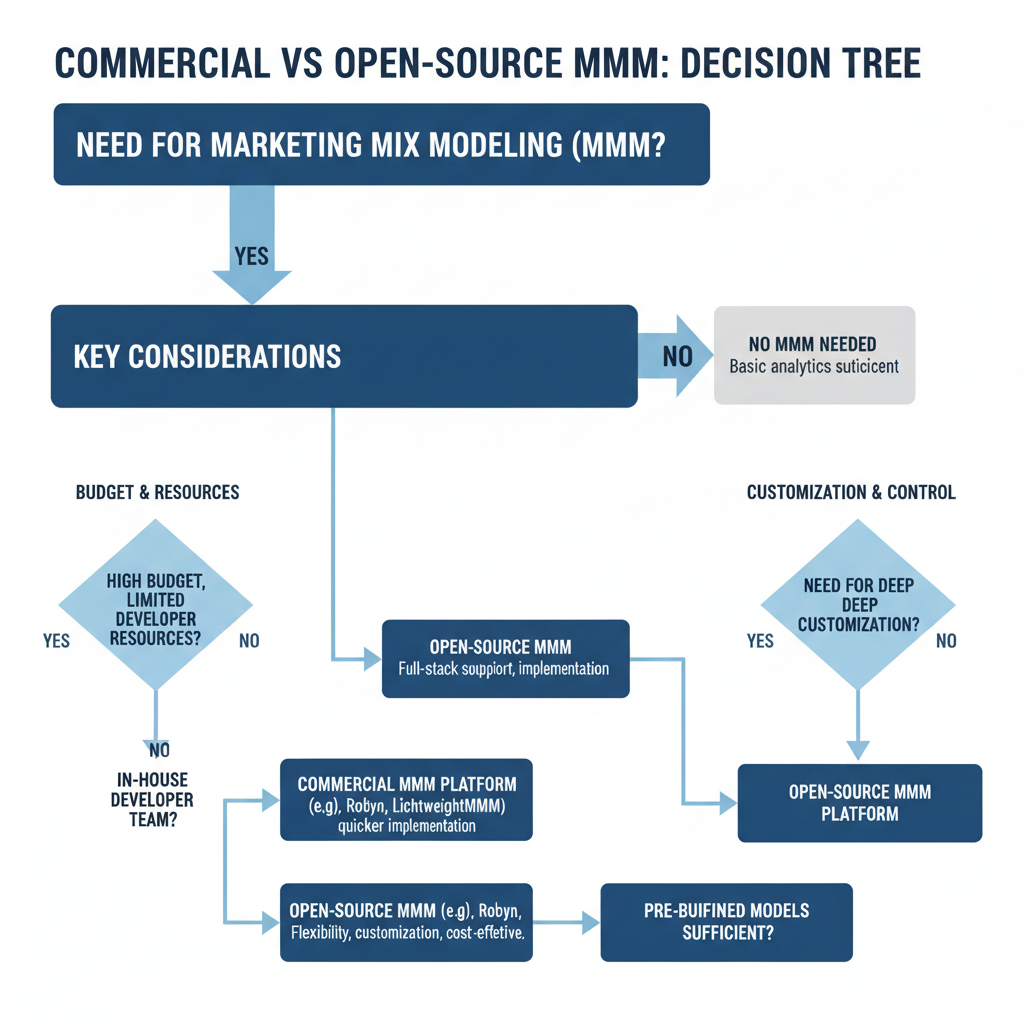
Choose commercial platforms for speed and support, open-source for customization and control
How to Choose the Right Recast Alternative
Selecting the right marketing measurement platform requires evaluating multiple dimensions beyond features and pricing.
1. Supported Methodologies
Modern marketing measurement platforms should offer multiple approaches:
Core methodologies to look for:
- Marketing Mix Modeling (MMM): Continuous measurement of all marketing channels
- Geo-testing: Geographic split tests to measure incrementality
- Incrementality testing: Various experimental designs beyond just geo-tests
- Causal attribution: Attribution adjusted for true incrementality
The best platforms don't force you to choose. They integrate multiple methodologies, using incrementality testing to validate and calibrate MMM, creating what industry experts call "triangulation."
2. Integration and Data Governance
Your measurement platform needs data from multiple sources. Evaluate:
- Marketing platform integrations (Meta, Google, TikTok, etc.)
- Analytics tool connections (Google Analytics, Adobe, Segment)
- CRM and revenue data imports
- Data warehouse compatibility
- Privacy and security compliance
Red flag: Platforms requiring extensive manual data preparation will create ongoing operational burden.
3. Time-to-Value and Experiment Velocity
Traditional MMM implementations took 3-6 months to first insights. Modern platforms reduce this to 4-8 weeks.
Ask vendors:
- How long until first model results?
- How frequently do models update?
- How quickly can we run incrementality tests?
- What's required from our team during setup?
Faster time-to-value means you start optimizing sooner, directly impacting ROI.
4. Transparency and Validation
Demand visibility into how platforms generate recommendations:
Essential transparency features:
- Access to model coefficients and statistical diagnostics
- Explanation of how incrementality is calculated
- Validation metrics (R², MAPE, confidence intervals)
- Documentation of methodologies used
Validation questions for vendors:
- Can you show me a live geo-test readout with lift %, confidence intervals, and heterogeneity?
- How do you account for external factors and potential biases?
- What guardrails prevent false positives in testing?
- How do test learnings recalibrate your MMM?
5. Granularity and Flexibility
Different businesses need different levels of detail:
- Channel level: Overall performance by channel (Meta, Google, TV)
- Campaign level: Performance of specific campaigns
- Creative level: Performance by ad creative or message
- Audience level: Performance by customer segment
Match platform capabilities to your optimization needs. If you optimize at the campaign level, channel-only measurement won't provide actionable insights.
6. Support and Expertise
MMM platforms range from DIY tools to fully-managed services:
Self-service platforms provide software and documentation but expect you to run analysis and optimization yourself. Best for teams with analytical capabilities.
Managed services include analysts who handle modeling, testing, and recommendations. Best for teams focused on execution rather than analysis.
Hybrid models offer self-service tools with expert support available as needed. Often the best balance for mid-market companies.
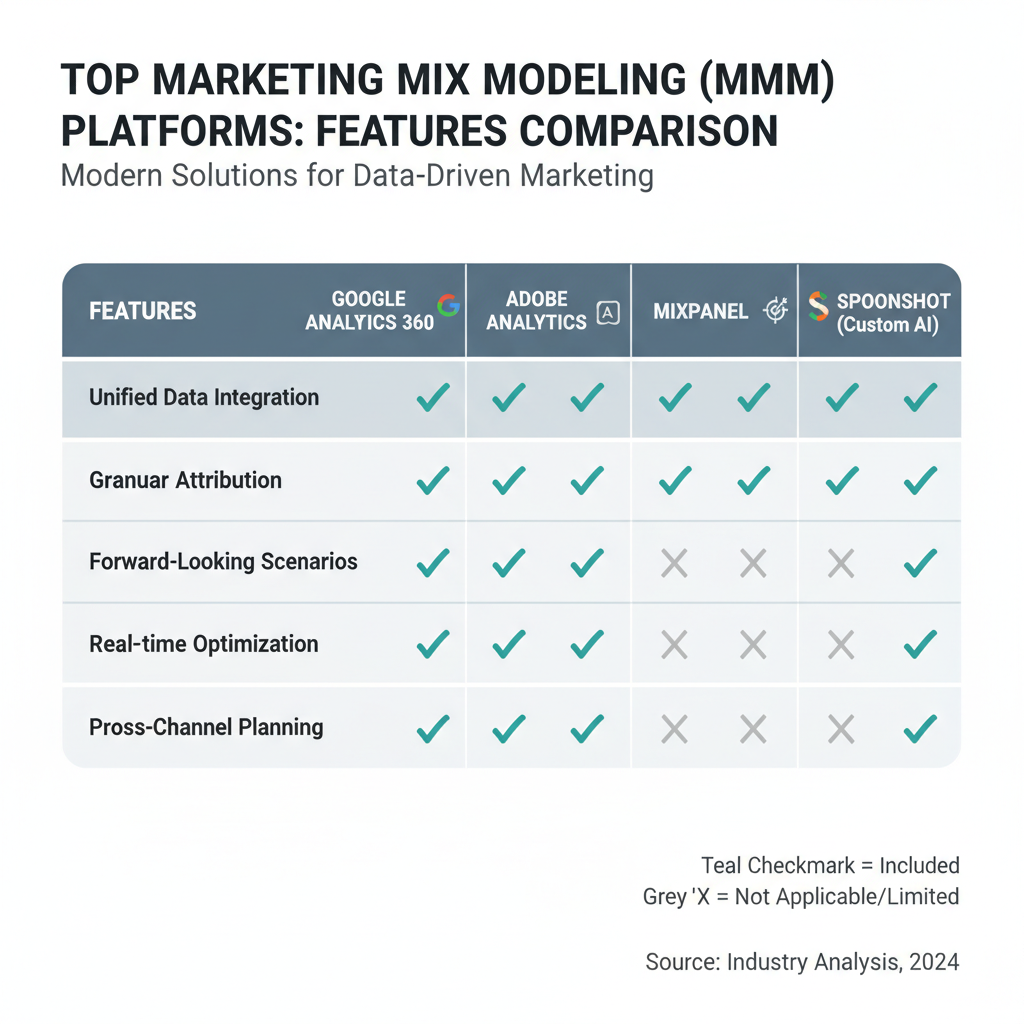
Evaluate platforms across methodologies, integrations, speed, and support level
Key Features Comparison: Recast vs. Top Alternatives
Here's how the leading platforms stack up across critical dimensions:
| Platform | Setup Time | Incrementality Testing | MMM | Attribution | Pricing Model |
|---|---|---|---|---|---|
| Recast | 6-8 weeks | ✓ GeoLift | ✓ Bayesian | Limited | $35K-75K/year |
| Measured | 4 weeks | ✓ Automated | ✓ Advanced | ✓ Full | Enterprise |
| Lifesight | 4-6 weeks | ✓ No-code | ✓ Causal | ✓ Adjusted | $2K+/month |
| Haus | 6-8 weeks | ✓ Advanced | ✓ Causal | ✓ Causal | Custom |
| WorkMagic | 4-6 weeks | ✓ Multi-method | ✓ Predictive | ✓ MTA + MMM | Custom |
| Sellforte | 4 weeks | ✓ Continuous | ✓ Automated | Limited | €2.5K+/month |
| Prescient AI | 6-8 weeks | Limited | ✓ Core | ✓ Multi-channel | Custom |
| Keen | 4 weeks | Limited | ✓ AI-powered | Limited | Subscription |
| Meridian (Google) | 8-12 weeks* | Limited | ✓ Open-source | Limited | Free |
| Robyn (Meta) | 12+ weeks* | None | ✓ Customizable | None | Free |
*Implementation time for open-source solutions varies significantly based on technical resources and customization requirements.
Pricing Considerations for MMM Platforms
Marketing mix modeling platforms use various pricing models that can significantly impact total cost of ownership.
Commercial Platform Pricing Models
Annual subscription ($35K-100K+/year)
- Fixed cost regardless of ad spend
- Predictable budgeting
- Best for: Mid-market to enterprise with stable marketing budgets
- Example: Recast ($35K-75K)
Usage-based pricing
- Cost scales with ad spend or data volume
- Pay more as you grow
- Best for: Rapidly growing brands where fixed costs would be either too high initially or too constraining later
- Example: Lifesight (starting $2K/month)
Setup + subscription
- One-time implementation fee plus ongoing subscription
- Higher initial investment, lower ongoing costs
- Best for: Enterprises with complex data requirements
Managed service pricing
- Includes platform plus analyst support
- Highest cost but lowest internal resource requirements
- Best for: Brands without data science teams
Hidden Costs to Consider
Beyond platform fees, factor in:
- Data integration costs: Engineering time to connect data sources
- Internal resources: Time from marketing, analytics, and data teams
- Training: Getting teams up to speed on the platform
- Testing budget: Money allocated for running incrementality tests (typically 1-5% of ad spend)
Total cost of ownership calculation: Platform costs + (Internal resources × hourly rate) + Testing budget = Annual TCO
For many mid-market brands, a $50K platform requiring minimal internal resources delivers better ROI than a $25K platform demanding significant data science support.
When to Choose Open-Source vs. Commercial Platforms
The open-source versus commercial decision isn't just about budget—it's about resources, expertise, and strategic priorities.
Choose Open-Source (Meridian, Robyn) When:
You have the technical resources:
- Experienced data scientists comfortable with R or Python
- Data engineers to handle integrations and pipelines
- Analysts to interpret results and generate insights
You need maximum customization:
- Unique business model requiring custom modeling
- Specific methodological requirements
- Integration with proprietary systems
Budget is the primary constraint:
- Marketing spend under $2M annually where platform fees represent significant percentage
- Experimentation phase before committing to commercial solution
Choose Commercial Platforms When:
Speed matters:
- Need insights in weeks, not months
- Want to optimize current budget immediately
- Lack time to build and maintain infrastructure
Resources are limited:
- Small or no data science team
- Analytics team focused on other priorities
- Marketing team needs self-service access
Support is valuable:
- Want expert guidance on measurement strategy
- Need help interpreting results and generating recommendations
- Value having vendor accountable for accuracy
Most brands spending $3M+ annually on marketing find commercial platforms deliver better ROI despite higher upfront costs. The opportunity cost of delayed insights typically exceeds software savings.
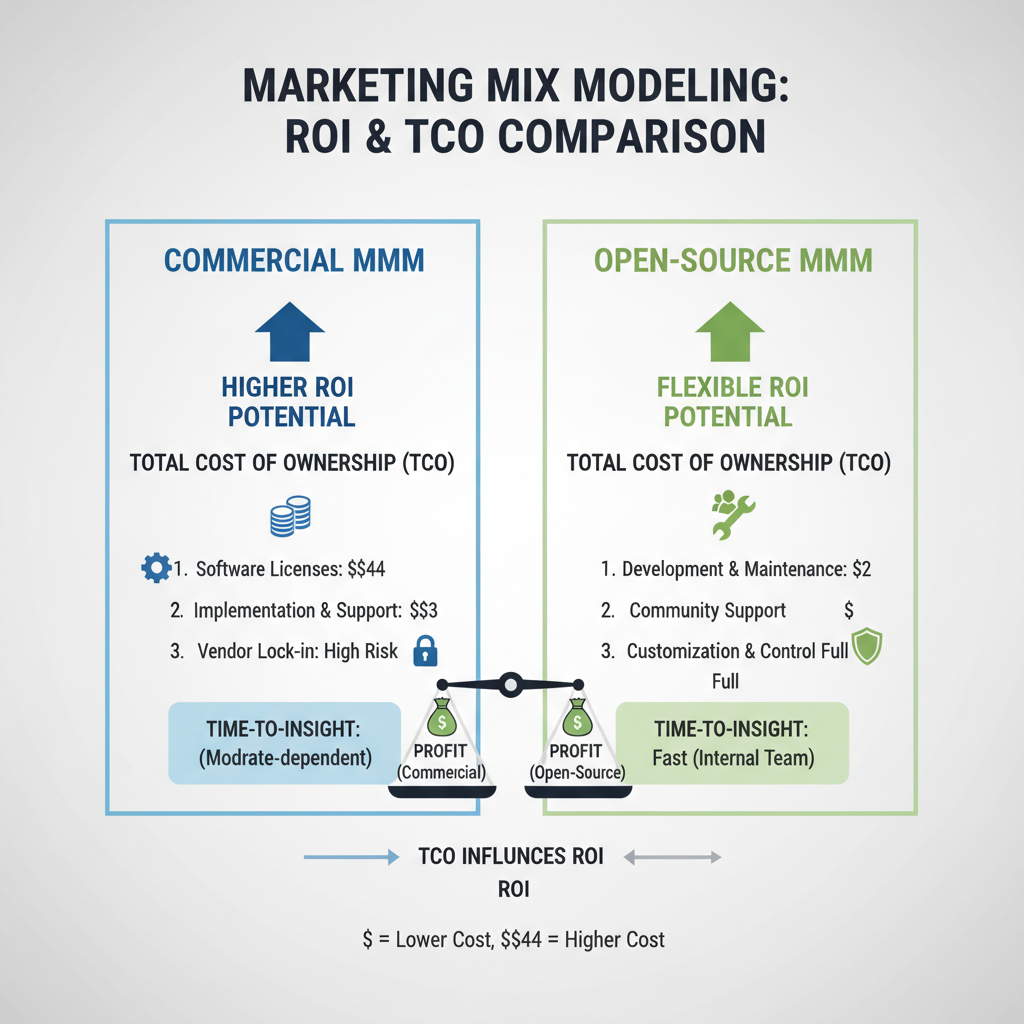
Commercial platforms cost more but deliver faster time-to-value and require fewer internal resources
The Future of Marketing Measurement in 2026
The MMM landscape continues evolving rapidly. Key trends reshaping marketing measurement:
AI automation is table stakes. Modern platforms automate data preparation, variable selection, and model iteration that traditionally required months of manual work. By 2026, AI has compressed implementation time from months to weeks.
Incrementality testing integration is non-negotiable. Credible MMM providers now integrate incrementality testing as a core feature, not an add-on. The combination of continuous modeling with periodic experimental validation represents the gold standard.
Privacy-first measurement wins. With tracking limitations intensifying, aggregate-level MMM provides measurement that doesn't rely on individual user tracking. This privacy-first approach future-proofs your measurement as regulations tighten.
Real-time optimization replaces quarterly planning. Legacy MMM delivered insights quarterly. Modern platforms provide continuous measurement enabling weekly or even daily optimization decisions.
Cross-channel view becomes universal. The best platforms measure everything—digital, traditional media, retail, and below-the-line marketing—in a single framework, ending siloed measurement.
Frequently Asked Questions
What's the difference between MMM and incrementality testing?
Marketing mix modeling (MMM) uses statistical regression to measure the impact of all marketing channels continuously based on historical data. Incrementality testing runs controlled experiments (like geo-tests) to measure the causal impact of specific marketing activities. Modern platforms combine both approaches—using MMM for continuous measurement and incrementality tests for validation.
How much should I budget for a marketing mix modeling platform?
Commercial MMM platforms typically range from $24K-$100K+ annually depending on features, support level, and company size. Budget 1-5% of your annual marketing spend for incrementality testing, plus internal resource costs. Most experts recommend minimum $3M annual marketing spend to justify MMM investment.
Can I run MMM in-house with open-source tools?
Yes, but it requires significant technical expertise. Open-source options like Google Meridian or Meta Robyn are free but demand data science skills, R/Python programming knowledge, and ongoing maintenance. Most companies find commercial platforms deliver better ROI unless they have dedicated data science teams.
How long does it take to implement a marketing mix modeling platform?
Modern commercial platforms deliver first insights in 4-8 weeks. Traditional implementations took 3-6 months. Open-source solutions typically require 3-6 months depending on technical resources and customization needs. Implementation speed is a critical differentiator between platforms.
What's better: multi-touch attribution or marketing mix modeling?
Neither is universally "better"—they answer different questions. Multi-touch attribution shows the customer journey at a granular level but struggles with accuracy due to tracking limitations and doesn't measure upper-funnel impact. MMM measures all channels including offline and provides true incrementality but lacks granular journey visibility. The best approach? Use both, with incrementality testing to calibrate attribution accuracy.
Do I need a data science team to use MMM platforms?
It depends on the platform. Self-service platforms assume analytical capabilities. Managed service providers handle analysis for you. Hybrid models offer the best of both—self-service tools with expert support available. Open-source solutions absolutely require data science expertise. Choose based on your team's capabilities.
How do I validate that an MMM platform is accurate?
Demand transparency into methodologies and validation metrics. Run incrementality tests to verify MMM predictions match experimental results. Check statistical diagnostics like R² (model fit), MAPE (forecast accuracy), and confidence intervals. Ask vendors to demonstrate how they account for external factors, avoid overfitting, and handle data quality issues.
Making Your Decision: Next Steps
Choosing the right Recast alternative comes down to matching platform capabilities with your specific requirements, resources, and budget.
Start here:
- Assess your requirements – Document your must-have features, technical capabilities, budget constraints, and timeline
- Shortlist 3-4 platforms – Based on this analysis, identify platforms matching your profile
- Request demos – Ask vendors to address your specific use cases, show live results, and explain their methodology
- Validate claims – Request customer references in similar situations and ask about actual implementation experience
- Run a pilot – If possible, start with a limited engagement before committing to multi-year contracts
Red flags to watch for:
- Vendors unwilling to explain their methodology
- Promises of perfect accuracy or guaranteed ROAS improvements
- Lack of customer references or case studies
- Resistance to showing actual platform capabilities in demos
The right marketing measurement platform becomes your competitive advantage. It identifies what's working, reveals what's wasting budget, and guides optimization decisions that compound over time.
While Recast offers solid capabilities, it's one option in an increasingly sophisticated market. Measured delivers unmatched speed for enterprises. Lifesight provides the most comprehensive unified measurement. Haus offers maximum scientific rigor. Open-source solutions like Meridian work for technical teams on tight budgets.
The best platform isn't the one with the most features—it's the one that matches your needs, gets implemented quickly, and actually gets used by your team to make better decisions.
Ready to improve your marketing measurement? The platforms above represent the leading edge of marketing analytics in 2026. Pick the one that fits your organization, and you'll finally have the visibility needed to optimize with confidence.
Stay in the loop
Get updates on new posts and resources.