Recast vs BlueAlpha: Which MMM Platform Delivers Better ROI in 2026?
Compare Recast and BlueAlpha's marketing mix modeling platforms. See features, pricing, and which MMM tool fits your marketing budget and team size.
Marketing mix modeling stopped being optional around 2024. By 2026, the question isn't whether you need MMM—it's which platform gives you the fastest path to measurable ROI improvements.
Recast and BlueAlpha both promise to solve the same problem: helping marketing teams understand what's actually driving revenue. But they approach that problem from very different angles. One platform brings years of enterprise validation and proven forecasting accuracy. The other brings fresh AI-powered automation and rapid implementation.
This comparison cuts through the marketing speak to show you exactly what each platform delivers, what it costs, and which one fits your specific needs.
What Is Recast?
Recast is a marketing mix modeling platform built for modern brands that need weekly insights instead of quarterly reports. The platform currently guides over $4 billion in annual marketing spend for Fortune 50 companies, CPG brands, fintech firms, and pharmaceutical companies.
The core difference? Recast uses a time-series model that estimates incremental ROI for every channel, every day. This means you see exactly how marketing performance evolves with creative changes, seasonality, and market conditions—not just a static snapshot from three months ago.
Key Features
Recast's Causal MMM employs fully Bayesian statistical modeling with Hamiltonian Monte Carlo sampling, which translates to more accurate predictions with quantified uncertainty. The platform openly publishes its model documentation and performance metrics—a transparent "glass box" approach that lets data teams validate every assumption.
The platform includes Recast GeoLift for matched-market geo experiments, providing true causal validation. According to independent research on MMM validation methods, combining MMM with incrementality testing creates a feedback loop where MMM sets performance expectations and experiments validate those predictions.
Weekly model refreshes mean you catch performance shifts in days, not quarters. Revenue forecasting hits 94%+ accuracy, giving finance teams confidence in your marketing projections.
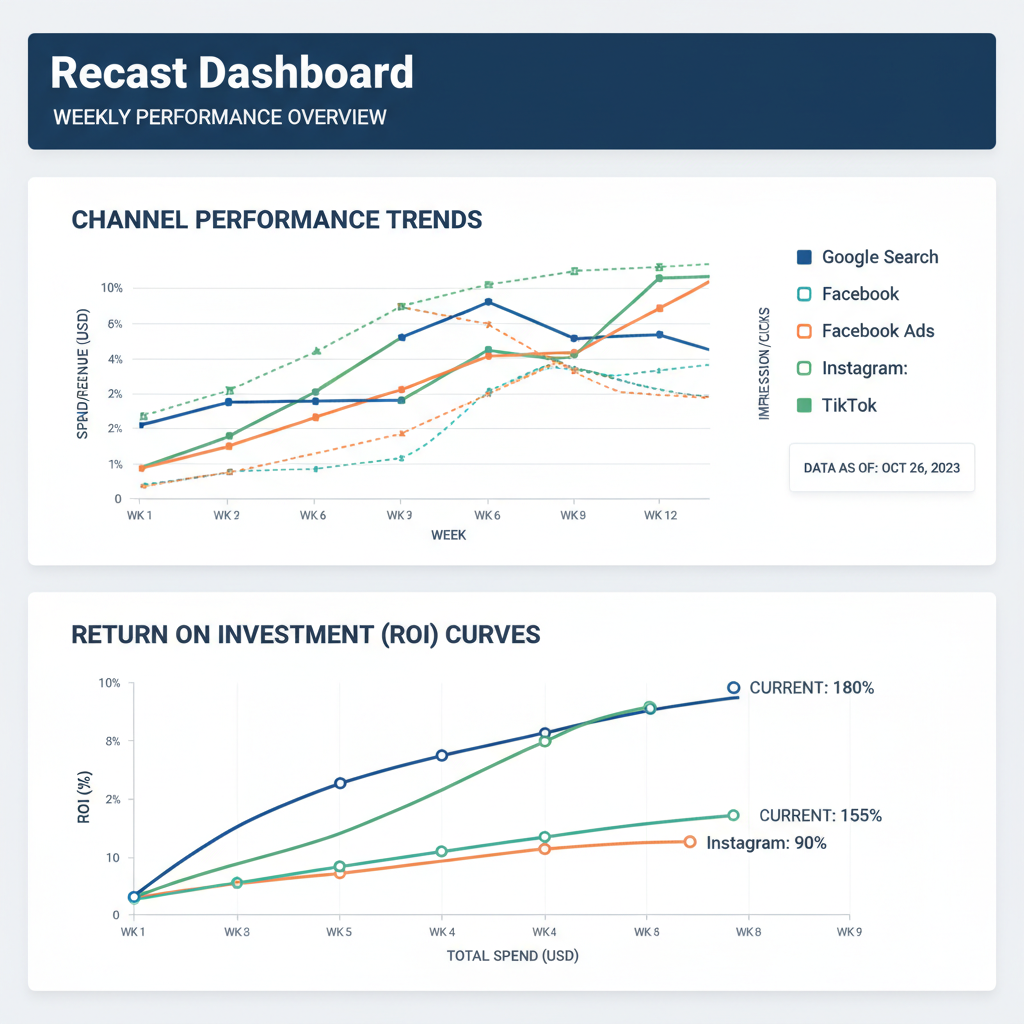
Recast's dashboard tracks daily channel performance with uncertainty intervals and budget optimization recommendations
Pricing
Recast operates on a subscription model with average annual costs around $35,000, though enterprise implementations can reach $75,000 depending on data complexity and channel count. For context, building a custom MMM solution typically costs $125,000 upfront plus $22,000 annually in maintenance—making Recast's SaaS approach significantly more cost-effective.
What Is BlueAlpha?
BlueAlpha launched in 2024 as an AI-powered marketing optimization platform. The founding team previously built Tesla's marketing optimization frameworks, bringing that experience to a broader market.
BlueAlpha positions itself as "the AI Action System for Marketing," emphasizing automated insights and natural language explanations. The platform uses an LLM to interpret modeling results and suggest specific actions—scale this campaign, pause that channel, optimize this budget allocation.
Key Features
BlueAlpha's AI-powered MMM updates weekly and adapts automatically without manual intervention. Implementation timelines run about three weeks from connection to measurable insights, which is faster than most traditional MMM vendors.
The platform integrates time-varying coefficients into a Bayesian MMM framework, accounting for how channel effectiveness shifts over time. According to marketing measurement research from 2026, time-varying models better capture the dynamic nature of digital marketing compared to static coefficient approaches.
BlueAlpha emphasizes campaign-level recommendations rather than just channel-level insights. The AI suggests specific optimizations like "reduce Meta prospecting spend by 15%, shift to retargeting" instead of generic guidance.
Pricing
BlueAlpha doesn't publish pricing publicly. As a newer platform founded in 2024, the company likely offers custom pricing based on marketing spend and complexity. Industry benchmarks suggest SaaS MMM solutions start around $2,000/month for SMBs and scale up for enterprise needs.
Feature Comparison: Recast vs BlueAlpha
Let's compare the platforms across dimensions that actually matter for marketing teams.
Modeling Approach
Both platforms use Bayesian methods, but with different implementations. Recast employs Hamiltonian Monte Carlo sampling for its posterior distributions, which provides more accurate uncertainty quantification than traditional approaches. BlueAlpha's AI-driven approach automates model specification and hyperparameter tuning.
According to analysis of next-gen MMM tools, Bayesian methods have become the standard in 2026 because they incorporate prior domain knowledge and produce more plausible results than frequentist approaches.
Recast's time-series specification allows marketing performance to dynamically change over time with per-channel seasonality. BlueAlpha's time-varying coefficients serve a similar purpose but emphasize automated detection of performance shifts.
Incrementality Integration
Recast includes GeoLift for matched-market experiments directly in the platform. This matters because incrementality testing is the gold standard for causal inference—it proves what your MMM predicts.
BlueAlpha offers incrementality testing integration but doesn't specify whether it's built-in or requires separate setup. The platform emphasizes the MMM/incrementality learning loop in its marketing materials.
Research from marketing measurement experts shows that MMM alone provides correlational insights, while incrementality tests deliver causal proof. The combination is more powerful than either approach alone.
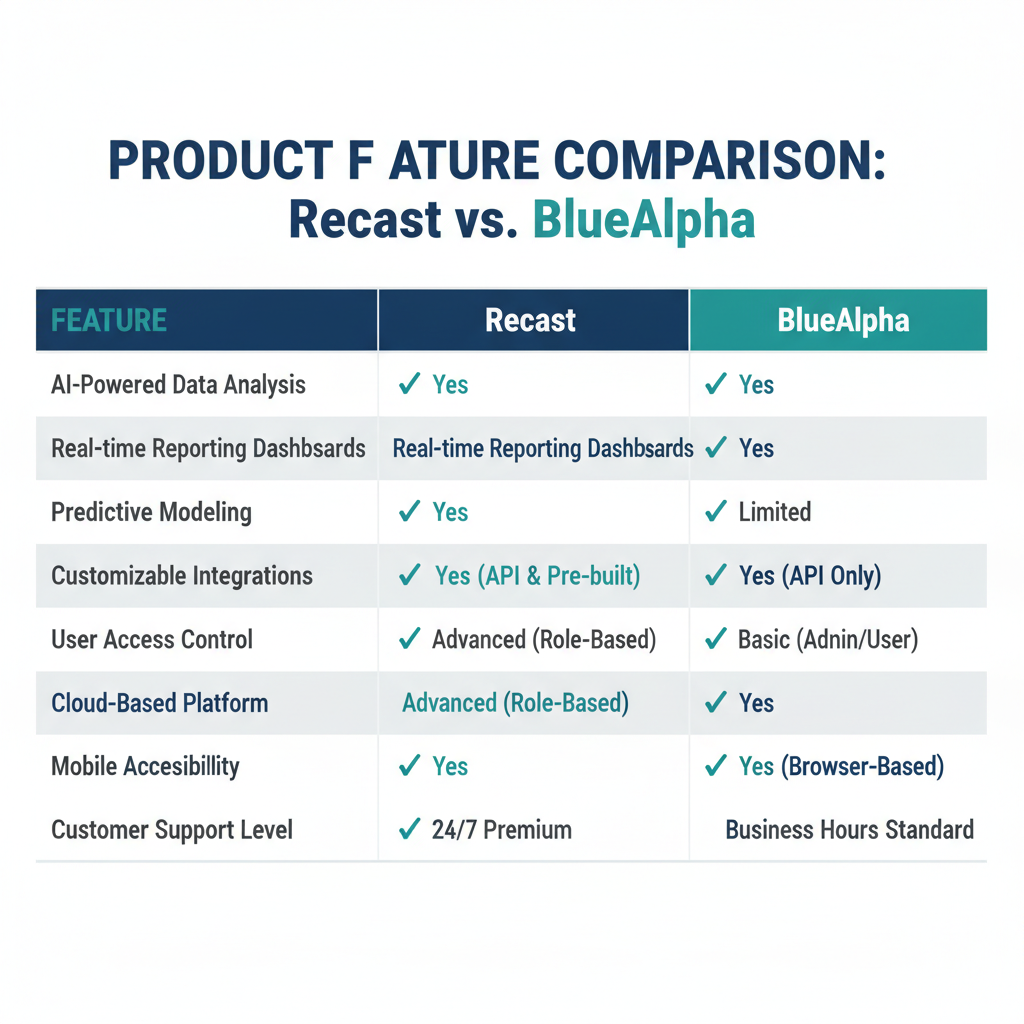
Key feature differences between Recast and BlueAlpha for marketing teams evaluating MMM platforms
Update Frequency & Speed
Both platforms offer weekly model refreshes. This represents a massive shift from legacy MMM approaches that updated quarterly. By 2026, weekly updates are considered slow, with real-time MMM becoming the expectation for mid-market and enterprise brands.
Recast's continuous back-testing validates models by running them through historical dates and comparing predictions to actual outcomes. This approach verifies that your MMM correctly estimates true incrementality rather than just fitting historical patterns.
BlueAlpha's AI automation means models "learn and adapt automatically," though specific validation methodologies aren't detailed in public documentation.
Transparency & Documentation
Recast openly publishes its model architecture and validation approach. Data teams can audit assumptions, understand priors, and validate statistical methods. This "glass box" approach builds trust with technical stakeholders.
BlueAlpha's AI-driven system emphasizes automated insights over manual inspection. The LLM interprets results in plain language, which helps non-technical users but may limit auditability for data science teams.
According to research on choosing MMM tools, transparency matters more for larger organizations with internal analytics teams, while automation matters more for lean teams without data scientists.
Budget Optimization
Recast includes optimization tools that recommend budget reallocations based on diminishing returns curves. The platform shows exactly where each additional dollar drives maximum incremental revenue.
BlueAlpha's AI suggests campaign-level optimizations with specific percentages: "shift 10% from channel A to channel B." This actionable specificity helps teams execute recommendations faster.
Both approaches work. The question is whether you want to review optimization logic (Recast) or trust AI recommendations (BlueAlpha).
Pricing Comparison
Recast's transparent pricing averages $35,000-$75,000 annually depending on complexity. This includes weekly model updates, GeoLift experiments, forecasting, and budget optimization. No hidden fees or per-model charges.
BlueAlpha uses custom pricing without public ranges. As a newer platform, pricing likely varies significantly based on implementation scope.
For comparison, enterprise MMM platforms like Measured or Analytic Partners often exceed $100,000 annually. Mid-market SaaS solutions like Sellforte start around $36,000/year.
According to MMM build-vs-buy analysis, the three-year total cost of ownership for SaaS MMM ranges from $1M-$2.7M when you factor in internal staff resources and data processing.
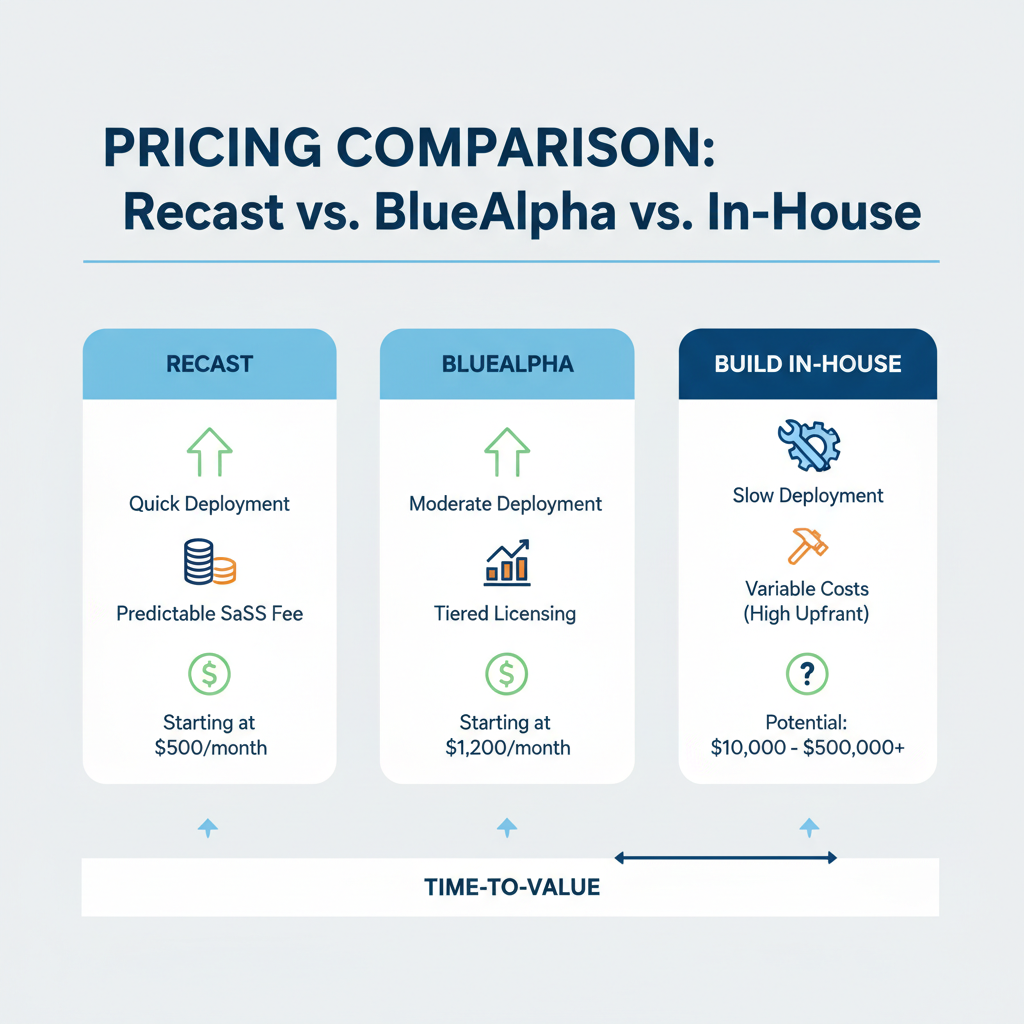
Total cost of ownership for different MMM approaches including subscription fees and internal resources
Which Platform Should You Choose?
The right choice depends on your team structure, technical capabilities, and where you are in your measurement journey.
Choose Recast If You:
-
Need proven accuracy at scale: Managing $50M+ in annual marketing spend means forecasting errors cost real money. Recast's 94%+ accuracy and Fortune 50 client base provide confidence.
-
Have technical stakeholders: CFOs, data scientists, and analytics teams want to audit model assumptions. Recast's transparent documentation and published methodologies enable that scrutiny.
-
Value true causal validation: Built-in GeoLift experiments prove incrementality rather than just predicting it. This matters when incrementality is the gold standard.
-
Want established reliability: Years of enterprise deployments mean fewer platform bugs and more mature features. You're not beta-testing a new product.
Choose BlueAlpha If You:
-
Need faster implementation: Three-week timelines appeal to teams that can't wait months for insights. Speed matters when market conditions shift weekly.
-
Have lean marketing teams: If you don't have dedicated data scientists, AI-driven recommendations with plain language explanations reduce the learning curve.
-
Prefer campaign-level guidance: Specific optimization percentages ("reduce this 15%") enable faster execution than channel-level insights alone.
-
Value cutting-edge AI: The Tesla growth team pedigree and LLM-powered insights represent the newest thinking in marketing measurement.
Real-World Use Cases
A fintech company spending $200M annually on paid acquisition would likely choose Recast. The financial stakes require proven accuracy, forecasting precision for board presentations, and causal validation that CFOs trust. The data team can audit model specifications and validate assumptions.
A $10M ARR DTC brand with two marketing analysts would likely choose BlueAlpha. Fast implementation means insights in weeks, not quarters. AI-driven recommendations help a lean team act quickly without building data science expertise. Campaign-level specificity translates directly to execution.
A pharmaceutical company launching a DTC brand would likely choose Recast. Regulatory scrutiny demands transparent methodologies. Multi-stage MMM capabilities handle complex conversion funnels. Continuous back-testing proves the model works before betting millions on its recommendations.
According to buyer's guides for choosing MMM platforms, there's no universal best choice—only the platform that best aligns with your organization's needs and constraints.
Frequently Asked Questions
What's the main difference between Recast and BlueAlpha?
Recast is an established MMM platform with proven accuracy at enterprise scale, transparent modeling, and built-in incrementality testing. BlueAlpha is a newer AI-powered platform emphasizing rapid implementation, automated insights, and natural language recommendations. Recast suits teams that need proven reliability and causal validation. BlueAlpha suits teams that need fast setup and AI-driven guidance.
How accurate is marketing mix modeling in 2026?
Modern MMM platforms like Recast achieve 94%+ revenue forecasting accuracy when properly calibrated with incrementality tests. Accuracy depends heavily on data quality, model validation, and how the platform handles time-varying effects. According to Gartner research on MMM, Bayesian approaches with weekly updates significantly outperform legacy quarterly models.
Do I need incrementality testing with my MMM?
Yes. MMM shows correlation while incrementality tests prove causation. Without incrementality validation, you're trusting that your model correctly identified causal relationships rather than just historical patterns. Credible MMM providers integrate incrementality testing as a core feature in 2026—platforms without it are behind the curve.
How long does MMM implementation take?
Implementation timelines vary significantly. BlueAlpha advertises three weeks from connection to insights. Recast's timeline depends on data complexity but typically delivers initial models within 4-6 weeks. Legacy consulting-based MMM projects often take 3-6 months. According to analysis of MMM implementation, modern SaaS platforms have dramatically reduced setup time compared to traditional approaches.
Can small brands afford marketing mix modeling?
Yes, but budget constraints matter. SaaS MMM solutions start around $2,000/month for basic packages, though robust platforms like Recast average $35,000 annually. Open-source tools like Meta's Robyn or Google's Meridian offer free alternatives if you have technical resources. Most experts recommend brands spend at least $500K annually on marketing before MMM delivers positive ROI.
Which MMM platform is better for ecommerce brands?
Both platforms work for ecommerce, but priorities differ. If you're a fast-growing DTC brand with daily marketing decisions, BlueAlpha's campaign-level recommendations and rapid implementation fit that pace. If you're an established ecommerce company with complex attribution needs, Recast's proven accuracy and multi-stage MMM capabilities better handle sophisticated conversion funnels. According to ecommerce MMM guides, platforms with campaign-level insights and daily updates perform best for digital-first brands.
Making Your Decision
Choosing between Recast and BlueAlpha comes down to where you prioritize: proven enterprise reliability with transparent validation, or cutting-edge AI automation with rapid deployment.
Recast delivers battle-tested accuracy for brands where marketing measurement directly impacts financial forecasts and boardroom decisions. The platform's transparent methodologies, built-in incrementality testing, and years of enterprise validation make it the safer choice when marketing budgets exceed $50M and forecast errors carry significant consequences.
BlueAlpha brings fresh AI-powered thinking to teams that need fast answers without building data science capabilities. The platform's three-week implementation and automated insights help lean marketing teams move quickly.
Both platforms represent the modern MMM approach—weekly updates, Bayesian methods, and incrementality integration. Both are vastly better than legacy quarterly models or no MMM at all.
Start by auditing your team's technical capabilities, marketing spend level, and how much transparency your stakeholders require. If you need proven accuracy and can validate every assumption, Recast's approach aligns with those priorities. If you need speed and AI-driven guidance for a lean team, BlueAlpha merits consideration.
The MMM market matured significantly by 2026. You're no longer choosing between good and bad options—you're choosing which excellent platform fits your specific constraints. The wrong choice is not choosing at all.
Ready to see how Recast measures true marketing incrementality? Schedule a demo to see weekly model updates and causal validation in action.
Stay in the loop
Get updates on new posts and resources.