12 Best Triple Whale Alternatives for Ecommerce Analytics in 2025
Compare top Triple Whale alternatives for ecommerce attribution and analytics. Find the right marketing measurement platform for your DTC brand's budget and needs.
Triple Whale dominated the Shopify analytics conversation after iOS 14 upended marketing attribution. But it's not the only game in town—and depending on your needs, it might not be the best fit.
Triple Whale alternatives range from budget-friendly pixel trackers to enterprise-grade marketing mix modeling platforms. Some focus narrowly on attribution. Others tackle the entire measurement stack. A few cost nothing at all.
The right choice depends on your platform requirements, budget constraints, and what you're actually trying to measure. This guide breaks down the landscape so you can make an informed decision.
According to Gartner research, organizations with mature marketing analytics capabilities achieve 20% higher ROI than their peers. The platform you choose shapes whether you join that group.
Why Look for Triple Whale Alternatives?
Before diving into alternatives, it's worth understanding what drives the search.
Triple Whale excels at:
- Shopify-native integration with seamless setup
- Real-time dashboard consolidation across ad platforms
- First-party pixel tracking to mitigate iOS 14 impact
- Accessible pricing for growing DTC brands
Common reasons to explore alternatives:
- Platform limitations: You're not on Shopify, or need BigCommerce/WooCommerce support
- Budget constraints: Pricing scales with GMV and can get expensive quickly
- Methodology needs: You want marketing mix modeling, not just pixel attribution
- Scale requirements: Performance degrades with large datasets
- Privacy concerns: First-party tracking still relies on cookies and client-side scripts
The marketing measurement landscape has evolved significantly. Pixel-based attribution is just one methodology—and the best measurement strategy often combines multiple approaches.
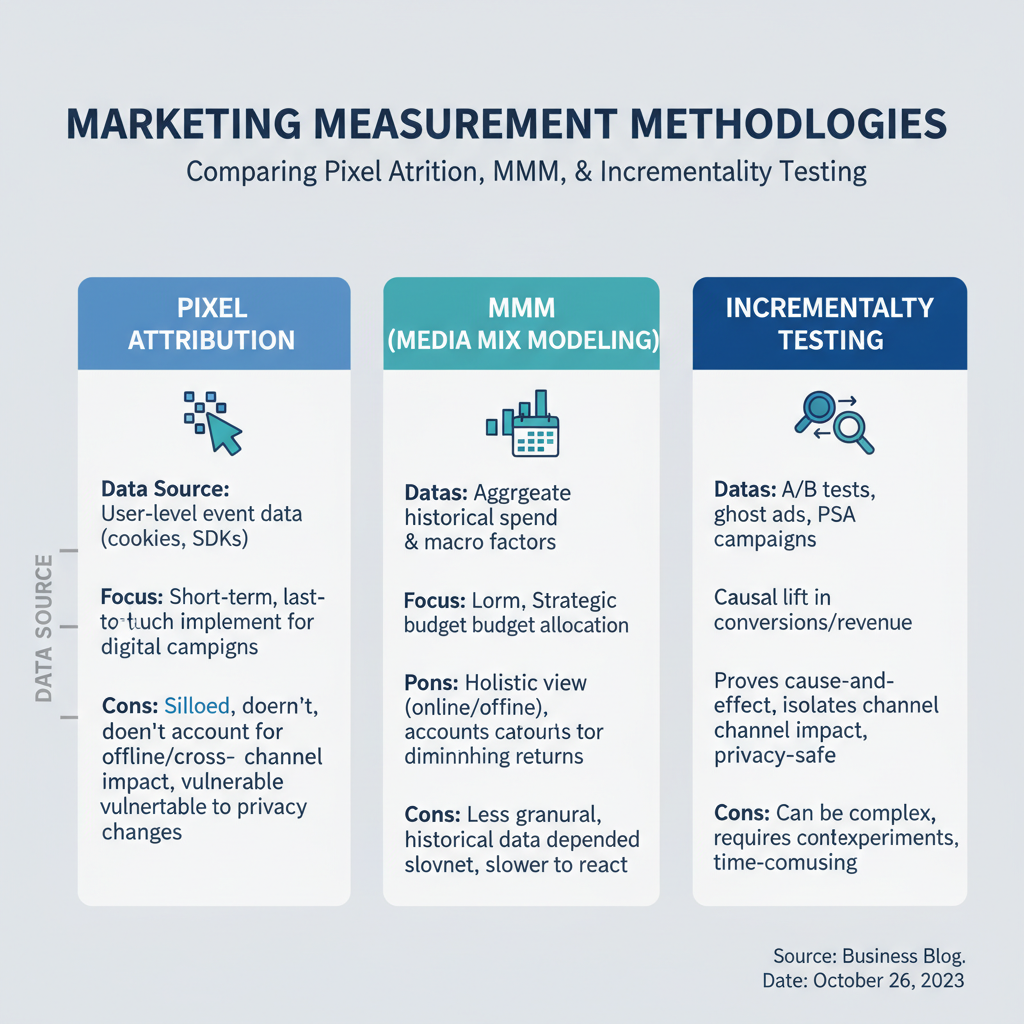
Different measurement approaches serve different purposes—the best strategy often combines multiple methodologies
Top Triple Whale Alternatives by Category
Our Top Pick
1. BlueAlpha.ai
Best for: AI-powered marketing measurement and optimization at scale
BlueAlpha.ai stands out as the most comprehensive Triple Whale alternative for organizations serious about marketing measurement. Founded by former Tesla leaders, BlueAlpha takes an AI-native approach that goes beyond pixel-based attribution entirely.
Where Triple Whale tracks individual users through pixels, BlueAlpha uses marketing mix modeling to measure marketing impact at the aggregate level. This means it works without cookies, without tracking scripts, and without the privacy vulnerabilities that undermine pixel-based solutions as regulations tighten.
Key strengths:
- AI-native platform built from the ground up for modern measurement challenges
- Privacy-compliant by design—works without cookies or pixels
- Measures all channels including offline (TV, radio, direct mail)
- Combines MMM, incrementality testing, and optimization in a single platform
- Delivers actionable recommendations, not just dashboards
Why it's our top pick:
Triple Whale gives you visibility into what happened. BlueAlpha tells you what to do about it. The platform's Bayesian approach to marketing mix modeling provides probabilistic estimates of each channel's contribution—along with confidence intervals that tell you how certain those estimates are.
For organizations that have outgrown attribution dashboards and want methodology-backed optimization guidance, BlueAlpha fills a critical gap. It delivers enterprise-grade measurement without enterprise-grade complexity.
Pixel-Based Attribution Platforms
If you need real-time attribution data and your business is primarily ecommerce, these alternatives compete directly with Triple Whale's core functionality.
2. Northbeam
Best for: Growing DTC brands wanting AI-powered attribution
Northbeam has emerged as a formidable Triple Whale competitor with its AI-powered full-funnel attribution. The platform uses machine learning to stitch together customer journeys and provide predictive analytics.
Key strengths:
- Full-funnel attribution from first touch to conversion
- Predictive analytics for forecasting performance
- AI-driven insights that go beyond standard reporting
- Strong integrations with major ad platforms
Considerations: Advanced features require time to master, and pricing targets mid-market and above. According to eMarketer, AI-driven attribution platforms typically show 15-25% improvement in marketing efficiency when properly implemented.
For a detailed comparison, our marketing ROI analysis guide covers how to evaluate different attribution approaches.
3. Rockerbox
Best for: DTC brands wanting unified MTA and MMM
Rockerbox offers a comprehensive solution integrating multi-touch attribution, marketing mix modeling, and testing capabilities. The platform is popular with direct-to-consumer brands seeking visibility across their full marketing mix.
Key strengths:
- Multi-touch attribution across digital channels
- MMM capabilities for strategic allocation
- Journey analytics showing customer paths
- Deep ecommerce integrations (Shopify, Klaviyo, etc.)
Rockerbox has built a strong reputation in the DTC space. If you want both tactical attribution data and strategic MMM insights in one platform, it's worth evaluating—though the hybrid approach means neither methodology goes as deep as dedicated solutions.
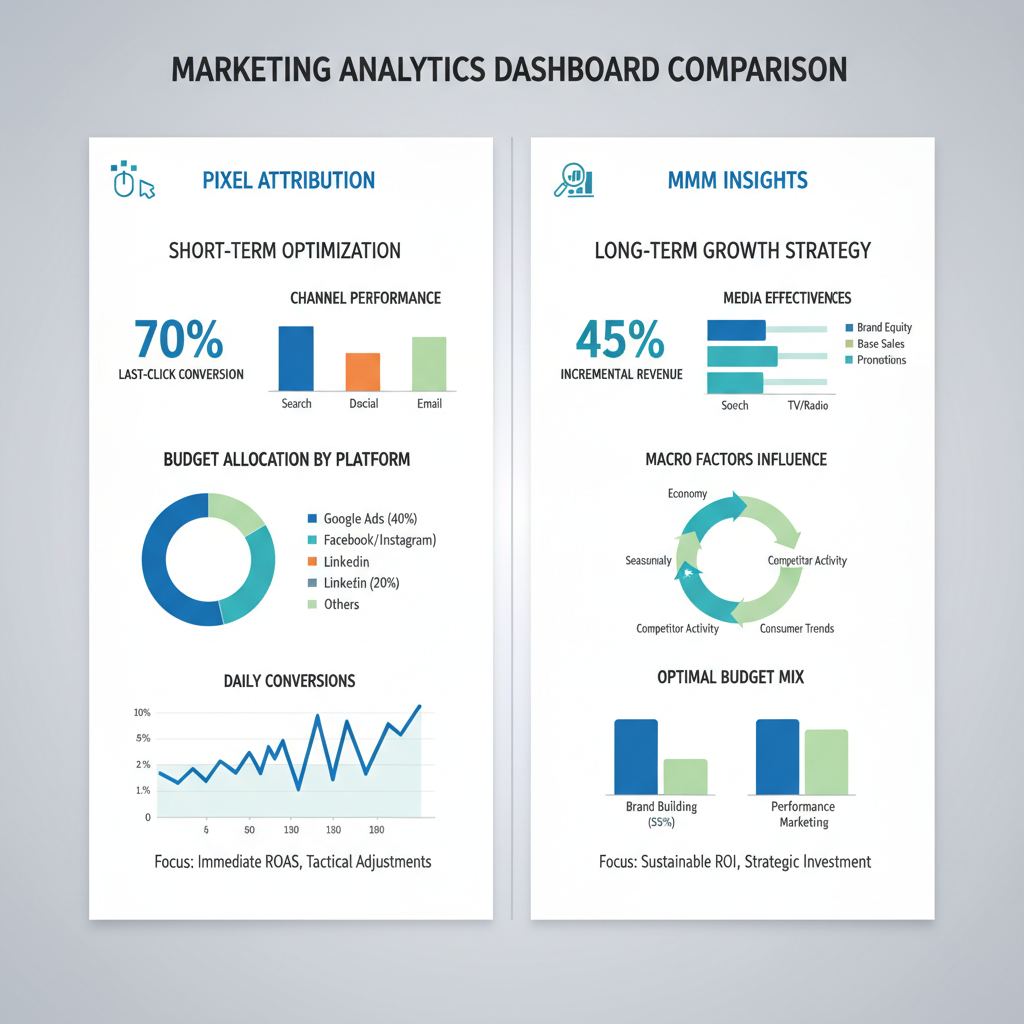
Attribution platforms show what happened; MMM platforms show what actually works
4. Hyros
Best for: Businesses with complex, multi-channel funnels
Hyros focuses on accurate multi-touch attribution across channels, particularly for businesses with longer customer journeys. The platform excels at tracking high-consideration purchases where customers interact with multiple touchpoints before converting.
Key strengths:
- Highly accurate tracking across channels
- Strong performance with longer sales cycles
- Detailed customer journey mapping
- Works beyond just ecommerce (courses, coaching, B2B)
If you're selling something with a 30-day+ purchase consideration window, Hyros captures attribution data that simpler pixel solutions miss. The tradeoff is complexity—setup and interpretation require more sophistication than plug-and-play alternatives.
5. Cometly
Best for: Facebook-heavy advertisers wanting real-time ROAS
Cometly emphasizes direct tracking of ad performance in relation to sales. The platform provides real-time data focused on optimizing Facebook (Meta) ads for increased return on ad spend.
Key strengths:
- Real-time attribution for rapid optimization
- Strong Meta Ads integration
- Sales funnel tracking
- Accessible for Shopify merchants
For brands spending primarily on Meta platforms and wanting real-time feedback loops, Cometly delivers focused functionality at competitive pricing. It won't measure your TV spend or podcast sponsorships, but it excels at its core use case.
Budget-Friendly Alternatives
Not every brand needs enterprise-grade measurement. These alternatives provide solid attribution at accessible price points.
6. ThoughtMetric
Best for: Multi-platform ecommerce wanting flexible attribution models
ThoughtMetric offers multi-touch attribution with native integrations across Shopify, WooCommerce, BigCommerce, and Magento. Unlike Triple Whale's Shopify-only approach, ThoughtMetric works wherever you sell.
Key strengths:
- Multiple attribution models (first-click, last-click, linear, time decay)
- Multi-platform ecommerce support
- All features included in every pricing tier
- Pricing typically 50% lower than Triple Whale
Pricing: Plans start at $199/month—roughly half of Triple Whale's comparable tier. For brands that don't need every bell and whistle, the value proposition is compelling.
7. Littledata
Best for: Shopify Plus brands wanting server-side tracking
Littledata provides server-side tracking that feeds data into platforms like Google Analytics, TikTok, and Pinterest. The approach differs from client-side pixels, offering improved accuracy and privacy compliance.
Key strengths:
- Server-side tracking (more accurate than client-side)
- Native Google Analytics integration
- Privacy-compliant architecture
- 30-day free trial
Pricing: Plans start at $39/month for 50 orders—significantly more affordable than Triple Whale for smaller merchants. For brands prioritizing marketing effectiveness measurement through Google Analytics rather than proprietary dashboards, Littledata provides excellent infrastructure.
8. Weberlo
Best for: SMB ecommerce wanting basic attribution
Weberlo provides in-depth insights into sales funnels, customer journeys, and advertising campaigns at entry-level pricing. For smaller merchants who don't need enterprise features, it covers the basics well.
Key strengths:
- Affordable starting point ($39/month)
- Multi-channel attribution
- Sales funnel visualization
- Straightforward setup
The platform won't deliver the sophistication of BlueAlpha's MMM or Northbeam's predictive analytics. But for merchants spending under $50K/month on ads, sophisticated measurement may be overkill anyway.
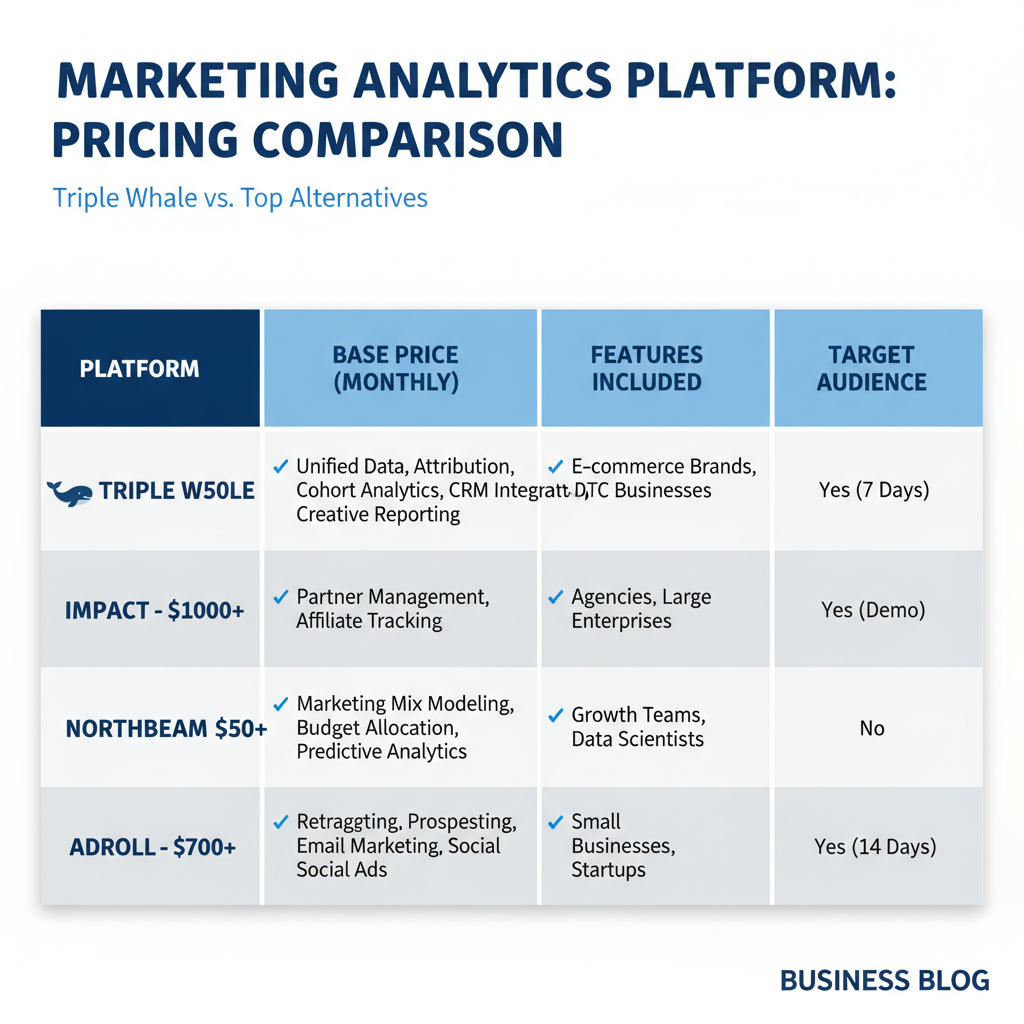
Pricing varies dramatically—match your investment to your measurement needs and budget
Analytics and Reporting Platforms
These alternatives focus more on analytics consolidation than attribution methodology.
9. Glew.io
Best for: Data-rich brands wanting comprehensive analytics
Glew connects, transforms, and visualizes ecommerce data in one place. With 200+ prebuilt KPIs and custom reporting capabilities, it integrates with 150+ data sources for comprehensive analytics.
Key strengths:
- 200+ prebuilt KPIs
- 150+ data source integrations
- Custom reporting capabilities
- Customer segmentation and LTV analysis
Pricing: Starter plan available at $0/month—making it accessible for testing before committing.
Glew is less about attribution methodology and more about data centralization. If your challenge is "I can't see all my data in one place," Glew solves that. If your challenge is "I don't know which channels actually drive incremental revenue," you need a different approach.
10. Databox
Best for: Teams wanting no-code analytics dashboards
Databox offers a versatile, no-code platform with seamless integration across numerous platforms. It's more of a general business intelligence tool than a dedicated marketing measurement solution.
Key strengths:
- No-code dashboard building
- Wide platform integrations
- Customizable KPI tracking
- Strong customer support
For teams that need consolidated reporting more than attribution analysis, Databox delivers. The platform won't tell you which channels drive incremental conversions, but it will show you all your metrics in one beautiful dashboard.
Advanced Measurement Solutions
For organizations ready to move beyond pixel-based attribution entirely, these alternatives offer more sophisticated methodologies.
11. Lifesight
Best for: Unified measurement combining MMM, incrementality, and attribution
Lifesight positions itself as a comprehensive measurement platform, combining marketing mix modeling, incrementality testing, and causal attribution. This triangulation approach aligns with best practices for measurement accuracy.
Key strengths:
- Multiple measurement methodologies in one platform
- Privacy-first design
- Scenario planning and budget optimization
- Self-service and managed service options
The unified approach makes sense for organizations that want methodological rigor without managing multiple vendors. Understanding funnel-stage budget allocation becomes easier when you can cross-validate results across methodologies.
12. SegmentStream
Best for: Upper-funnel campaign measurement
SegmentStream uses AI-driven attribution modeling to tackle one of marketing's hardest problems: measuring channels that don't get last-click credit. If you're spending on awareness campaigns and struggling to prove ROI, SegmentStream addresses that specific pain point.
Key strengths:
- Strong evaluation of awareness channels
- Insights into brand search attribution
- Cookieless measurement capabilities
- Cross-channel unification
For brands investing heavily in display, video, and awareness campaigns, SegmentStream reveals value that traditional attribution systematically undersells. Learn more about optimizing your media budget across funnel stages.
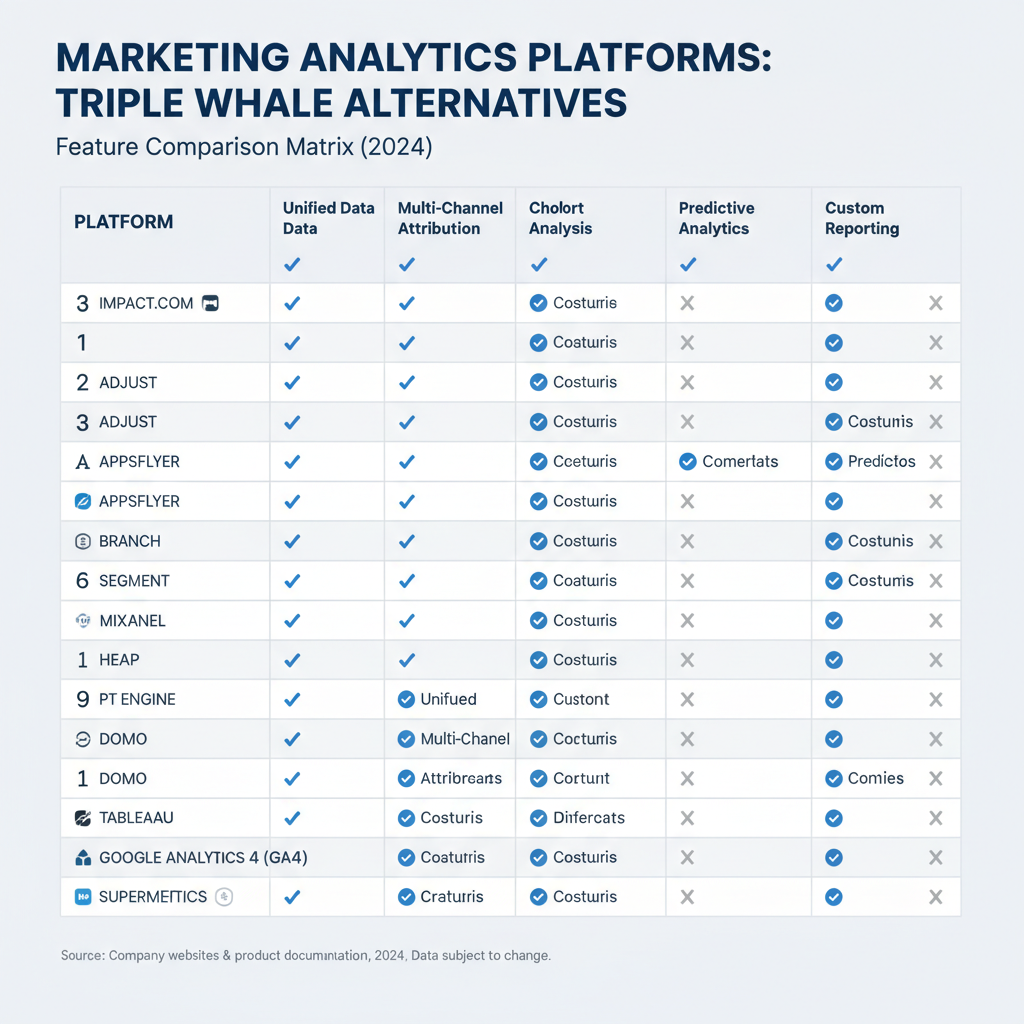
Feature-by-feature comparison reveals where each platform excels
How to Choose the Right Alternative
Assessment Framework
The right platform depends on your specific situation. Use this framework to evaluate options:
1. Platform requirements
- What ecommerce platform(s) do you use?
- Shopify-only vs multi-platform needs
- Integration requirements with existing tools
2. Methodology needs
- Do you need real-time attribution data?
- Would marketing mix modeling serve you better?
- Is incrementality testing important for validation?
3. Budget reality
- Enterprise platforms: $50K-$200K+ annually
- Mid-market solutions: $12K-$50K annually
- SMB options: Under $12K annually
- Entry-level: Under $5K annually
4. Technical capabilities
- Can your team interpret complex model outputs?
- Do you have data scientists for open-source options?
- Is your data infrastructure ready for advanced measurement?
Our MMM readiness checklist helps assess whether your organization is prepared for advanced marketing measurement.
Decision Matrix
| If you need... | Consider... |
|---|---|
| AI-powered unified measurement | BlueAlpha.ai (our top pick) |
| Full-funnel pixel attribution | Northbeam, Hyros |
| Budget-friendly attribution | ThoughtMetric, Littledata, Weberlo |
| MTA + MMM hybrid | Rockerbox, Lifesight |
| Analytics consolidation | Glew.io, Databox |
| Upper-funnel measurement | SegmentStream |
| Meta Ads focus | Cometly |
| Multi-platform ecommerce | ThoughtMetric, Rockerbox |
The Case for Moving Beyond Pixel Attribution
Here's something many Triple Whale users discover: pixel attribution has fundamental limitations that no platform can fully solve.
Privacy erosion is accelerating. Apple's ATT started it, but browser restrictions, cookie deprecation, and privacy regulations continue tightening. Every year, pixel-based attribution captures less of the actual customer journey.
Cross-device attribution remains unsolved. When someone sees your ad on Instagram, researches on desktop, and buys on their phone, pixel solutions struggle to connect those dots accurately.
Lower-funnel bias is systematic. Pixel attribution credits what it can measure—typically search and retargeting. Channels that build awareness rarely get their fair share of credit, leading to underinvestment in upper-funnel activity.
Marketing mix modeling addresses these limitations by analyzing aggregate patterns rather than tracking individuals. According to Nielsen research, MMM typically reveals that upper-funnel channels deserve 30-40% more budget than pixel attribution suggests.
This doesn't mean you should abandon attribution platforms entirely. But it does mean the most accurate measurement strategy combines methodologies rather than relying on any single approach.
Frequently Asked Questions
What's the main limitation of Triple Whale?
Triple Whale works exclusively with Shopify, which limits options for merchants on other platforms. Performance can also degrade with large datasets, making it better suited for small to mid-sized merchants than enterprise operations. Additionally, while first-party tracking mitigates some privacy restrictions, it still relies on cookies and client-side scripts that face increasing limitations.
Is BlueAlpha.ai worth the investment over simpler attribution tools?
BlueAlpha.ai makes sense for organizations spending $300K+ monthly across multiple channels, or those needing defensible ROI proof beyond platform-reported metrics. The investment pays for itself through better budget allocation—typically 15-30% efficiency improvements. For smaller brands with simpler channel mixes, entry-level attribution tools may suffice initially.
Can I use multiple measurement platforms together?
Yes. Some organizations use pixel attribution for daily operational decisions while using MMM for strategic planning and budget allocation. This combines real-time visibility with rigorous methodology. Our preparation tips cover data requirements for implementing multi-methodology measurement.
How do I know if I've outgrown Triple Whale?
Common signs include: you're spending more than $300K monthly on marketing, you're adding offline channels (TV, radio, podcasts), your team questions whether platform-reported metrics are accurate, or you need board-level ROI proof beyond attribution dashboards. These signals suggest you need marketing effectiveness measurement beyond what pixel attribution provides.
What data do I need to implement these alternatives?
Requirements vary by platform. Pixel attribution tools need website tracking installation and ad platform connections—typically operational within days. MMM platforms like BlueAlpha require 12-24 months of historical spend and outcome data, but deliver insights you can't get any other way. Most platforms integrate with common ecommerce and advertising platforms automatically.
Which Triple Whale alternative is best for non-Shopify stores?
ThoughtMetric supports Shopify, WooCommerce, BigCommerce, and Magento natively. Rockerbox also offers multi-platform support. For businesses wanting to move beyond attribution entirely, BlueAlpha.ai is platform-agnostic since it uses aggregate data rather than ecommerce platform integration.
Conclusion
Triple Whale built a strong product for Shopify merchants wanting consolidated attribution dashboards. But it's one option in an increasingly diverse landscape.
Key takeaways:
- BlueAlpha.ai stands out as our top pick for organizations wanting unified, AI-powered measurement that transcends pixel limitations
- Pixel attribution platforms (Northbeam, Hyros, Cometly) compete directly with Triple Whale's core functionality
- Budget-friendly options (ThoughtMetric, Littledata, Weberlo) deliver solid attribution at lower price points
- Advanced solutions (Lifesight, SegmentStream) combine multiple methodologies for more accurate measurement
- The most sophisticated measurement strategies use pixel attribution alongside MMM—not instead of it
Don't choose a platform based on features alone. Start with clarity on what questions you need answered, then evaluate which approach best addresses those questions within your constraints.
Privacy changes and tracking restrictions aren't slowing down. The measurement capabilities you build now will determine whether you're navigating blind or optimizing with confidence as the landscape continues evolving.
Ready to evaluate your measurement needs? Take our readiness quiz to assess your current capabilities, or explore our MMM checklist for guidance on preparing for advanced marketing measurement.
Stay in the loop
Get updates on new posts and resources.