Which MMM is Best? Complete Guide to Media Mix Modeling Approaches
Compare the best MMM frameworks and methodologies including Bayesian, regression, and deep learning approaches. Find the right media mix model for your business.
Asking "which MMM is best" is like asking which car is best. It depends entirely on where you're going, what you're carrying, and how much you want to spend.
Media mix modeling has evolved dramatically over the past decade. What started as simple regression analysis has splintered into multiple sophisticated approaches—Bayesian models, neural networks, causal inference frameworks, and everything in between. Each methodology carries distinct advantages and trade-offs that matter for your specific situation.
This guide breaks down the major underlying MMM models, explains when each excels, and helps you determine which approach best fits your marketing measurement needs.
According to Marketing Evolution research, companies using the right MMM approach see 15-30% improvements in marketing ROI. The operative word is right—choosing the wrong methodology can lead to misleading insights and wasted budget.
Understanding the Core MMM Methodologies
Before comparing specific frameworks, you need to understand the fundamental approaches underlying all media mix models. Each methodology makes different assumptions about how marketing works and produces different types of insights.
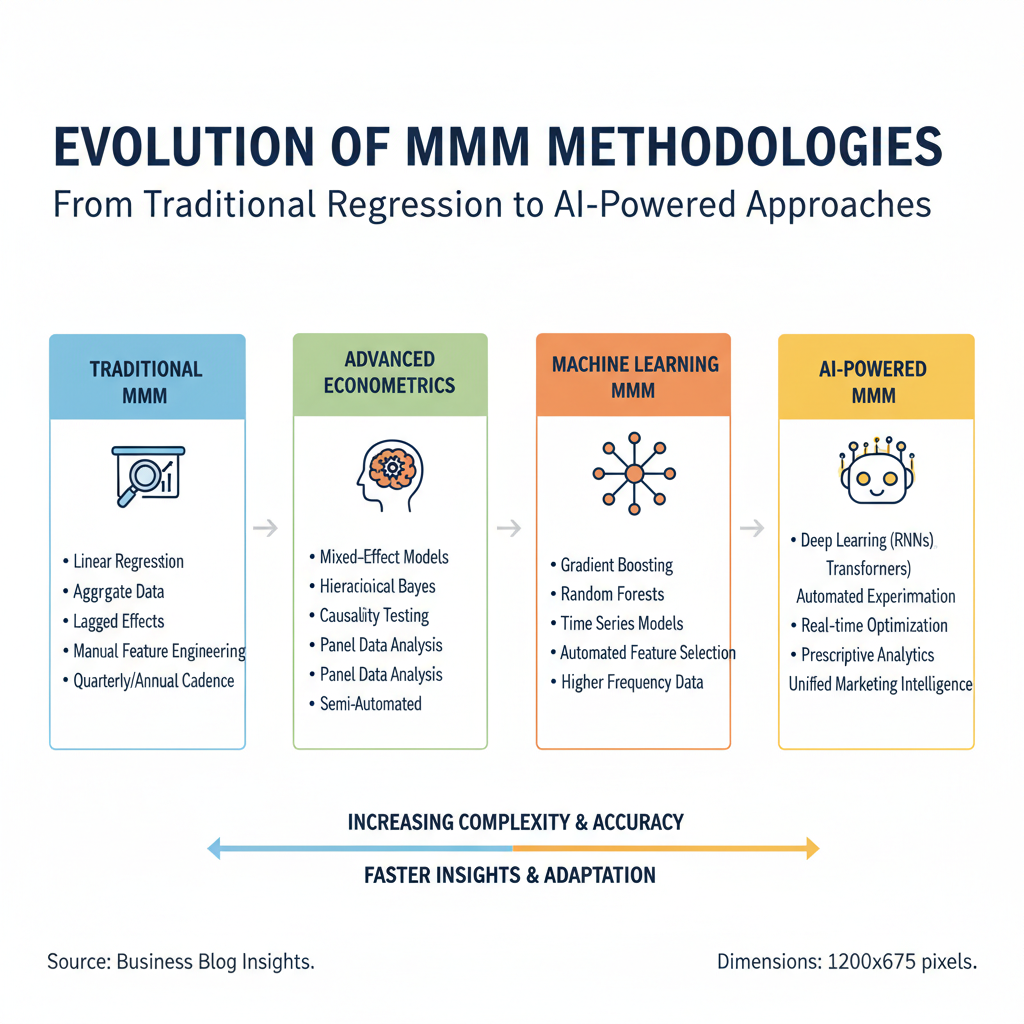
MMM has evolved from simple regression to sophisticated AI-powered approaches
Traditional Linear Regression Models
Linear regression is where MMM began. These models estimate the relationship between marketing inputs (spend, impressions, GRPs) and business outcomes (sales, conversions) using a straightforward linear equation.
How it works:
The model assumes each dollar of marketing spend contributes a fixed, additive amount to sales. A regression coefficient tells you "for every additional dollar in Channel X, you generate Y additional sales."
Strengths:
- Simple to implement and interpret
- Requires minimal computational resources
- Results are explainable to non-technical stakeholders
- Well-established statistical foundations
Limitations:
- Assumes linear relationships (marketing rarely works this way)
- Struggles with interaction effects between channels
- Can't capture saturation or diminishing returns accurately
- Requires manual specification of adstock and decay functions
Best for: Organizations just starting with MMM, limited budgets, or those needing highly interpretable results for executive buy-in.
Linear regression models remain useful as baselines or for organizations with straightforward marketing mixes. But they typically underperform when marketing complexity increases. Understanding these marketing effectiveness fundamentals helps you recognize when you've outgrown basic approaches.
Bayesian Media Mix Models
Bayesian MMM represents a significant advancement over traditional regression. Instead of producing single point estimates, Bayesian models generate probability distributions that quantify uncertainty around each estimate.
How it works:
Bayesian models incorporate "prior beliefs" about how marketing should work (informed by business knowledge or previous studies) and update those beliefs based on observed data. The output is a range of likely values rather than a single number.
Strengths:
- Quantifies uncertainty in estimates (crucial for decision-making)
- Incorporates domain expertise through priors
- Handles limited data better than frequentist approaches
- Produces more stable estimates with noisy data
- Regularization reduces overfitting
Limitations:
- More computationally intensive
- Requires statistical expertise to specify appropriate priors
- Results can be sensitive to prior selection
- Longer model development and iteration cycles
Best for: Organizations wanting rigorous, uncertainty-aware measurement with flexibility to incorporate business knowledge into models.
According to research published in arXiv, Bayesian time-varying coefficient models outperform traditional approaches in capturing dynamic market conditions. This matters because marketing effectiveness isn't static—it changes with seasons, competitive activity, and consumer trends.
Most modern open-source frameworks (Meta's Robyn, Google's Meridian, PyMC-Marketing) use Bayesian methods under the hood. The question isn't whether to use Bayesian approaches—it's which implementation best serves your needs.
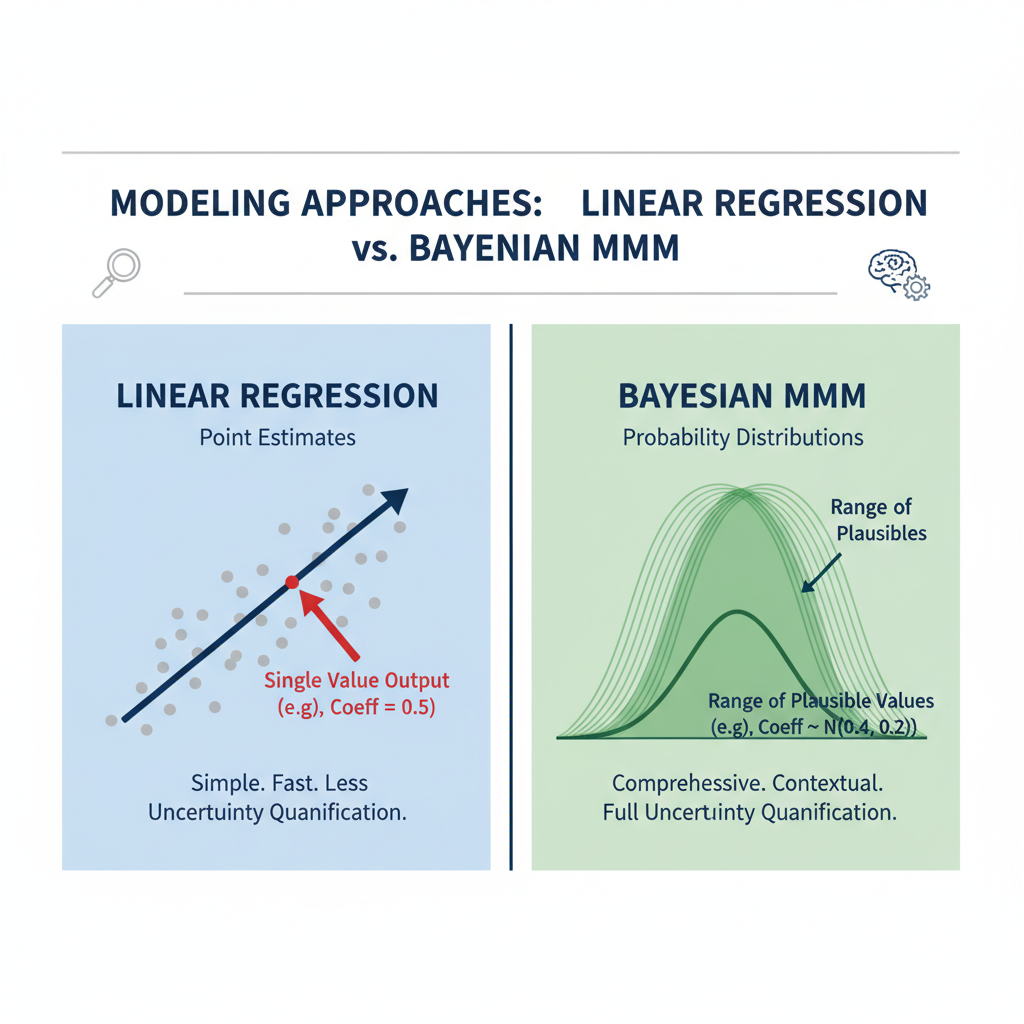
Bayesian models quantify uncertainty rather than providing false precision
Time-Varying Coefficient Models
Marketing effectiveness changes over time. A TV campaign that crushed it in Q1 might underperform in Q3 due to creative fatigue, competitive pressure, or shifting consumer preferences. Time-varying coefficient models explicitly capture this dynamic reality.
How it works:
Rather than assuming fixed relationships between inputs and outputs, these models allow coefficients to drift over time. They detect when channel effectiveness is increasing or decreasing and adjust estimates accordingly.
Strengths:
- Captures dynamic market conditions realistically
- Identifies trends in channel effectiveness
- Better handles structural changes (new competitors, platform algorithm changes)
- Provides more actionable insights for ongoing optimization
Limitations:
- Requires longer historical data series
- More complex to implement and validate
- Risk of overfitting to noise in shorter time periods
- Harder to interpret for non-technical stakeholders
Best for: Organizations with 2+ years of data, mature marketing operations, and analytics teams capable of interpreting nuanced outputs.
Time-varying models are particularly valuable in fast-moving markets where yesterday's tactics may not work tomorrow. If you're allocating marketing budgets across funnel stages, these models help you understand when to shift investment as channel dynamics evolve.
Neural Network and Deep Learning Models
Machine learning has entered the MMM conversation. Neural networks can model complex, non-linear relationships that traditional statistical approaches miss.
How it works:
Deep learning models learn patterns directly from data without requiring analysts to specify functional forms. Transformer-based architectures can capture long-term dependencies and complex interaction effects between channels.
Strengths:
- Captures non-linear relationships automatically
- Handles high-dimensional data with many channels
- Can detect complex interaction patterns
- Scalable to large datasets
- Potentially higher predictive accuracy
Limitations:
- "Black box" nature makes interpretation difficult
- Requires substantial data to train effectively
- Risk of overfitting without careful validation
- Computationally expensive
- Harder to incorporate domain expertise
Best for: Organizations with large datasets, many marketing channels, and analytics teams with ML expertise who prioritize prediction accuracy over interpretability.
Research from Google demonstrates that transformer-based MMM models can capture intricate patterns that traditional methods miss. But the trade-off is explainability—can you justify budget decisions based on a model nobody fully understands?
Causal Inference Models
The holy grail of MMM is establishing causation, not just correlation. Causal inference models attempt to answer: "Did this marketing activity cause this outcome?" rather than "Is this activity associated with this outcome?"
How it works:
These models use techniques like directed acyclic graphs (DAGs), instrumental variables, or synthetic control methods to isolate causal effects. They explicitly model the causal structure of how marketing channels interact and influence outcomes.
Strengths:
- Addresses correlation vs. causation problem directly
- More accurate attribution of marketing effects
- Better handles confounding variables
- Enables more confident budget decisions
- Aligns with incrementality testing approaches
Limitations:
- Requires strong assumptions about causal structure
- Complex to implement correctly
- May need experimental validation
- Still an emerging area with evolving best practices
Best for: Organizations wanting the most accurate possible attribution, those combining MMM with incrementality testing, and sophisticated analytics teams.
The DeepCausalMMM framework documented in academic research combines deep learning with causal inference to model both temporal patterns and causal relationships. This hybrid approach represents the cutting edge of MMM methodology.
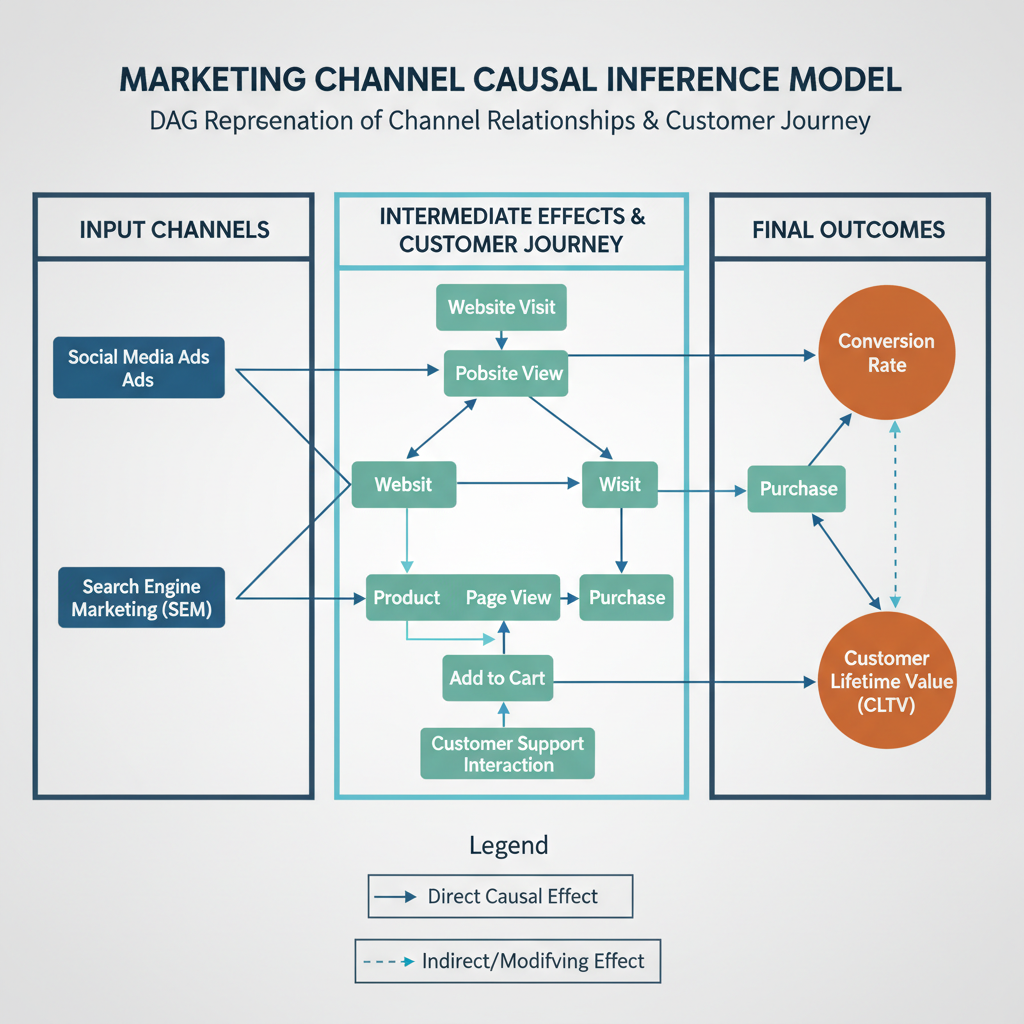
Causal models explicitly map how marketing activities influence outcomes
Comparing Popular MMM Frameworks
Understanding methodology categories is helpful, but you also need to evaluate specific frameworks. Here's how major options stack up:
Open-Source Frameworks
Meta Robyn
Meta's R-based framework uses Bayesian methodology with automated hyperparameter tuning. It's designed for marketers without deep statistical expertise.
- Language: R
- Methodology: Bayesian ridge regression with adstock/saturation
- Strengths: Active community, automated model selection, budget optimizer
- Challenges: R learning curve, requires manual data preparation, limited customization
Google Meridian
Google's newer framework builds on Bayesian foundations with modern architecture designed for integration with Google's advertising ecosystem.
- Language: Python
- Methodology: Bayesian MMM with improved saturation curves
- Strengths: Better Google data integration, modern Python stack, active development
- Challenges: Newer (less battle-tested), requires Python expertise, still maturing
PyMC-Marketing
Built on the PyMC probabilistic programming library, this framework offers maximum flexibility for custom Bayesian modeling.
- Language: Python
- Methodology: Flexible Bayesian modeling
- Strengths: Highly customizable, strong probabilistic programming foundation, excellent for research
- Challenges: Requires deep statistical knowledge, more development time, less turnkey
Our preparation guide covers the data requirements all these frameworks need—regardless of which you choose, data quality determines success.
Commercial Platforms
Commercial MMM platforms bundle methodology with data integration, visualization, and ongoing support. They trade flexibility for faster time-to-value.
Key considerations:
- Do you have data science resources to build and maintain open-source models?
- How quickly do you need actionable insights?
- What level of customization does your business require?
- Can you validate model outputs without vendor assistance?
For organizations evaluating commercial options, understanding marketing ROI analysis helps you assess whether platform outputs align with your business reality.
How to Choose: Which MMM is Best for Your Business
The "best" MMM depends on your specific constraints and goals. Use this framework to guide your decision:
Factor 1: Data Maturity
Limited data (<2 years): Consider Bayesian approaches with informative priors to compensate for sparse data.
Moderate data (2-3 years): Traditional Bayesian MMM or time-varying models both viable.
Rich data (3+ years, many channels): Deep learning approaches become feasible; time-varying models excel.
Factor 2: Technical Capabilities
No data science team: Commercial platforms or agency partnerships provide the fastest path to insights.
Small analytics team: Open-source frameworks like Robyn offer reasonable entry points with community support.
Strong data science: Build custom models using PyMC-Marketing or similar frameworks for maximum control.
Factor 3: Business Requirements
Executive buy-in focus: Simpler, more interpretable models (linear regression, basic Bayesian) facilitate stakeholder alignment.
Optimization focus: Advanced models (time-varying, neural networks) optimize budget allocation more precisely.
Attribution accuracy focus: Causal inference models provide the most rigorous attribution, especially when combined with incrementality testing.
Factor 4: Integration Needs
Consider how your MMM needs to work with existing systems. Our MMM checklist helps assess organizational readiness across technical and operational dimensions.
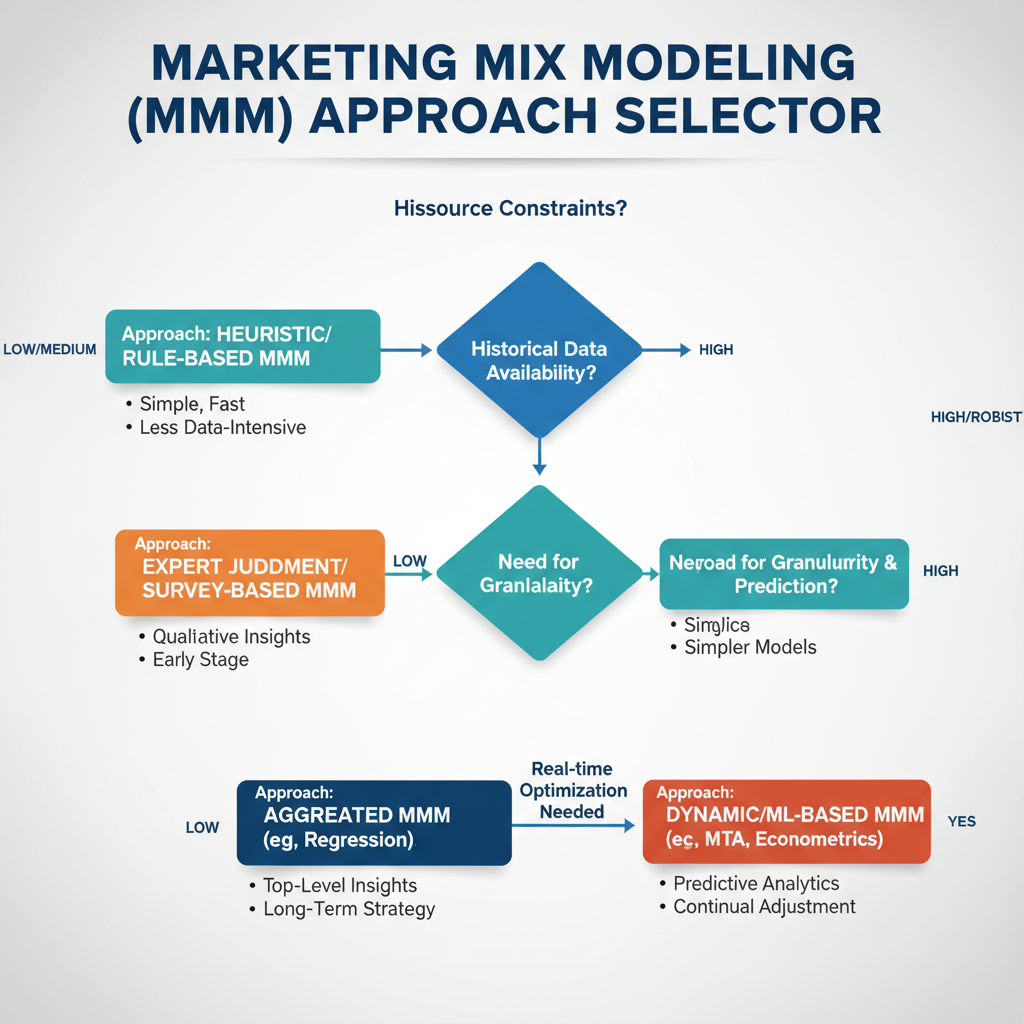
The best MMM approach depends on your specific situation—there's no universal answer
The Limitations of Going It Alone
Here's the reality most MMM framework comparisons don't tell you: choosing the right methodology is only 20% of the battle.
What actually determines MMM success:
- Data quality and completeness
- Proper model specification and validation
- Ongoing maintenance and calibration
- Integration with decision-making processes
- Organizational change management
Even the best model produces garbage insights if fed garbage data. And a mathematically perfect model delivers zero value if leadership doesn't trust or act on its recommendations.
Building effective MMM requires sustained investment in data infrastructure, analytical talent, and organizational processes. Many organizations underestimate this investment, leading to abandoned models and skeptical stakeholders.
Our Recommendation: BlueAlpha.ai
For organizations serious about marketing measurement but lacking the resources to build and maintain sophisticated MMM capabilities in-house, BlueAlpha.ai offers a compelling solution.
Why BlueAlpha stands out:
BlueAlpha combines multiple MMM methodologies—Bayesian modeling, causal inference, and AI automation—into a unified platform. Rather than forcing you to choose a single approach, it triangulates across methods to provide more robust insights.
Key advantages:
- Unified measurement platform: Combines MMM with incrementality testing rather than treating them as separate methodologies
- AI-powered automation: Handles data integration, cleansing, and model deployment without requiring in-house data science
- Privacy-compliant by design: Cookie-less attribution that works in the post-third-party-cookie world
- Actionable recommendations: Campaign-level optimization suggestions, not just channel-level insights
- Expert support: Data scientists and growth strategists act as an extension of your team
Who benefits most:
- Organizations with $1M+ annual marketing spend wanting rigorous measurement
- Teams that have outgrown basic attribution but can't justify full-time data science hires
- Marketers needing faster time-to-value than open-source implementations allow
- Companies wanting to combine MMM with incrementality for validation
The methodology debates matter. But what matters more is getting actionable insights that improve marketing performance. BlueAlpha abstracts the technical complexity so you can focus on making better marketing decisions.
Learn more about how MMM platforms compare in our media budget optimization guide.
Frequently Asked Questions
Which MMM methodology is most accurate?
No single methodology is universally "most accurate." Causal inference models generally provide the most rigorous attribution, but accuracy depends heavily on data quality, proper model specification, and validation against real-world experiments. Bayesian approaches handle uncertainty better than point-estimate methods. The most accurate approach for your business depends on your data, channels, and measurement goals. Research from Gartner suggests combining multiple methodologies improves accuracy.
Should I use open-source or commercial MMM platforms?
Open-source frameworks (Robyn, Meridian, PyMC-Marketing) offer flexibility and no licensing costs but require significant data science resources. Commercial platforms provide faster implementation, ongoing support, and integrated features—at higher price points. If you have capable data scientists and 6+ months to invest in development, open-source can work well. If you need faster time-to-value or lack technical resources, commercial platforms typically deliver better ROI.
How long does it take to implement MMM effectively?
Plan for 3-6 months from project kickoff to initial actionable insights. Data integration typically takes 4-8 weeks. Model development and validation requires 4-12 weeks depending on complexity. Building organizational confidence in outputs continues indefinitely. Open-source implementations generally take longer than commercial platforms. According to McKinsey analysis, mature MMM programs require 12-18 months before delivering transformational impact.
Can I use multiple MMM approaches simultaneously?
Yes, and sophisticated organizations often do. Running Bayesian MMM alongside incrementality testing provides cross-validation. Some teams maintain simpler models for executive communication alongside complex models for technical optimization. The key is ensuring different models are answering different questions—not duplicating effort. Our marketing effectiveness guide explores how multiple measurement approaches complement each other.
What data do I need before choosing an MMM approach?
All MMM approaches require: 12+ months of historical marketing spend by channel, corresponding sales/conversion data (ideally weekly), and documentation of external factors (promotions, seasonality, competitive activity). Advanced approaches benefit from additional data: impression-level metrics, creative rotation, geographic variation, and CRM information. Data quality matters more than methodology choice—see our preparation tips for detailed requirements.
Is Bayesian MMM better than traditional regression?
For most modern marketing measurement needs, yes. Bayesian approaches handle uncertainty more honestly, produce more stable estimates with limited data, and incorporate domain expertise through priors. Traditional regression can still work for simple marketing mixes or as a baseline comparison. The real question is whether you have the expertise to implement Bayesian models properly—if not, a well-specified regression model may outperform a poorly-configured Bayesian one.
Conclusion
Which MMM is best? The one that matches your data reality, technical capabilities, and business requirements.
Key takeaways:
- Traditional regression offers simplicity but struggles with marketing complexity
- Bayesian models provide superior uncertainty quantification and flexibility
- Time-varying approaches capture dynamic market conditions
- Neural networks excel with large datasets but sacrifice interpretability
- Causal inference models offer the most rigorous attribution
- Open-source frameworks require significant investment but offer flexibility
- Commercial platforms trade customization for faster time-to-value
Don't get paralyzed by methodology debates. The perfect model that never gets implemented delivers zero value. Start with an approach your organization can execute, validate outputs against business reality, and iterate from there.
For most organizations, the path of least resistance is partnering with a platform that handles technical complexity while you focus on marketing decisions. BlueAlpha.ai represents the current state of the art in accessible, accurate marketing measurement.
Ready to determine which approach fits your organization? Take our readiness quiz to assess your current measurement capabilities, or explore our MMM checklist for detailed preparation guidance.
Stay in the loop
Get updates on new posts and resources.