Workmagic vs BlueAlpha.ai: Which AI Marketing Platform Wins?
Compare Workmagic vs BlueAlpha.ai to find the right AI marketing platform. Discover key differences in content generation, attribution, and analytics.
AI marketing platforms promise to solve everything—content creation, attribution, budget optimization, campaign management. The challenge? Most platforms excel at one thing while claiming to do it all.
Workmagic vs BlueAlpha.ai represents a particularly interesting comparison because both platforms target similar audiences but approach the problem from opposite directions. One starts with content, the other starts with measurement. That distinction shapes everything.
This guide breaks down both platforms, their actual capabilities, and which type of organization should consider each option. According to Gartner's marketing technology research, choosing the wrong marketing platform costs organizations an average of 12% of their marketing budget through inefficiency and misattribution.
Understanding the Core Difference: Content-First vs Measurement-First
Before comparing features, understand what each platform fundamentally does. Workmagic vs BlueAlpha.ai isn't just a feature comparison—it's a philosophical difference in how to approach marketing effectiveness.
What Workmagic Does
Workmagic is an AI-powered marketing platform built for e-commerce businesses, particularly those on Shopify. The platform's core strength is content automation—generating product images, marketing copy, and campaign assets without traditional production processes.
Key capabilities include:
- AI-generated product photography without photoshoots
- Automated marketing copy for ads, emails, and social
- Campaign management across multiple channels
- Data-driven attribution with incrementality testing
- 3D video generation for product marketing
Workmagic's approach: Start with content creation, then measure what works. The platform prioritizes operational efficiency—reducing the time and cost of producing marketing assets.
What BlueAlpha.ai Does
BlueAlpha.ai takes the opposite approach. Instead of starting with content, it starts with measurement and optimization. The platform focuses on marketing mix modeling (MMM) and advanced analytics to determine which marketing investments actually drive results.
Core capabilities include:
- Bayesian marketing mix modeling for attribution
- Budget allocation optimization across channels
- Saturation curve analysis for diminishing returns
- Cross-channel synergy detection
- Predictive analytics for campaign planning
BlueAlpha.ai's approach: Understand what works first, then optimize accordingly. The platform prioritizes measurement accuracy over content production.
This fundamental difference—content-first versus measurement-first—determines which platform fits your specific needs. According to Forrester's marketing research, organizations that prioritize measurement before scaling content see 40% better marketing ROI.
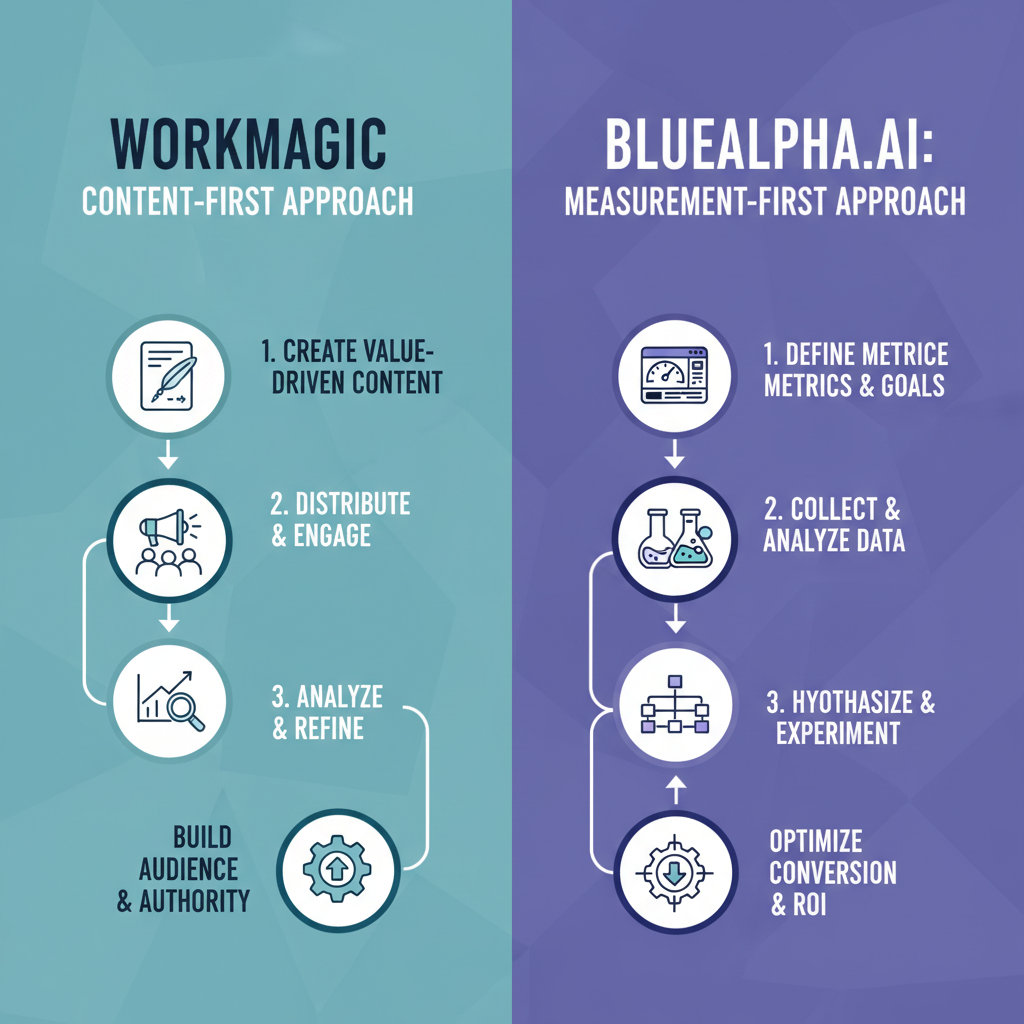
Two fundamentally different philosophies for AI-powered marketing optimization
Workmagic: Deep Dive into Capabilities
Let's examine what Workmagic actually delivers and where it excels.
Content Generation Features
Workmagic's primary value proposition is automated content creation. The platform eliminates traditional bottlenecks in marketing asset production:
AI Image Generation: Create product photography without photographers, studios, or physical shoots. The system generates professional-quality images from existing product data, customizable for different channels and contexts.
Marketing Copy Automation: Generate ad copy, email content, blog posts, and social media text automatically. The AI adapts tone and messaging based on channel requirements.
3D Video Production: Create dynamic product videos without video production resources. This capability is particularly valuable for e-commerce brands needing visual content at scale.
For e-commerce businesses managing hundreds or thousands of SKUs, this content automation represents significant cost savings. Traditional product photography costs $200-500 per product—Workmagic's AI generation costs a fraction of that.
Attribution and Analytics
Workmagic includes attribution capabilities, though they're not the platform's primary focus:
Incrementality-Adjusted Attribution: The platform claims to calibrate attribution models using incrementality tests, attempting to measure actual marketing impact rather than just correlations.
Campaign Performance Tracking: Monitor campaign results across channels from a centralized dashboard.
However, Workmagic's analytics are optimized for e-commerce metrics—ROAS, conversion rates, and campaign-level performance. For strategic marketing ROI analysis across complex media mixes, the platform's measurement capabilities may be insufficient.
Ideal Use Cases for Workmagic
Workmagic works best for:
- E-commerce businesses on Shopify needing rapid content production
- Small teams without creative resources requiring automated asset generation
- Direct-to-consumer brands with straightforward marketing funnels
- Organizations prioritizing content volume over measurement depth
The platform struggles when organizations need sophisticated cross-channel measurement, offline media analysis, or enterprise-level budget optimization.
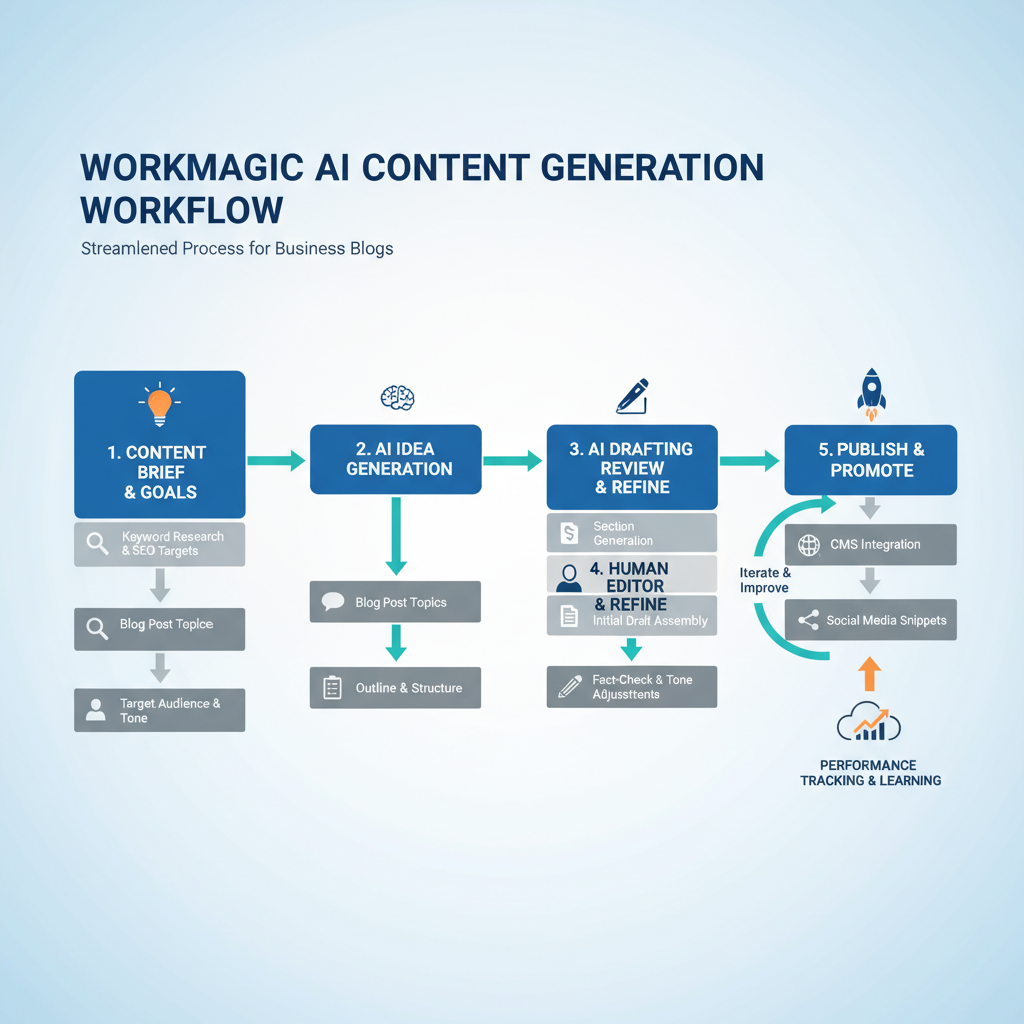
Content automation reduces production costs but doesn't solve attribution challenges
BlueAlpha.ai: Deep Dive into Capabilities
Now let's examine BlueAlpha.ai and its measurement-first approach.
Marketing Mix Modeling Features
BlueAlpha.ai specializes in advanced analytics that answer strategic questions about marketing effectiveness:
Bayesian Marketing Mix Modeling: The platform uses Bayesian statistical methods to determine the incremental contribution of each marketing channel. Unlike simple attribution, MMM isolates what would have happened without marketing from what marketing actually drove.
Budget Optimization Recommendations: Based on channel performance curves, BlueAlpha.ai recommends optimal budget allocation. This goes beyond reporting—it's prescriptive analytics that tell you where to invest next.
Saturation Curve Analysis: Every channel hits a point of diminishing returns. BlueAlpha.ai models these curves to prevent over-investment in saturated channels—a common mistake that wastes millions in marketing spend. Research from the Marketing Science Institute shows that 60% of digital channels are over-invested due to poor diminishing returns analysis.
Adstock Modeling: Marketing effects don't disappear immediately after campaigns end. BlueAlpha.ai models how long impact persists, enabling more accurate ROI calculations.
Cross-Channel Synergy Detection: Some channel combinations produce effects greater than the sum of their parts. MMM reveals these synergies to inform strategic planning.
Privacy-Resilient Measurement
A critical advantage: BlueAlpha.ai's modeling approach doesn't depend on user-level tracking. With iOS privacy changes and cookie deprecation disrupting traditional attribution, aggregate statistical modeling provides a resilient alternative.
This matters for organizations facing:
- Attribution gaps from iOS 14.5+ and App Tracking Transparency
- Third-party cookie deprecation
- Platform reporting discrepancies
- Cross-channel measurement challenges
Ideal Use Cases for BlueAlpha.ai
BlueAlpha.ai delivers the most value for:
- Organizations with significant marketing spend ($300K+ monthly) across multiple channels
- Brands needing to justify marketing investments to executive stakeholders
- Marketers combining digital and traditional media where cookie-based attribution fails
- Teams prioritizing measurement accuracy over content production efficiency
- Organizations building sophisticated marketing analytics capabilities
Nielsen's annual marketing report confirms that organizations investing in advanced measurement outperform those relying on platform-reported metrics.
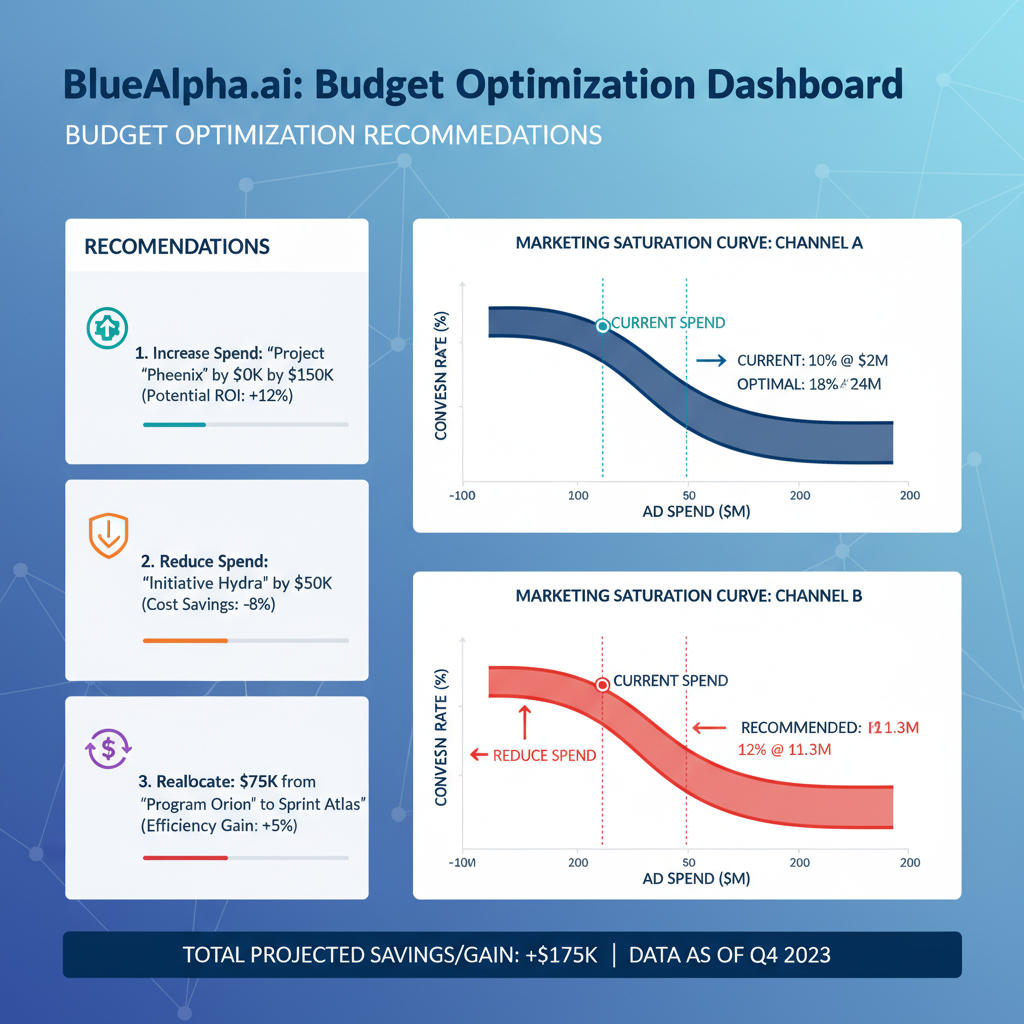
Measurement-first platforms reveal where marketing dollars actually drive results
Workmagic vs BlueAlpha.ai: Head-to-Head Comparison
Here's how these platforms compare across key dimensions:
| Capability | Workmagic | BlueAlpha.ai |
|---|---|---|
| Primary Focus | Content generation | Marketing measurement |
| AI Image Creation | ✅ Core feature | ❌ Not offered |
| Copy Generation | ✅ Automated | ❌ Not offered |
| Video Production | ✅ 3D video | ❌ Not offered |
| Marketing Mix Modeling | ⚠️ Basic | ✅ Advanced Bayesian |
| Budget Optimization | ⚠️ Limited | ✅ Prescriptive |
| Saturation Analysis | ❌ No | ✅ Full support |
| Offline Media Support | ❌ Digital only | ✅ All channels |
| Privacy-Resilient | ⚠️ Platform-dependent | ✅ Aggregate modeling |
| Target Audience | E-commerce SMBs | Growth & Enterprise |
When to Choose Workmagic
Workmagic is the right choice when:
Your primary pain point is content production. If your team spends excessive time and budget creating marketing assets, Workmagic's automation provides immediate relief.
You're an e-commerce business on Shopify. The platform is purpose-built for this use case with deep integrations and e-commerce-specific workflows.
You need to scale content without scaling headcount. For brands managing large product catalogs requiring continuous content updates, AI generation makes sense.
Your marketing mix is predominantly digital. If most of your spend is in platforms with strong API integrations, Workmagic can track basic performance. But for understanding true incrementality across channels, you'll need something more sophisticated like marketing mix modeling.
When to Choose BlueAlpha.ai
BlueAlpha.ai is the right choice when:
You need to prove marketing's business impact. When executives ask "what did we get from that spend," MMM provides the answer in business terms—incremental revenue, not platform-reported ROAS.
Budget allocation is your strategic challenge. When you're deciding how to split significant budgets across channels, optimization recommendations beat historical reports.
Privacy changes have broken your attribution. iOS 14.5, cookie deprecation, and walled garden restrictions have made digital attribution unreliable. Marketing mix modeling provides a privacy-resistant alternative.
You spend across digital and traditional media. TV, radio, podcasts, and sponsorships can't be tracked with pixels. MMM measures their contribution alongside digital.
You want strategic guidance, not just tools. BlueAlpha.ai's consultative approach ensures proper implementation and interpretation of results.
Do You Need Both Platforms?
Here's an honest assessment: these platforms serve different functions that could complement each other.
Workmagic for execution: Automate content creation and basic campaign management for efficient marketing operations.
BlueAlpha.ai for strategy: Determine which channels deserve investment and optimize budget allocation based on actual incrementality.
This isn't mutually exclusive. A sophisticated marketing organization might use Workmagic to generate content efficiently while using BlueAlpha.ai to ensure that content is deployed to channels that actually drive results.
However, budget constraints matter. If you must choose one, the decision depends on your biggest bottleneck:
- Content production bottleneck: Workmagic
- Measurement and optimization bottleneck: BlueAlpha.ai
Harvard Business Review research suggests that organizations solving measurement problems before scaling content see better long-term results. Creating more content for channels that don't work compounds waste rather than efficiency.
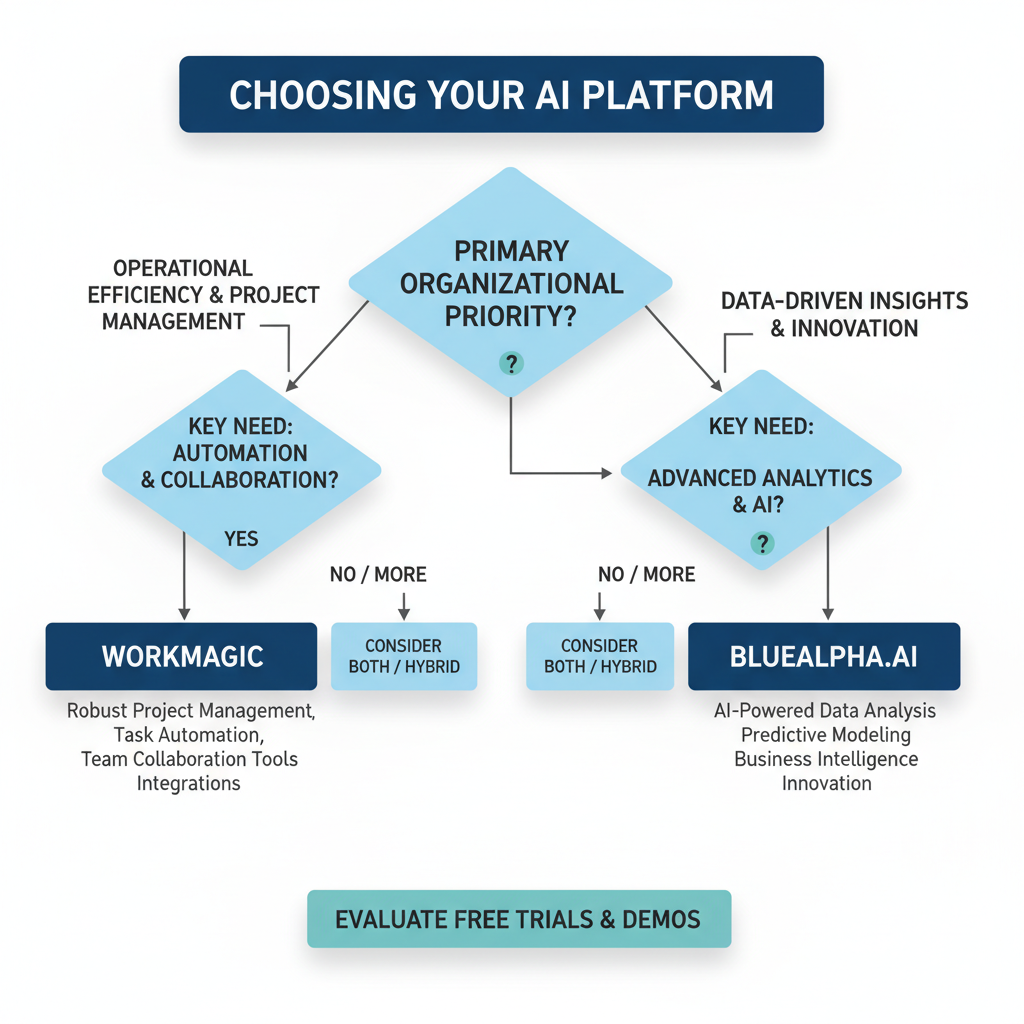
Choose based on your primary bottleneck—content production or measurement accuracy
Making the Right Decision
Choosing between Workmagic vs BlueAlpha.ai comes down to where your organization needs the most help:
Choose Workmagic if your problem is: "We can't produce enough marketing content to keep up with demand, and our creative costs are unsustainable."
Choose BlueAlpha.ai if your problem is: "We don't know which channels actually work, and we're making budget decisions based on unreliable attribution."
Consider both if: "We need to scale content production AND ensure those efforts are deployed to channels that actually drive incremental results."
Questions to Ask Before Deciding
Before committing to either platform, answer these questions:
- What's your biggest bottleneck—content or measurement? Be honest about where you're actually struggling.
- How complex is your media mix? Digital-only favors Workmagic; multi-channel favors BlueAlpha.ai.
- What level of attribution accuracy do you need? Basic tracking vs. statistically rigorous incrementality measurement.
- What does your executive team actually want to know? Content efficiency vs. proven ROI.
- How much do you spend monthly? Higher budgets benefit more from optimization than content savings. See our guide on marketing ROI analysis for benchmarks.
Frequently Asked Questions
What's the main difference between Workmagic and BlueAlpha.ai?
Workmagic is primarily a content generation platform that also includes basic attribution. BlueAlpha.ai is primarily a marketing measurement platform focused on advanced analytics and optimization. Workmagic starts with content and adds measurement; BlueAlpha.ai starts with measurement and informs content strategy.
Can Workmagic replace marketing mix modeling?
No. Workmagic's attribution capabilities are designed for e-commerce campaign tracking, not statistical marketing mix modeling. For accurate cross-channel measurement, saturation analysis, and budget optimization, you need a dedicated MMM platform like BlueAlpha.ai.
Is BlueAlpha.ai only for large enterprises?
Not exclusively. While marketing mix modeling traditionally required enterprise budgets, platforms like BlueAlpha.ai have made the methodology more accessible. Organizations spending $300K+ monthly across multiple channels typically see the strongest ROI, but the threshold continues to decrease as technology improves.
How does privacy regulation affect these platforms?
Workmagic's content generation is unaffected by privacy regulation, but its attribution features depend on platform APIs that are increasingly restricted. BlueAlpha.ai uses aggregate statistical modeling that doesn't require individual-level tracking, making it more resilient to privacy changes. This is why marketing mix modeling has gained renewed interest since iOS 14.5.
Can I use both platforms together?
Yes, and some organizations do. Workmagic handles content production and basic campaign management, while BlueAlpha.ai provides strategic measurement and budget optimization. The platforms serve complementary functions rather than direct substitutes.
What's the typical implementation timeline for each platform?
Workmagic can be operational within 1-2 weeks for basic setups, focusing on content generation. BlueAlpha.ai typically requires 6-12 weeks for initial model development, including data gathering and validation—but that investment pays dividends in measurement accuracy.
Conclusion
The Workmagic vs BlueAlpha.ai decision reflects a broader strategic question: Do you need to produce more marketing content, or do you need to understand which marketing actually works?
Workmagic excels at eliminating content production bottlenecks. For e-commerce businesses drowning in the cost and complexity of marketing asset creation, the platform delivers immediate operational relief.
BlueAlpha.ai excels at answering strategic questions about marketing effectiveness. When executives demand proof of marketing's business impact and guidance on where to invest next, marketing mix modeling delivers those insights.
The smartest organizations recognize that both functions matter. But if you must prioritize, consider this: creating more content for channels that don't work is a faster path to waste than ensuring you invest in channels that do.
Start by identifying your primary pain point. Is it content volume or measurement accuracy? That answer points you toward the right platform—or confirms you need both working together.
Ready to improve your marketing measurement capabilities? Take our readiness quiz to assess your current data infrastructure, or explore how media mix modeling can transform your budget allocation decisions.
Stay in the loop
Get updates on new posts and resources.