Marketing Measurement Platforms Measure Different Things
Compare marketing measurement platforms across MMM, attribution, incrementality, data integration, and budget decision support.

No single marketing measurement platform answers every question about marketing performance. Some tools track clicks and conversions. Some run controlled tests. Some model spend against revenue over time. Buyers who pick a tool before they name the decision it must support often end up with data they cannot use.
This guide maps the category by job, not by vendor label. It gives you a framework to match a platform to your decision cadence.
What counts as a measurement platform
A measurement platform is software that connects marketing activity to business outcomes. That definition covers a wide range of tools. Analytics dashboards that count clicks and sessions qualify. Attribution systems that assign credit across touchpoints qualify. Experimentation platforms that run holdout tests qualify. Marketing mix modeling (MMM) software, which estimates channel contribution from historical data, also qualifies.
These tools are not interchangeable. Each one uses a different method to answer a different question. Attribution tracks user-level touchpoints. It asks which channels a converting customer touched.
Incrementality testing uses a control group. It asks whether spend caused an outcome that would not have happened otherwise. MMM uses aggregated historical data. It asks how much each channel contributes to revenue over time. A platform that does one of these jobs well rarely does the other two well without added methodology.
Our unified marketing measurement guide covers how these methods can work together instead of competing for the same budget decision.
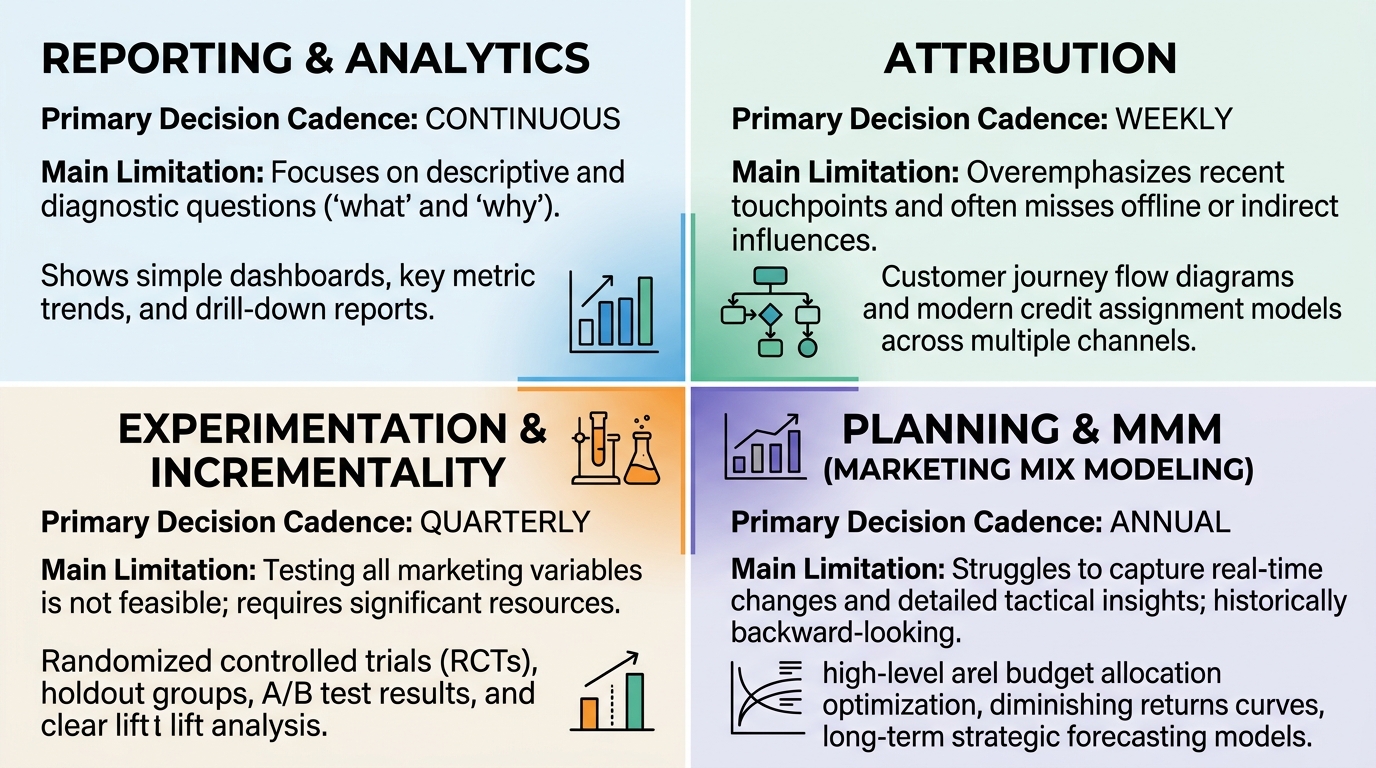
Jobs and platform categories
Buyers get better outcomes when they start with the job, not the product category. Four jobs cover most measurement needs.
Reporting and analytics. These platforms count what happened. They track sessions, clicks, conversions, and spend across channels. They answer "what happened" questions well, but they rarely prove cause. Our marketing analytics tools review covers this category in depth.
Attribution (multi-touch attribution, or MTA). These platforms assign conversion credit across touchpoints a user encountered before conversion. They run on continuous data. They support daily and weekly decisions such as bid changes and creative tests.
Attribution has a known bias problem. It credits correlation, not proven cause. It also loses signal as privacy rules limit tracking, a point outlined in a 2026 review of marketing measurement methods.
Experimentation and incrementality. These platforms run controlled tests, often geo holdouts, to measure whether a channel caused an outcome. This method gives the closest thing to a proven causal answer. It is also the most costly and narrow method. These tests typically cover one channel at a time. Teams run them only a few times a year, according to the same review of measurement methods cited above.
Planning and MMM. These platforms use historical spend and outcome data to model contribution across the full channel mix, including offline media. MMM works best for quarterly and annual budget decisions. The model only measures channels and tactics its builders included in it. It also needs a history of data to produce a stable model, per the same source.
Our marketing effectiveness measurement guide walks through how these four jobs connect to actual planning cycles.
Evaluation framework
Match the tool to the decision, not the decision to the tool. Use a practical framework based on decision type, time horizon, and budget.
| Decision type | Time horizon | Primary method | Supporting method |
|---|---|---|---|
| Keyword bids, creative tests | Daily | Attribution | None required |
| Campaign adjustments | Weekly to monthly | Attribution | Incrementality on top channels |
| Annual budget allocation | Quarterly to annual | MMM | Incrementality for calibration |
| New channel launch | Any | Incrementality | MMM for context |
| Executive or board planning | Annual | MMM plus incrementality | Attribution for execution |
This table reflects guidance from a 2026 comparison of MMM, MTA, and incrementality methods. The same source suggests a rough budget guide. Teams spending under one million dollars a year can often rely on selective incrementality tests plus attribution. Teams spending above twenty million dollars across many channels usually need all three methods together.
Ask five questions of any platform before you buy it.
- Does it name the method it uses: attribution, incrementality, or MMM?
- Does it state its data needs and refresh cadence?
- Can incrementality test results feed back into its model as a calibration check?
- Does it show its method, or does it hide the model as a black box?
- Does its output map to a decision you actually make, at the cadence you make it?
Leading options
The vendor landscape spans open-source modeling tools, self-serve software-as-a-service (SaaS) platforms, and managed consulting services. We checked the following notes as of the current date. Reverify them before purchase, since pricing and features change.
Meta offers Robyn and Google offers Meridian, both open-source MMM tools with no license cost. Both need a modeler with data science skills to run them, according to a 2026 survey of MMM software. Several vendors sell self-serve MMM as a subscription. Reported pricing runs in the low thousands of dollars per month for smaller advertisers and higher for enterprise-scale spend, per the same survey. Other vendors position themselves as unified platforms that combine MMM, attribution, and incrementality in one system. These platforms calibrate each method against the others rather than running them in isolation, an approach described by a unified marketing measurement platform vendor.
BlueAlpha.ai's measurement platform is one managed option for teams that want MMM and budget decision support without running an internal modeling stack. Evaluate its data requirements, methods, refresh cadence, exports, and service scope with the same criteria used for every other platform.
Do not treat any vendor list as a ranking. Feature sets, pricing, and data needs change often. Confirm current claims directly with each vendor before you commit budget.
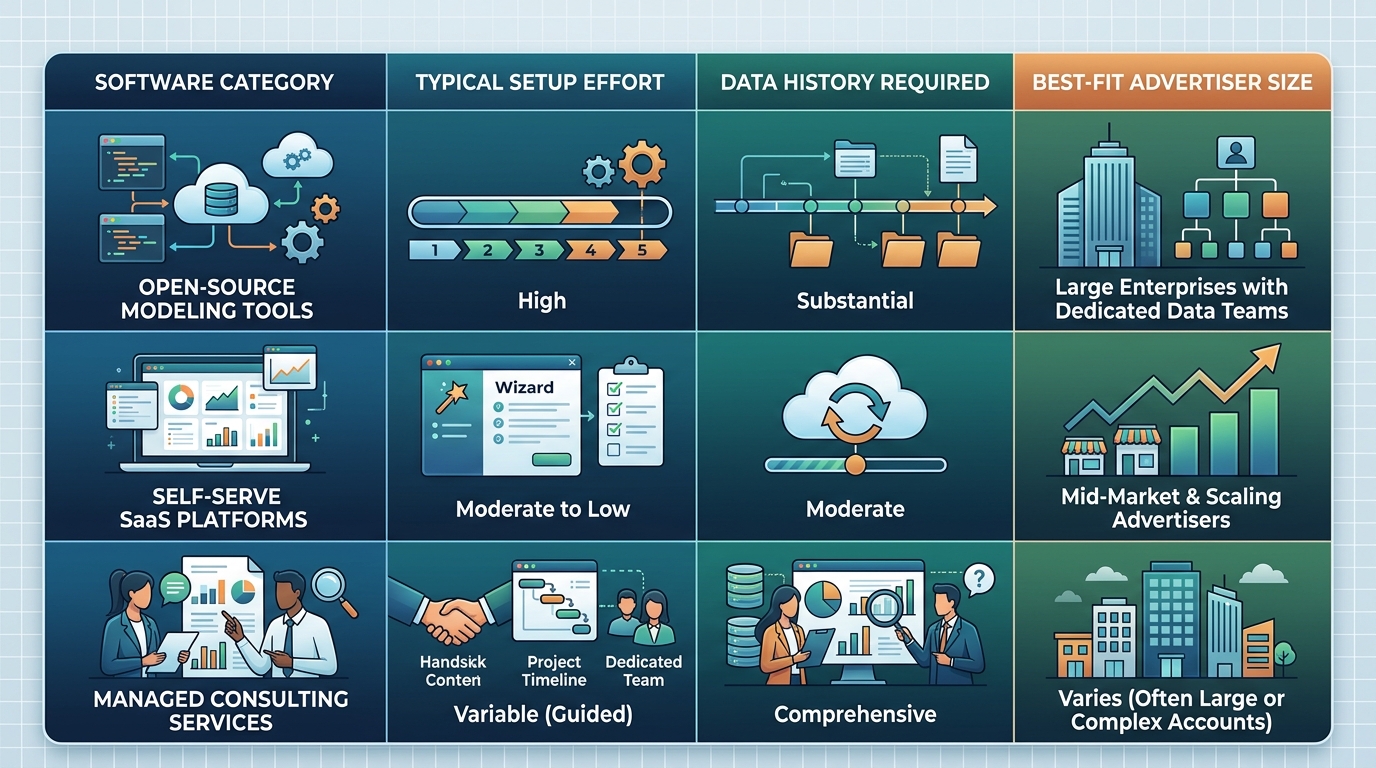
Architecture tradeoffs
Every measurement stack makes a tradeoff between speed, cost, and causal strength. Attribution is fast and cheap to run, but it cannot prove that a channel caused a sale. Incrementality testing proves cause, but it is slow and narrow. MMM covers the full channel mix and long time horizons, but it moves slowly and smooths over week-to-week tactics.
A second tradeoff sits underneath these methods: where does your data live? A unified measurement writeup argues that a single, centralized data warehouse is a requirement for combining methods well. Without one shared data layer, attribution, incrementality, and MMM outputs stay siloed. They often disagree with no way to reconcile them.
A third tradeoff is build versus buy. Open-source MMM tools cost nothing in license fees, but they need a skilled modeler on staff. Managed services remove that burden but cost more and reduce your view into the model. Neither choice is wrong. The right choice depends on your team's data science capacity and your budget for outside help.
Worked example (hypothetical). A retailer spends four million dollars a year across paid search, paid social, and linear television. The team runs weekly attribution for search and social bid decisions.
Twice a year, it runs a geo holdout test on television to check whether attribution and gut instinct both track real lift. Once a year, before budget planning, it runs an MMM pass across all three channels. It uses the incrementality results as a calibration check on the model's television coefficient.
No single tool did all three jobs. Three methods, used at three cadences, produced one coherent plan.
Selection checklist
Use this checklist before you sign a contract for any marketing measurement software.
- List the decisions your team makes and how often you make each one.
- Match each decision to attribution, incrementality, or MMM based on its cadence and stakes.
- Confirm the platform states its method and data needs in plain terms.
- Confirm the platform can ingest your actual data history, not just a demo data set.
- Ask for a reference customer at a similar spend level and channel mix.
- Ask how the platform handles disagreement between methods, if it uses more than one.
- Check pricing and contract terms directly with the vendor, since public pricing data ages quickly.
Conclusion
A marketing measurement platform is only as useful as the decision it supports. Reporting tools count activity. Attribution tracks touchpoints. Incrementality tests prove cause. MMM allocates budget across the full mix. No one tool replaces the other three.
Map your own decision cadence to these methods before you shop for software. Start by listing your top five recurring marketing decisions. Then match each one to the method built to answer it.

If you're still deciding which measurement method fits the decisions your team actually makes, connect with an MMM consultant. A short review can tell you whether MMM belongs in your stack or whether another method should come first.
Stay in the loop
Get updates on new posts and resources.