Best Marketing Analytics Tools: Top 4 Platforms Compared
Compare top marketing analytics tools: Heap, Mixpanel, GA4, and Amplitude. Find the right fit for your strategy and discover how BlueAlpha enhances your insights.
Data is loud. It screams from every click, swipe, and page view. But listening to the noise isn't enough. You need to understand what it’s saying.
Choosing the right stack from the sea of marketing analytics tools feels like picking a favorite child. You have the giants, the innovators, and the specialists. Today, we break down the four biggest players in the room: Heap, Mixpanel, Google Analytics 4 (GA4), and Amplitude.
Most marketers get stuck here. They pick a tool because it is popular. Six months later, they drown in data but starve for insights. According to Harvard Business Review, companies that rely on data-driven decision-making are 5% more productive and 6% more profitable. But that only works if you can actually read the data.
To avoid the data trap, you need a solid grasp of marketing effectiveness measurement before you even sign a contract.
This guide cuts through the feature bloat. We compare these platforms head-to-head. We also explain how they fit into a broader measurement strategy, and how solutions like BlueAlpha handle the high-level attribution these tools often miss.
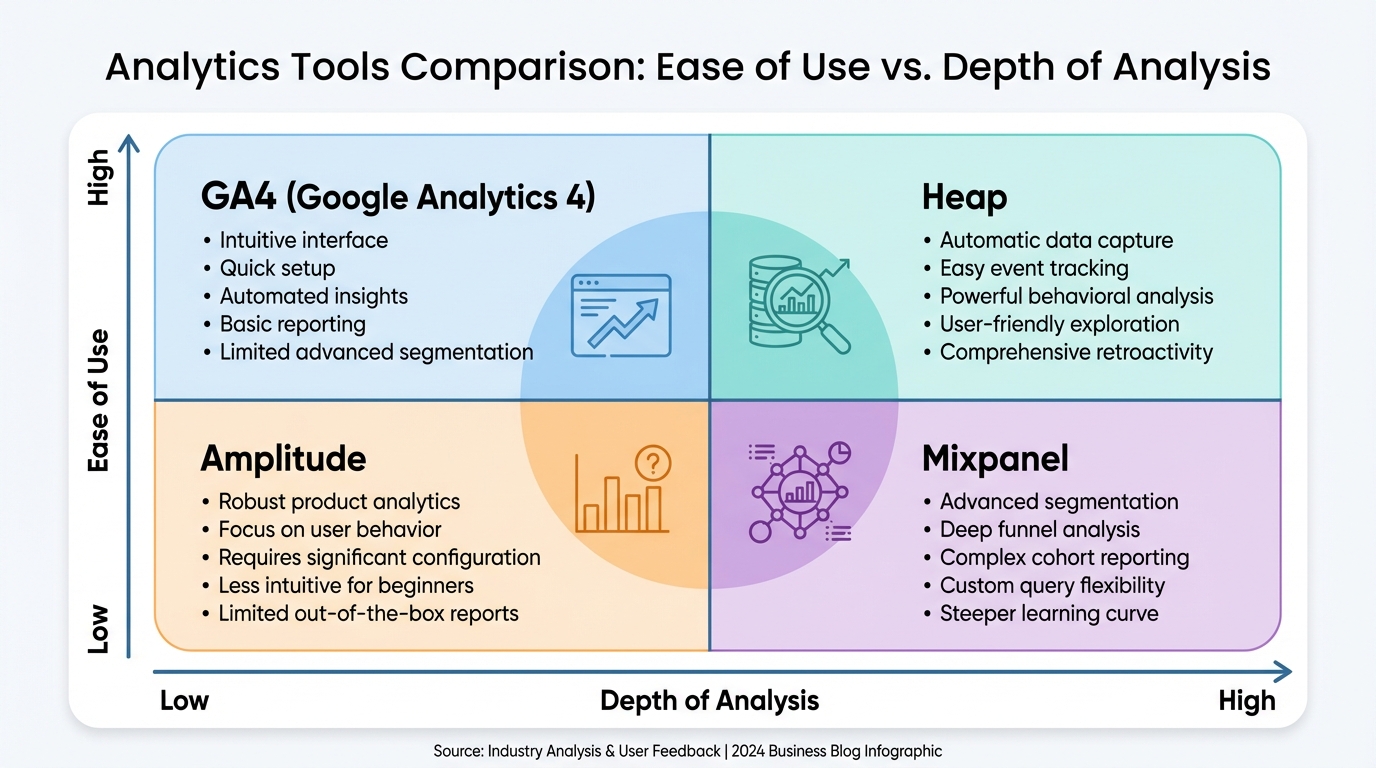
The Landscape: Product vs. Marketing Analytics
Before we dive into features, let's clear up a myth. Historically, GA4 was for marketers (traffic sources). Amplitude, Mixpanel, and Heap were for product managers (user behavior).
That line is gone.
Modern growth marketing needs deep product insights. You cannot optimize ad spend if you don't know what users do after the click. That is why these product-focused platforms are now essential marketing analytics tools.
However, tracking user journeys is only half the battle. You also need to measure effectiveness across channels. For a deep dive on how different measurement models interact, check out our marketing attribution guide.
Google Analytics 4 (GA4): The Big Player
Everyone uses it. Few love it.
GA4 replaced Universal Analytics to address a privacy-first world. It shifted from session-based tracking to an event-based model. This makes it act more like the other tools on this list. When discussing Google Analytics 4 vs Mixpanel, the main difference is simple. GA4 still cares about sessions. Mixpanel cares about users.
The Good
It’s Free: For most businesses, the price tag is zero. This makes it the default starting point. Google Ecosystem Integration: If you run Google Ads, the integration is seamless. You can push audiences from GA4 directly to your ad campaigns. Machine Learning: GA4 uses predictive metrics to fill in data gaps caused by cookie consent rejections.
The Bad
Steep Learning Curve: The interface is very hard to use. Standard reports are limited. You have to build custom "Explorations" for basic data. Data Thresholding: To protect privacy, Google hides data when user counts are low. This makes analyzing small campaigns frustrating. Sampling: On the free version, heavy data usage leads to sampling. You aren't looking at your actual numbers, just an estimate.
According to a recent report by Gartner, over 60% of marketing leaders feel their analytics tools are too complex for their teams to use effectively. GA4 often contributes to this statistic.
Best For
GA4 is essential for top-of-funnel traffic analysis. It remains the standard for understanding where your visitors come from. However, for deep user retention analysis, it falls short compared to dedicated product analytics platforms. If you are looking for other options to measure performance, consider reviewing Lifesight alternatives to see how different platforms handle attribution.
Amplitude: The Power User’s Choice
Amplitude is the heavyweight champion of behavioral analysis. It doesn't just tell you what happened. It helps you figure out why.
It treats every user interaction as an event. This allows for incredibly detailed analysis of the user journey.
The Good
Advanced Cohort Analysis: You can segment users by almost any behavior. Want to see retention rates for users who clicked a specific button three times in their first week? Amplitude handles that easily. Microscope Feature: You can click on any data point in a chart to see the individual users behind the number. Scalability: It handles massive datasets without slowing down.
The Bad
Hard to Set Up: You must define your tracking plan perfectly before you start. If you forget to tag an event, you can't analyze it later. Cost: It gets expensive quickly as your event volume grows. Complexity: Like a fighter jet cockpit, there are buttons everywhere. It requires a dedicated analyst to get the most out of it.
For teams struggling to justify marketing spend based on complex user behaviors, understanding marketing ROI analysis is critical before investing in a tool this robust.
According to McKinsey & Company, companies that integrate advanced behavioral analytics into their marketing stack see a 15-20% increase in marketing efficiency.
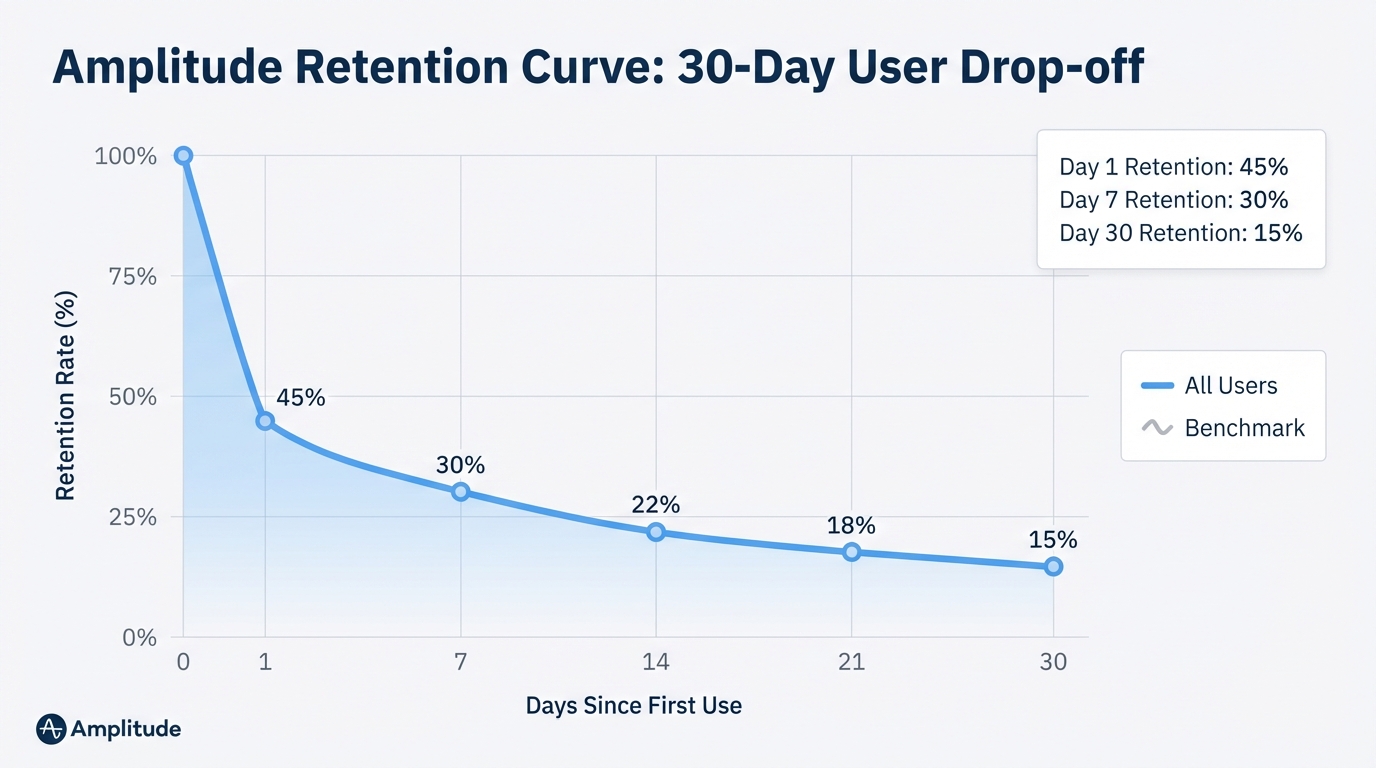
[IMAGE: Screenshot of an Amplitude retention curve chart showing user drop-off over 30 days.] Alt text: Amplitude retention analysis dashboard showing cohort performance.
Mixpanel offers a balance between power and usability. It was one of the first to champion the "event-based" model that GA4 eventually adopted.
Its philosophy is simple: data for everyone. You shouldn't need to write code to answer a question. This approach makes it a favorite for teams where designers and marketers need direct access to data.
The Good
User Interface: It is arguably the best-looking tool of the bunch. The reports are intuitive and easy to build. Interactive Reports: You can slice and dice data in real-time without waiting for queries to load. Group Analytics: Excellent for B2B companies that need to track account-level health, not just individual users. This is vital for account-based marketing attribution.
The Bad
Implementation Effort: Like Amplitude, it requires a strict tracking plan. Garbage in, garbage out. Pricing Model: The pricing can be unpredictable if your monthly tracked users (MTUs) spike unexpectedly.
When comparing Google Analytics 4 vs Mixpanel, Mixpanel wins on usability and funnel visualization. GA4 wins on acquisition data. A study by Forrester highlights that tools prioritizing UI/UX see 2x higher adoption rates within marketing teams than technical-first platforms.
Heap: The Low-Code Automator
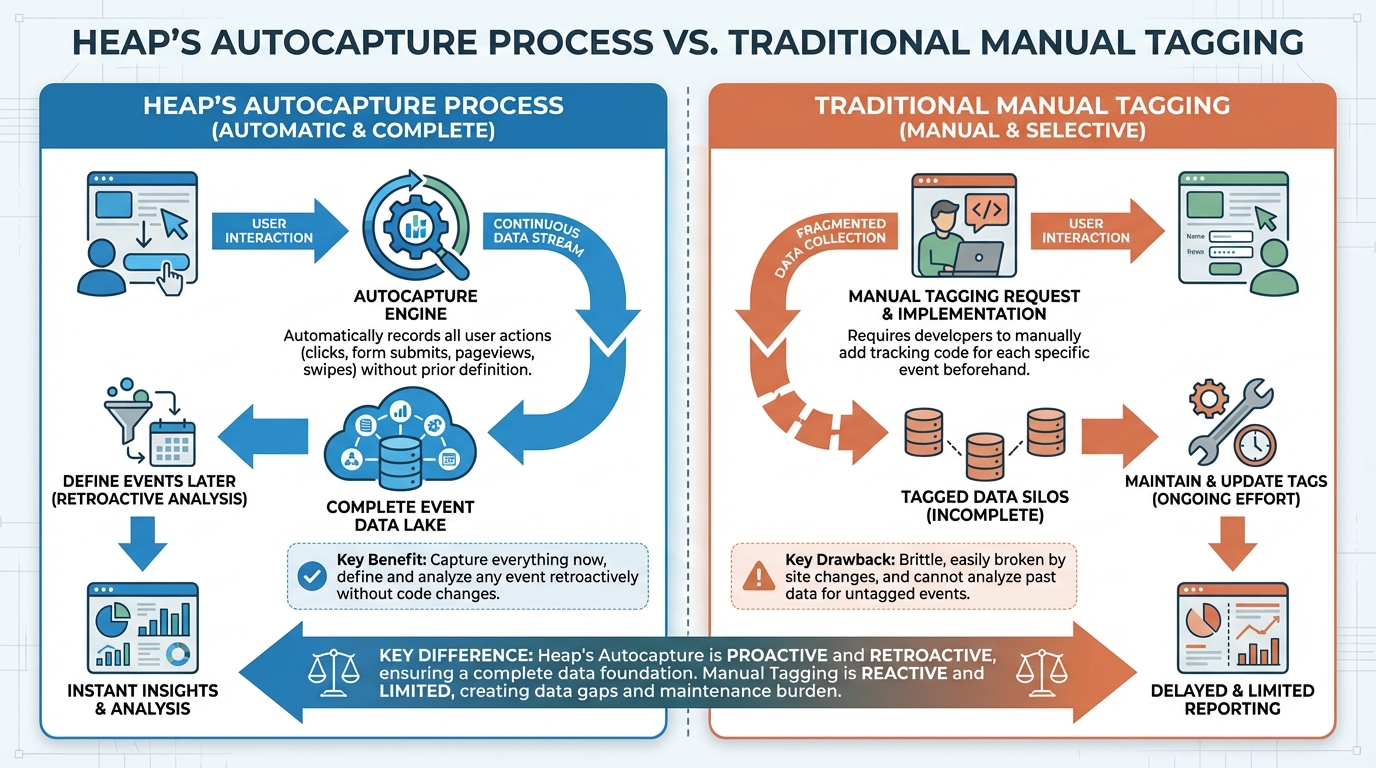
Heap’s claim to fame is "autocapture." Other tools require you to manually tag every button and page view before you can track them. Heap records everything automatically.
The Good
Retroactive Data: This is the killer feature. If you decide today that you want to track a button you launched six months ago, Heap already has the data. You just define the event, and the history populates instantly. Speed to Insight: You can install the snippet and have data flowing in minutes. Low Technical Debt: You don't need to bug developers every time you want to track a new conversion event.
The Bad
Data Noise: Because it captures everything, your dataset can get messy. You need strong governance to keep it clean. Cost: It is generally pricier than the entry-level tiers of Mixpanel or Amplitude. Performance: The autocapture script can be slightly heavier on your website’s load time compared to the others.
Bad data costs money. A report by Forbes suggests that poor data quality costs the US economy $3.1 trillion annually. Heap captures a lot of data, so keeping it clean is vital.
For teams looking to optimize their measurement stack without heavy engineering, Heap aligns well with agile methodologies. If cost is a factor, you might also want to explore alternatives to Measured.com to see how other measurement tools price their services.
To see how this fits into broader data strategies, look at alternatives to Funnel.io for managing your data pipelines.
[IMAGE: Diagram illustrating Heap's autocapture process vs. traditional manual tagging.] Alt text: Visual comparison of manual tracking code vs Heap's automatic data capture. Caption: Heap captures all interactions upfront, allowing for retroactive analysis.
| Feature | GA4 | Amplitude | Mixpanel | Heap |
|---|---|---|---|---|
| Primary Use | Traffic & Acquisition | Deep Product Analytics | Self-Serve Analytics | Agile Analytics |
| Tracking Method | Event-based (Manual) | Event-based (Manual) | Event-based (Manual) | Autocapture |
| Retroactive Data | No | No | No | Yes |
| Learning Curve | High | High | Medium | Low |
| Free Tier | Generous | Generous | Moderate | Limited |
| Best For | SEO/PPC Traffic | Product Teams | Design-led Teams | Lean Marketing Teams |
When deciding between Google Analytics 4 vs Mixpanel or Heap vs Amplitude, the decision often comes down to your engineering resources. If you have zero dev time, Heap is the winner. If you have a data team, Amplitude offers the most power.
The Missing Piece: Where Does MMM Fit?
We have covered the best marketing analytics tools for tracking user behavior. But there is a gap.
These tools are deterministic. They rely on tracking a user from Point A to Point B via cookies, device IDs, or user logins.
The problem? Privacy regulations (GDPR, CCPA) and browser restrictions (iOS14+, ITP) are breaking these links. You are seeing less of the user journey than ever before. Furthermore, none of these tools can tell you the impact of a billboard, a TV ad, or an influencer mention that didn't result in an immediate click.
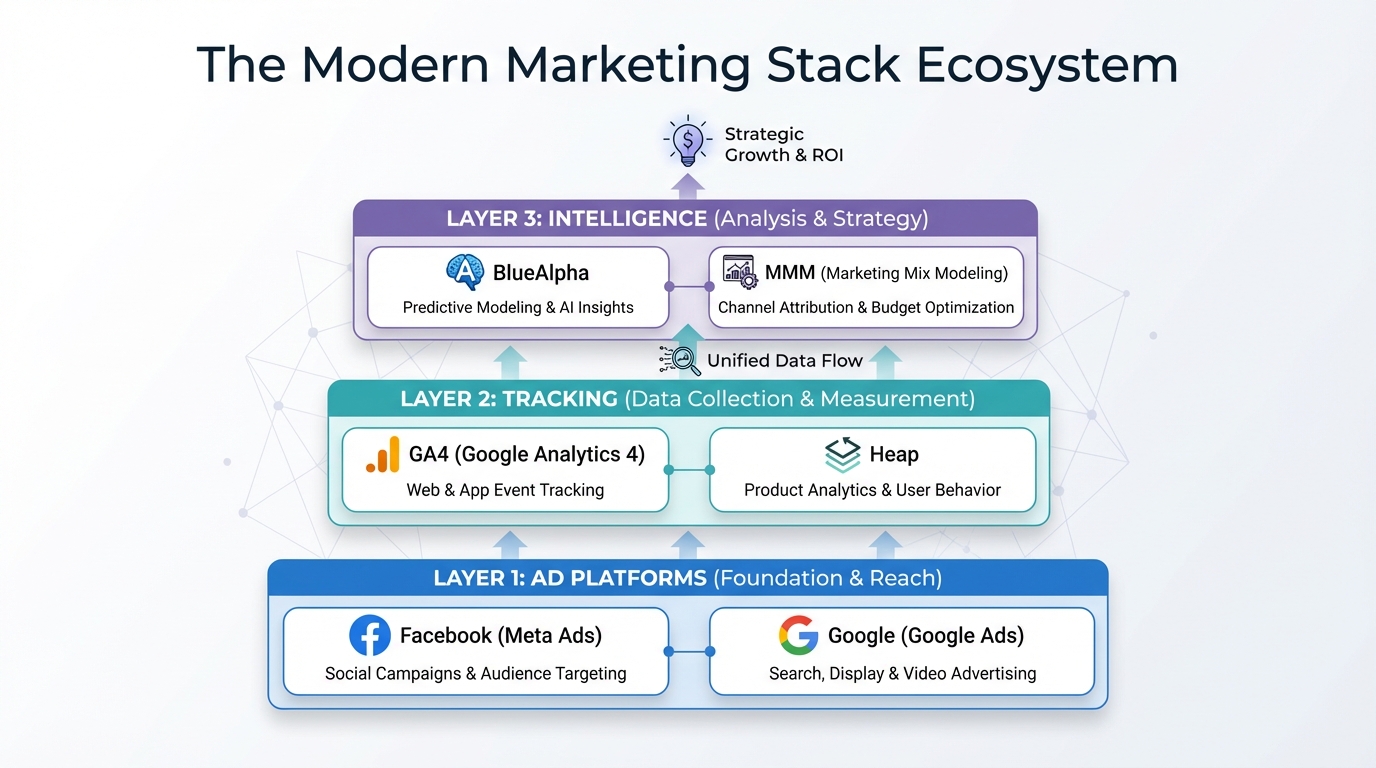
This is where Media Mix Modeling (MMM) comes in. For a detailed breakdown of the top models, read our comparison of the best MMM platforms.
While Amplitude and Heap track the micro (user clicks), MMM tracks the macro (budget efficiency).
Why You Need Both
- Attribution: GA4 might say your Facebook Ads aren't working because it can't track the view-through conversions. MMM analyzes the statistical correlation between your Facebook spend and your total sales to reveal the true lift.
- Budgeting: You cannot plan next year's budget based solely on click data. You need to understand the diminishing returns of each channel. Read more in our media budget optimization guide.
- Privacy: MMM doesn't need user-level data. It works with aggregated data, making it completely privacy-safe.
According to Deloitte, the shift away from third-party cookies is forcing 80% of marketers to rethink their attribution strategies, moving towards probabilistic models like MMM.
Enter BlueAlpha
BlueAlpha bridges the gap between granular event tracking and high-level strategy. It uses advanced AI to ingest data from your marketing analytics tools and your ad platforms to provide a unified view of performance.
BlueAlpha isn't just another report. BlueAlpha delivers insights 10x faster than traditional MMM.
While legacy models take months to build and update, BlueAlpha operates at the speed of modern marketing. It complements tools like Mixpanel or GA4 by answering the questions they can't: "What is the true incremental value of my YouTube spend?" It turns a guessing game into a science.
If you are currently relying solely on Multi-Touch Attribution (MTA) provided by these platforms, you might be misallocating budget. Compare the methodologies in our MTA vs MMM comparison.
[IMAGE: Infographic showing the marketing stack ecosystem. Layer 1: Ad Platforms (FB, Google). Layer 2: Tracking (GA4, Heap). Layer 3: Intelligence (BlueAlpha/MMM).] Alt text: The modern marketing technology stack showing where MMM fits above tracking tools. Caption: A complete stack requires both tracking (Heap/GA4) and strategic modeling (BlueAlpha).
Decision paralysis is real. Here is a simple framework to choose the right marketing analytics tools for your specific situation.
Scenario A: The Content Site
If you run a blog or a media site where "time on page" and "page views" are your main metrics, stick with GA4. It is free and built for this.
Scenario B: The SaaS Startup
You have a web app. You need to know if users who complete the onboarding tutorial are less likely to churn.
- Choose Heap if you have a small team and no engineers to spare.
- Choose Mixpanel if you want beautiful dashboards to share with investors.
Scenario C: The Enterprise Product
You have millions of daily active users and a dedicated data science team. You need raw data access and complex query capabilities. Amplitude is your best bet.
Scenario D: The Omnichannel Brand
You sell online, but you also run podcasts, TV ads, and heavy social campaigns.
- Use GA4 for traffic.
- Use Heap/Shopify for on-site conversion optimization.
- Crucially, deploy a solution like BlueAlpha to measure the holistic impact of your media mix.
For brands with heavy physical presence, understanding digital impact is hard. Our OOH advertising tracking guide explains how to bridge that gap. Similarly, if you rely on creators, check out our influencer marketing measurement guide.
Implementation: Don't Just Set It and Forget It
Buying the tool is the easy part. Implementation is where value is created or destroyed.
- Define Your Questions First: Don't track everything. Track the answers to your business questions.
- Standardize Naming:
Sign_Up_Buttonandsignup_btnwill appear as two different events. Create a naming convention and enforce it. - Audit Regularly: Links break. Tags fall off. Schedule a quarterly audit of your analytics setup.
- Connect the Pipes: Ensure your analytics tool talks to your CRM and your attribution model. For insights on data integration, check out our guide on pipeline attribution.
According to Harvard Business Review, the most successful companies treat analytics not as a reporting function, but as a core product capability.
Frequently Asked Questions
Can I use GA4 and Mixpanel together?
Absolutely. This is a common setup. Use GA4 for acquisition metrics (where did they come from?) and Mixpanel for retention metrics (what did they do after they signed up?). This leverages the strengths of both Google Analytics 4 vs Mixpanel.
Is Heap really code-free?
Mostly. The autocapture handles 90% of use cases. However, for complex server-side events or tracking data that isn't visible on the screen (like a User ID), you will still need a developer.
How does BlueAlpha differ from these tools?
Heap, Mixpanel, and GA4 track user actions. BlueAlpha models business outcomes. It uses statistical modeling to tell you how your marketing budget influences revenue. It accounts for offline channels and privacy restrictions that tracking tools miss. Learn more about deployment in our how to deploy media mix model article.
Which tool is best for mobile apps?
Amplitude and Mixpanel are superior to GA4 and Heap for mobile app analytics. They have robust SDKs and focus on event streams rather than page views. See research from MIT Sloan Management Review on how mobile engagement metrics differ from web.
Conclusion
There is no single "best" tool among marketing analytics tools. There is only the tool that fits your current stage and technical resources.
- GA4 is your baseline for traffic.
- Heap is for speed and agility.
- Mixpanel is for design and data democratization.
- Amplitude is for depth and scale.
But remember, tracking clicks is not the same as measuring value. As your marketing mix grows complex, relying solely on click-based tracking leads to blind spots.
To truly master your marketing efficiency, you need to combine the micro-insights of these platforms with the macro-intelligence of Media Mix Modeling.
Ready to see the full picture? Don't just track the user—measure the impact.
[IMAGE: A clean, minimalist summary graphic listing the logos of the 4 tools plus BlueAlpha with a 'Better Together' tagline.] Alt text: Logos of Heap, Mixpanel, GA4, Amplitude and BlueAlpha. Caption: Combine behavioral analytics with MMM for total marketing visibility.
Stay in the loop
Get updates on new posts and resources.