Pipeline Attribution: The B2B SaaS Growth Engine
Stop optimizing for leads. Discover how pipeline attribution connects marketing efforts directly to revenue and reveals what truly drives B2B SaaS growth.
MQLs are great. They look good on a dashboard. They make the marketing team feel productive.
But you can’t pay salaries with MQLs.
In the complex world of B2B SaaS, the gap between a lead and a closed deal is massive. It’s a winding road of stakeholders, demos, committees, and budget approvals. If you are only measuring the start of that road, you're flying blind.
This is where pipeline attribution changes the game.
It moves the goalpost from "who filled out a form" to "who actually bought the software." It connects your marketing spend directly to revenue, allowing you to cut the fluff and double down on what works.
Here is how to build an attribution strategy that actually drives growth.
The Problem with Traditional Metrics
Most B2B marketers suffer from a "lead bias."
You run ads. You get clicks. People download a whitepaper. You celebrate.
But three months later, sales asks a painful question: "Where is the revenue?"
The disconnect happens because standard attribution models—usually built for e-commerce—don't account for the B2B buying cycle. A $50 sneaker purchase is impulsive. A $50,000 SaaS contract is calculated.
According to Harvard Business Review, focusing solely on short-term metrics like clicks often destroys long-term value.
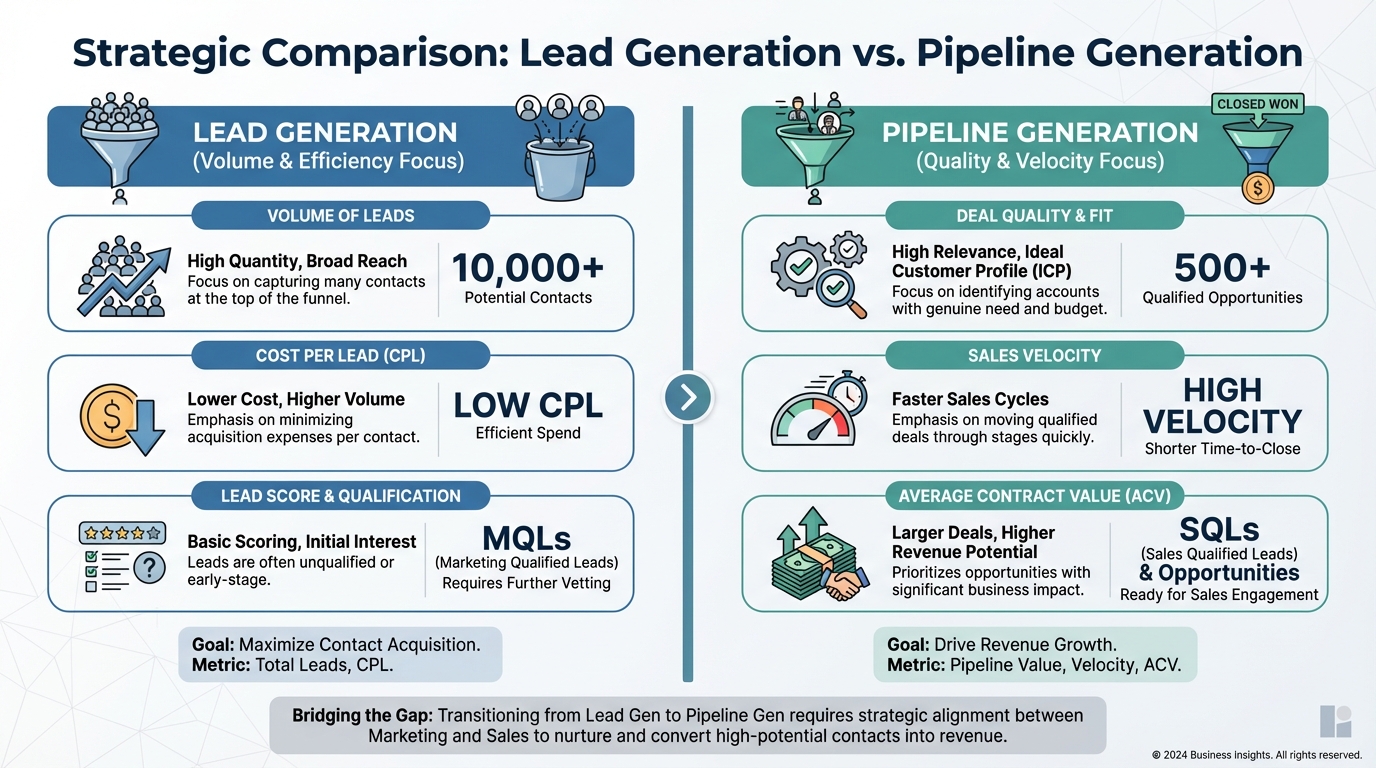
To fix this, you need to understand the difference between generating interest and generating pipeline.
Revenue attribution tracks the influence of marketing touchpoints on opportunities that actually enter the sales process. It ignores the noise of low-quality signups and focuses on the signal of high-intent buyers.
If you want to dive deeper into the basics, check out our guide on marketing attribution fundamentals.
Ultimately, the goal is true revenue attribution. You need to know which dollar spent today generates ten dollars next quarter.
Why B2B SaaS is Different
The average B2B buying group involves six to ten decision-makers.
That is a statistic from Gartner, and it highlights why single-touch attribution fails in SaaS.
Your CEO might see a LinkedIn ad. The CTO reads a technical blog post. The end-user searches for a solution on Google. Finally, the VP of Sales books the demo.
This is the chaotic reality of the modern customer journey.
If you use "Last Touch" attribution, Google Search gets 100% of the credit. The LinkedIn ad and the blog post—which actually educated the market—get zero. You cut the budget for those channels, and suddenly, your search traffic dries up.
You destroyed your demand generation engine because your attribution model lied to you.
The Complexity of the Journey
B2B customer journeys are non-linear. They loop. They stall. They restart.
Effective pipeline attribution must account for:
- Time Lag: The months between first touch and closed-won revenue.
- Multiple Personas: Different people from the same company interacting with different content.
- Offline Interactions: Events, sales calls, and word-of-mouth.
This complexity is why simple tracking pixels aren't enough. You need a robust framework for B2B SaaS attribution.
The Models: Moving Beyond First and Last Touch
Not all models are created equal. Let's break down the standard options and see which ones actually support growth.
1. The Legacy Models (Avoid These)
- First Touch: Gives 100% credit to the first interaction. Good for seeing brand awareness, terrible for closing deals.
- Last Touch: Gives 100% credit to the conversion point (usually a "Book Demo" button). This ignores the entire nurturing process.
These are vanity models. They simplify reality to the point of uselessness.
2. Linear Attribution
This model splits credit equally across every touchpoint.
If a prospect hits five channels before buying, each gets 20%. It is democratic, but it is also dumb. It values a low-impact social post the same as a high-impact case study. It's better than single-touch, but it lacks nuance for strategic marketing budget optimization.
3. Time Decay
This model gives more credit to interactions that happened closer to the conversion.
It assumes that the touchpoints immediately preceding the sale were the most persuasive. In B2B, this is often true, but it still undervalues the content that sparked the initial interest.
For a deeper look at how these models impact budget, read about marketing ROI calculations.
4. Position-Based (U-Shaped and W-Shaped)
Now we are getting somewhere.
U-Shaped gives 40% to the first touch, 40% to the lead creation touch, and splits the remaining 20% among the middle.
W-Shaped is the darling of multi-touch attribution. It distributes credit like this:
- 30% to First Touch (Introduction)
- 30% to Lead Creation (Conversion)
- 30% to Opportunity Creation (The Handoff to Sales)
- 10% to nurturing steps in between.
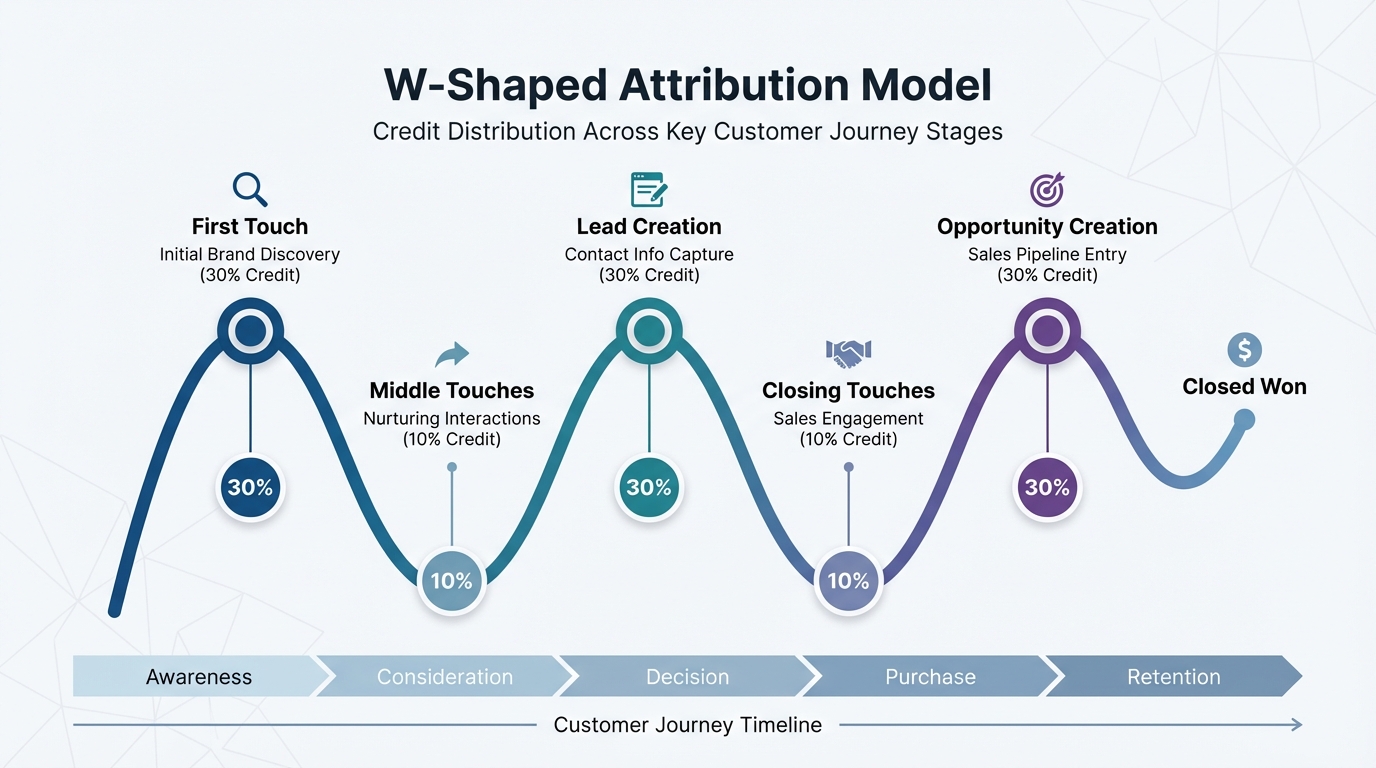
This model acknowledges that starting the relationship, capturing the lead, and qualifying the deal are the three critical milestones. This structure is often the baseline for effective B2B SaaS attribution. You can learn more about setting this up in our guide to multi-touch attribution.
The Data Gap: Where Attribution Fails
Here is the uncomfortable truth: multi-touch attribution is dying.
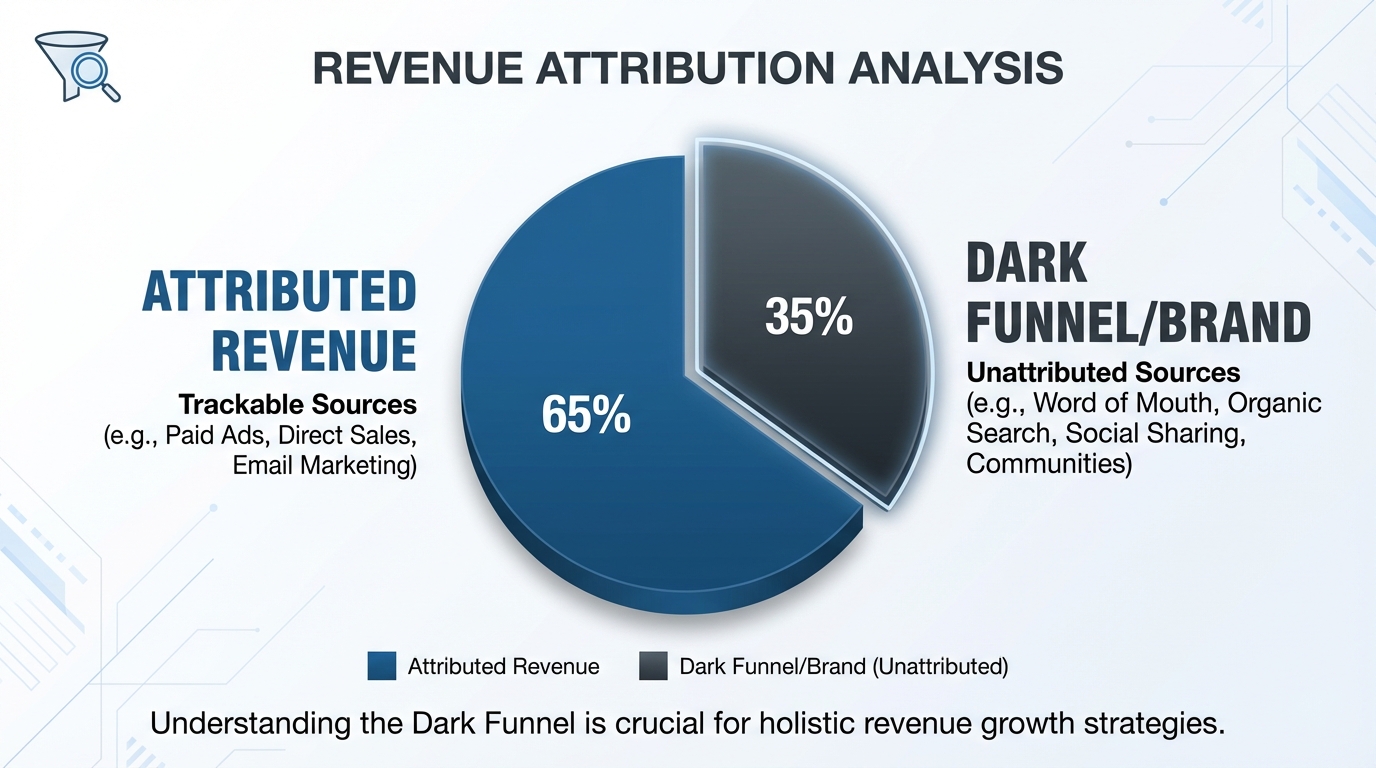
Privacy regulations (GDPR, CCPA), the death of third-party cookies, and the rise of "Dark Social" are blinding standard tracking tools.
If a CEO asks a peer in a private Slack community, "What software do you use?", and then types your URL directly into their browser, your attribution software calls that "Direct Traffic."
You think your brand awareness campaigns aren't working because the software can't see the conversation.
According to research by Refine Labs, dark social can account for a massive portion of B2B demand that software completely misses.
Enter Marketing Mix Modeling (MMM)
This is where the industry is heading.
Since you can no longer track every user individually with perfect accuracy, you need to analyze data at the aggregate level.
Marketing mix modeling uses statistical analysis to correlate spikes in marketing spend with spikes in revenue. It doesn't care about cookies. It looks at the big picture.
- You spent $50k on LinkedIn.
- You spent $20k on Podcasts.
- Pipeline grew by $200k.
MMM calculates the incremental lift of each channel.
Leading platforms like BlueAlpha are pioneering this hybrid approach. They combine the granular data of touch-based attribution with the holistic view of MMM. This ensures you aren't just tracking clicks, but understanding the true drivers of revenue.
You can learn more about how this statistical approach works in our guide to media mix modeling.
Implementing Pipeline Attribution
You can’t just flip a switch. Building a pipeline attribution engine requires infrastructure.
1. Clean Your CRM Data
Your attribution is only as good as your data. If your sales team isn't tagging contacts to opportunities correctly, your reports will be garbage. Poor data hygiene is the number one reason attribution projects fail, according to Salesforce.
- Enforce contact roles on every opportunity.
- Map lead sources consistently.
- Eliminate duplicate records.
This data hygiene is absolutely crucial if you are running account-based marketing, where account-level accuracy defines success.
For tips on maintaining a healthy database, ensure your CRM data quality processes are robust.
2. Define Your "North Star" Metric
Stop reporting on ten different things. Pick one revenue metric that marketing owns.
Usually, this is "Pipeline Generated" (dollars) or "Closed-Won Revenue" (dollars).
3. Integrate Your Tech Stack
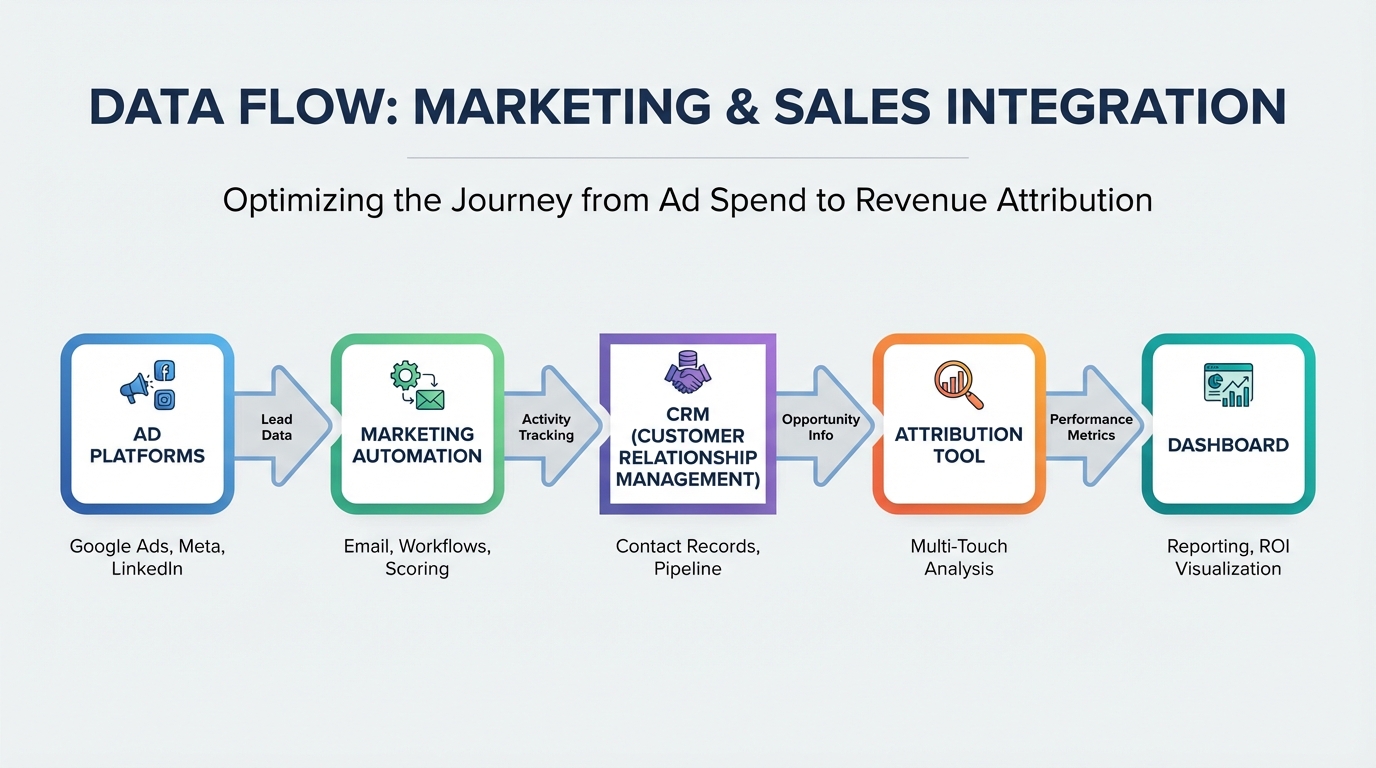
Your ad platforms need to talk to your CRM.
If you are using LinkedIn Ads, ensure the "Hidden Fields" in your forms are passing campaign ID data into your marketing automation platform, which then pushes it to the CRM.
Without this chain of custody, the data is lost. You need to ensure your marketing analytics stack is fully integrated.
For more technical details on setting up these integrations, HubSpot's developer documentation offers a great baseline for how data should structure between systems.
Analyzing the Output
Once you have data flowing, how do you read it?
You need to look for discrepancies between models.
If Facebook Ads show high ROI on "First Touch" but zero ROI on "Last Touch," that tells you something specific: Facebook is a great discovery channel, but it doesn't close deals.
Action: Keep running Facebook ads to fill the top of the funnel, but retarget those visitors via email or LinkedIn to close them.
If you cut Facebook because it had poor "Last Touch" performance, your pipeline would eventually starve.
This is the power of nuanced pipeline attribution. It prevents knee-jerk budget cuts.
The Role of Content
Content is the fuel for the B2B engine.
Attribution reveals which specific blog posts or whitepapers influence revenue and shape your conversion paths. You might find that a post with very low traffic actually converts 50% of readers into high-value opportunities.
- High Traffic / Low Revenue: Brand awareness (Top of Funnel).
- Low Traffic / High Revenue: Sales enablement (Bottom of Funnel).
You need both. Attribution tells you the ratio.
Measuring individual post performance helps you understand which content drives revenue.
Overcoming the "Perfect Data" Myth
You will never have 100% perfect attribution.
Don't let perfect be the enemy of good. Even 80% accuracy gives you a massive competitive advantage over companies running on gut feeling. McKinsey notes that companies using data-driven marketing see 15-20% higher ROI.
The goal is directionally accurate data-driven marketing that allows you to make confident budget decisions.
The Human Element
Data can't tell you everything.
Add a "How did you hear about us?" field to your demo request forms. It’s low-tech, self-reported attribution.
You will be shocked at how often the software says "Google Search" but the human says "I heard your CEO on a podcast."
Combine the hard data from your pipeline attribution software with the soft data from customers. That is the sweet spot.
Future-Proofing with AI
The future of attribution isn't tracking pixels. It's AI.
Artificial intelligence can analyze vast datasets to identify patterns humans miss. It can predict which accounts are likely to close based on early-stage signals.
Platforms like BlueAlpha use AI to simulate budget scenarios.
- "What happens to pipeline if I cut Google Ads by 20% and move it to YouTube?"
AI answers that question before you spend a dime. It moves attribution from a reactive report card to a proactive GPS.
If you want to stay ahead of the curve, you must understand predictive marketing analytics and how AI enhances attribution.
Conclusion: Revenue is the Only Metric
Marketing exists to make money.
If you cannot prove your value, your budget is the first thing the CFO cuts when times get tough.
Pipeline attribution is your shield. It proves that marketing isn't a cost center—it's an investment portfolio.
Start small. Fix your CRM data. Move away from First Touch. And consider advanced modeling like MMM to capture the full picture.
To truly scale, you need to align your attribution with your broader demand generation strategy.
The companies that win in the next decade won't be the ones with the most leads. They will be the ones that understand exactly how those leads turn into revenue.
Ready to move beyond basic tracking? Explore how a comprehensive marketing strategy evolves when you have the right data and measurement tools.
FAQ
What is the difference between lead attribution and pipeline attribution?
Lead attribution focuses on the volume of contacts generated (quantity). Pipeline attribution focuses on the dollar value of the opportunities created from those contacts (quality). Pipeline attribution connects marketing directly to revenue potential.
Which attribution model is best for B2B SaaS?
Generally, the W-Shaped model is considered the standard for B2B SaaS attribution because it credits the three major transition points: First Touch, Lead Creation, and Opportunity Creation. However, data-driven attribution (using machine learning) is becoming the new gold standard.
How do I handle offline attribution?
Offline attribution requires connecting your CRM to offline events. This can be done via CRM campaigns for trade shows, unique promo codes for podcasts, or simply asking customers "How did you hear about us?" and manually updating the opportunity source.
Can I do pipeline attribution without a fancy tool?
Yes, but it is difficult. You can set up basic tracking using UTM parameters and spreadsheets, but as you scale, the data becomes too complex to manage manually. Specialized tools or advanced analytics platforms like BlueAlpha eventually become necessary for accuracy.
What is the "Dark Funnel"?
The Dark Funnel refers to buyer activities that tracking software cannot see. Forrester describes this as the "unseen" portion of the buyer's journey. This includes word-of-mouth, private communities (Slack, Discord), podcasts, and organic social consumption. It is a major reason why relying solely on software-based attribution can be misleading.
Stay in the loop
Get updates on new posts and resources.