How to Deploy Media Mix Model (MMM): Complete Guide for 2025
Learn how to deploy a media mix model with proven strategies for data collection, model validation, and production deployment. Get your MMM running in weeks, not months.
Most marketing teams spend months trying to deploy a media mix model. They wrestle with data pipelines, argue over statistical approaches, and watch their timelines slip.
There's a better way.
Deploying a media mix model (MMM) doesn't require a PhD in statistics or a six-month timeline. What it does require is a systematic approach to data preparation, model configuration, and production deployment. This guide walks you through exactly how to deploy an MMM that delivers actionable insights for your marketing team.
What is Media Mix Model Deployment?
Media mix modeling uses statistical analysis to measure how different marketing channels contribute to business outcomes. Deployment means taking this analytical framework from theory to production—turning historical data into a running system that guides budget decisions.
The deployment process transforms raw marketing data into a production-ready model that answers one critical question: Which marketing investments actually drive results?
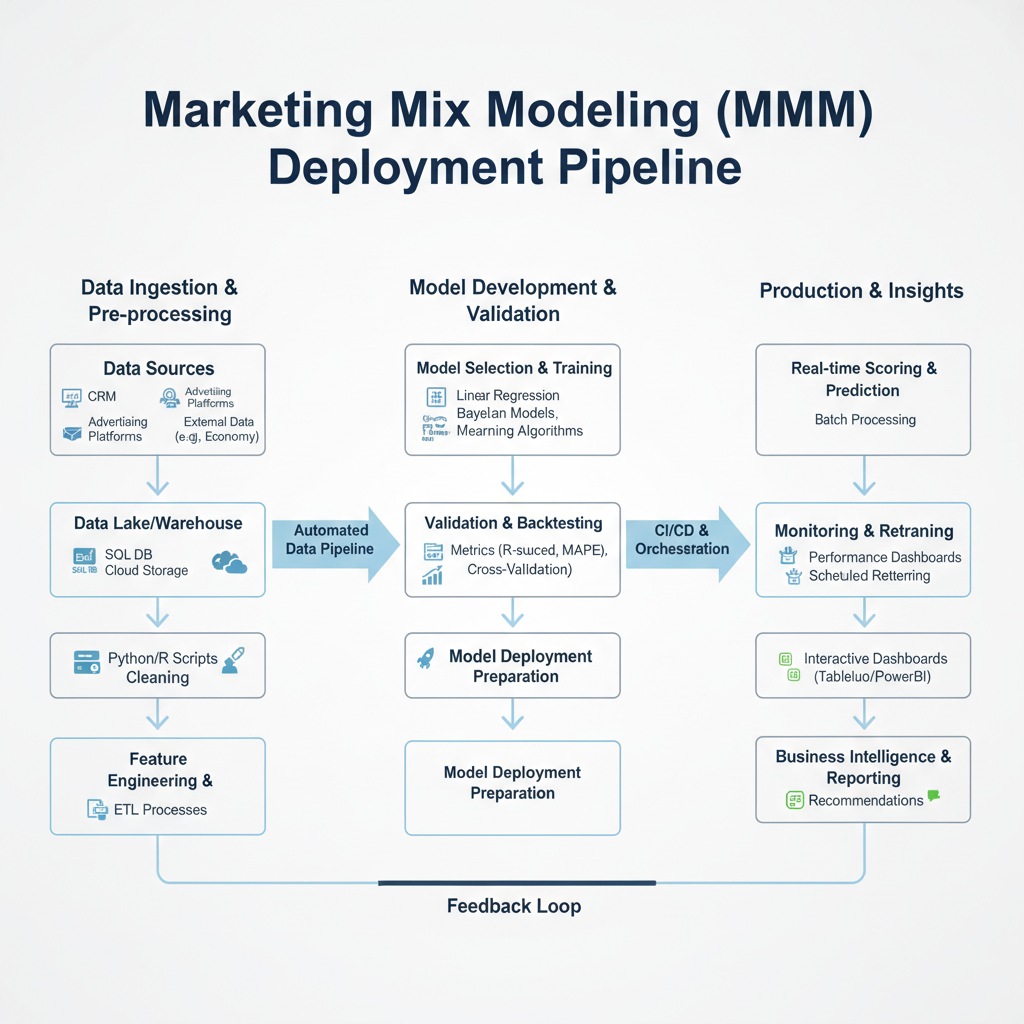
A typical MMM deployment pipeline processes data from multiple sources through validation and into production
Step 1: Define Your Deployment Objectives
Before touching any data, get crystal clear on what you want your MMM to accomplish.
Don't say "optimize marketing spend." That's too vague. Instead, specify measurable goals: Increase ROAS by 20% across paid channels, or quantify the incremental impact of brand campaigns on revenue.
Your objectives determine everything downstream—data requirements, model complexity, and validation criteria. According to G2M Insights research, teams that define clear KPIs before deployment complete their MMM projects 40% faster than those that don't.
Ask yourself:
- What business decisions will this model inform?
- Which marketing channels need measurement?
- What level of granularity do stakeholders require?
- How frequently will the model need updates?
These answers shape your entire deployment strategy.
Step 2: Gather and Prepare Your Data
Here's where most MMM deployments succeed or fail. You need high-quality time series data covering at least 18-24 months, ideally at daily or weekly granularity.
Required Data Categories
Sales/KPI Data: Your dependent variable. This could be revenue, conversions, app downloads, or any business outcome you want to model. Without clean sales data, you don't have an MMM project.
Marketing Spend Data: Budget allocation across all channels—TV, radio, digital, print, social, search. Include both paid and owned media with metrics like impressions, reach, and frequency where available.
Control Variables: External factors that impact sales but aren't marketing-related. Think seasonality, competitor actions, pricing changes, economic indicators, and promotional activity like out-of-home advertising. The model needs these to avoid attributing external effects to your marketing.
Contextual Data: Weather patterns, industry trends, product launches, PR events and influencer campaigns—anything that moved the needle on your business outcomes.
Data Preparation Process
Clean your data before modeling. This means:
- Standardizing date formats across all sources
- Handling missing values (interpolation for small gaps, flagging for investigation if substantial)
- Normalizing currency and unit measurements
- Aligning timeframes across disparate data sources
- Removing outliers and anomalies (with documentation)
According to marketing mix modeling best practices, data quality issues cause 60% of MMM project delays. Get this right first.
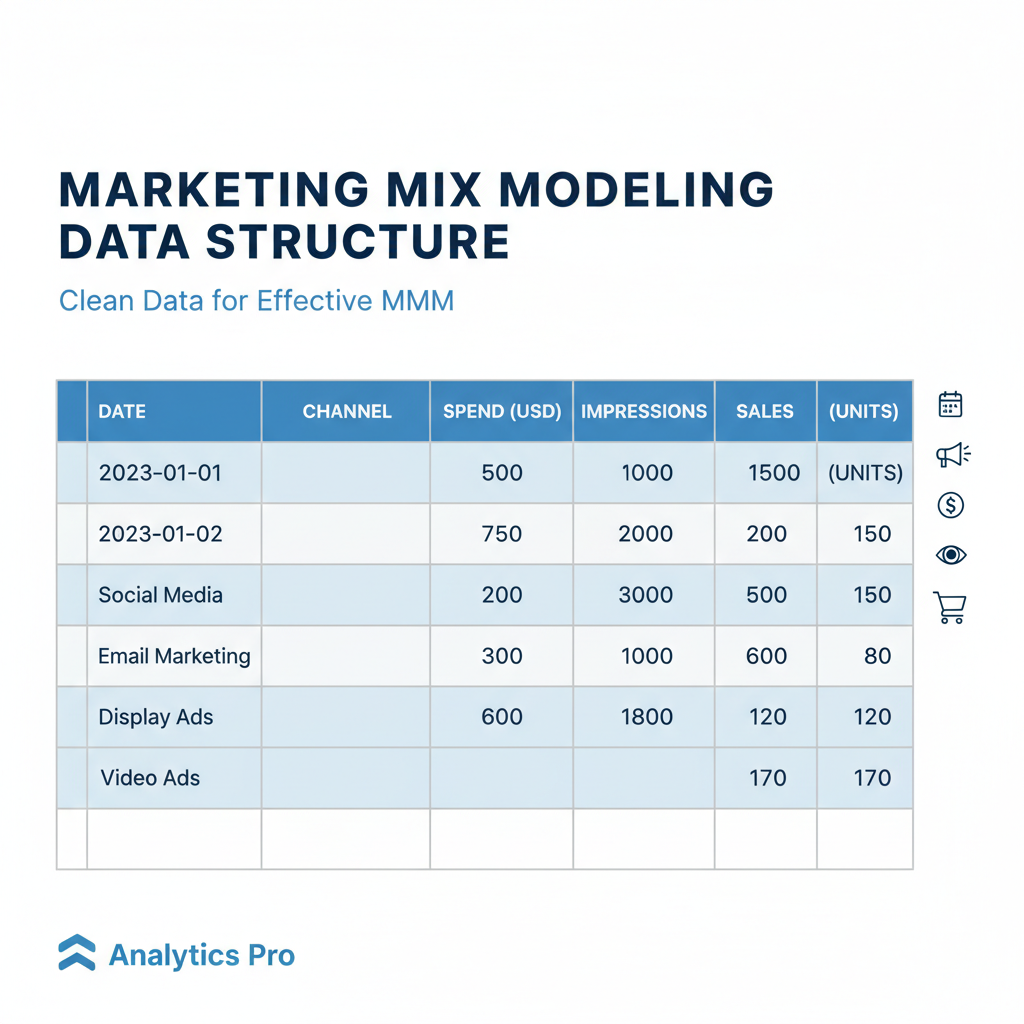
Clean, standardized data structure is essential for successful MMM deployment
Step 3: Select Your Modeling Approach and Tools
You've got options for how to deploy your media mix model. The right choice depends on your team's technical capabilities, budget, and timeline.
Modern MMM Platforms
Leading MMM software platforms handle much of the deployment complexity. Solutions like Measured, Sellforte, and Adobe Mix Modeler offer fast setup—some in as little as 4 weeks—with built-in validation and continuous updates.
These platforms excel when you need speed to value and don't have dedicated data science resources. They automate data ingestion, model training, and result generation, letting marketing teams focus on strategy rather than statistics.
BlueAlpha (bluealpha.ai) takes a different approach. Rather than a black-box platform, BlueAlpha provides transparent AI-powered analytics that gives marketing teams full visibility into model mechanics while automating the heavy lifting of deployment and optimization.
Open-Source Solutions
For teams with statistical expertise, PyMC-Marketing offers Bayesian approaches that handle uncertainty better than traditional regression. Meta's Robyn and Google's Meridian provide free tools designed for digital-focused campaigns.
Open-source deployment requires more technical work but offers maximum flexibility. You'll need Python or R expertise, infrastructure for model training, and processes for ongoing maintenance.
Statistical Techniques
Most MMMs use multiple linear regression to quantify relationships between marketing activities and sales. More sophisticated approaches incorporate:
- Adstock transformations (capturing delayed effects)
- Saturation curves (diminishing returns)
- Bayesian methods (handling uncertainty)
- Machine learning algorithms (capturing non-linear patterns)
Start simple. A well-validated linear model beats a complex model you can't explain to stakeholders.
Step 4: Build and Train Your Model
With clean data and a chosen approach, you're ready to configure and train your MMM.
Model Configuration
Define your model structure:
- Which channels to include as independent variables
- What transformations to apply (adstock, saturation)
- How to handle seasonality and trends
- Which control variables to incorporate
Databricks research shows that models incorporating proper adstock transformations improve prediction accuracy by 25-35% compared to naive approaches.
Training Process
Split your data into training and holdout sets. Train on the first 75-80% of your time series, reserving recent data for validation.
Run the regression analysis and examine:
- R-squared: How much variance your model explains (aim for 0.75+)
- Coefficient signs: Do they make intuitive sense?
- Statistical significance: Are your marketing variables significant?
- Multicollinearity: Are variables too correlated? (Check VIF scores)
If coefficients are unstable or counterintuitive, investigate. According to LinkedIn analysis, coefficient instability is the biggest challenge modeling teams face.
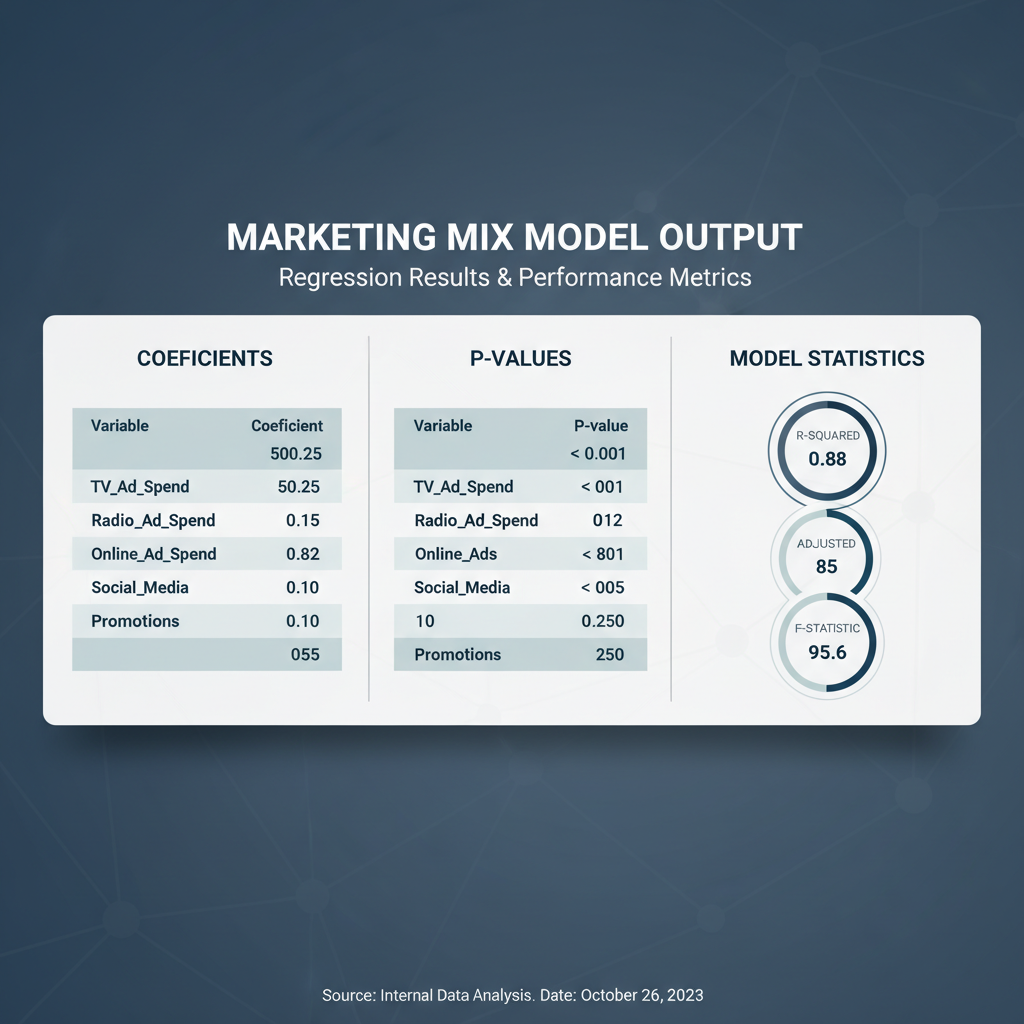
Key statistical metrics to review when validating your MMM before deployment
Step 5: Validate Your Model Rigorously
Never deploy without validation. Period.
Out-of-Sample Testing
Your holdout data (the 20-25% you didn't train on) is your first validation check. A reliable MMM should predict within 15% of actual results on out-of-sample data.
If your model nails the training period but fails on holdout data, you've overfit. Simplify and retrain.
Reality Checks
Does your model pass the smell test?
- Do channel contributions align with known performance?
- Are response curves realistic (diminishing returns at high spend)?
- Do results match any existing lift tests or experiments?
Show the model to experienced marketers. If they say "that can't be right," investigate before deployment.
Cross-Validation Methods
Three methods validate MMM incrementality:
Conversion Lift Studies: Run controlled experiments (geo tests, holdout groups) to measure actual incremental impact. Compare to MMM estimates.
Holdout Forecasting: Predict forward 3-6 months and compare to actuals as they come in.
Dynamic Budget Optimization: Implement MMM recommendations on a small scale, measure results, validate predictions.
Use all three if possible. Each catches different model weaknesses.
Step 6: Deploy to Production
Validation complete? Time to operationalize.
Infrastructure Setup
Production MMM deployment requires:
- Data pipelines: Automated ingestion from all marketing platforms and data sources
- Compute resources: Sufficient to retrain models on schedule (weekly, monthly, quarterly)
- Orchestration: Tools like Apache Airflow or Prefect to schedule and monitor workflows
- Version control: Track model versions, data lineups, and configuration changes
Docker containerization ensures consistency across development, testing, and production environments. This simplifies scaling and reduces "it worked on my machine" issues.
Integration with Marketing Systems
Your MMM needs to feed insights back to decision-makers. This means:
- Dashboards for stakeholders to explore results
- APIs for budget optimization tools
- Alerts for significant changes in channel performance
- Export capabilities for media planning
The best models are useless if insights stay locked in a data science notebook.
Monitoring and Alerts
Set up monitoring for:
- Data quality issues (missing feeds, anomalous values)
- Model drift (degrading prediction accuracy)
- Pipeline failures (broken automations)
- Statistical warnings (coefficient instability)
According to Think with Google, successful MMM deployments include automated alerts that catch issues before they impact recommendations.

Production MMM dashboards deliver actionable insights to marketing teams
Step 7: Maintain and Iterate
Deployment isn't the finish line. It's the starting line.
Regular Updates
Update your MMM quarterly instead of annually. Consumer behavior shifts fast. A model trained on 2023 data might miss important 2025 trends.
Each update cycle:
- Incorporate new data (last 3-6 months)
- Retrain with updated parameters
- Validate against recent actuals
- Document changes in model performance
Continuous Validation
Don't wait for annual reviews to catch model drift. Run ongoing validation:
- Compare weekly predictions to actuals
- Track forecast accuracy over time
- Monitor channel contribution stability
- Test against new lift studies
When prediction accuracy drops below thresholds, investigate and retrain.
Model Refinement
As you learn, improve:
- Add new channels as they scale
- Incorporate interaction effects between channels
- Refine adstock and saturation curves based on experiments
- Update priors with new information
The most valuable MMMs evolve continuously based on what the business learns about its marketing effectiveness.
Common Deployment Challenges and Solutions
Challenge: Data Silos
Problem: Marketing data lives in 15 different platforms with no standardization.
Solution: Invest in a marketing data warehouse upfront. Tools like Snowflake, BigQuery, or specialized marketing data platforms centralize and standardize data before modeling.
Challenge: Collinearity
Problem: TV and radio spend move together, making it impossible to isolate individual effects.
Solution: Either remove highly correlated variables or use principal component analysis (PCA) to extract independent components. Alternatively, run controlled experiments to break correlation patterns.
Challenge: Executive Buy-In
Problem: Leadership doesn't trust "black box" model recommendations.
Solution: Start with simple, explainable models. Show validation results. Run parallel tests where MMM recommendations compete against current approaches. Let results build credibility.
Challenge: Long Feedback Loops
Problem: Traditional MMM analyzes past data but markets change fast.
Solution: Combine MMM with real-time digital attribution for faster signal. Use MMM for strategic planning, attribution for tactical optimization.
Best Practices for MMM Deployment Success
Start with minimum viable model. Don't try to model everything on day one. Begin with major channels where you have clean data. Expand once the foundation proves reliable.
Validate aggressively. Run multiple validation approaches. One successful holdout test isn't enough. Your model needs to prove accuracy across different time periods and market conditions.
Document everything. Assumptions, data sources, transformations, validation results. Six months from now, you'll need to explain why the model recommended X. Documentation makes this possible.
Plan for maintenance. Budget 20-30% of initial deployment effort for ongoing model updates and refinement. MMMs degrade without regular attention.
Combine with experiments. MMM works best alongside randomized tests and ABM measurement. Use experiments to validate and calibrate MMM estimates. Use MMM to design smarter experiments.
Frequently Asked Questions
How long does it take to deploy a media mix model?
With modern platforms and clean data, you can deploy an MMM in 4-8 weeks. Custom implementations typically take 3-6 months depending on data complexity and technical resources. The key variable is data preparation—teams with established data pipelines deploy much faster than those starting from scratch.
What is the minimum data required for MMM deployment?
You need at least 18-24 months of historical data, though 2-3 years is ideal. Data should be at weekly or daily granularity. If you have less than 18 months, consider waiting to gather more data or using simplified attribution approaches until sufficient history exists.
How much does it cost to deploy a media mix model?
Platform-based solutions range from $50,000-$300,000 annually depending on data volume and features. Custom in-house deployments cost $100,000-$500,000 for initial build plus ongoing maintenance. Open-source approaches minimize software costs but require significant data science resources. ROI typically justifies investment for brands spending $5M+ annually on marketing.
How often should you retrain your MMM after deployment?
Update quarterly at minimum. High-velocity businesses with frequent campaign changes should retrain monthly. Each training cycle incorporates new data and validates against recent performance. Models trained once and left unchanged for a year lose accuracy as market conditions evolve.
Can you deploy MMM without data science expertise?
Modern MMM platforms like Measured, Sellforte, and BlueAlpha make deployment accessible to marketing teams without deep statistical knowledge. However, understanding basic concepts like statistical significance, correlation, and causation helps you interpret results correctly and spot potential issues.
Take Action: Deploy Your MMM
Media mix modeling transforms how marketing teams allocate budgets. Instead of guessing which channels work, you know. Instead of spreadsheet debates, you have statistical evidence.
The deployment process demands rigor but doesn't require years. Following systematic steps—clear objectives, quality data, proper validation, production infrastructure—you can move from concept to actionable insights in weeks.
Start with your data. If you don't have 18-24 months of clean historical data, make that your first priority. Everything else depends on this foundation.
Ready to deploy an MMM that actually delivers? BlueAlpha's AI-powered platform automates the complex parts of deployment while keeping you in control of model decisions. Explore media budget optimization strategies and marketing effectiveness measurement that fit your team's needs and timeline.
The marketing teams making smarter budget decisions aren't waiting for perfect data or perfect models. They're deploying MMMs now, learning from results, and iterating. Your deployment starts today.
Stay in the loop
Get updates on new posts and resources.