Influencer Marketing Performance: How to Measure What Really Matters
Learn how to measure influencer marketing performance with proven attribution frameworks, ROI metrics, and data-driven strategies that connect creator partnerships to revenue.
The influencer marketing industry just hit $32.55 billion in global spending. And here's the uncomfortable truth: most brands have no idea if their creator partnerships actually work.
Influencer marketing performance measurement has become the defining challenge for marketing teams investing in creator-driven campaigns. The old metrics—likes, comments, follower counts—don't cut it anymore. Brands are demanding proof that influencer spend drives actual business outcomes.
According to Later's 2025 Influencer Marketing Report, revenue and sales have overtaken engagement as the top performance indicator, with 31.5% of brands now prioritizing these metrics above all else. Research from Sprout Social confirms this shift—businesses now average $6.50 return for every dollar spent on influencer marketing. This signals a fundamental change in how companies evaluate influencer partnerships.
This guide breaks down how to measure influencer marketing performance properly—from essential metrics to advanced attribution frameworks that connect creator content to your bottom line.
Why Traditional Influencer Metrics Fall Short
For years, brands measured influencer success by vanity metrics: impressions, reach, engagement rate. These numbers looked impressive in reports but revealed almost nothing about business impact.
The problem isn't that engagement metrics are worthless. They're just incomplete.
A post with 50,000 likes might generate zero sales. Meanwhile, a micro-influencer with modest engagement could drive thousands in attributable revenue. Without proper marketing effectiveness measurement, you're essentially flying blind.
The Attribution Gap
Influencer marketing creates unique attribution challenges that other channels don't face:
- Delayed conversion windows: Audiences often discover brands through influencers but convert days or weeks later through different channels
- Multi-touchpoint journeys: A customer might see an influencer's content, then search your brand name, then click a retargeting ad before purchasing
- Cross-platform behavior: Content on TikTok might drive searches on Google that lead to purchases on your website
- Organic amplification: Influencer content gets shared, screenshotted, and discussed beyond trackable interactions
Traditional last-click attribution typically misses 60-80% of influencer-driven conversions. Research from Harvard Business Review confirms this attribution gap exists across most digital marketing channels—but it's especially pronounced with influencer content. That's not a measurement gap—it's a measurement canyon.
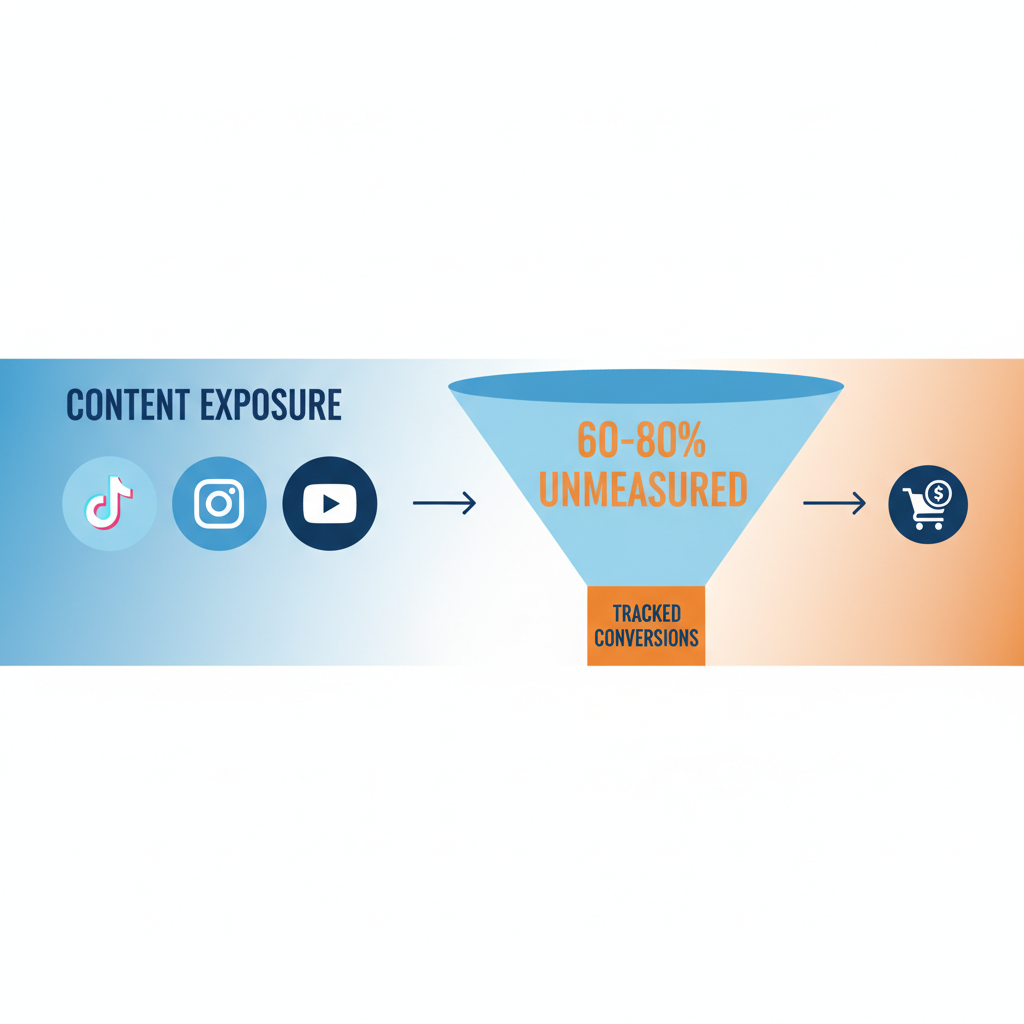
The attribution gap means most influencer-driven revenue goes unmeasured with traditional tracking
Essential Influencer Marketing Performance Metrics
Effective influencer campaign metrics span the full marketing funnel, from awareness through conversion to long-term customer value. The key is building a measurement framework that connects top-funnel activity to bottom-line results.
Revenue and Conversion Metrics
Direct Revenue Attribution tracks sales directly tied to influencer campaigns through unique discount codes, affiliate links, or dedicated landing pages. This represents your floor—the minimum provable impact of influencer partnerships.
Cost Per Acquisition (CPA) measures how much you spend to acquire each customer through influencer channels. Calculate it by dividing total campaign cost by the number of new customers acquired. Compare this to your overall CAC to evaluate channel efficiency.
Conversion Rate tracks what percentage of influencer-referred traffic completes desired actions. Segment this by influencer, content type, and platform to identify what drives results.
Average Order Value (AOV) from influencer traffic often differs significantly from other channels. Higher AOV suggests the influencer is reaching qualified audiences; lower AOV might indicate misalignment between audience and product.
Customer Lifetime Value (CLV) of influencer-acquired customers reveals long-term partnership value. Track this metric over time using proper ROI measurement frameworks to understand true channel profitability.
Engagement Quality Metrics
Not all engagement signals purchase intent equally. Focus on metrics that correlate with conversion:
Save Rate indicates audiences want to return to content—a strong signal of purchase consideration. Posts with high save rates typically drive higher downstream conversion.
Share Rate measures organic amplification. When audiences share content, they're essentially endorsing your brand to their networks.
Comment Sentiment matters more than comment volume. Analyze whether comments express purchase intent ("where can I buy this?") or genuine interest versus generic reactions.
Click-Through Rate (CTR) from bio links, swipe-ups, or in-content calls-to-action directly measures audience willingness to take action.
Brand Impact Metrics
Some influencer value doesn't show up in direct response metrics:
Branded Search Lift measures increases in brand name searches following influencer campaigns. According to Google's research on brand lift, this metric correlates strongly with downstream purchase behavior.
Social Mentions track brand conversation volume and sentiment across social platforms.
New Audience Reach measures exposure to audiences who hadn't previously interacted with your brand.
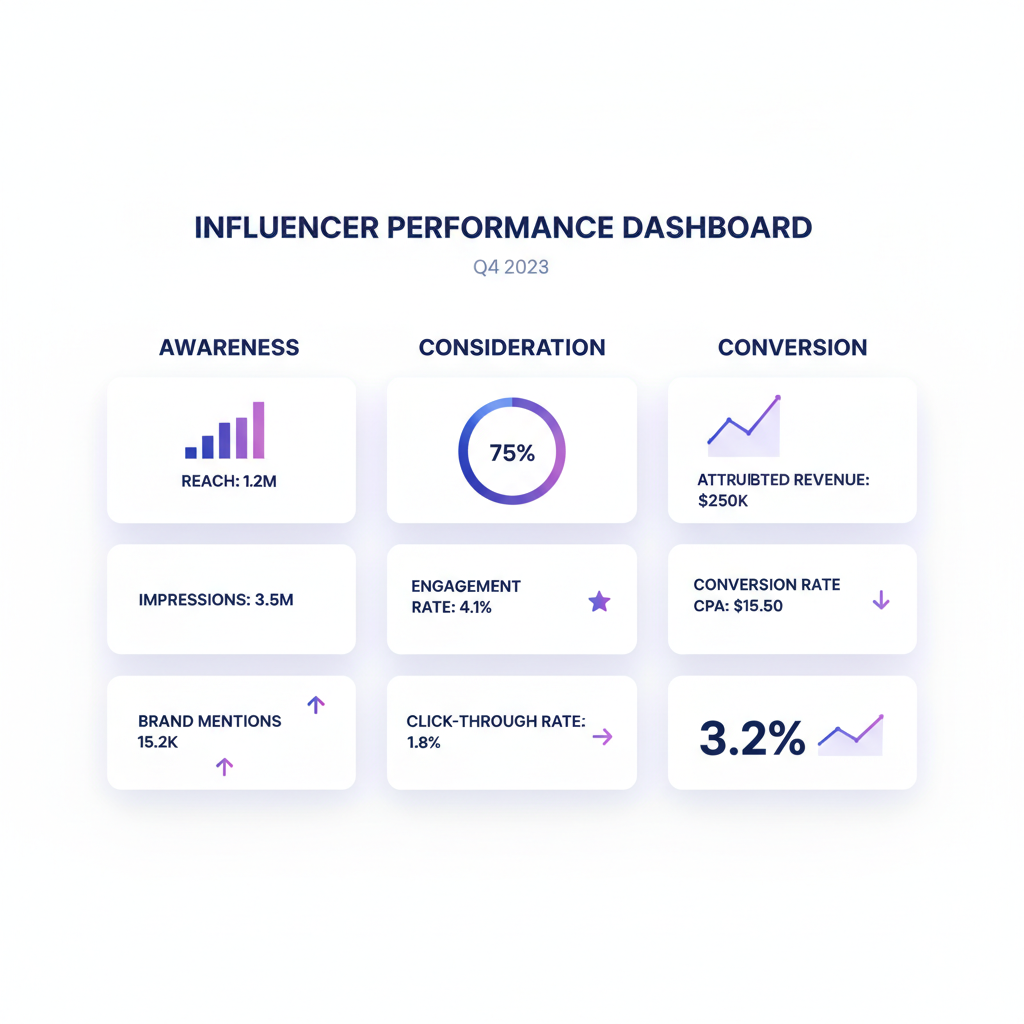
A balanced measurement dashboard tracks metrics across awareness, consideration, and conversion stages
Building an Influencer Performance Attribution Framework
Measuring influencer marketing ROI requires a multi-layered attribution approach that captures both direct and influenced conversions. Here's how leading brands structure their measurement.
Direct Attribution Layer
Start with trackable, attributable conversions using:
Unique Promo Codes: Assign each influencer a dedicated discount code. This provides clear attribution but typically captures only 15-30% of influencer-driven sales, since many customers don't use codes even when influenced.
Dedicated Landing Pages: Create influencer-specific URLs to track referred traffic and conversions. Use UTM parameters consistently across all campaigns.
Affiliate Links: Implement pixel-based tracking through affiliate platforms to capture more conversions than promo codes alone.
Platform Shopping Features: Leverage native commerce tools like Instagram Shopping and TikTok Shop for streamlined attribution.
Influenced Attribution Layer
Capture conversions where influencer content played a role but wasn't the final touchpoint:
Post-View Conversion Windows: Track users who were exposed to influencer content and later converted through any channel. A 7-14 day window captures most influenced purchases.
Brand Search Attribution: Monitor increases in branded search volume and conversions correlated with influencer posting schedules.
Halo Effect Measurement: Analyze performance lifts across other marketing channels during and immediately following influencer campaigns.
Incrementality Measurement
The gold standard for performance-based influencer marketing measurement is proving incremental impact—that conversions wouldn't have happened without the influencer partnership.
Geo-Based Testing: Run influencer campaigns in specific markets while holding out comparison markets to measure true lift. According to Nielsen's marketing effectiveness research, geo-testing remains one of the most reliable methods for proving incrementality.
Audience Holdout Groups: Where platform capabilities allow, exclude portions of the influencer's audience from seeing content to create test and control groups.
Time-Series Analysis: Compare conversion patterns during active campaigns versus baseline periods, controlling for seasonality and other marketing activities. This approach aligns with best practices for comparing attribution models.
For comprehensive incrementality measurement across channels including influencer marketing, media mix modeling provides the most accurate view of true campaign impact.
Tracking and Analytics Infrastructure
Measuring influencer analytics effectively requires proper technical infrastructure. Most brands underinvest here, then wonder why their measurement is unreliable.
Essential Tracking Components
UTM Parameter Standards: Establish consistent UTM naming conventions across all influencer partnerships. Include influencer name, platform, content type, and campaign in your parameters.
Example structure:
utm_source=instagramutm_medium=influencerutm_campaign=summer2025utm_content=creator_name_post_type
First-Party Data Collection: With third-party cookie deprecation, capturing first-party data becomes critical. Implement post-purchase surveys asking "How did you hear about us?" to capture influencer attribution that tracking misses.
Cross-Platform Identity Resolution: Connect user identities across platforms and devices to track complete customer journeys. This is increasingly challenging but essential for accurate measurement. Customer data platforms help unify these fragmented identities.
Conversion API Implementation: Use server-side tracking (Meta Conversions API, TikTok Events API) to capture conversions that browser-based pixels miss due to ad blockers and privacy settings. According to Meta's Business Help Center, server-side tracking captures 10-20% more conversion events than browser pixels alone.
Reporting and Visualization
Build dashboards that connect influencer activities to business outcomes:
Real-Time Performance Tracking: Monitor campaign performance as content goes live to enable rapid optimization.
Cohort Analysis: Track how influencer-acquired customers perform over time compared to customers from other channels. This approach mirrors how ABM programs measure long-term ROI.
Channel Comparison: Benchmark influencer performance against other marketing channels to inform budget allocation decisions.

Real-time tracking enables rapid optimization and demonstrates campaign value to stakeholders
Calculating Influencer Marketing ROI
With proper tracking in place, calculating influencer marketing ROI becomes straightforward:
Basic ROI Formula: ROI = ((Revenue Attributed to Influencer - Total Campaign Cost) / Total Campaign Cost) × 100
But "total campaign cost" and "revenue attributed" both require careful definition.
Cost Components to Include
- Influencer fees (flat rate, performance bonuses)
- Product gifting and shipping
- Agency or platform fees
- Content production support
- Paid amplification of influencer content
- Internal team time (often overlooked)
Revenue Attribution Approaches
Conservative (Direct Only): Count only promo code and affiliate-attributed sales. This understates true impact but provides defensible numbers.
Moderate (Direct + Influenced): Include post-view conversions and attributed brand search conversions. More accurate but requires stronger tracking infrastructure.
Comprehensive (Full Attribution): Use marketing mix modeling or incrementality testing to capture total contribution including halo effects. Most accurate but requires sophisticated measurement capabilities.
According to Influencer Marketing Hub research, businesses average $5.78 return for every $1 spent on influencer marketing. Top performers achieve $20+ returns. The difference often comes down to measurement sophistication—brands that measure better optimize better.
Optimizing Influencer Performance
Measurement without optimization is just expensive reporting. Use your data to continuously improve influencer marketing performance.
Influencer Selection Optimization
Analyze which creator characteristics correlate with performance—similar to how Google's Meridian MMM helps identify channel-level performance drivers:
- Audience demographics: Match with your customer profile
- Content format: Video vs. static, long-form vs. short
- Engagement patterns: Saves and shares vs. likes and comments
- Historical conversion data: Past performance predicts future results
Build predictive models that score potential partners based on likelihood to drive business outcomes, not just reach.
Content and Creative Optimization
Test and iterate on what drives results:
- Call-to-action placement: Beginning vs. middle vs. end
- Product integration style: Dedicated reviews vs. lifestyle integration
- Authenticity markers: Scripted vs. organic mentions
- Content length: Optimal duration varies by platform and product category
Budget Allocation Optimization
Use performance data to inform investment decisions—the same principles behind effective media budget optimization apply here:
- Reallocation to top performers: Double down on influencers driving efficient conversions
- Platform mix optimization: Shift spend to platforms delivering best ROAS
- Campaign timing: Identify optimal posting windows and campaign durations
- Tier mix optimization: Balance macro-influencer reach with micro-influencer conversion efficiency
Sophisticated teams use funnel-stage budget allocation to systematically distribute influencer spend for maximum impact across awareness, consideration, and conversion objectives.
Common Measurement Mistakes to Avoid
Even sophisticated marketing teams make these errors when measuring influencer performance:
Over-relying on platform metrics: Native analytics show reach and engagement but miss conversions happening off-platform. Always connect platform data to your own conversion tracking using proper attribution methodologies.
Ignoring attribution windows: Using too-short attribution windows misses delayed conversions; too-long windows claim credit for organic demand. Test to find the right window for your product's consideration cycle.
Comparing apples to oranges: Influencer marketing often drives upper-funnel outcomes. Comparing it directly to bottom-funnel channels like paid search creates misleading conclusions. Understanding the difference between MTA and MMM helps contextualize these comparisons.
Neglecting qualitative signals: Not everything valuable is quantifiable. Customer feedback, brand sentiment shifts, and audience quality matter alongside hard metrics.
Measuring campaigns in isolation: Influencer marketing interacts with other channels. Holistic measurement approaches capture these channel synergies and provide a more complete performance picture.
Frequently Asked Questions
What is the average ROI for influencer marketing?
Industry benchmarks show businesses earn an average of $5.78 for every $1 spent on influencer marketing, according to Tomoson's influencer marketing research. However, ROI varies dramatically based on industry, product price point, influencer selection, and measurement methodology. Top-performing campaigns achieve $20+ returns, while poorly executed programs may see negative returns.
How do you track influencer marketing conversions without promo codes?
Implement multi-layer tracking: dedicated landing pages with UTM parameters, post-view conversion windows through pixel tracking, brand search lift analysis, post-purchase surveys, and platform-specific commerce features. For the most accurate measurement, use marketing mix modeling to capture total contribution across all attribution methods.
What metrics should brands prioritize for performance-based influencer marketing?
Focus on revenue-correlated metrics: direct attributed sales, cost per acquisition, conversion rate from influencer traffic, and customer lifetime value of influencer-acquired customers. Supplement with leading indicators like save rates, branded search lift, and click-through rates that predict downstream conversion.
How long should you wait to measure influencer campaign results?
Measurement windows depend on your product's typical consideration cycle. Consumer products may convert within 7-14 days; B2B or high-consideration purchases may require 30-90 day windows. Analyze your conversion data to identify the optimal window where you capture most influenced conversions without claiming unrelated demand.
How does influencer marketing attribution differ from other digital channels?
Influencer attribution faces unique challenges: longer and less linear customer journeys, cross-platform behavior, significant organic amplification beyond trackable interactions, and reliance on trust-based persuasion rather than direct response. Traditional last-click attribution typically captures only 15-30% of influencer-driven conversions, making multi-touch and incrementality measurement essential.
Conclusion
Influencer marketing performance measurement separates brands that grow efficiently from those wasting budget on vanity metrics. The shift from reach-based to revenue-based measurement isn't optional anymore—it's the price of admission for serious influencer marketing investment.
Start by building foundational tracking infrastructure: consistent UTM parameters, unique attribution mechanisms, and first-party data collection. Layer in influenced attribution to capture conversions beyond last-click. Progress to incrementality measurement to prove true campaign impact.
The brands winning at influencer marketing share one trait: they measure rigorously, optimize relentlessly, and continuously improve their attribution sophistication. In a $32 billion industry where most competitors still chase likes, measurement capability becomes competitive advantage.
Your next steps:
- Audit your current influencer tracking infrastructure for gaps
- Implement post-purchase surveys to capture attribution blind spots
- Test incrementality measurement on your next major campaign
- Build dashboards connecting influencer activity to business outcomes
The measurement foundation you build today determines the influencer marketing results you'll achieve tomorrow.
Stay in the loop
Get updates on new posts and resources.