Out of Home Advertising Tracking: The Complete Measurement Guide
Master out of home advertising tracking with proven measurement methods, mobile data integration, and attribution strategies that prove billboard ROI.
Billboards don't come with click tracking. Neither do bus shelters, transit ads, or digital displays in Times Square. Yet out of home advertising tracking has become remarkably sophisticated—and most marketers are still stuck counting cars.
The OOH advertising market hit $8.73 billion in U.S. spending in 2023, with digital out-of-home growing at nearly 10% annually. Brands from Apple to local pizza chains invest heavily in billboards and transit advertising. The challenge? Proving that investment actually works.
This guide breaks down exactly how modern OOH measurement works—from mobile location data to media mix modeling—so you can finally answer the question every CFO asks: "What's our billboard ROI?" We'll cover everything from basic metrics to advanced attribution strategies that connect outdoor impressions to business outcomes.
Why Out of Home Advertising Tracking Matters
Traditional OOH measurement relied on traffic counts and gut feelings. Advertisers knew approximately how many cars passed their billboard each day. They hoped some of those drivers remembered their brand. That was about it.
This approach created two problems.
First, marketers couldn't prove OOH value compared to digital channels with precise attribution. When budget discussions happened, outdoor advertising became an easy target for cuts. Why fund something you can't measure?
Second, brands couldn't optimize. Without data, every billboard placement was equally valuable (or equally questionable). Strategic decisions became guesswork—exactly the opposite of data-driven budget allocation.
Modern outdoor advertising measurement solves both problems. Today's tracking technologies connect physical ad exposure to measurable outcomes—store visits, website traffic, and actual purchases.
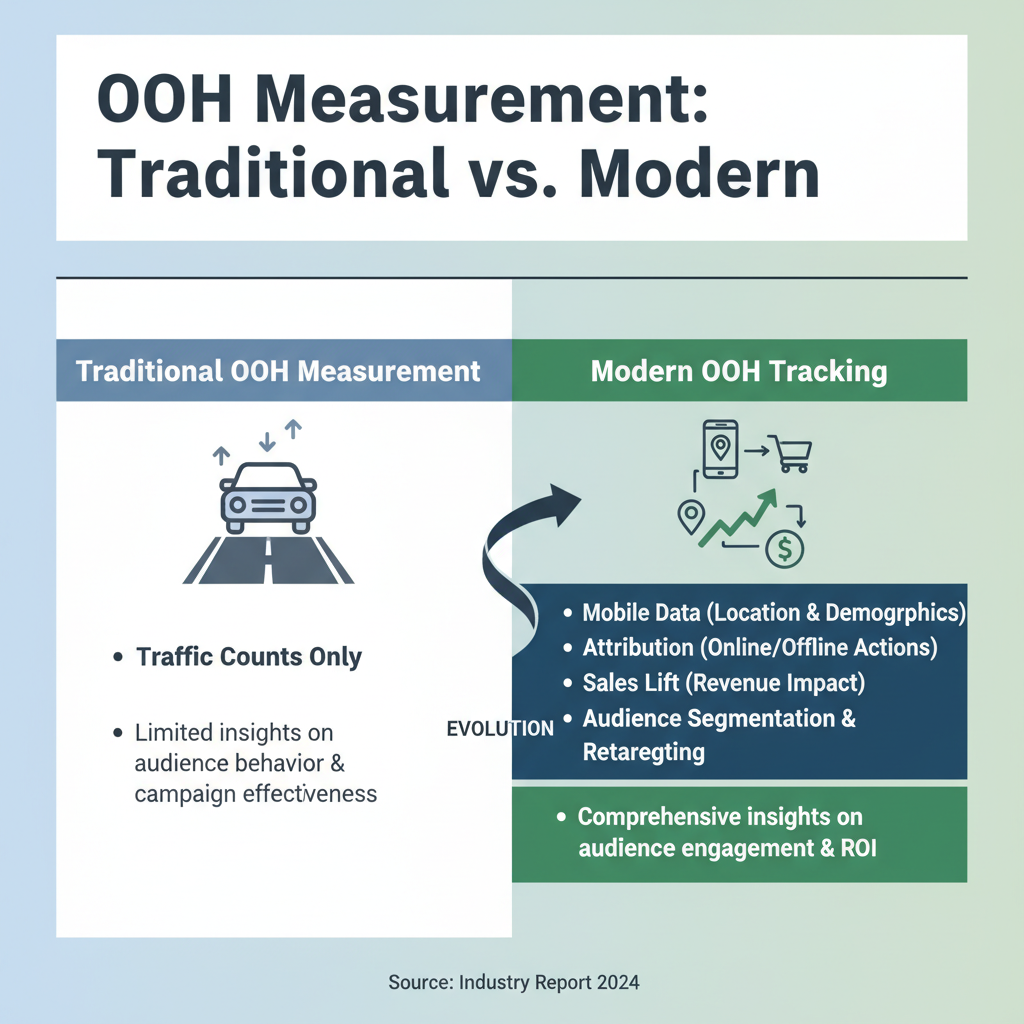
Modern OOH tracking connects billboard exposure to measurable business outcomes
The Attribution Challenge
OOH sits in a unique position within the marketing attribution landscape. Unlike digital ads, billboards can't capture clicks or cookies. Unlike TV, they don't have standardized audience measurement panels.
Yet billboards influence purchasing decisions constantly. Someone sees your transit ad during their morning commute. Later that evening, they search your brand name and convert through your website. Traditional attribution gives 100% credit to the search ad. The billboard gets nothing.
This attribution gap has historically undervalued OOH in marketing effectiveness measurement. Modern tracking methods close this gap.
Core OOH Advertising Measurement Methods
Effective billboard advertising tracking combines multiple data sources and methodologies. No single approach captures the complete picture.
Mobile Location Data
Mobile location tracking has revolutionized OOH measurement. Here's how it works.
Apps on smartphones (weather apps, games, navigation tools) collect anonymized location data with user permission. Companies aggregate this data to understand movement patterns. When someone passes within view of your billboard, their device ID gets logged.
Later, if that same device ID appears at your store location, you've captured a potential conversion. Aggregate this across thousands of exposures, and you can calculate exposure-to-visit rates with statistical confidence.
According to research from the Out of Home Advertising Association of America (OAAA), mobile location data can track:
- Dwell time near OOH placements
- Foot traffic to retail locations post-exposure
- Audience demographics based on location patterns
- Cross-device attribution when exposure and conversion happen on different devices
The technology isn't perfect. Indoor locations, dense urban environments, and privacy opt-outs create data gaps. But for directional insights, mobile location data represents a massive improvement over traffic counts alone—similar to how multi-touch attribution improved on last-click models.
Digital Integration Techniques
Smart marketers bridge the physical-digital gap with trackable elements.
QR Codes: Adding scannable codes to OOH creative enables direct measurement. Someone scans your billboard's QR code, and you've captured a countable interaction. The challenge: scan rates typically run below 1% of exposed audiences, limiting sample size.
Unique URLs: Vanity URLs specific to OOH campaigns (like yoursite.com/billboard) track website visits driven by outdoor advertising. Simple, but relies on audiences remembering and manually typing the URL.
Promo Codes: OOH-specific discount codes ("Use code SUBWAY20 at checkout") directly attribute purchases to outdoor campaigns. This approach works particularly well for e-commerce marketing measurement.
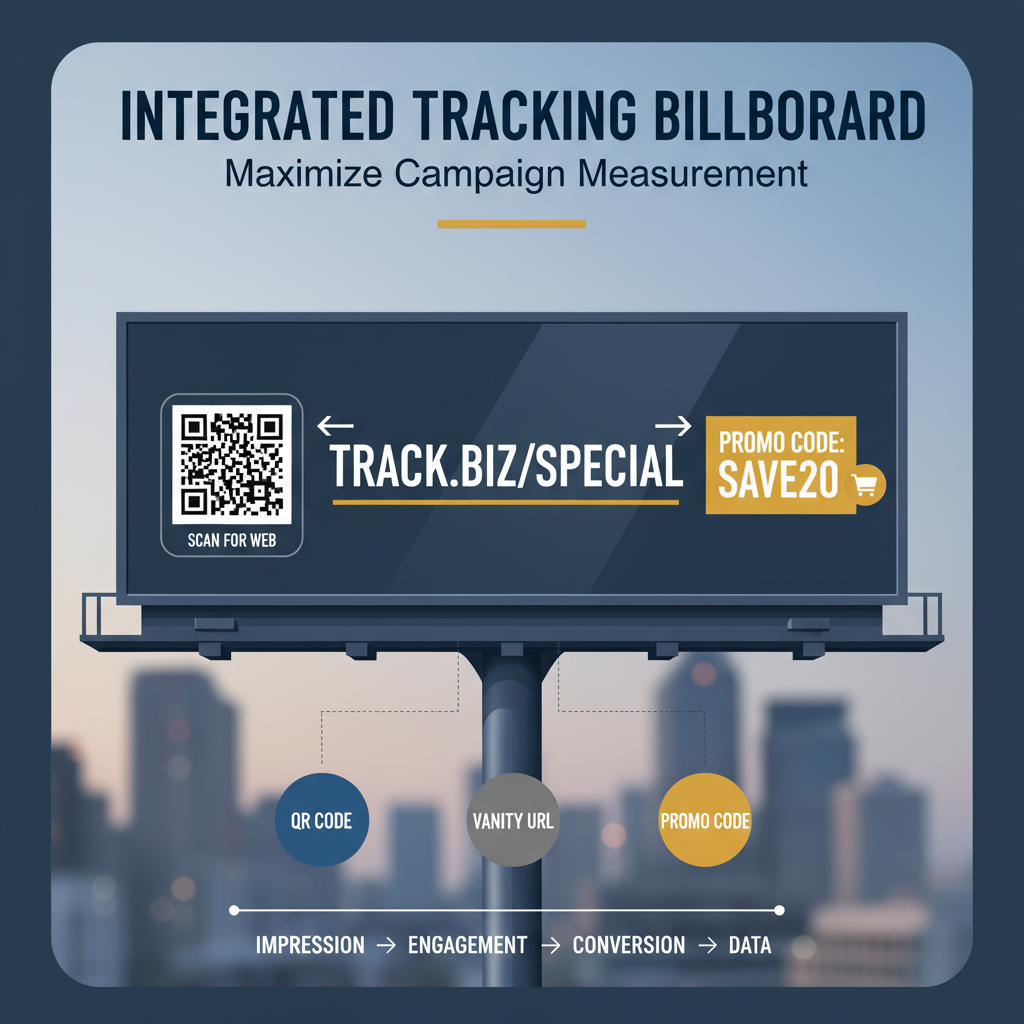
Integrating trackable elements into OOH creative enables direct response measurement
Audience Measurement Systems
Industry measurement providers like Ipsos and Geopath have developed comprehensive OOH audience measurement methodologies. These systems combine:
- Inventory databases cataloging every OOH placement's specifications
- Travel surveys mapping typical movement patterns
- Traffic intensity models estimating exposure by location and time
- Visibility adjustments accounting for ad size, angle, and obstructions
The result: standardized impression estimates that enable apples-to-apples comparisons across OOH formats and locations. When you buy a billboard, you know approximately how many people will see it—and who they are. This data feeds directly into marketing ROI calculations.
Advanced OOH Tracking Technologies
Basic measurement answers "how many saw it." Advanced tracking answers "did it work?"
Real-Time Digital OOH Analytics
Digital out-of-home (DOOH) displays offer measurement capabilities closer to digital advertising. Modern DOOH networks can capture:
Actual impressions: Sensors count real people viewing screens, not estimated traffic. Computer vision technology determines when someone actually looks at the display versus walks past without noticing.
Audience composition: Anonymous video analytics can estimate viewer demographics—age ranges, gender split—without identifying individuals. This helps brands verify they're reaching target audiences.
Attention metrics: According to AdExchanger, companies like Billups now offer attention measurement for OOH that considers viewing angle, display size, environmental clutter, and dwell time to estimate actual attention rather than mere exposure.
Brand Lift Studies
When direct attribution isn't possible, brand lift studies measure OOH impact through survey methodology.
The approach: Survey audiences in markets with OOH campaigns versus control markets without. Compare brand awareness, consideration, and purchase intent between groups. The difference represents lift attributable to outdoor advertising. This methodology parallels how marketers measure ABM effectiveness through control group comparisons.
IAB's DOOH measurement guidelines recommend brand lift studies as a complement to exposure data, particularly for campaigns focused on awareness rather than immediate response.
Connected Vehicle Data
An emerging measurement frontier: connected car data. Modern vehicles generate detailed trajectory information—where they drive, how long they stop, what routes they take.
This data can identify high-visibility locations for billboard placement and verify actual exposure among drivers (who can't exactly look at their phones while passing your billboard, but definitely see the highway sign ahead).
Media Mix Modeling for OOH Attribution
Here's where marketing mix modeling becomes essential for OOH advertising attribution.
MMM analyzes historical data to isolate each marketing channel's contribution to business outcomes. For OOH specifically, MMM accounts for:
Adstock effects: Billboard impact doesn't end when someone drives past. The memory persists for days or weeks, influencing later purchasing decisions. MMM models this decay to capture OOH's full contribution.
Geographic variation: By comparing sales performance in markets with different OOH investment levels, MMM isolates outdoor advertising's incremental impact.
Cross-channel interactions: OOH often amplifies other channels. Someone sees your billboard, then recognizes your brand in social media feed. MMM captures these synergistic effects that single-channel attribution misses.
External factors: Seasonality, economic conditions, competitor activity—all influence sales independently of your marketing. MMM separates these effects from true marketing contribution. Open-source tools like Google's Meridian and Meta's Robyn can handle OOH data alongside digital channels.
Platforms like Blue Alpha specialize in media mix modeling that incorporates OOH alongside digital channels, providing unified measurement across the entire marketing budget.
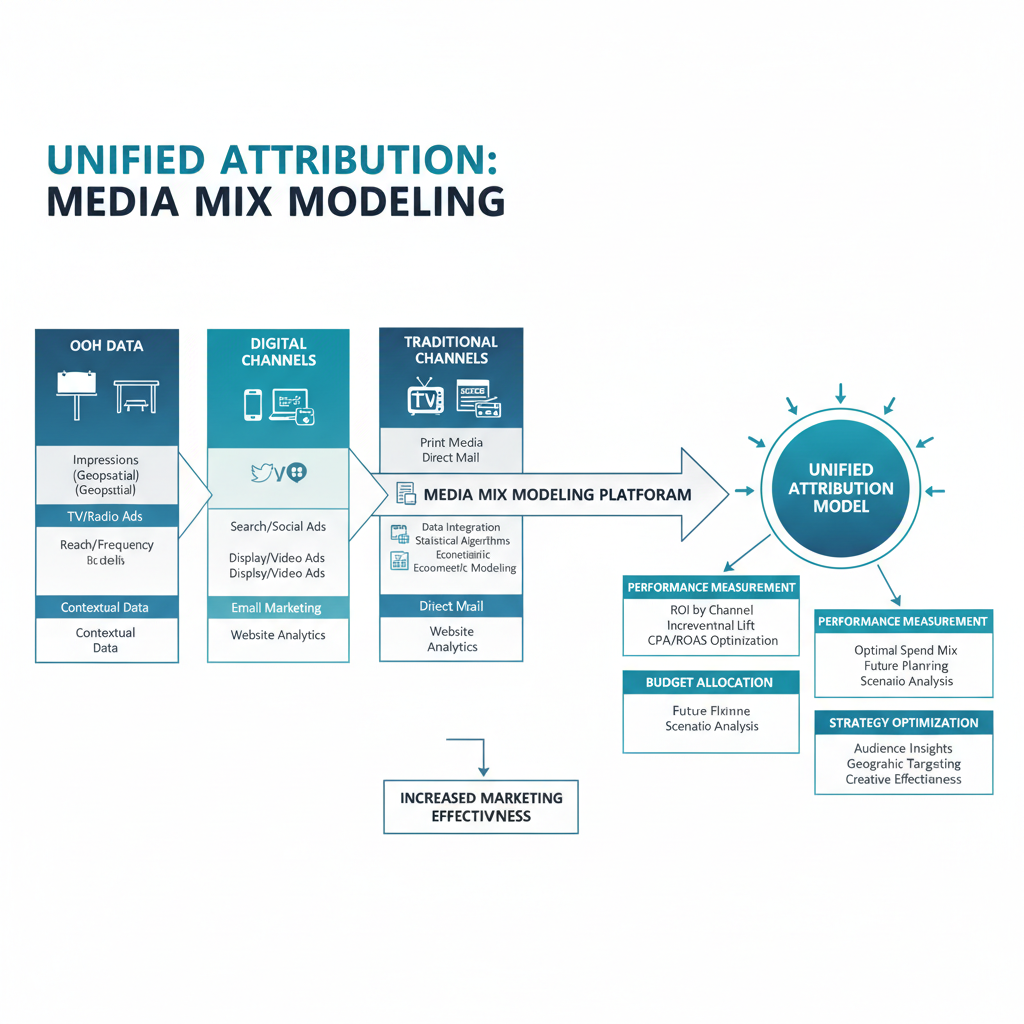
MMM provides unified attribution across OOH and digital marketing investments
Incrementality Testing
The gold standard for proving OOH effectiveness: controlled experiments.
Geo-based tests: Run OOH campaigns in some markets while holding out others as controls. Compare business outcomes between test and control markets. The difference represents OOH's incremental contribution. This approach is becoming standard for comparing different marketing measurement methods.
Matched market analysis: Can't afford a pure holdout? Identify historically similar markets, increase OOH investment in some while maintaining baseline in others, and measure the difference.
These experiments complement MMM findings with causal evidence. If your model says billboards drive 15% of store visits, and your geo test shows 14% lift in test markets, you've got strong validation.
Measuring Digital Out-of-Home (DOOH) Performance
DOOH deserves special attention. Programmatic DOOH now enables buying outdoor advertising with digital-style precision—specific times, locations, audience conditions.
Key DOOH Metrics
Impressions: Unlike traditional billboards with static monthly estimates, DOOH can measure actual displays served—exactly how many times your creative appeared on screen.
Share of voice: In rotation-based DOOH, your ad competes with others for screen time. Share of voice measures your percentage of total available impressions at a location.
Daypart performance: DOOH analytics reveal which times of day generate strongest engagement, enabling optimization toward high-value windows.
Creative performance: Running multiple creatives? DOOH measurement can compare response rates to identify top performers.
Programmatic DOOH Attribution
Programmatic DOOH platforms increasingly integrate with mobile location data providers to offer closed-loop measurement.
The workflow:
- You serve programmatic DOOH impressions
- The platform captures device IDs of exposed users (via beacon technology or mobile location data partnerships)
- Those device IDs get matched against conversion events—store visits, app installs, website visits
- You see attribution reports similar to digital campaign dashboards
This approach brings digital out-of-home measurement closer to the precision marketers expect from online advertising. It's a significant advancement for teams evaluating marketing analytics platforms.
Building Your OOH Measurement Framework
Effective measurement requires strategy, not just technology. Here's how to structure your approach.
Step 1: Define Success Metrics
What does OOH success look like for your brand? Options include:
- Awareness lift: Do more people recognize your brand after campaigns?
- Consideration lift: Does intent to purchase increase in OOH markets?
- Store visits: Can you trace physical visits to billboard exposure?
- Website traffic: Do campaigns drive measurable traffic to owned properties?
- Sales lift: Does revenue increase in markets with OOH investment?
Match metrics to campaign objectives. A brand awareness campaign shouldn't be judged solely on direct response metrics. Understanding which metrics matter prevents misaligned expectations.
Step 2: Establish Baselines
Before launching campaigns, document current performance levels. What's your baseline brand awareness in target markets? What does typical store traffic look like? How much organic website traffic do you receive?
Without baselines, you can't measure lift.
Step 3: Implement Tracking Infrastructure
Based on your metrics, implement appropriate tracking:
| Metric | Required Tracking |
|---|---|
| Brand awareness | Pre/post surveys, brand lift studies |
| Store visits | Mobile location data partnerships |
| Website traffic | UTM parameters, unique URLs, QR codes |
| Sales lift | Geographic sales data, MMM integration |
Step 4: Allow Sufficient Time
OOH works differently than performance marketing. Brand effects build over weeks and months, not days. According to OAAA research, most OOH campaigns require 4-6 weeks minimum to generate measurable impact.
Don't judge billboard performance after one week. You'll undercount true impact.
Step 5: Integrate with Cross-Channel Measurement
OOH doesn't exist in isolation. Integrate OOH tracking data with your broader marketing analytics infrastructure.
This means:
- Feeding OOH exposure data into attribution models
- Including OOH spend in media mix models
- Comparing OOH efficiency against other channels
- Identifying OOH's role in cross-channel customer journeys
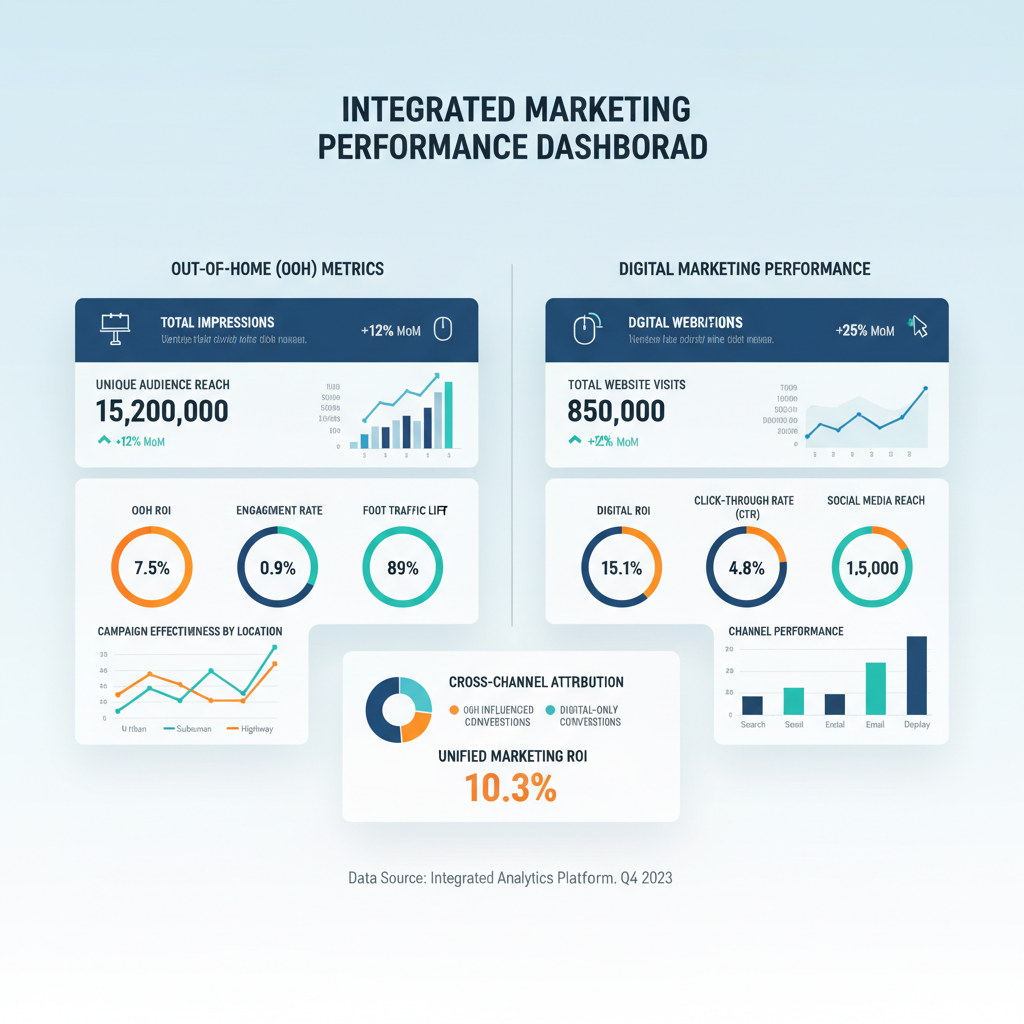
Unified dashboards enable apples-to-apples comparison across channels
Privacy Considerations in OOH Tracking
Modern OOH advertising measurement relies heavily on mobile data, raising legitimate privacy questions.
Responsible measurement practices include:
Anonymization: Location data should be anonymized and aggregated, never tied to identifiable individuals. Reputable data providers strip personally identifiable information before analysis.
Consent-based collection: Mobile data should come from apps where users have opted into location sharing. Avoid data sources with questionable consent practices.
Regulatory compliance: GDPR in Europe and CCPA in California impose specific requirements on location data usage. Ensure your measurement partners maintain compliance.
Transparency: Be prepared to explain your measurement methodology to consumers, partners, and regulators. "We track people with their phones" isn't a good look. "We use anonymized, consented data to understand advertising effectiveness" tells a better story.
Frequently Asked Questions
How accurate is mobile location data for OOH measurement?
Mobile location data typically achieves 70-85% accuracy for outdoor advertising measurement. Urban density, building interference, and opt-out rates create gaps. Treat mobile data as directional rather than precise—excellent for comparing relative performance, less reliable for exact conversion counts.
Can you track traditional billboard performance like digital ads?
Not with click-level precision, but you can get surprisingly close. Combining mobile location data, MMM analysis, and brand lift studies provides comprehensive traditional billboard measurement. You won't know exactly who saw your billboard, but you'll understand overall campaign impact.
What's the best way to measure OOH ROI?
The most reliable approach combines multiple methods: mobile location data for exposure tracking, MMM for attribution modeling, and incrementality tests for validation. Single-method approaches risk over or under-counting OOH contribution.
How long before OOH campaigns show measurable results?
Expect minimum 4-6 weeks for meaningful measurement. Brand awareness effects often take 8-12 weeks to fully develop. Direct response campaigns (with QR codes or promo codes) can show results faster, typically within 2-4 weeks.
Does programmatic DOOH provide better measurement than traditional OOH?
Generally yes. Programmatic DOOH offers more granular data—actual impressions served, precise timing, and often integrated mobile attribution. Traditional OOH relies more heavily on modeled estimates. However, both can be measured effectively with proper methodology.
Conclusion
Out of home advertising tracking has evolved from educated guesswork to sophisticated, data-driven measurement. Mobile location data, digital integration, and media mix modeling now enable marketers to prove OOH effectiveness with confidence.
The key takeaways:
- Combine multiple measurement methods rather than relying on any single approach
- Integrate OOH tracking with broader marketing measurement for unified attribution
- Allow sufficient time for billboard campaigns to generate measurable impact
- Prioritize privacy-compliant data sources that maintain consumer trust
- Use incrementality testing to validate model-based attribution findings
OOH remains one of marketing's most impactful channels—commanding attention in a fragmented media landscape and reaching audiences when they're out in the world, ready to act. With proper measurement, you can finally prove what billboard advertisers have long suspected: outdoor advertising works.
The days of justifying OOH spend with traffic counts are over. Modern measurement tools exist. The question is whether you'll use them.
Start by auditing your current OOH measurement capabilities. Identify gaps between what you're tracking and what you need to prove. Then build the infrastructure to capture OOH's true contribution to your marketing ROI.
Your next budget conversation will thank you.
Stay in the loop
Get updates on new posts and resources.