Seasonality Can Distort a Marketing Mix Model
Learn how MMM separates seasonality, trends, holidays, and promotions from media impact without absorbing the signal you need.

If a marketing mix model does not separate seasonality from media effects, it gives paid channels credit for natural sales. This error is largest in weeks when a category has its natural peak. Examples include holidays or back-to-school periods. The model then tells you to spend more when demand is high and less when demand is low.
Why Seasonality Matters
Most consumer categories move with the calendar. Weather, holidays, school schedules, and paydays change demand in patterns that repeat each year. These swings can be large compared to the effect of any single media channel.
A marketing mix model (MMM) is a statistical tool that estimates the relationship between marketing spend and sales over time. The model tries to explain sales with spend, price, distribution, and other inputs. If the model lacks a correct seasonal baseline, it assigns holiday demand to active channels. One industry guide states that holiday spend looks too effective when the model confuses seasonal demand with paid lift, according to presenc.ai.
MMM, attribution, and incrementality testing answer different questions. Attribution tracks which touchpoint a customer saw before a purchase. Incrementality testing measures true lift when you remove a channel, such as in a geographic holdout test. No single method provides the only truth. A poor baseline in an MMM makes a channel look incremental when it is not.

Trend vs Recurring Seasonality
Two different forces exist under the word "seasonality." A good model must treat them separately.
Trend is a slow, long-run change. Examples include category growth, inflation, or shifts in consumer habits. A trend does not repeat on a calendar cycle. It develops over months or years.
Seasonality is a repeating pattern tied to the calendar. It repeats every week, month, or year. Retail sales that rise every December show seasonality. A five-year rise in category demand shows trend.
Classic time series decomposition splits a sales series into trend, seasonal, and remainder parts, as described by bounteous.com. The formula is simple:
Sales = Trend + Seasonality + Remainder
An MMM extends this concept. It adds media and other paid factors to the remainder:
Sales = Trend + Seasonality + Holiday Effects + Media + Other Controls + Error
Combining trend and seasonality into one term hides real problems. A high-growth category needs a flexible trend, while a mature category needs only a straight line, according to guidance on handling seasonality in MMM. An error in this split causes bias in all model coefficients, including media.
Holiday and Event Variables
Holidays differ from smooth seasonality. Thanksgiving and Easter move each year, and promotions do not follow a fixed schedule. A model that uses only smooth seasonal curves misses these irregular events.
Analysts use dummy variables to capture holidays and one-off events directly, as noted in a review by statstest.com. A dummy variable is a binary indicator set to one on the event date and zero on other dates. Without an indicator for a large event, the model spreads that effect across nearby variables. This creates biased media coefficients, which is a risk noted by presenc.ai.
Maintain a written log of known events and promotions with the model. Include:
- Fixed holidays, such as Christmas and New Year
- Movable holidays, such as Easter and Lunar New Year
- Known promotions and price changes
- One-off market events, such as competitor exits, regulatory changes, and viral moments
This log provides inputs for model control variables, as explained in our guide to marketing mix modeling control variables. A model without these controls credits a discount to marketing. A model without seasonality controls credits a holiday to marketing, as noted by fusepointinsights.com.
Modeling Approaches
Several methods capture recurring calendar effects. Each method has trade-offs.
Calendar indicators. Week-of-year, day-of-week, and holiday dummy variables capture predictable effects directly, as described by presenc.ai. This approach is simple to explain.
Fourier terms. Analysts use pairs of sine and cosine waves at different periods for smooth cycles. Three to six Fourier pairs capture the seasonal shape without a dummy variable for every week. Tools such as PyMC-Marketing include Fourier seasonality transformations, per pymc-marketing.io.
Trend and remainder controls. Place long-term growth or decline in a separate trend term. This prevents the model from mistaking rapid growth for a permanent seasonal shift, per the same source.
A caution on separability. Some analysts question whether you can separate base demand, marketing, and seasonality. Marketing often works better when seasonal demand is high. Recast argues that standard controls can under-credit media during peak periods, because the model gives all credit to the season, per getrecast.com. Separately, research from Prescient states that regression models with this structure overstate holiday effects by 20 to 30 percent in some analyses, per prescientai.com.
These views show a real tension. Removing all seasonal variance can hide real media lift during peak seasons. Leaving seasonality unmodeled gives media credit that it did not earn. Analysts must test both approaches and compare results, as described in our guide on marketing mix modeling regression methods.
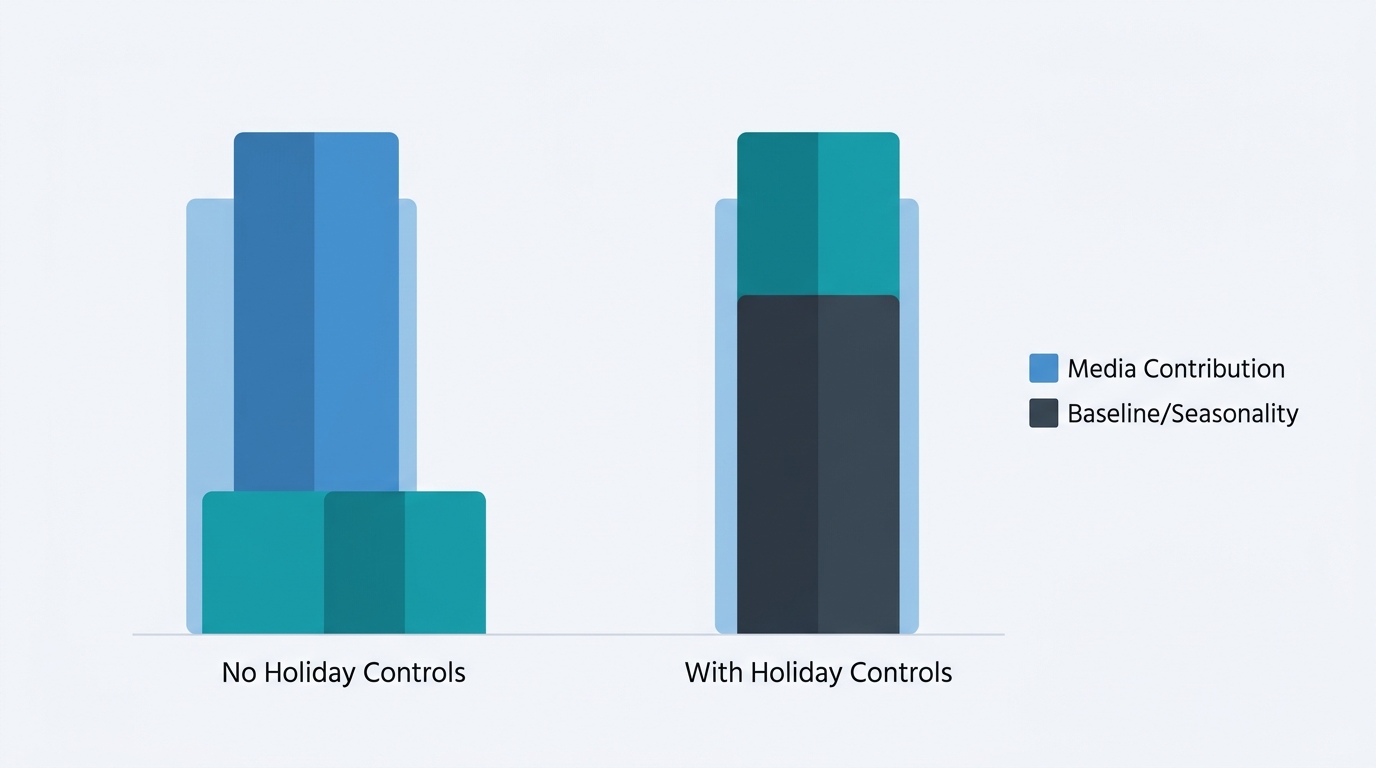
Worked example (hypothetical). A retailer has $10 million in December sales. A model without holiday controls attributes $3 million of those sales to a December TV campaign. The analyst then adds holiday dummy variables and a Fourier seasonal term. The model now attributes $1.2 million to the TV campaign, and the rest to baseline holiday demand. This example shows that baseline choices change media estimates.
Diagnostics
Check model outputs before you trust media results.
Examine the share of sales that the model assigns to seasonality versus paid channels. If seasonality explains more than all channels combined in a seasonal category, the terms can be over-fit. If seasonality explains almost nothing in a seasonal category, the seasonal terms are too weak, as noted by presenc.ai.
Run standard statistical tests:
- Trend and seasonality checks confirm that the model captures long-term growth and seasonal peaks before it adds media, per marketingiq.co.uk.
- Autocorrelation checks (ACF) confirm that the model explains time patterns in the errors, per the same source.
- Durbin-Watson and Breusch-Pagan tests check for remaining time patterns and changing error variance in residuals, per marketingiq.co.uk.
Compare model output to known facts. If the model shows a media spike that matches a holiday date, check the baseline. Do not trust the media estimate without this check. Our guide to validate an MMM explains this review process.
Planning Implications
A biased baseline changes spending decisions, not just model output. If a model over-credits media during a holiday peak, planners raise budgets for that period. That budget increase will not produce the predicted return, because past lift came from the season, not marketing.
The opposite error also causes waste. If a model removes too much seasonal variance, it hides channels that perform well during high-demand periods, as noted by getrecast.com. Planners then invest too little in channels that perform best at critical times.
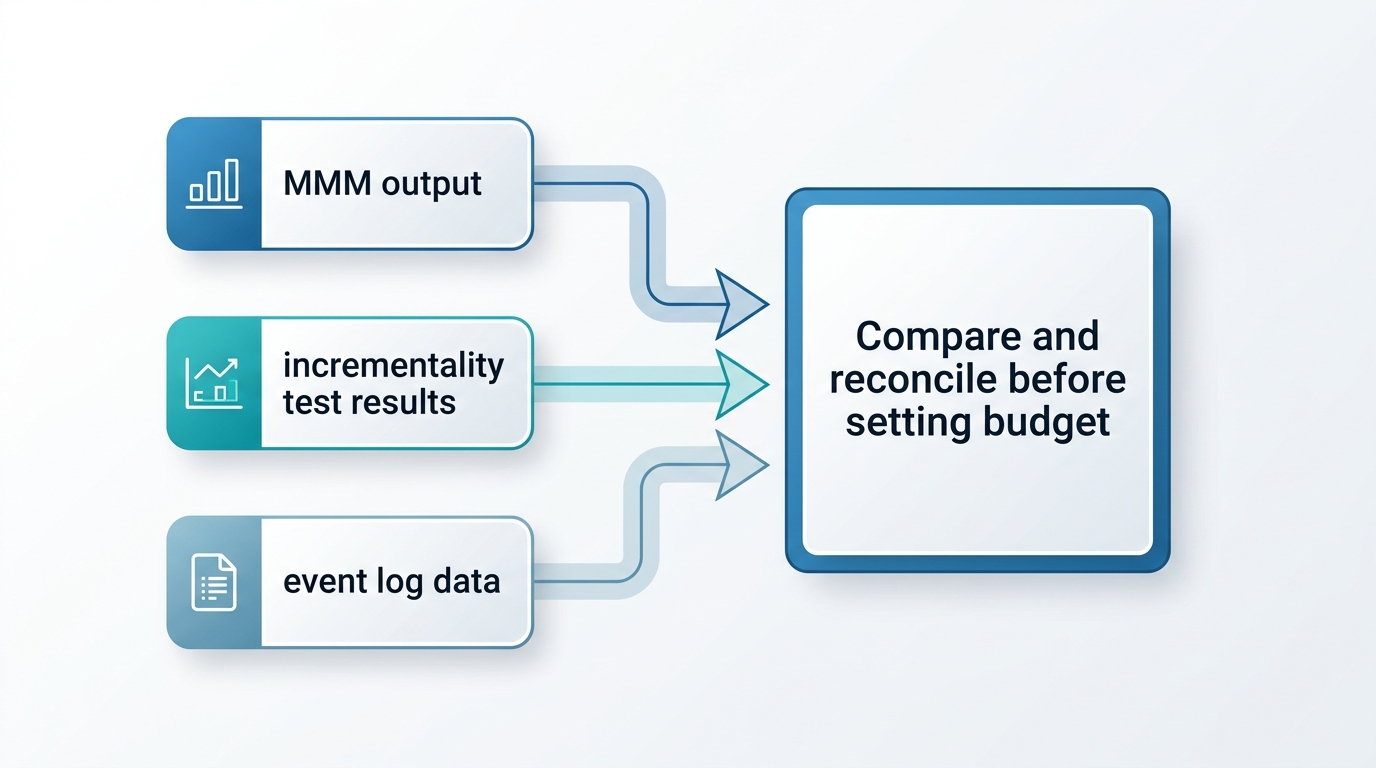
Treat the baseline as a hypothesis to test, not as a proven fact. Compare model results with incrementality tests, such as geographic holdout experiments, during peak and off-peak periods. Return on ad spend measures total revenue per dollar spent. Marginal return measures revenue gained from an additional dollar of spend. When MMM and test results disagree, examine the gap.
Conclusion
Seasonality is not a small detail in a marketing mix model. It is one of the largest sources of variance that the model must explain. An error in seasonality distorts every media coefficient. Trend, recurring seasonality, and one-off events need separate treatments, and every choice requires validation against tests.
We offer a review of baseline and media separation if you need an evaluation of your model. This review helps you find seasonal bias in your channel estimates.
Stay in the loop
Get updates on new posts and resources.