Adobe Mix Modeler Alternatives for Teams That Need More Control
Compare Adobe Mix Modeler alternatives by modeling approach, integrations, service model, implementation effort, and buyer fit.
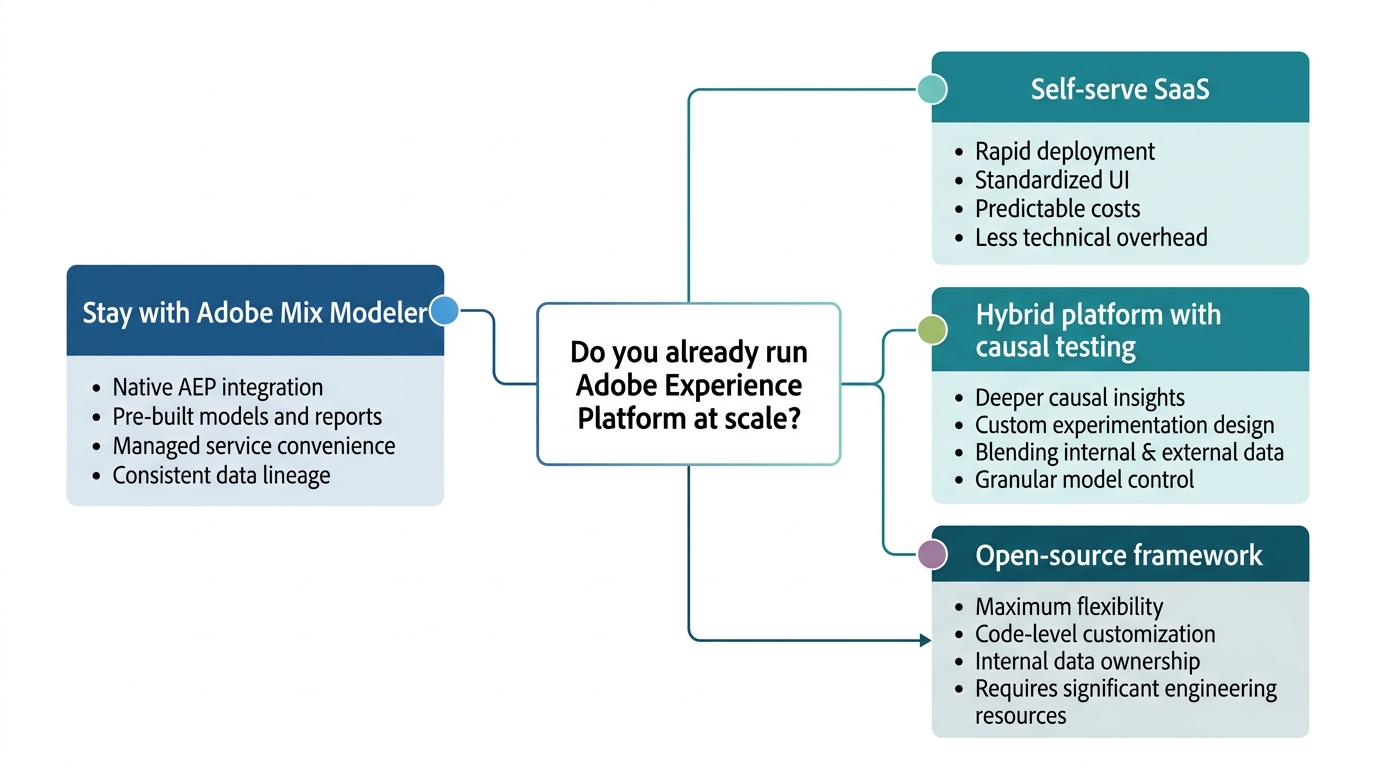
Your choice of an Adobe Mix Modeler alternative depends on three factors. These factors are your Adobe software investment, your internal data science capacity, and your need to inspect model code. Teams outside the Adobe system or teams that need transparent models choose one of four options. These options are self-serve software-as-a-service (SaaS) platforms, hybrid platforms with causal validation, open-source frameworks, and full-service consultancies. This guide compares them with facts rather than marketing claims. We checked vendor pricing and features on the current date, but these facts can change.
Why Teams Consider Alternatives
Adobe Mix Modeler works best inside Adobe Experience Platform. Data moves directly from Adobe Analytics and Customer Journey Analytics into the tool. This direct connection removes pipeline work for current customers. However, this software requirement causes many teams to seek other tools.
Teams outside the Adobe software stack should plan for data integration before the first model. SegmentStream's comparison of MMM software explains how platform fit and data readiness affect implementation work. Improvado's review of marketing mix modeling providers describes Adobe Mix Modeler as part of the wider Adobe product suite. This structure can make cost and implementation comparisons harder for teams that do not use Adobe Analytics. Independent product coverage remains limited, although SegmentStream provides one external comparison of Adobe and other MMM tools.
Teams also evaluate alternatives for these reasons:
- They do not use the wider Adobe software suite.
- They need model transparency that a bundled enterprise tool does not provide.
- They need causal validation tests, such as geographic experiments or holdout tests.
- They want to own the model and data pipeline after a contract ends.
Teams must understand three measurement methods before they evaluate vendors. Marketing mix modeling (MMM) uses aggregated historical data to measure the effect of advertising spend on sales over time. Multi-touch attribution (MTA) uses user touchpoint data to assign credit across a digital journey. Incrementality testing measures the causal lift of a channel by comparing exposed and unexposed groups. Each method answers a different question, and no single method gives absolute truth. Our guide to MMM build versus buy explains these differences.
Evaluation Criteria
Use these criteria when you compare competitors of Adobe Mix Modeler.
Refresh cadence. Some tools update models continuously, while other tools rebuild models on a monthly or quarterly schedule. A continuous model helps you make fast budget decisions.
Ownership and lock-in. Ask what you retain after a contract ends. Some vendors let you keep the model, the pipeline, and the data. Other vendors retain all assets.
Methodology transparency. Ask if the vendor explains how the model calculates outputs. You cannot easily defend an unverified model to finance leaders or board members.
Causal validation. Ask if the platform calibrates outputs against geographic experiments or conversion lift tests. Statistical correlation alone does not prove causal impact.
Path to in-housing. Ask if you can start with a managed service and transfer skills to your internal team over time.
Time to value and total cost. Ask how many weeks pass before you get a usable model. Calculate the full annual cost, including internal staff labor.
Alternative Categories
Alternatives to Adobe Mix Modeler fit into four primary groups based on service level and delivery method.
Self-serve SaaS platforms. These platforms provide an account login, standard data connectors, and statistical models that your team operates. Pricing ranges from $2,000 to $8,000 per month MBuzz's review of MMM software and pricing. These platforms target brands that spend between $1 million and $50 million per year on advertising.
Hybrid platforms. These systems combine software with causal experiments, such as geographic tests, to validate marketing mix modeling outputs. Pricing ranges from $75,000 to $500,000 per year MBuzz's review of MMM software and pricing.
Open-source frameworks. Google Meridian and Meta Robyn provide free software licenses. Your team must manage data engineering, model validation, and routine maintenance. Google Meridian uses Bayesian methods, Python, and TensorFlow AdLibrary's overview of open-source MMM. Its documentation and default values reflect Google measurement research.
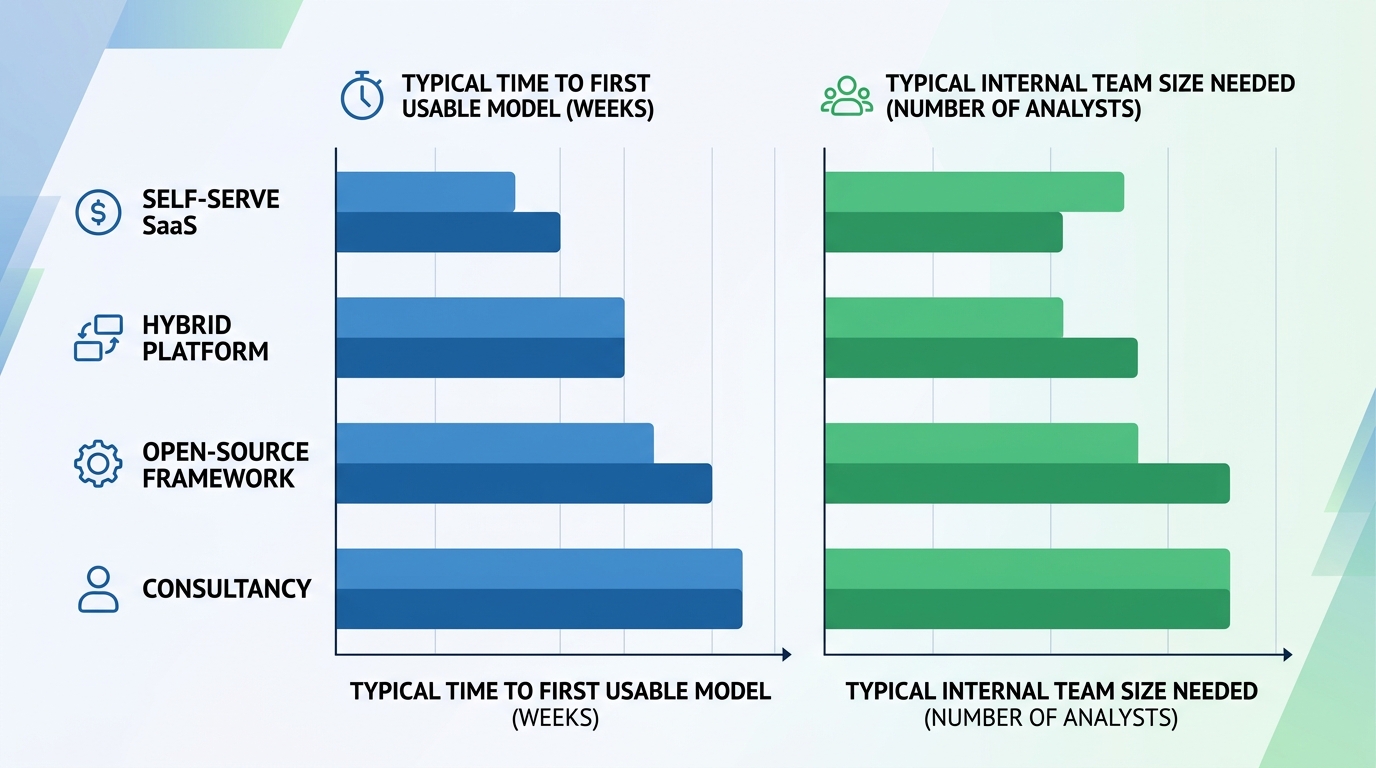
Consultancy and legacy providers. Companies such as Analytic Partners, Nielsen, Kantar, and Ekimetrics deliver bespoke services that require large human teams Objective Platform's comparison of MMM delivery models. They build models during periodic projects rather than continuous software updates. This model serves large enterprises that want full vendor management.
Vendor-by-Vendor Comparison
The table below summarizes reported features of common alternatives to Adobe Mix Modeler. Contact each vendor directly to verify current terms, because prices change.
| Vendor | Category | Reported Pricing | Refresh Cadence | Model Transparency |
|---|---|---|---|---|
| Google Meridian | Open-source | Free (you provide data science staff) | On-demand, you control it | Full, open-source code |
| Meta Robyn | Open-source | Free (you provide data science staff) | On-demand, you control it | Full, open-source code |
| BlueAlpha.ai | Managed MMM and decision support | Verify directly with vendor | Verify directly with vendor | Verify methodology and export options during evaluation |
| Recast | Self-serve SaaS | Roughly $2,000–$5,000 per month | Weekly | Medium, no direct code access |
| Mutinex | Hybrid, SaaS plus experiments | Roughly $75,000–$150,000 per year | Monthly | High, experiment-backed |
| Measured | Hybrid, incrementality plus MMM | Custom enterprise pricing | Weekly | High, causal validation |
| Analytic Partners, Nielsen, Kantar | Consultancy | Custom, project-based | Periodic | Varies by engagement |
The market also includes managed options such as BlueAlpha.ai's measurement platform for teams that want MMM and budget decision support without maintaining an open-source model. Buyers should test its data requirements, refresh process, methodology access, and exports against the same scorecard used for every vendor. Industry reports frequently list Google Meridian, Meta Robyn, and Adobe Mix Modeler as prominent solutions a current overview of prominent MMM solutions. Self-serve platforms fit teams that have one or two analysts and moderate media budgets. Hybrid platforms serve teams that must demonstrate causation before they change media spend. Open-source frameworks fit teams that have dedicated data scientists and require complete software control. Read our guide to the best marketing mix modeling software for more vendor comparisons.
Migration Considerations
You must plan your move away from Adobe Mix Modeler carefully. Review these points before you execute a new contract.
Data export. Confirm that you can export historical spend, outcomes, and model outputs from Adobe before you cancel your service. Ask your new vendor which data formats they accept.
Parallel run period. Operate your new model beside your old model for at least one complete update cycle. Compare the two outputs before you deactivate the old software.
Staff training. Allocate sufficient time for your analysts to learn new tools if you adopt an open-source framework. A clear training path reduces operational risk Mass Analytics' guide to MMM vendor implementation.
Contract terms on ownership. Secure written terms that state you own the model and data pipeline after the contract ends. Some hybrid and consultancy vendors keep these assets if you do not negotiate ownership.
Cost during transition. You will likely pay two vendors during the migration period. Include this overlap in your budget. Our guide to marketing mix modeling cost outlines typical industry ranges.
Worked example (hypothetical). A retail business with a $12 million annual media budget buys Adobe Analytics and Adobe Mix Modeler as a package. The business selects a self-serve platform that costs $4,000 per month, or $48,000 per year. The company pays for both platforms during a three-month transition period. The brand must record this temporary overlap as a one-time migration cost rather than a routine operating expense.
Who Should Stay with Adobe
Adobe Mix Modeler remains a practical option for one specific group of users. Companies that run Adobe Experience Platform, Adobe Analytics, and Customer Journey Analytics eliminate technical data integration work Improvado's review of marketing mix modeling providers. A third-party measurement tool introduces integration costs that current Adobe customers do not need to pay.
You should stay with Adobe if you satisfy three specific conditions. You actively use Adobe Experience Platform. You do not require public model code. You do not require independent causal experiments inside the platform. If your company does not meet all three conditions, examine alternative options.
Conclusion
No single alternative to Adobe Mix Modeler satisfies every organization. Your Adobe software investment, internal analyst capacity, and need for causal proof must guide your choice. Compare vendors against our evaluation criteria before you sign an agreement. Confirm all pricing terms and technical features directly with sales representatives.
Assess your internal requirements against the four vendor categories before you make a selection. An internal checklist of your budget, staffing, and transparency needs will accelerate vendor conversations.

If the shortlist still feels hard to separate, connect with an MMM consultant for an independent fit check. You can work out whether MMM makes sense for your team, then compare Adobe and its alternatives against the requirements that matter.
Stay in the loop
Get updates on new posts and resources.