Marketing Mix Modeling Cost: 2026 Pricing Guide
Discover the real marketing mix modeling cost in 2026. From legacy consulting to AI SaaS, we break down pricing tiers and expected ROI for growth teams.
Five years ago, asking "how much does marketing mix modeling cost?" usually resulted in a six-figure answer.
It was a game reserved for the Fortune 500. You hired a consulting firm, handed over a massive check, and waited six months for a PowerPoint deck. By the time you got the results, the market had changed.
2026 looks different.
The democratization of AI and computing power has shattered the old pricing structures. As noted by Harvard Business Review, the barrier to entry for advanced analytics has lowered significantly. You no longer need a PhD in econometrics on your payroll to understand your media efficiency.
But confusion remains. You will still find quotes ranging from $2,000 a month to $100,000 per project.
This guide cuts through the noise. We break down exactly what you should pay for Media Mix Modeling (MMM), what drives the price up, and where the hidden costs lie.
The Three Tiers of MMM Pricing
To understand marketing mix modeling cost, you must recognize that you aren't just buying a "model." You are buying a methodology. The market currently splits into three distinct tiers.
1. The Legacy Consulting Tier
Cost: $50,000 – $250,000+ per project / per year
This is the traditional route. You hire a large data consultancy or a specialized agency. They deploy a team of data scientists to interview your stakeholders, manually clean your data, and build bespoke models.
Pros:
- High level of customization.
- "White glove" service (they do the thinking for you).
- Brand safety for large enterprises who need a "signed off" audit.
Cons:
- Extremely slow. Results often take 12-16 weeks.
- Static snapshots. You get a report on last year's performance, not last week's.
- Black box methodology. You rarely own the code or the model.
Why is it so expensive? You are paying for human hours. Data science agency rates for senior econometricians often exceed $300 per hour. When you hire a consultancy, you pay for their office space, their overhead, and their brand prestige.
If you are a massive CPG conglomerate with static distribution channels, this might still work. For agile digital brands, this speed kills performance. If you need to track long sales cycles, verify if their methodology handles pipeline attribution effectively before signing a six-figure contract.
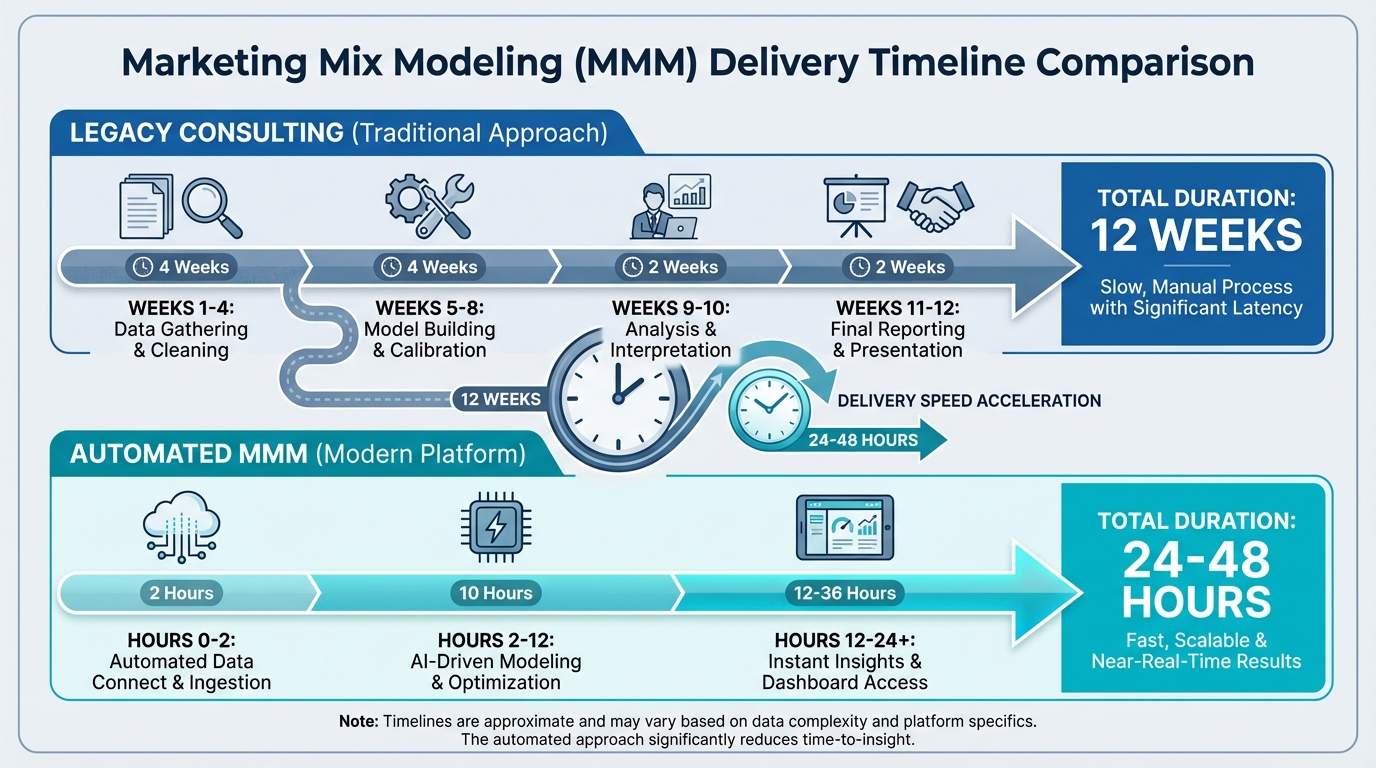
2. The Automated SaaS / AI Tier (The Modern Standard)
Cost: $1,500 – $15,000 per month
This is where the industry has shifted. Platforms like BlueAlpha use machine learning to automate the heavy lifting of data ingestion and model selection.
Instead of paying humans to clean CSV files, you pay for compute power and algorithm sophistication. This significantly lowers the automated MMM cost while increasing speed.
Pros:
- Speed. Models update weekly or even daily.
- Transparency. You can see the inputs and outputs clearly.
- Actionability. These tools often include budget optimizers.
- Scalability. Connect new channels without renegotiating a contract.
Cons:
- Requires clean data connectors (though most platforms handle this now).
- Less "hand-holding" than a consultancy (though support teams exist).
For 95% of businesses spending between $1M and $100M annually on ads, this is the sweet spot. It balances marketing mix modeling cost with utility.
If you are evaluating options in this tier, it helps to understand the landscape. For example, you might look at how different platforms handle attribution. See our breakdown in this media mix model marketing attribution guide.
3. The Open Source / DIY Tier
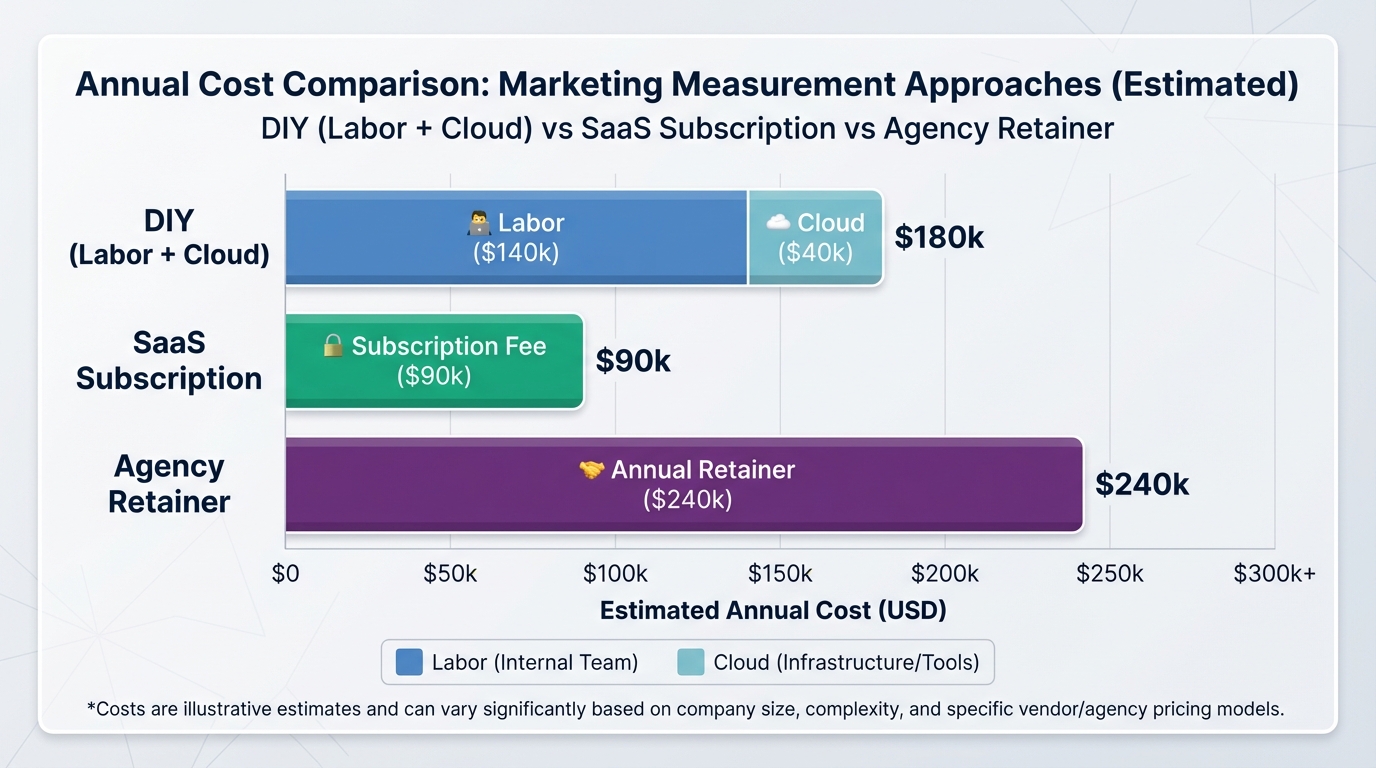
Software Cost: $0 Labor Cost: $150,000+ per year (Internal Headcount)
Tech giants have released open-source libraries. Meta has Robyn, and Google has Meridian. The code is free.
The Trap: The code is free, but the implementation is not. According to Glassdoor salary data, the average base pay for a Data Scientist in the US is well over $120,000. Senior roles required to manage complex econometric modeling fees and variables often command $200,000+.
Pros:
- Total control over every variable.
- Zero software licensing fees.
- Transparency and community support.
Cons:
- Talent cost. A good data scientist costs $150k-$200k/year.
- Maintenance. If your data scientist quits, your model dies.
- Compute costs. You pay for the cloud servers to run the models.
We've compared the nuances of these models in detail. Check out our comparison of which MMM is best.
If you have a robust in-house data science team with spare capacity, this is a viable option. If you don't, the "free" price tag is an illusion.
Key Factors That Influence Price
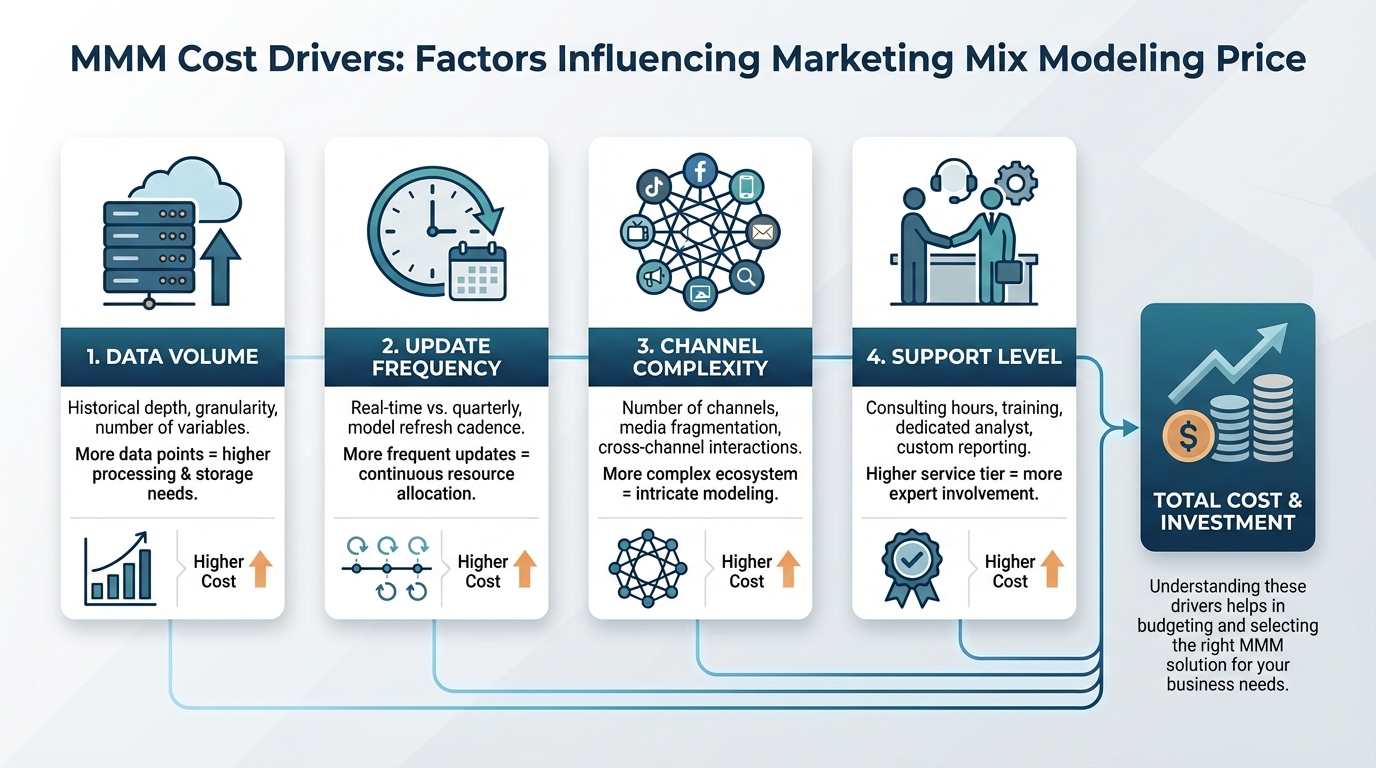
Why does one vendor charge $3,000 and another $10,000? When evaluating MMM pricing, it usually comes down to four variables.
1. Data Granularity and Volume
A model that analyzes spend at a national level once a month is cheap to run.
A model that analyzes spend by state, by campaign, or by SKU on a daily basis requires significantly more processing power. Higher granularity allows for tactical optimization, but it increases the marketing mix modeling cost.
If you are running complex campaigns across multiple regions, you need a tool that can handle that load without crashing.
2. Frequency of Updates
- Quarterly Refresh: Low cost. Good for high-level strategy.
- Weekly/Daily Refresh: Higher cost. Essential for tactical budget shifting.
Modern marketing moves too fast for quarterly reports. If you are spending heavily on volatility channels like Meta or TikTok, you need frequent updates.
3. Number of Channels and Integration Complexity
Connecting Facebook and Google Ads is standard.
But what if you need to measure out-of-home advertising? Or perhaps you are heavily invested in B2B strategies and need an account-based marketing attribution guide?
Custom integrations for offline data, direct mail, or complex CRM data often incur setup fees or higher tier pricing. The more fragmented your media mix, the higher the investment required to unify it.
4. Consulting vs. Self-Serve Support
Some SaaS platforms offer a "Managed Service" layer. You get the software, plus a dedicated analyst to help you interpret the results. This hybrid approach bridges the gap between Tier 1 and Tier 2 but adds to the monthly retainer.
[IMAGE: Diagram showing the cost drivers of MMM: Data Volume, Update Frequency, Channel Complexity, and Support Level. 1200x675px. Alt text: Factors influencing the price of marketing mix modeling.]
The Cost of Inaction (Opportunity Cost)
When executives scrutinize the media mix modeling investment, they often look at the line item cost: "$5,000 a month seems expensive."
They rarely calculate the cost of not having it.
Without MMM, you are likely operating on last-click attribution or platform-reported metrics (like ROAS). These metrics are notoriously biased. A study by Forrester highlights that marketers who rely solely on channel-specific metrics often misallocate up to 40% of their budgets.
The Math of Inaction:
- Annual Budget: $5,000,000
- Misallocation Rate: 20% (Conservative estimate)
- Wasted Spend: $1,000,000 per year
In this scenario, refusing to allocate $60,000 of your marketing analytics budget for an MMM tool is costing you $1,000,000 in lost efficiency. The "savings" of not buying the tool are dwarfed by the waste in your ad account.
Before you deploy any tool, you must understand the deployment process. Review our guide on how to deploy a media mix model to estimate the internal lift required.
Hidden Costs You Must Anticipate
The sticker price is rarely the final price. When budgeting for MMM, account for these often-overlooked expenses.
Data Cleaning and Preparation
Garbage in, garbage out. If your historical data is a mess—inconsistent naming conventions, missing periods, mixed currencies—it must be fixed before modeling begins. According to Forbes, data scientists spend nearly 80% of their time just preparing data.
Agencies charge hourly for this. SaaS platforms might charge an onboarding fee. If you are using a platform like Funnel.io to aggregate data before it hits your MMM, you need to factor in those subscription costs as well. See our Funnel.io alternatives marketing data platforms guide for cost-effective options.
Cloud Storage and Compute
If you choose the DIY route (Tier 3), you are responsible for the infrastructure. Storing terabytes of granular marketing data in Snowflake or BigQuery isn't free.
Running complex Bayesian models requires high-performance GPUs. According to AWS pricing documentation, high-memory instances can cost several dollars per hour. If you are retraining models daily, your monthly cloud bill can easily exceed $1,000 or $2,000. This brings the DIY cost surprisingly close to the automated MMM cost of a SaaS subscription.
When comparing SaaS vs consulting pricing, always look at the total cost of ownership, including these compute fees.
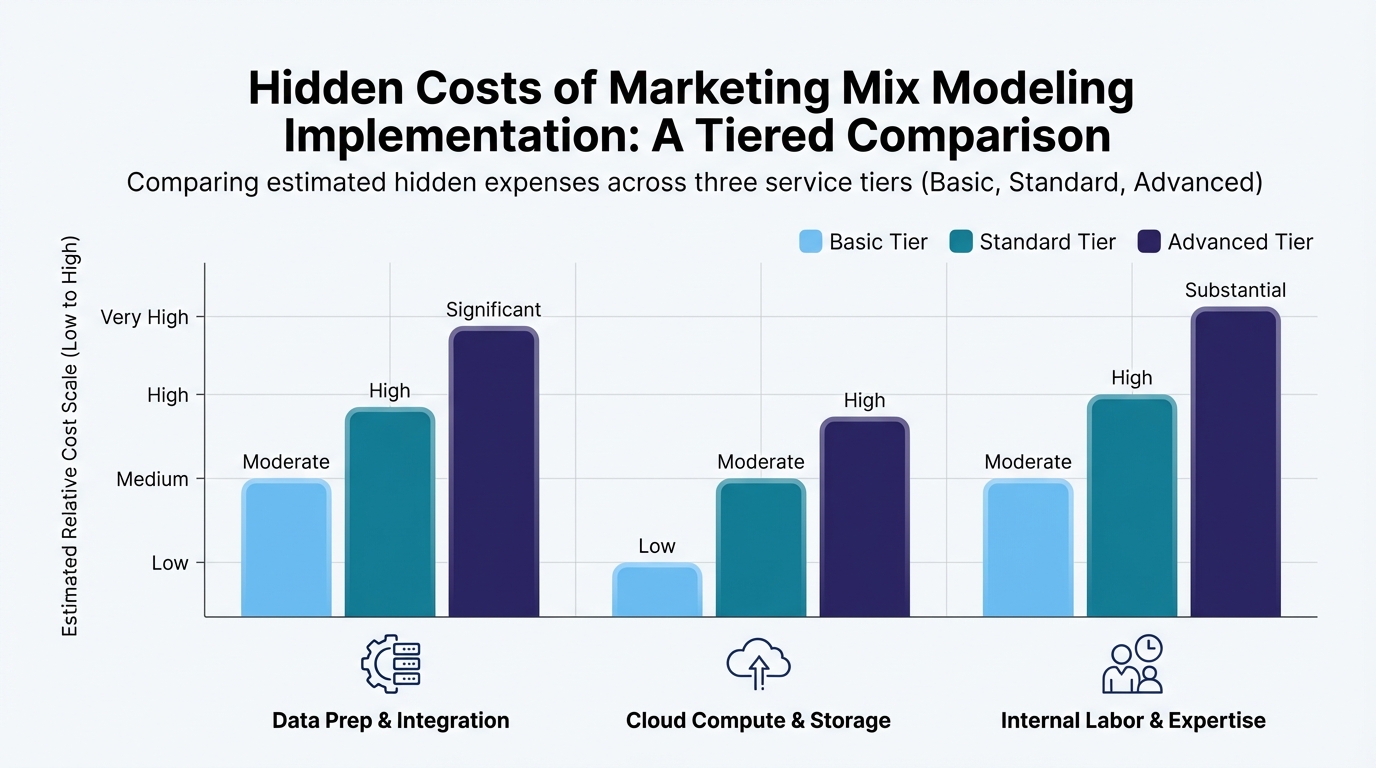
Internal Team Time
Even with an automated solution, your team needs to validate the data. Your CMO needs to learn how to read the insights.
Implementation takes time. Expect to dedicate 10-20 hours of internal resources during the first month of setup. Ongoing management usually requires 2-5 hours a week from a marketing analyst.
Experimentation Budget
MMM tells you what worked. To find out what will work, you need to run lift tests to calibrate the model.
Allocating budget for holdout tests or geo-lift experiments is crucial for model accuracy. This isn't a fee paid to the vendor, but it is a necessary cost of running a rigorous measurement program.
For a deeper dive on validating these models, read our marketing effectiveness measurement guide.
ROI Analysis: Is MMM Worth the Cost?
Cost is irrelevant without context. The better question is: What is the ROI of the tool?
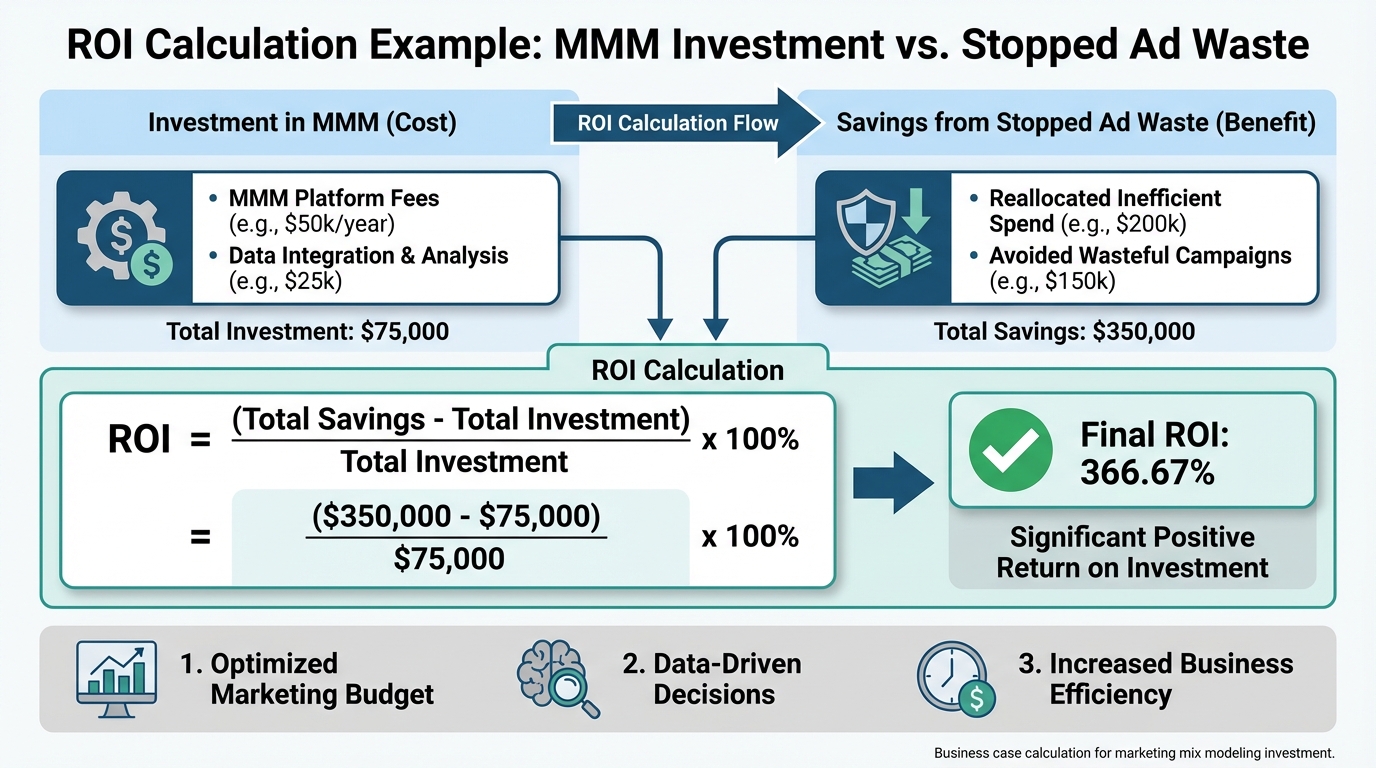
If a $5,000/month tool helps you identify that 20% of your $500,000/month ad spend is wasted, the tool pays for itself in 48 hours.
The "1% Rule"
A general rule of thumb in marketing analytics, supported by Gartner's CMO Spend Survey, is that your measurement stack should cost roughly 1% to 3% of your total media budget.
- Media Budget: $1M/year -> Measurement Budget: $10k - $30k/year.
- Media Budget: $10M/year -> Measurement Budget: $100k - $300k/year.
If you spend $10M a year and rely on free Google Analytics (which suffers from severe tracking limitations), you are likely wasting hundreds of thousands of dollars due to bad data. Your marketing analytics budget must scale with your media spend.
Conversely, if you spend $100k a year, a $50k custom model makes no sense.
To calculate your specific returns, conduct a full marketing ROI analysis using the frameworks in our marketing ROI analysis guide.
Comparing Popular Solutions (2026 Landscape)
The market is crowded. Here is how different categories of tools stack up against modern AI solutions like BlueAlpha regarding MMM pricing and value.
Specialized Attribution vs. MMM
Some platforms focus heavily on click-based attribution or "multi-touch attribution" (MTA). While useful for user journeys, they fail to capture offline impact or the diminishing returns of spend.
We've compared the two methodologies extensively. See our MTA vs MMM marketing attribution comparison.
Platform-Specific Comparisons
You might be evaluating specific vendors. It is vital to compare apples to apples regarding transparency and cost structures.
- Recast: Known for Bayesian modeling, but pricing can be steep for mid-market brands. Compare features in our Recast vs BlueAlpha comparison.
- Northbeam: A strong contender in the attribution space that pivoted toward MMM. See how they differ in our Northbeam vs BlueAlpha comparison.
- Triple Whale: Heavily focused on Shopify/DTC. If you have a complex omni-channel mix, read our Triple Whale vs BlueAlpha comparison.
- Keen Decision Systems: A more traditional player often used by larger enterprises. See if their model fits your agility needs in our Keen Decision Systems vs BlueAlpha guide.
The Open Source Giants
If you are considering the DIY route, you are likely looking at Google or Meta.
- Google Meridian: A powerful tool, but requires heavy lifting. Read our Google Meridian MMM complete guide.
- Meta Robyn: The open-source pioneer. You can view their official documentation here. Great community, steep learning curve. Check the Meta Robyn open source MMM guide.
[IMAGE: Bar chart showing the estimated annual cost of DIY (Labor + Cloud) vs SaaS Subscription vs Agency Retainer. 1200x675px. Alt text: Annual cost comparison of different marketing measurement approaches.]
Why BlueAlpha Changes the Pricing Dynamic
BlueAlpha was built on the premise that marketing mix modeling cost shouldn't prohibit mid-market companies from accessing enterprise-grade intelligence.
By automating the data pipeline and using AI to select the best-fitting models, BlueAlpha removes the expensive "consulting hours" from the equation.
You get:
- Automated Data Ingestion: No manual CSV uploads.
- Continuous Calibration: The model learns as you spend.
- Budget Optimization: Tools to plan future spend, not just analyze the past.
This shifts the conversation from "how much does the model cost?" to "how much profit can the model generate?"
For a direct look at how we stack up against other modern tools, check our Measured.com vs BlueAlpha comparison.
Making the Business Case to Your CFO
You know you need MMM. Now you need to convince the person holding the checkbook.
Don't talk about "Bayesian priors" or "saturation curves." Talk about capital efficiency. According to McKinsey, data-driven marketing can increase total return by 15-20%.
When pitching the media mix modeling investment, use this three-step framework:
- Quantify the Waste: "We are currently spending $X blindly. Based on industry benchmarks, we are likely wasting 20% of that."
- Highlight Agility: "We need to move budget from underperforming channels to high-performing ones instantly, not quarterly. This tool allows for real-time media budget optimization."
- Unified Truth: "This eliminates the argument between the Facebook report and the Google report."
Show them the plan for funnel stage budget allocation and how it directly impacts the bottom line. If you are in the B2B space, emphasize the ability to track ROI accurately using our ABM ROI measurement guide.
Frequently Asked Questions
Q: What is the minimum ad spend required for MMM? A: Historically, you needed $1M+ annually. With modern AI tools like BlueAlpha, the threshold has lowered. If you spend $30k-$50k per month across 3+ channels, you have enough signal for a model to provide value.
Q: Can MMM replace Multi-Touch Attribution (MTA)? A: They do different things. MTA tracks user paths (micro view). MMM measures incremental impact (macro view). However, as privacy laws (GDPR, iOS updates) kill tracking cookies, MMM is becoming the primary source of truth. Read more about alternatives in our Lifesight alternatives marketing measurement platforms guide.
Q: What is the average ROI of investing in MMM? A: The ROI depends on your current inefficiency. However, most brands see a 15-30% improvement in media efficiency within the first 6 months. If your media mix modeling investment is $20k/year and you save $200k in wasted ad spend, the ROI is 10x.
Q: How long does it take to get results? A: Agencies take 3-4 months. Automated platforms can deliver an initial model in 2-4 weeks, with ongoing updates available daily or weekly thereafter.
Q: Is open-source MMM actually free? A: No. The code is free. The cloud computing costs and the salary of the data scientist required to run it are significant. It is often more expensive than a SaaS subscription when you calculate the total marketing analytics budget required.
Q: What about contract lengths? A: Consulting firms often require annual contracts. Many SaaS providers offer annual agreements with quarterly outs, or even month-to-month options for smaller tiers. Always check the exit terms.
Conclusion
The marketing mix modeling cost in 2026 is no longer a barrier to entry. It is a filter.
It filters out the brands that are serious about growth from those that are gambling with their budget.
You can pay a consultancy $100k for a static report. You can pay a data scientist $150k to build a DIY model. Or you can use a modern platform to get continuous, actionable intelligence for a fraction of that price.
The era of guessing is over. The era of precision has begun.
Ready to see how your budget should really be allocated? Start by understanding the fundamentals of funnel stage budget allocation and take control of your marketing performance.
Stay in the loop
Get updates on new posts and resources.