MMM Build vs Buy: The 2026 Decision Framework for CMOs
Should you build an in-house media mix model or buy a platform? We break down costs, risks, and timelines in this comprehensive MMM build vs buy guide for CMOs.
The spreadsheet is broken. The cookies are gone. And your CFO is asking for hard numbers on that last brand campaign.
If you are reading this, you already know you need Media Mix Modeling (MMM). The question isn't if you need it. The question is how you get it.
Do you hire a team of data scientists to build a custom model from scratch? Or do you sign a contract with a software vendor?
This is the classic MMM build vs buy dilemma.
In 2026, this decision is harder than ever. Open-source tools are more powerful. SaaS platforms are smarter. The gap between the two is closing, but the risks of choosing wrong are widening.
Make the wrong choice, and you burn six months and $200,000 with nothing to show for it. Make the right choice, and you unlock budget efficiency that pays for the investment ten times over.
Here is the no-nonsense framework to decide.
The Core Problem: Control vs. Speed
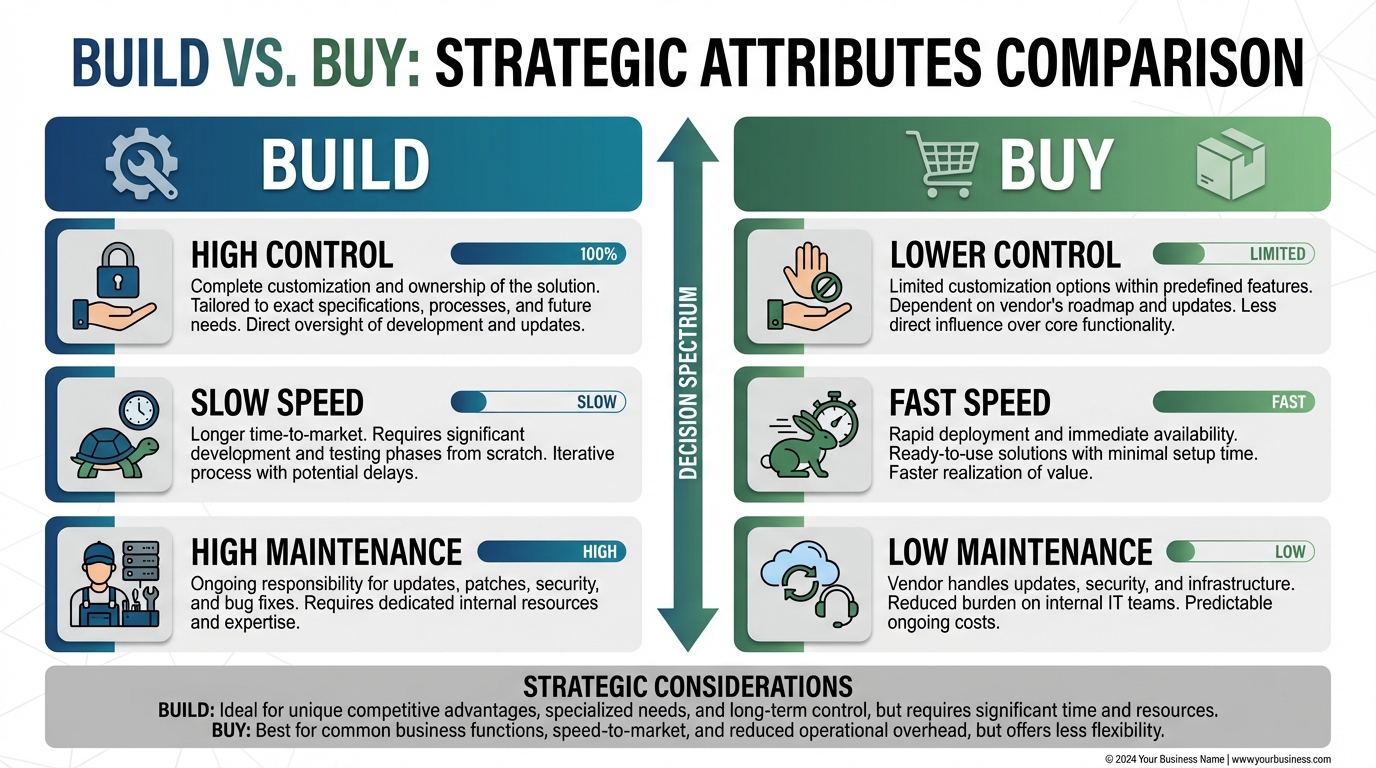
Every "build vs buy" decision comes down to a trade-off between control and speed.
Building gives you total control. You own the code. You own the assumptions. You can tweak the hyper-parameters until the model fits your business like a glove.
Buying gives you speed. You plug in your data. You get answers. You don't have to worry about maintaining a Python library that hasn't been updated in two years.
But marketing data is messy. It doesn't fit neatly into boxes. According to McKinsey, the complexity of consumer journeys means speed often sacrifices accuracy if the underlying model isn't robust.
This is why understanding the nuances of the media mix model marketing attribution guide is the first step before spending a dime.
Option 1: The "Build" Approach (In-House)
Building an MMM in-house used to be reserved for giants like P&G or Coca-Cola. Today, open-source libraries have democratized the math.
You aren't starting from zero. You are likely starting with frameworks like Meta’s Robyn or Google’s Meridian.
The Pros of Building
- Transparency: You see every line of code. There is no "black box." If the model says TV drove 20% of sales, you can trace exactly why.
- Customization: Does your business have weird seasonality? A unique sales cycle? You can hard-code these realities into your model.
- Data Privacy: Your data never leaves your servers. For highly regulated industries like finance or healthcare, this is a massive plus.
The Cons of Building
- Talent Scarcity: You need a data scientist who understands Bayesian statistics and marketing. That is a unicorn hire. According to Harvard Business Review, the demand for data scientists who can bridge technical and business gaps far outstrips supply.
- Maintenance Nightmare: Models drift. APIs break. If your lead data scientist quits, your MMM dies with them.
- Hidden Costs: The software is free. The cloud compute, data engineering, and salaries are not.
The Open Source Reality
If you choose to build, you will likely lean on major open-source projects.
Meta Robyn: This R-based package uses machine learning to automate much of the modeling process. It is powerful but requires significant technical expertise to tune correctly. You can read the official documentation on Meta's Engineering Blog to understand the technical lift required. For a practical breakdown, read our deep dive in the Meta Robyn open source MMM guide.
Google Meridian: The newcomer on the block. It offers a Bayesian approach that integrates well with Google's ecosystem but is still maturing. Check out the Google Meridian MMM complete guide for details.
Option 2: The "Buy" Approach (SaaS & Vendors)
The SaaS market for MMM has exploded. Vendors promise to ingest your data, run the models, and give you a dashboard with optimization levers.
The Pros of Buying
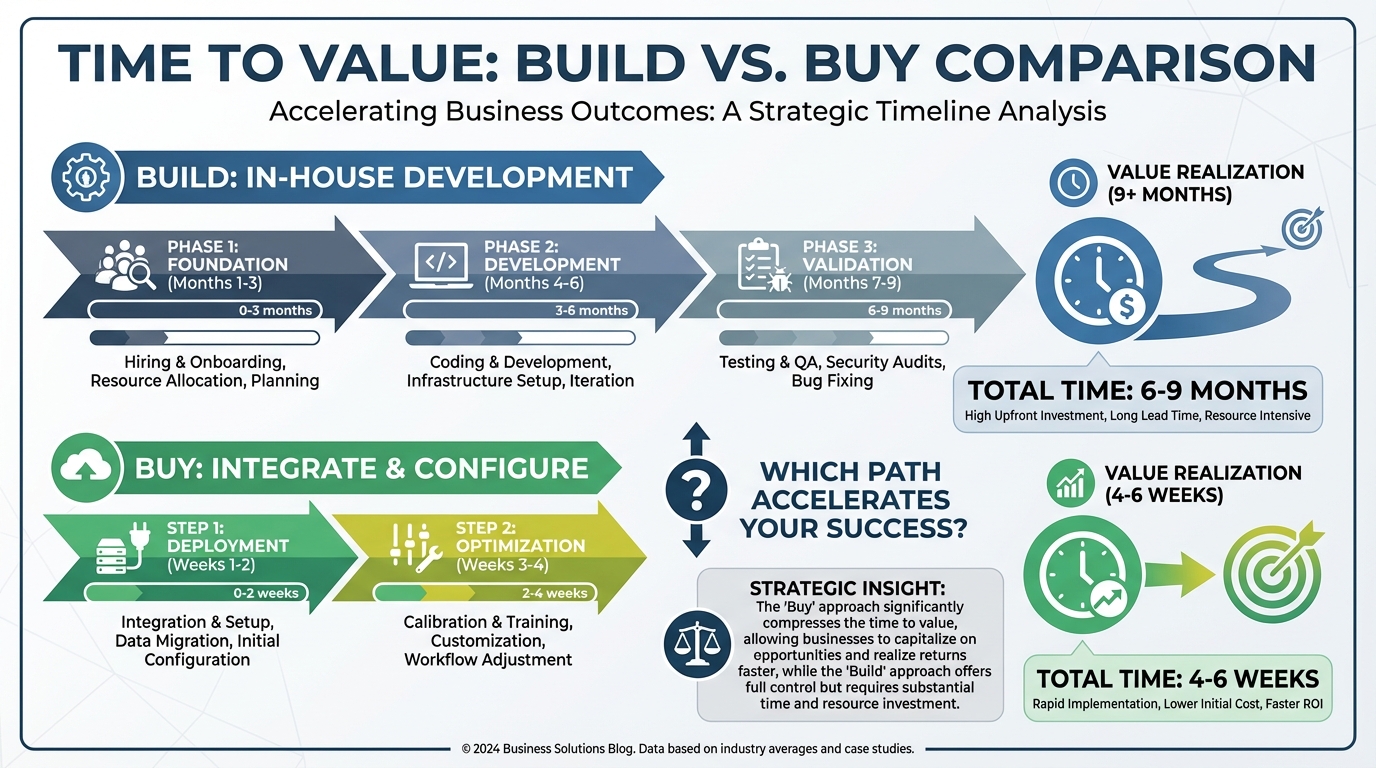
- Speed to Value: You can go from contract to insights in 4-6 weeks. Building in-house often takes 6-9 months.
- Expertise on Tap: Vendors see data from hundreds of companies. They know what "good" looks like. They can benchmark your performance against the industry.
- User Interface: Your CMO doesn't want to look at a Jupyter Notebook. They want a dashboard. Vendors provide polished UIs for budget planning.
The Cons of Buying
- The Black Box: Many legacy vendors won't show you their math. You have to trust them.
- Rigidity: If your business model doesn't fit their template, you might get bad data.
- Cost: SaaS fees can be steep, ranging from $3k to $20k+ per month depending on ad spend.
When evaluating vendors, it is crucial to look at how they handle different measurement frameworks. A good starting point is the MTA vs MMM marketing attribution comparison.
The Cost Analysis: Doing the Math
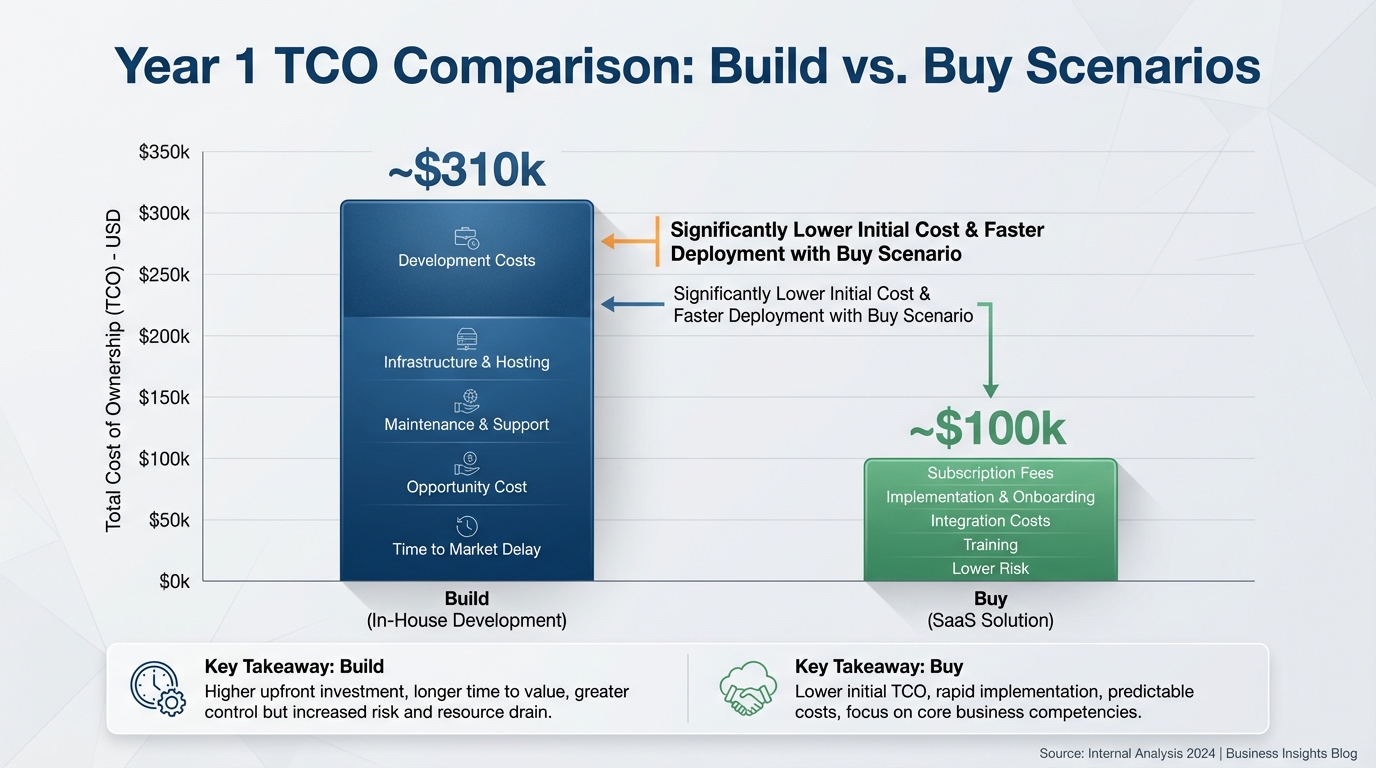
Let's get real about the money. The MMM build vs buy decision often comes down to Total Cost of Ownership (TCO).
The Cost of Building (Year 1)
- Senior Data Scientist: $180,000 (salary + benefits)
- Data Engineer (50% time): $80,000
- Cloud Compute/Storage: $15,000
- Visualization Tools (Tableau/Looker): $5,000
- Recruiting Fees: $30,000
- Total Year 1: $310,000+
The Cost of Buying (Year 1)
- Platform License: $40,000 - $100,000 (varies by spend)
- Implementation Fee: $10,000
- Internal Manager (10% time): $15,000
- Total Year 1: $65,000 - $125,000
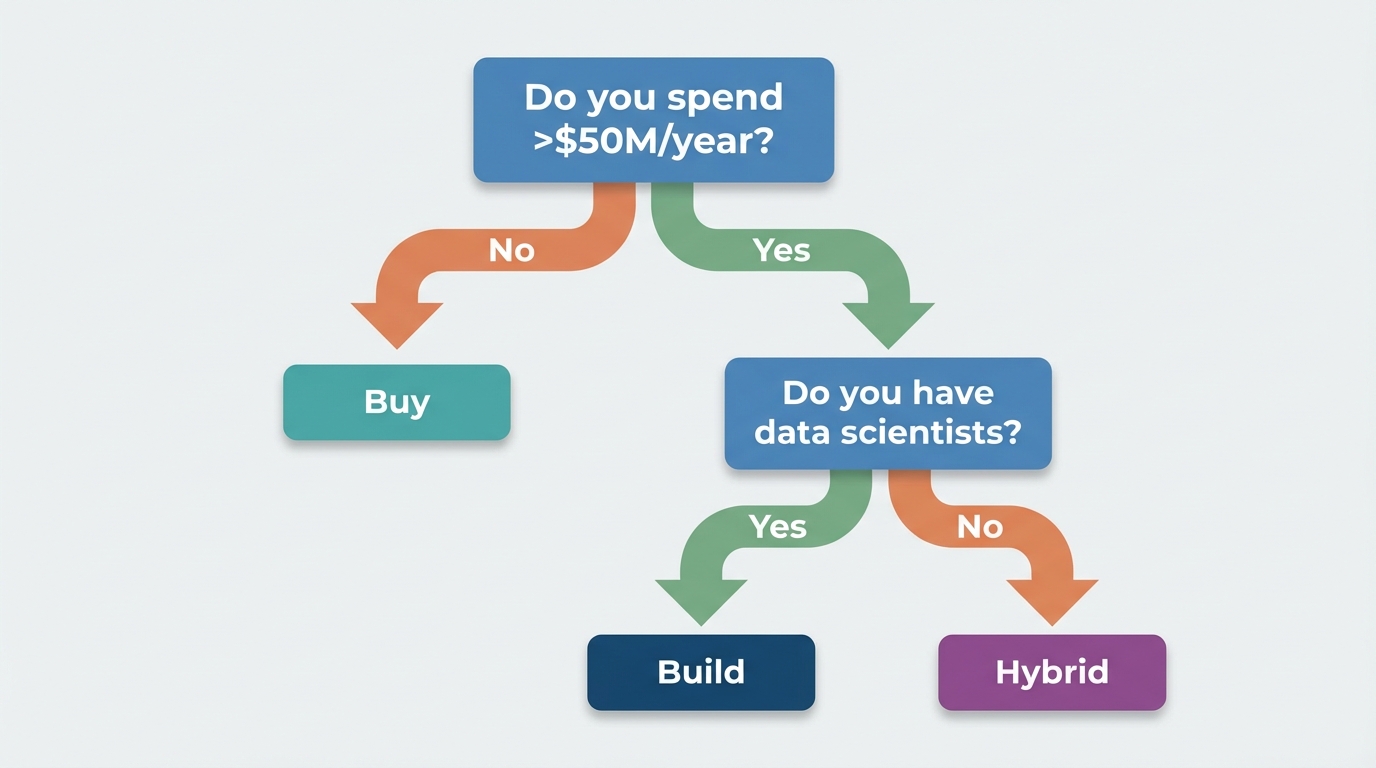
The Verdict: Buying is almost always cheaper in direct costs. Building only makes financial sense if you have massive scale (spending $50M+ annually) or if you already have a surplus of data science talent sitting idle.
However, cost isn't just about spend. It's about returns. If a custom model is 10% more accurate than a vendor model, that 10% efficiency gain on a $50M budget is $5M. That pays for the data science team easily.
To run these numbers for your own business, use our marketing ROI analysis guide.
The Hybrid Model: The Modern Solution
In 2026, the binary choice between "build" and "buy" is fading. A new wave of platforms is offering a hybrid approach.
BlueAlpha stands out in the modern, AI-first category by prioritizing transparency—showing you exactly how the model arrives at its recommendations—while delivering the speed and polish of a mature SaaS platform.
These platforms provide the infrastructure (data pipelines, dashboards, budget optimizers) but allow you to export the model parameters or even inject your own priors. This solves the "Black Box" problem without forcing you to manage a Kubernetes cluster.
For example, when looking at Recast vs BlueAlpha comparison, you see different approaches to transparency and speed. The goal is to find a partner that acts as an extension of your team, not just a software login.
5 Questions to Ask Before You Decide
Don't rely on gut feeling. Ask these five questions to your leadership team.
1. What is our data maturity?
Do you have a clean data warehouse? If your data is scattered across fifty spreadsheets, neither building nor buying will work yet. You need to fix the pipes first. Platforms can sometimes help clean data during ingestion, but they aren't magicians. Resource: Marketing effectiveness measurement guide
2. How unique is our business model?
If you are a standard e-commerce DTC brand, "buying" is a no-brainer. The models for DTC are well-solved. If you are a B2B enterprise with a 9-month sales cycle and offline events, you might need the customization of a build or a highly specialized vendor. Resource: Account based marketing attribution guide
3. Do we need to measure offline channels?
Most digital-only attribution tools fail here. If you spend heavily on Billboards, TV, or Direct Mail, ensure your solution handles it. According to Nielsen, offline channels still command significant ROI, yet they are the hardest to measure without advanced modeling. Resource: Out of home advertising tracking guide
4. What is the timeline?
If the CEO needs answers for the Q3 board meeting and it is currently May, do not build. You will not finish in time. Buy a solution to stop the bleeding, then evaluate building later. Resource: How to deploy media mix model
5. Who will own the model?
A model without an owner is useless. If you build, the Data Science team owns it. If you buy, the Marketing Ops team usually owns it. Ensure the owner has the political capital to enforce the budget changes the model suggests.
The Hidden Complexity of "Building"
Many CTOs underestimate the complexity of MMM. It isn't just a regression analysis.
You have to account for adstock (the lingering effect of ads). You have to account for diminishing returns (saturation). You have to separate baseline sales (what you would sell with zero ads) from incremental sales.
Then, you have to solve for the "optimization" problem. Knowing what happened is only half the battle. You need an algorithm that tells you what to do next.
This is where the media budget optimization guide comes into play. Building a solver that can allocate budget across 20 channels while respecting constraints (e.g., "don't spend less than $5k on Facebook") is mathematically difficult.
According to Gartner, over 50% of marketing analytics projects fail to reach production. The code works on the laptop but fails in the real world.
Furthermore, academic research often highlights the difficulty in selecting priors. A study by Google Research on Bayesian methods in marketing mix modeling emphasizes that incorrect prior assumptions can lead to vastly different (and incorrect) ROI calculations.
Evaluating the Vendor Landscape
If you decide to buy, the market is crowded.
You have legacy players who are expensive and slow. You have modern AI-first platforms. And you have "connector" tools that just visualize data without modeling it.
BlueAlpha sits in the modern, AI-first category. We focus on transparency and actionable insights, distinguishing us from older "black box" methodologies.
When shopping around, compare features directly:
- vs. Traditional Attribution: Check the Lifesight vs BlueAlpha AI comparison guide.
- vs. E-commerce Analytics: Look at Triple Whale vs BlueAlpha AI comparison.
- vs. Enterprise Solutions: Review Measured com vs BlueAlpha AI comparison.
Don't just look at the logo. Look at the methodology. Ask for a proof of concept (POC). You can also consult the MarTech Map to see how crowded the data and analytics landscape has become, reinforcing the need for careful selection.
The "Build AND Buy" Strategy
Here is a secret: The most sophisticated companies do both.
They buy a platform like BlueAlpha to handle the heavy lifting—data ingestion, standard reporting, daily optimization. This covers 80% of the work.
Then, their data science team builds custom modules on top of that data for the remaining 20%—like predicting the impact of a Super Bowl ad or a global pandemic.
This allows the internal team to focus on high-value, unique problems rather than cleaning Facebook API data.
If you are looking for alternatives to specific platforms to build this stack, consider reading our guides on Measured com alternatives guide or Northbeam alternatives marketing attribution platforms.
Conclusion: Make the Call
The MMM build vs buy debate won't be solved by a spreadsheet alone. It requires an honest look at your company culture.
Build if:
- You spend over $50M/year.
- You have a mature data science team.
- Your business logic is too complex for any vendor.
- You require absolute code ownership.
Buy if:
- You need answers now.
- You want to focus on marketing strategy, not model maintenance.
- You want industry benchmarks and expert support.
- You want a lower Total Cost of Ownership.
For most mid-market to enterprise companies, buying a modern, transparent platform is the smartest move in 2026. It gives you the power of MMM without the headache of becoming a software development shop.
Ready to see which MMM is right for you? Dive deeper into our which MMM is best media mix modeling comparison.
Frequently Asked Questions (FAQ)
Is open-source MMM truly free?
No. While the software libraries (like Robyn or Meridian) are free to download, the cost of implementation is high. You pay for data scientist salaries, cloud computing resources, data engineering time, and ongoing maintenance. The "free" tool often costs hundreds of thousands of dollars in internal resources annually. For a deeper look at resource allocation, review our marketing ROI analysis guide.
How long does it take to build an MMM in-house?
A typical in-house build takes 6 to 9 months to reach a production-ready state. This includes hiring talent, cleaning data, building the model, validating results, and creating dashboards. In contrast, buying a solution usually takes 4 to 8 weeks to deploy.
Can I switch from "Build" to "Buy" later?
Yes, and many companies do. Often, companies start by building a simple model to prove the concept. Once they realize the maintenance burden, they migrate to a dedicated platform to handle the scale and complexity.
What is the minimum ad spend for MMM?
Historically, you needed millions in spend. Today, thanks to better algorithms, companies spending as little as $500k to $1M annually can benefit from MMM. However, the data must be granular enough to find statistical significance. If you are budget-constrained, check our funnel stage budget allocation guide for optimization tips.
Does MMM replace Multi-Touch Attribution (MTA)?
They are better together. MTA is great for short-term, digital-only user-level tracking. MMM is superior for long-term, holistic measurement that includes offline channels and privacy-restricted environments. For a detailed breakdown, read our MTA vs MMM marketing attribution comparison.
Stay in the loop
Get updates on new posts and resources.