Which Marketing Mix Modeling Software Does Your Team Need?
Compare marketing mix modeling software by methodology, data needs, optimization features, service model, and total cost of ownership.
Marketing mix modeling software should match the decisions, data, and skills that your team already has. The best option is not one universal product. It is the solution that produces credible estimates and fits a repeatable operating process.
Start with the type of system that your team can support. Then compare products inside that category. This order prevents a polished demo from hiding a poor fit.
This guide compares four solution types. It also gives you a practical scorecard for methods, data, validation, planning, service, and total cost.
Quick shortlist by buyer type
Choose an open-source library when your team has strong data science and engineering skills. This path gives you the most control over model code, priors, transformations, diagnostics, and deployment.
Choose self-service software when analysts can prepare data and review outputs, but they do not want to maintain a full modeling stack. The product should guide setup, diagnostics, refreshes, and scenario work.
Choose a managed platform when your team needs a repeatable product and regular expert review. This model can suit teams that want software access without full ownership of model operations.
Choose a consultancy when the problem needs a custom study, complex stakeholder work, or specialized data collection. A project can answer a major planning question, but it might not create an ongoing measurement process.
Read our plain-English MMM introduction if your team needs a method review before it selects software.
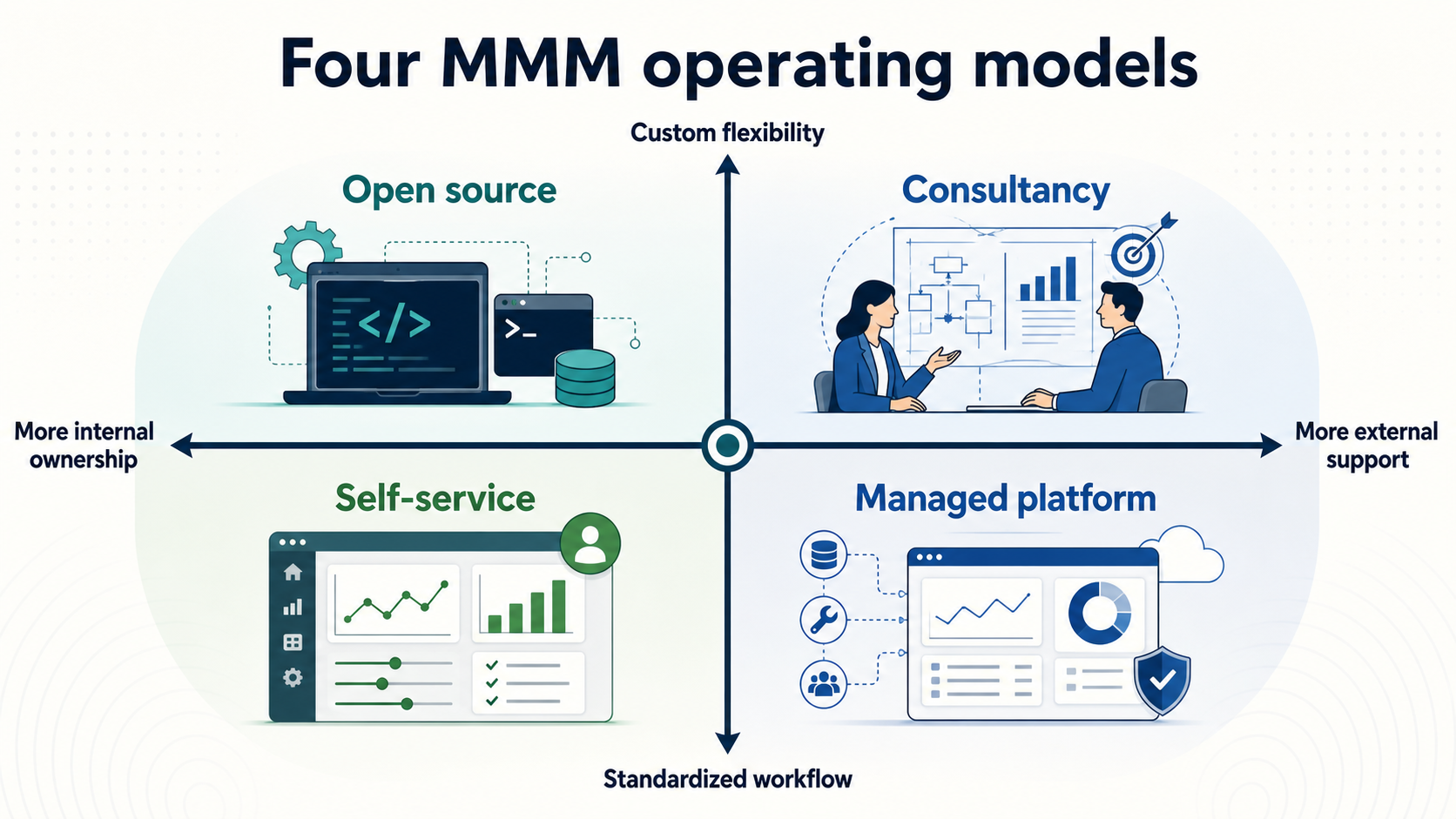
The right category depends on how much modeling control and outside support your team needs.
The four MMM solution categories
The category matters because each option assigns work to a different party. The work includes data preparation, model design, validation, interpretation, and refreshes.
Open-source libraries
Open-source libraries expose model code and configuration. They often provide the clearest route for technical review and custom development.
Google Meridian is an open-source Bayesian MMM framework. Google documents support for geo-level modeling, prior knowledge, reach and frequency data, and experiment calibration.
Meta Robyn is an open-source MMM package in R. Its documentation describes automated model exploration, response curves, budget allocation, and experiment calibration.
PyMC-Marketing gives Python teams a Bayesian MMM toolkit. Its documentation covers model components, adstock, saturation, inference, and budget allocation.
These libraries do not remove the need for judgment. Your team must still define outcomes, controls, channel groups, priors, tests, and decision rules.
Self-service software
Self-service products package much of the workflow behind an interface. A strong product should still show enough detail for a qualified analyst to review the model.
Ask whether users can inspect inputs, transformations, model fit, uncertainty, response curves, and allocation constraints. A simple dashboard with channel return numbers is not enough.
Also test the refresh process. A product that needs weeks of manual work for each update does not support a repeatable process.
Managed platforms
Managed platforms combine software with expert services. The provider often helps with data review, model choices, interpretation, and planning sessions.
This structure can reduce the skills burden on an internal team. It can also make quality depend on the assigned service team and the contract scope.
Analytic Partners describes a commercial analytics platform that joins measurement, forecasting, and optimization. That example shows how managed products often cover more than model estimation.
Ask who makes each modeling decision. Ask what your team can inspect, export, and retain after the contract ends.
Consultancies
Consultancies can build custom models and manage complex research programs. They can help when a company has unusual markets, sparse data, major offline activity, or many stakeholder groups.
The main tradeoff is continuity. A custom study can deliver a strong answer at one point in time. It can still fail to support monthly or quarterly budget work if the refresh process stays outside your team.
Evaluate evidence before features
Marketing mix modeling estimates the relationship between marketing inputs and a business outcome over time. Good software must help users separate media effects from seasonality, price, promotions, distribution, and outside events.
First, review the model structure. Ask which regression or Bayesian methods the system supports. Review adstock, saturation, trends, controls, priors, and hierarchical effects.
Second, review uncertainty. A product should not present one return number as a fact. Look for intervals, sensitivity checks, holdouts, and clear limits.
Third, review calibration. Experiments can add evidence that the time-series data does not contain. Both Meridian and Robyn document ways to use experiment results during model work.
Fourth, review validation. Ask how the provider tests predictions, model stability, residual patterns, and business plausibility. A high fit score alone does not prove a useful causal estimate.
Fifth, review transparency. Your team should understand why results change after a refresh. It should also see which data or assumptions caused the change.
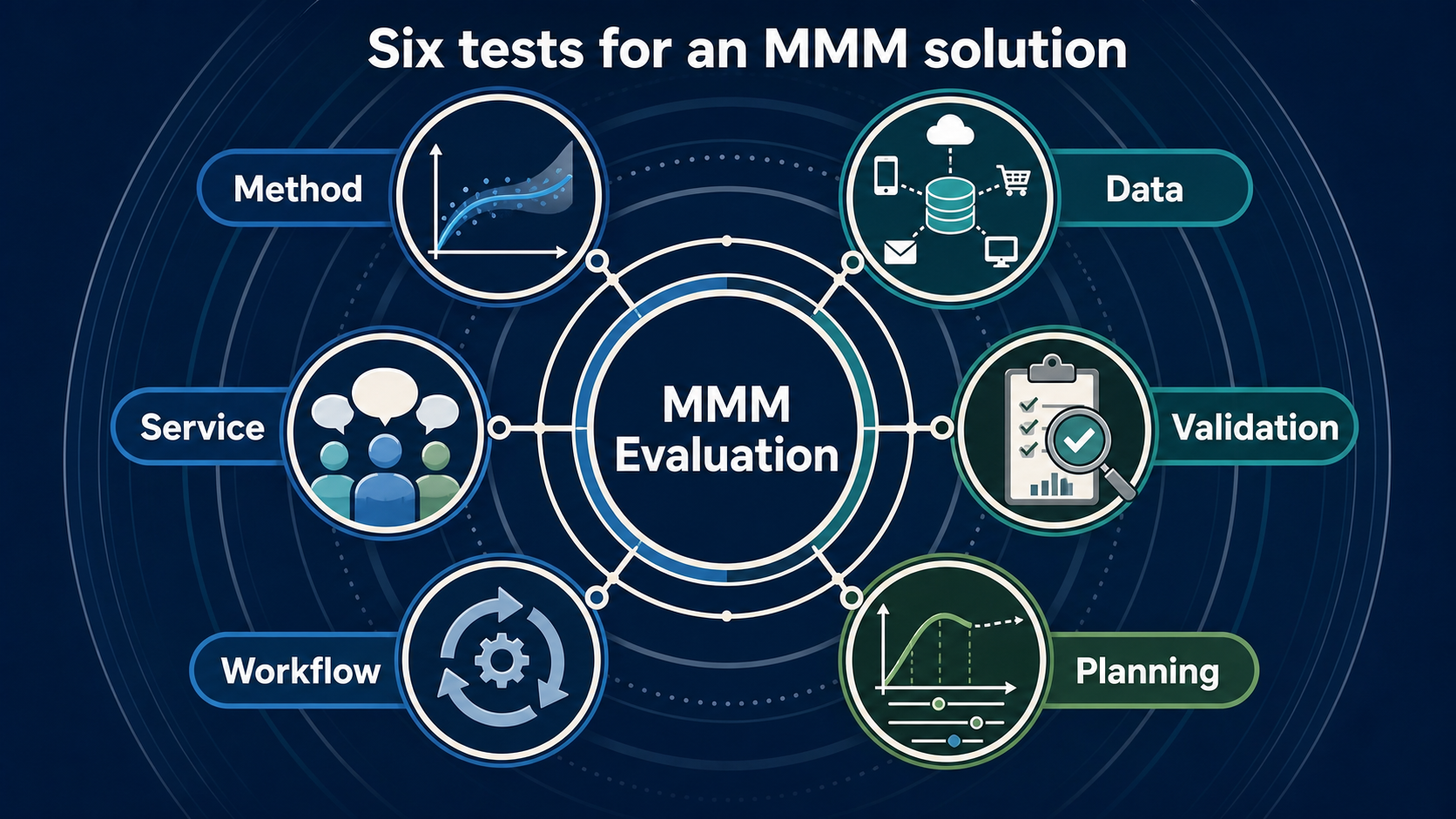
A useful scorecard tests evidence quality and operating fit before it compares feature lists.
Compare data and implementation needs
Every product needs a clean outcome series and media inputs. Many models also need price, promotions, distribution, holidays, macro factors, and other controls.
The required history depends on the decision, market variation, channel mix, and model structure. Do not accept one fixed data rule without a review of your business.
Ask each provider to map every required field before a contract starts. The map should name the source, owner, time grain, geography, refresh rate, and quality test.
Geo-level models can add useful variation, but they also add data work. Teams need consistent geographic definitions across outcomes, media, controls, and experiments.
Reach and frequency inputs can improve the treatment of some video channels. They also require reliable delivery data. Google documents this option for Meridian, but product support differs across tools.
Review identity and privacy needs as well. MMM can use aggregate data, yet source systems can still contain sensitive fields. The implementation should restrict access and retain only necessary inputs.
Our MMM cost guide explains why data work and internal labor can exceed the visible software fee.
Test planning and optimization features
Most buyers want more than a report about past performance. They want to compare future budget choices.
A useful planner starts with response curves. These curves show how expected results change as spend changes. The planner should also show uncertainty around those estimates.
Next, test constraints. Real plans include minimum commitments, maximum inventory, channel floors, market limits, and timing rules. An optimizer that ignores these limits can produce an unusable answer.
Then test the objective. Revenue, profit, customer growth, and risk-adjusted return can produce different plans. The product should make that choice explicit.
Finally, test holdout logic. A plan should leave room for learning when uncertainty stays high. The highest modeled return is not always the best practical decision.
Use a worked scenario during the sales process. Give every provider the same decision, constraints, and output requirements. Compare how each system explains the result.
Review workflow, service, and ownership
Software value depends on use after the first model. Ask who prepares each refresh, who approves changes, and how long the cycle takes.
Review access by role. Analysts need diagnostics and exports. Marketing leaders need clear scenarios and assumptions. Finance teams need definitions that connect to profit and planning.
Review version history. Your team should see when data, code, priors, mappings, or constraints change. It should also reproduce an earlier decision.
Review service boundaries. Some contracts include data engineering, experiment design, model review, and planning support. Other contracts charge for each task.
Review ownership at exit. Ask whether you can export prepared data, model results, assumptions, and scenario outputs. Open-source code does not solve this problem if your team cannot operate it.
Our build-versus-buy guide gives a deeper framework for internal ownership decisions.
Compare total cost, not the license alone
Total cost includes software, services, data work, cloud use, engineering, analyst time, training, and change management. It also includes the cost of slow refreshes and unused outputs.
Open source has no license fee, but it needs skilled labor and reliable infrastructure. Self-service software can lower technical work, but the team still needs measurement judgment.
Managed platforms add service cost, but they can reduce hiring and operating needs. Consultancies can suit a major one-time question, but repeat studies can increase long-term cost.
Ask for a first-year and steady-state estimate. Separate setup work from ongoing work. Include every internal role that must supply data, review models, and use plans.
Do not compare quoted prices without matching scope. One offer might include data preparation and quarterly planning. Another might cover only software access.
Use a decision checklist
Write down the business decisions before you book demos. Name the budget level, planning frequency, markets, channels, and people who will use the result.
Then score each option on these questions:
-
Does the method fit the available variation and decision?
-
Can the team inspect assumptions, diagnostics, and uncertainty?
-
Does the data plan name each source, owner, and quality test?
-
Can experiments or other evidence calibrate the model?
-
Does the planner support real business constraints?
-
Can the team refresh the model at the required pace?
-
Does each role get the detail that it needs?
-
What data and outputs can the company retain?
-
What is the full first-year and steady-state cost?
-
Which internal skills must the company add or maintain?
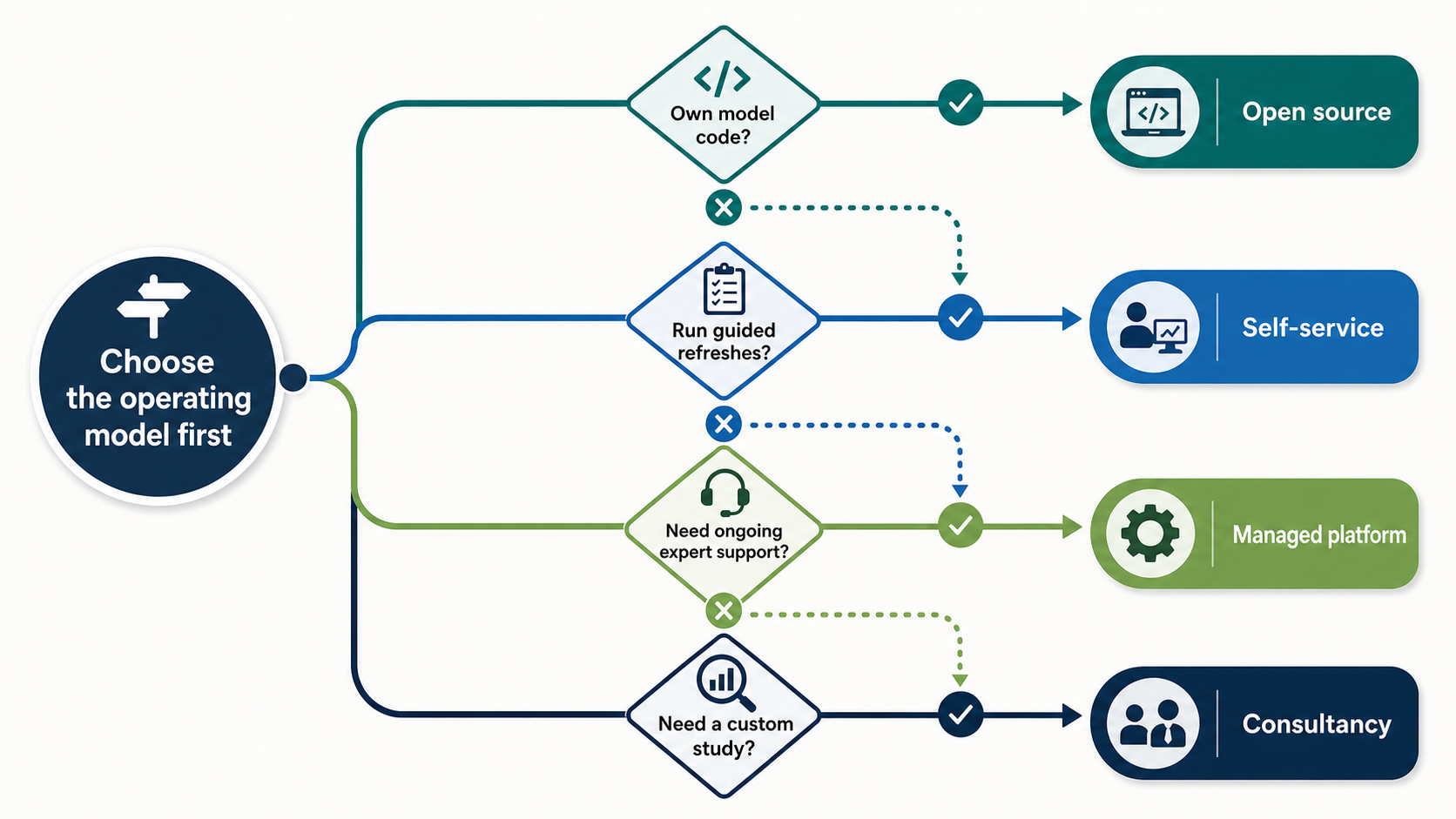
Start with the operating model your team can sustain, then compare products inside that category.
Choose the operating model first
The strongest shortlist starts with an operating choice, not a vendor ranking. Choose how much control, service, and internal work your team can support.
Open source can fit a mature technical team. Self-service software can fit an analyst-led team with clear processes. A managed platform can fit a team that needs regular expert support. A consultancy can fit a custom research problem.
After that choice, compare products with the same data sample and planning case. Require each provider to explain assumptions, uncertainty, constraints, refresh work, and ownership.
MediaMixModel can help your team assess measurement readiness and compare an appropriate MMM approach before you commit to a platform or project.
Sources
Stay in the loop
Get updates on new posts and resources.