Marketing Attribution Software Cannot Answer Every Question
Compare marketing attribution software across tracking methods, CRM and ad integrations, privacy, reporting, and measurement use cases.

Marketing attribution software cannot tell you if your ads caused sales. It can only show which touchpoints appeared before a conversion. This distinction matters when you choose a tool. Attribution platforms answer "what happened." They do not answer "what would have happened anyway." A useful shortlist starts with your business model, not a feature list.
Shortlist by use case
Match the tool to the job. Each business type creates a different measurement problem.
B2B attribution software. B2B sales cycles run long and involve many people. A B2B attribution tool must connect marketing touches to accounts, not just individual visitors. It must also tie those touches to pipeline stages in a customer relationship management (CRM) system. Look for account-level reporting and native CRM sync. B2B companies with long sales cycles benefit most from multi-touch, account-level attribution that connects marketing activity to pipeline and revenue.
Ecommerce attribution tools. Online retailers need fast, transaction-level reporting tied to ad spend across many channels. These tools often connect directly to ad platforms and checkout data to calculate return on ad spend, the ratio of revenue to ad cost.
App attribution. Mobile marketers need install-to-event tracking that follows platform rules from Apple and Google. This is a distinct technical problem from web attribution. It usually needs a dedicated mobile measurement partner.
Cross-channel attribution platform. Brands that run TV, streaming, and offline channels alongside digital ads need a cross-channel attribution platform built for mixed online and offline signals. One example provides cross-channel and omnichannel insights. It integrates online and offline data, including TV and radio commercials and podcast and video streaming advertising.
Before you buy, read our guide to marketing attribution models to learn how credit-assignment rules differ across tools.
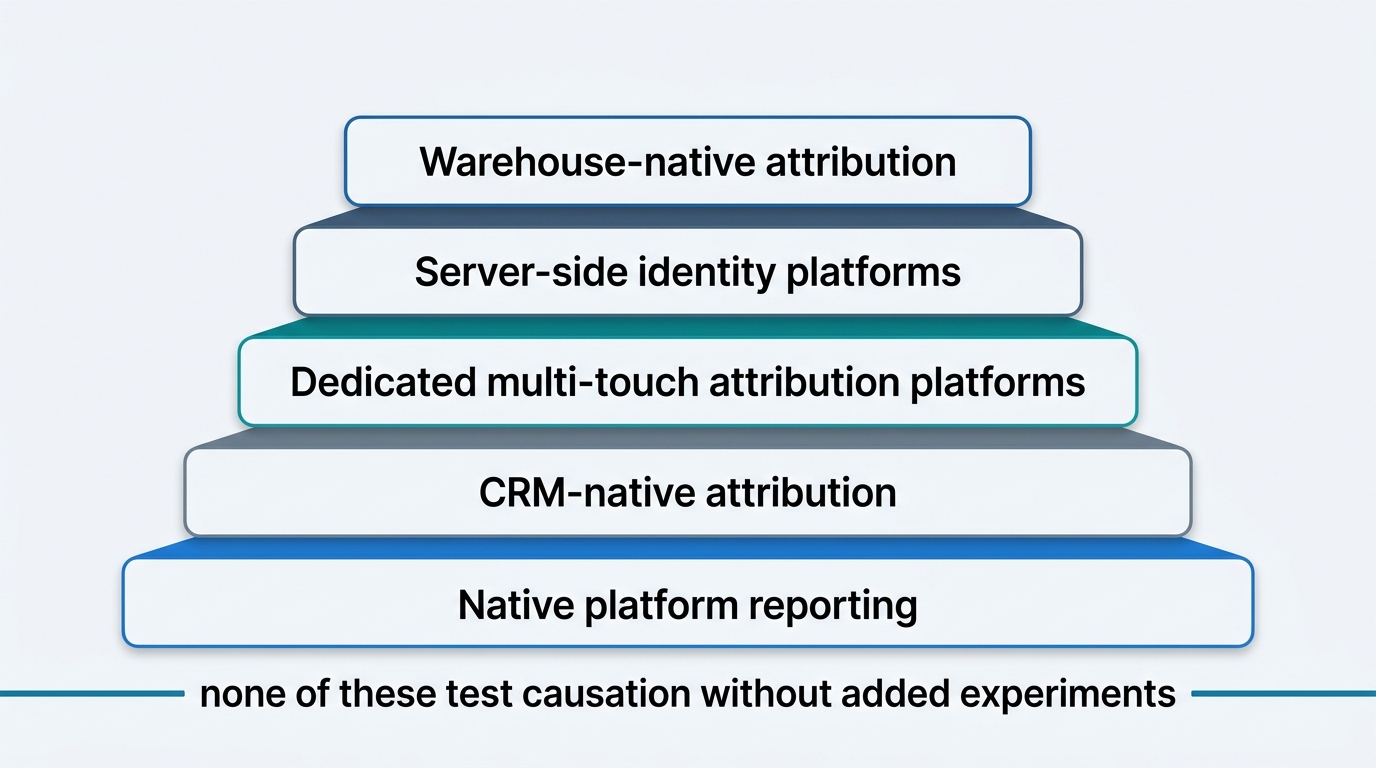
Attribution software categories
Marketing attribution tools fall into a few architectural groups. Each group makes different tradeoffs between accuracy, cost, and setup effort.
- Native platform attribution. Google Analytics 4 and ad platform dashboards report on their own data. As of November 2023, GA4 defaults to data-driven attribution. It removed first-click, linear, time-decay, and position-based models as primary options. The model needs 300 to 400 monthly conversions per conversion action. Below this threshold, GA4 reverts to last-click attribution without warning.
- CRM-native attribution. Some CRM platforms include built-in attribution reporting. This kind of tool is an all-in-one marketing platform with native multi-touch attribution reporting. Its attribution reporting is simpler than reporting from dedicated platforms.
- Dedicated multi-touch attribution (MTA) platforms. These vendors build attribution as their core product. They typically offer several attribution models plus deeper channel connections.
- Server-side and identity-based platforms. These tools capture events on a server instead of relying on a browser cookie, a small file that a browser stores to track a user. This method helps in a cookieless environment, where browsers block or limit such files.
- Warehouse-native attribution. These tools run attribution logic on a company's own data warehouse, such as Snowflake or BigQuery, rather than in a closed vendor system.
All of these categories share one limit. Multi-touch attribution software describes correlation, a link between two events, between touches and conversions. It does not test what happens when you remove a channel. That question belongs to incrementality testing or marketing mix modeling. We cover this separate discipline in our comparison of MTA versus MMM.
Evaluation criteria
Score any attribution platform against concrete requirements, not marketing claims. Use this checklist during a trial.
| Criterion | Question to ask | Why it matters |
|---|---|---|
| Data source coverage | Does it connect to your ad platforms, CRM, and checkout system? | Gaps in data create gaps in reported credit. |
| Identity resolution | How does it match a person across devices without third-party cookies? | This affects accuracy in a cookieless environment. |
| Attribution model flexibility | Can you compare first-touch, linear, and data-driven models side by side? | One model rarely fits every campaign type. |
| Reporting granularity | Can you view results by campaign, channel, and account? | B2B and ecommerce teams need different granularity. |
| Minimum data volume | Does the model need a conversion threshold to work well? | Some models silently degrade below a threshold, as shown in the GA4 example above. |
| Export and API access | Can you pull raw event data into your own warehouse? | This supports later use in incrementality tests or MMM. |
| Transparency of methodology | Does the vendor document how the model assigns credit? | A closed model limits your ability to audit results. |
Ask each vendor to explain, in writing, how their model assigns credit and what data it needs to work well. If a vendor cannot answer clearly, treat that as a warning sign.
Platform comparison
The market includes many marketing attribution tools, and capabilities change often. Vendor features and pricing change, so verify current details directly with each vendor before you buy. The comparison below, checked on August 30, 2026, groups tools by primary architecture, not by brand ranking.
| Category | Example architecture | Best fit | Known limit |
|---|---|---|---|
| Native platform (e.g., GA4) | Data-driven attribution within one ad ecosystem | Teams centered on one platform's ads | The model is a black box, and the vendor does not disclose which factors influence credit distribution |
| CRM-native attribution | Attribution built into CRM contact and deal records | B2B teams already using that CRM | Less attribution model flexibility than dedicated tools |
| Dedicated MTA platform | Independent event tracking with multiple models | Teams that need model comparison across channels | Still limited to correlation, not causation |
| Server-side/identity platform | First-party event capture that bypasses browser limits | Ecommerce brands facing iOS tracking limits | Identity matching is probabilistic, not certain |
| Warehouse-native attribution | Attribution logic run on your own data warehouse | Data teams with engineering resources | Requires more setup and internal skill |
We do not name a single winner in this table. The right architecture depends on your data infrastructure and your team's technical capacity, not on one universal best tool.
Privacy and data quality
Every attribution platform now operates in a shrinking-cookie environment. Multi-touch attribution relies on tracking users across many touchpoints. But Safari and Firefox already block third-party cookies by default. Even in Chrome, ad blockers shrink the trackable audience. This shift changes what attribution software can honestly report.
Cookieless attribution replaces some of the lost signal with other methods. This approach relies on first-party data, server-side tracking, identity resolution, and privacy-conscious measurement instead of third-party cookies. It connects marketing touchpoints while it respects user privacy. Common methods include server-side event capture and hashed first-party identifiers. Another method is the conversion application programming interface (API), which sends conversion data directly from a server to an ad platform.
No single method restores full visibility. Cookieless attribution needs many tracking methods joined into one identity resolution system. No single approach gives complete coverage, and each identity method has its own gap. Cookieless MTA methods include first-party data capture, identity graphs, and server-side tracking. These methods can partly recover the customer journey, but each has real blind spots.
Treat any vendor claim about tracking accuracy with caution. Ask for a plain description of the identity method used. Then ask what share of conversions the tool cannot match to a touchpoint. A vendor that states this gap honestly is more trustworthy than one that claims full coverage.
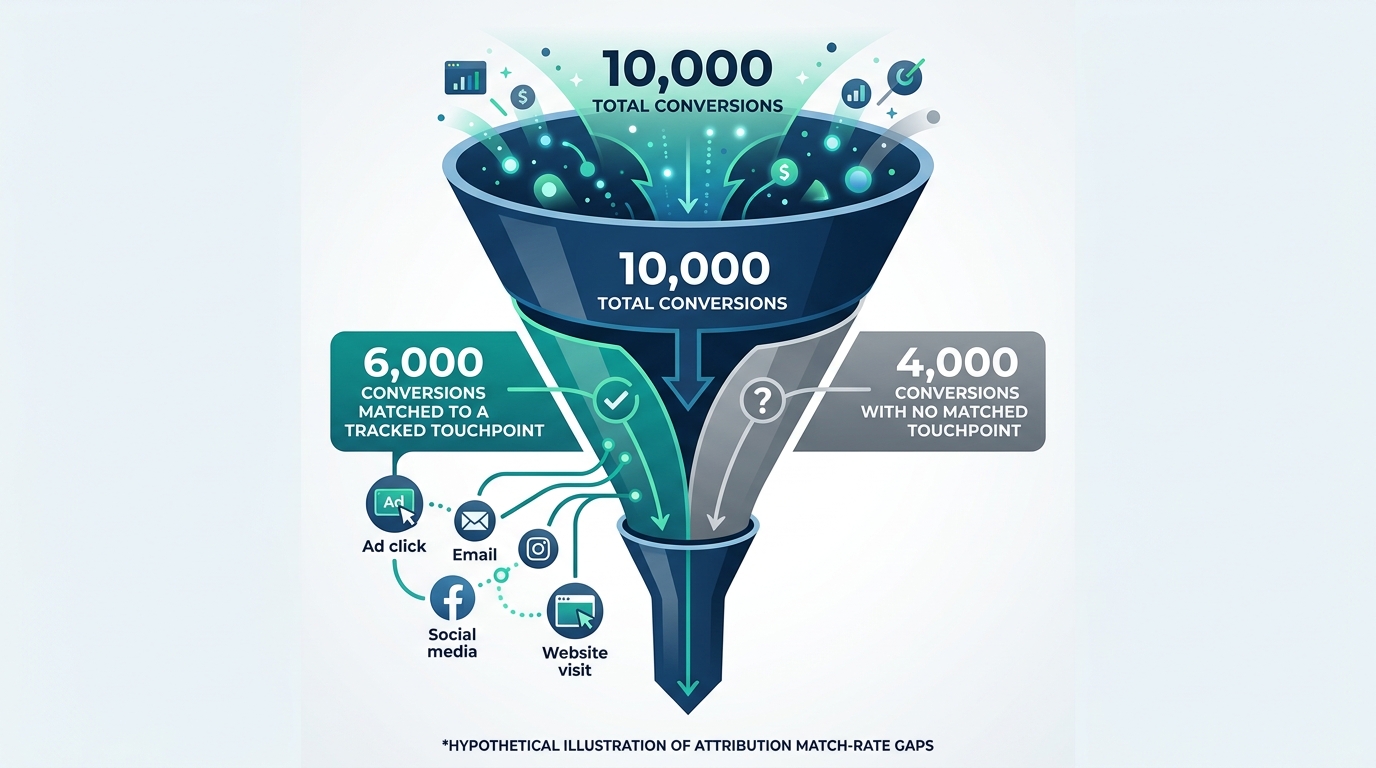
Worked example (hypothetical). Suppose an ecommerce brand sees 10,000 monthly conversions in its checkout system. Its attribution tool matches touchpoints to only 6,000 of them. The other 4,000 conversions still happened, but the tool cannot explain what drove them. A team that reports channel results based only on the matched 6,000 will overweight highly trackable channels, such as paid search. It will underweight less trackable channels, such as television or podcast ads.
This is a hypothetical illustration, not a benchmark for any real tool.
When to add MMM or experiments
Attribution answers a narrow question: which touchpoints appeared near a conversion. It does not answer whether a channel caused incremental sales, meaning sales that would not have happened without that channel. That second question needs a different method.
Marketing mix modeling (MMM) analyzes total spend and total outcomes over time, without the need to track individual users. MMM analyzes combined spend and outcomes to estimate each channel's effect on sales, without user-level tracking. This makes MMM useful for channels that attribution cannot see well, such as television. It also supports privacy-safe measurement that does not depend on cookies or device identifiers.
Teams often run incrementality testing as a geo holdout or randomized experiment. This method directly measures causation. It compares a group exposed to a channel against a group not exposed to that channel.
Attribution, MMM, and incrementality testing are three separate evidence methods. Attribution shows correlation across touchpoints. MMM shows combined channel effect over time. Incrementality testing shows a direct causal comparison. None of the three methods replaces the other two.
Many organizations run all three methods together rather than choose one. MMM gives a high-level view of channel efficiency. Server-side and identity approaches give the specific attribution that partners need to get paid. Add incrementality testing when you need to check a specific budget decision. Add MMM when you need to plan budget across channels that attribution cannot fully see. Our article on unified marketing measurement explains how to combine these methods into one measurement practice.
Conclusion
Marketing attribution software is a necessary tool, not a complete answer. It reports which touchpoints appeared before a conversion, but it cannot prove that any single channel caused that conversion. Choose a tool architecture that fits your business type. Verify vendor claims against your own data. Plan for the identity gaps that a cookieless environment creates.
If you evaluate marketing attribution tools now, do not stop at a single-tool purchase. Run a unified measurement assessment that maps attribution, marketing mix modeling, and incrementality testing to the specific questions your team needs to answer.

Sources
- Top 12 Marketing Attribution Tools in 2026 (Compared)
- Top multi-touch attribution (MTA) tools for 2026
- 12 Best Multi-Touch Attribution Solutions (2026)
- Best Multi Touch Attribution Software Reviews 2026
- Multi-Touch Attribution without Cookies: Methods & Gaps
- Cookieless attribution: How it works, methods & best practices
- Cookieless Attribution Guide: Methods & Accuracy (2026)
- Cookieless Affiliate Tracking: Modern Attribution Methods for a Privacy-First Web - Aree Blog
Stay in the loop
Get updates on new posts and resources.