Marketing Attribution Models Explained: The Complete Guide
Stop guessing which ads work. We break down first-touch, last-touch, and data-driven marketing attribution models so you can optimize ROI. Read the guide.
You spent $50,000 on ads last month. Revenue went up.
Great news, right?
Here is the problem: You don’t know which $50,000 actually worked. Was it the LinkedIn campaign? The YouTube pre-roll? Or that expensive influencer partnership?
If you get this wrong, you will scale the losers and cut the winners. You will burn cash.
This is where marketing attribution models come in. They are the rulebooks that decide which channel gets credit for a sale.
But picking the right one is messy. The tracking landscape is broken. Cookies are crumbling. The "perfect" data set doesn't exist anymore.
In this guide, we are going to strip away the jargon. We will look at how these models work, why single-touch models are dangerous, and how modern brands use triangulation to find the truth.
The Basics: What Are Marketing Attribution Models?
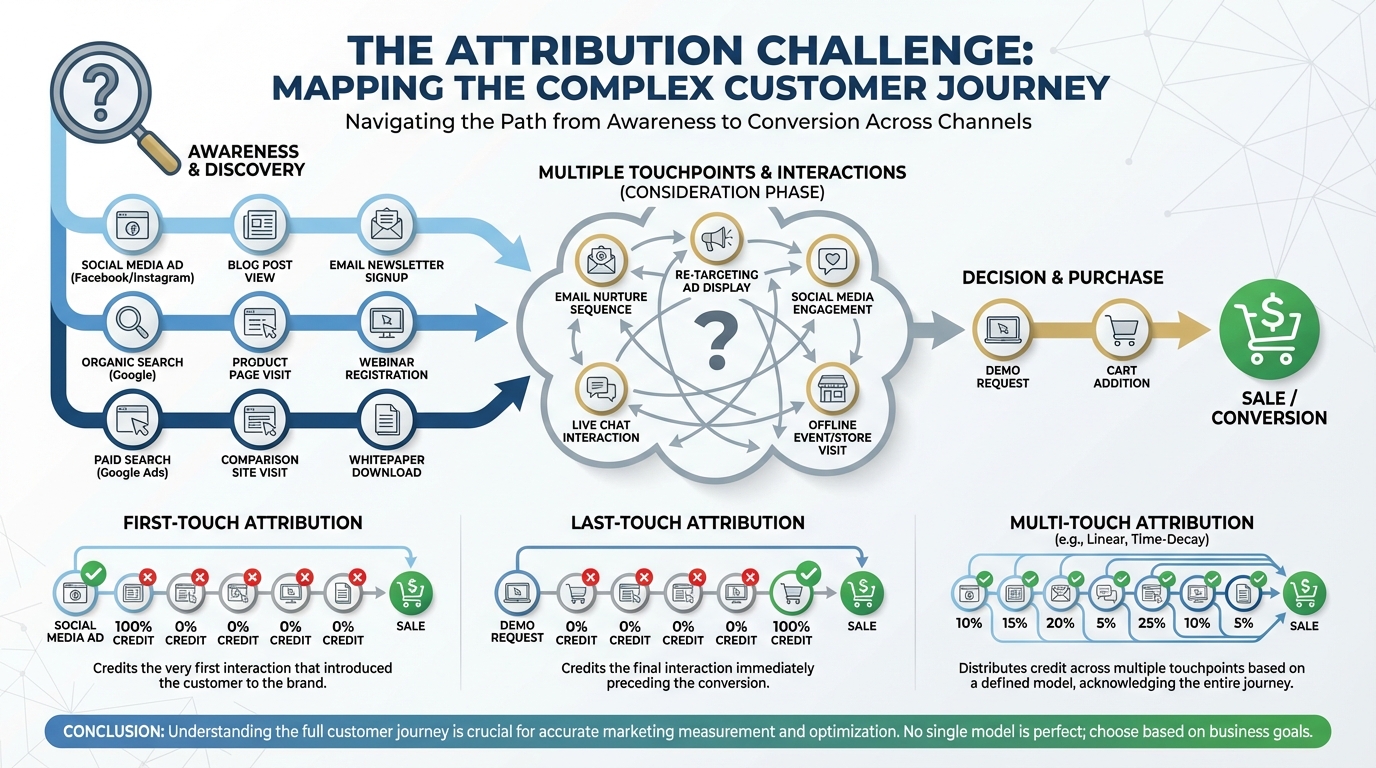
Marketing attribution models are frameworks that analyze the touchpoints a user interacts with before converting. They assign a value to each touchpoint.
Think of it like a soccer game.
A striker scores the goal. But the midfielder made the assist. And the goalkeeper started the play. Who gets the credit for the win?
- Last-Touch: The striker gets 100% of the credit.
- First-Touch: The goalkeeper gets 100% of the credit.
- Multi-Touch: Everyone gets a split based on their contribution.
For years, marketers relied on simple models. Today, you need a comprehensive approach to marketing effectiveness measurement. If you rely on the wrong model, your analysis will be flawed from day one.
According to Harvard Business Review, getting this attribution right can improve marketing efficiency by 15-30%. That is not a small margin when you are scaling.
Single-Touch Attribution Models
These are the dinosaurs. They are easy to set up but often tell a lie.
1. First-Touch Attribution
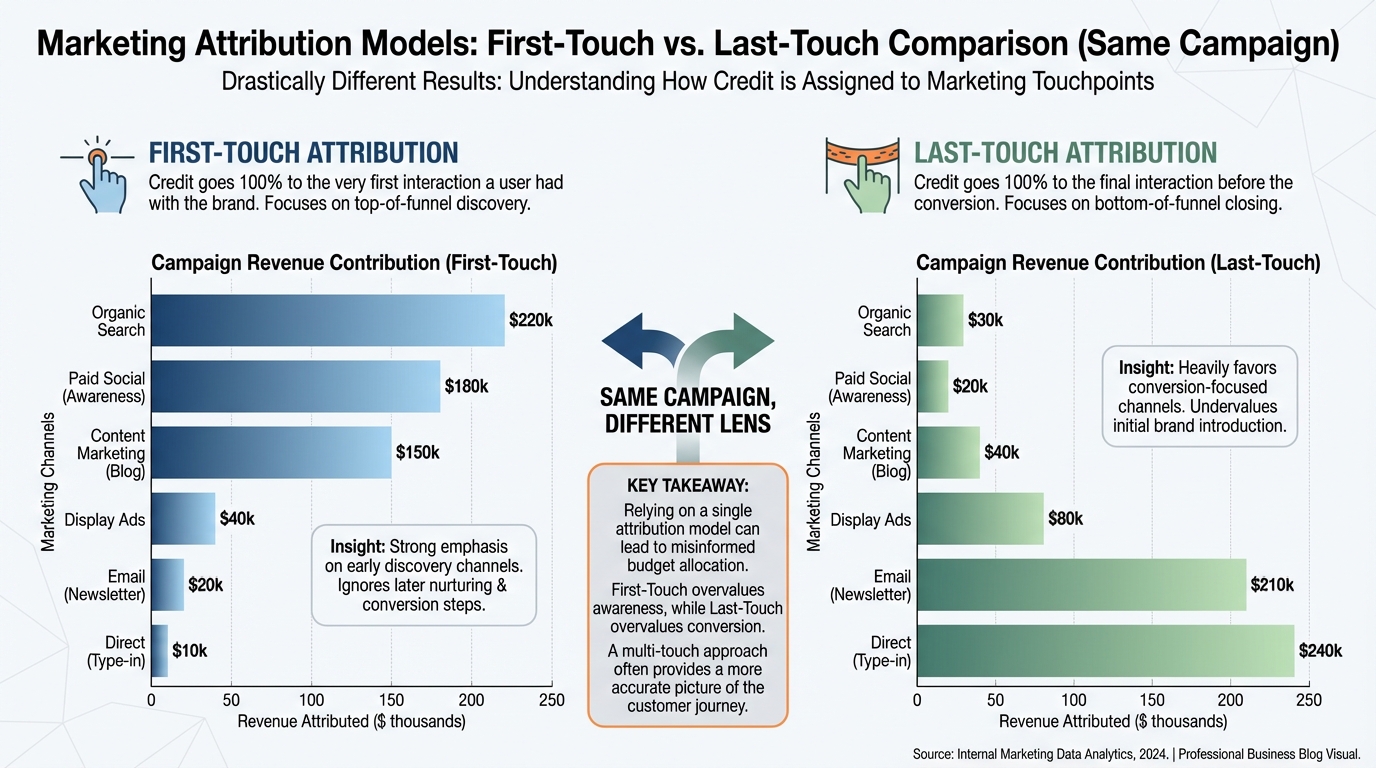
This model gives 100% of the credit to the very first interaction a customer had with your brand.
- Scenario: A user sees a Facebook ad. They click it. Two weeks later, they search for your brand on Google and buy.
- Result: Facebook gets 100% credit. Google gets zero.
Pros:
- Great for measuring top-of-funnel brand awareness.
- Easy to implement.
Cons:
- Ignores the nurture process. You might cut your retargeting budget because it "isn't working," only to see sales plummet.
2. Last-Touch Attribution
This is the default setting in many legacy analytics platforms. It gives 100% credit to the final touchpoint before conversion.
- Scenario: Same as above. Facebook ad first, Google search later.
- Result: Google Search gets 100% credit. Facebook gets zero.
Pros:
- Focuses on closing the deal.
- Low barrier to entry.
Cons:
- It kills demand generation. If you only fund the closer, you eventually run out of leads to close.
It is crucial to understand the limitations here. Relying solely on last-touch is a fast way to destroy your growth engine. For a deeper dive into calculating real returns, check our marketing ROI analysis guide.
[IMAGE: Bar chart comparing First-Touch vs. Last-Touch attribution for the same campaign, showing drastically different results.] Alt text: Comparison chart showing how first-touch favors social media while last-touch favors organic search.
Life isn’t black and white. Neither is marketing.
Multi-touch attribution (MTA) attempts to look at the whole picture. It acknowledges that a customer might hit 7, 10, or 20 touchpoints before buying. This requires sophisticated customer journey mapping to visualize every interaction a user has with your brand.
3. Linear Attribution
The "participation trophy" of attribution. Every touchpoint in the journey gets equal credit.
- Scenario: Facebook Ad -> Email -> Direct Visit -> Purchase.
- Result: Each channel gets 25% credit.
The Verdict: It’s better than single-touch, but it’s lazy. It values a low-intent display impression the same as a high-intent search click.
4. Time Decay Attribution
This model assumes that interactions closer to the conversion are more valuable.
- Scenario: A blog post read a month ago gets very little credit. The email clicked yesterday gets a lot.
The Verdict: Good for short sales cycles. Bad for B2B or high-ticket items where early education is critical.
5. U-Shaped (Position-Based) Attribution
This is a favorite for many growth marketers. It gives 40% credit to the first touch, 40% to the last touch, and splits the remaining 20% among the middle interactions.
- Why it works: It acknowledges the two most important distinct actions: finding you and buying from you.
The Death of MTA?
However, MTA has a massive flaw. It relies on user-level tracking (cookies, click IDs). With privacy changes like iOS14 and the death of third-party cookies, MTA is becoming blind.
According to a report by Gartner, marketers are rapidly abandoning traditional MTA because the data simply isn't there anymore. The signal loss is real.
When you lose 40% of your tracking data, your U-shaped model isn't just slightly off—it's hallucinating. If you are debating between tracking clicks vs. modeling data, read our comparison on MTA vs. MMM marketing attribution.
Advanced and Custom Models
When standard models fail, data teams get creative.
6. Data-Driven Attribution
This uses machine learning to assign credit. It compares the conversion path of users who bought against those who didn't. It identifies which touchpoints actually increased the probability of a sale.
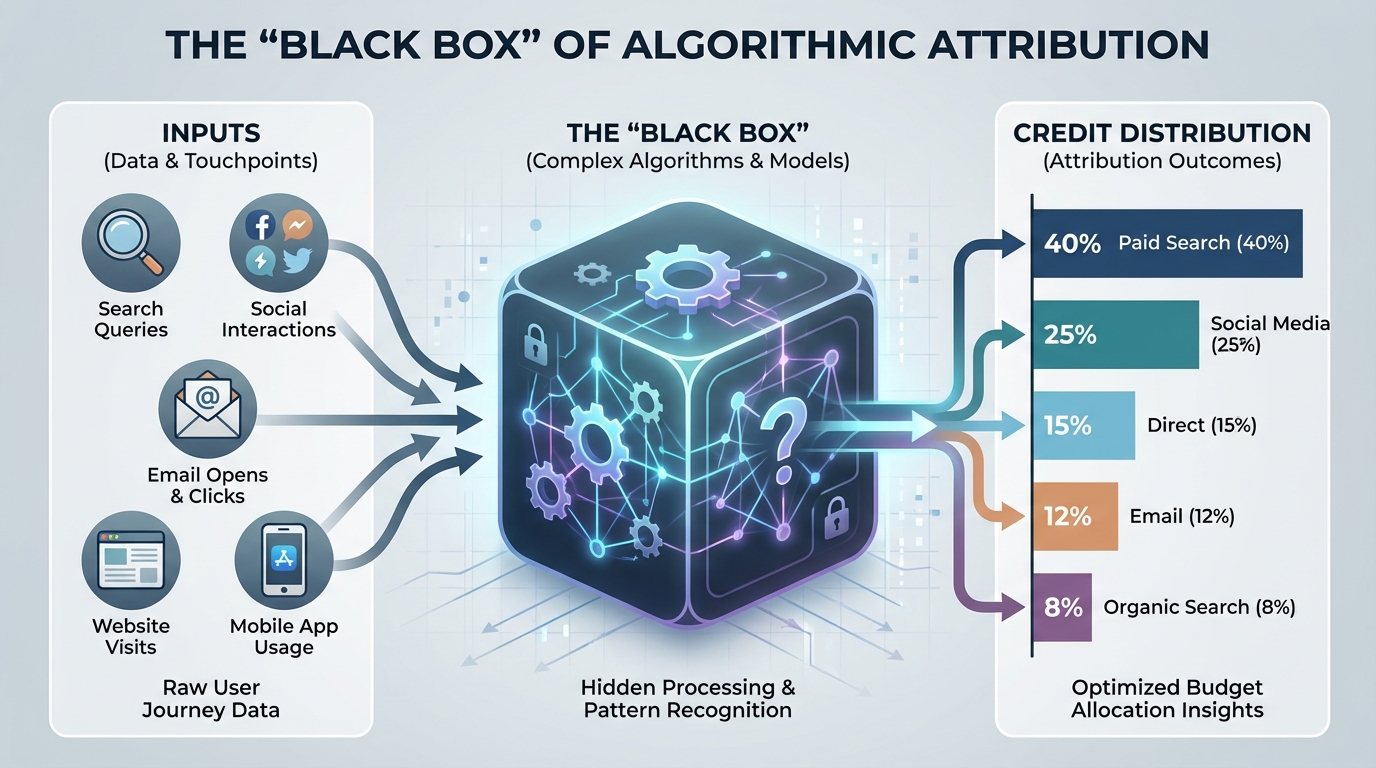
Platforms like Google Analytics 4 (GA4) default to data-driven attribution. It’s powerful, but it’s a "black box." You don’t always know why the algorithm made a decision.
7. Custom Attribution
You build the rules. Maybe you know that your whitepaper download is the most critical step. You can manually assign it 50% value.
This is common in complex B2B sales cycles. B2B journeys are notoriously hard to track because multiple people are involved in the decision. A study by Forrester notes that the average B2B buying group now involves six to ten decision-makers, making linear tracking nearly impossible.
If you are in B2B, look into our account-based marketing attribution guide.
[IMAGE: Infographic illustrating the "Black Box" concept of algorithmic attribution, showing inputs entering a box and credit distribution coming out.] Alt text: Illustration of data entering a machine learning model and attribution percentages emerging. Caption: Algorithmic models are smart, but they don't show their work.
Here is the uncomfortable truth: Marketing attribution models are biased toward what is easy to track.
Digital clicks are easy. But what about the rest?
- Podcasts: Someone hears your ad, remembers the URL, and types it in later. Attribution software calls that "Direct Traffic."
- Billboards (OOH): You spend $100k on billboards. Sales go up. Your attribution tool says "Organic Search" caused it.
- Influencers: A creator posts about you. A user views it but doesn't click. They buy later. No credit is given to the creator.
This is a major issue because trust drives sales. According to Nielsen, 88% of global consumers trust recommendations from people they know above all other forms of advertising. If you rely strictly on click-based attribution, you will defund these powerful brand-building channels.
You need a strategy for the un-trackable. For specific channels that defy click tracking, read our out-of-home advertising tracking guide or our influencer marketing performance measurement guide.
The Solution: Triangulation (MMM + Attribution)
Smart marketers stopped looking for a "single source of truth" years ago. It doesn't exist.
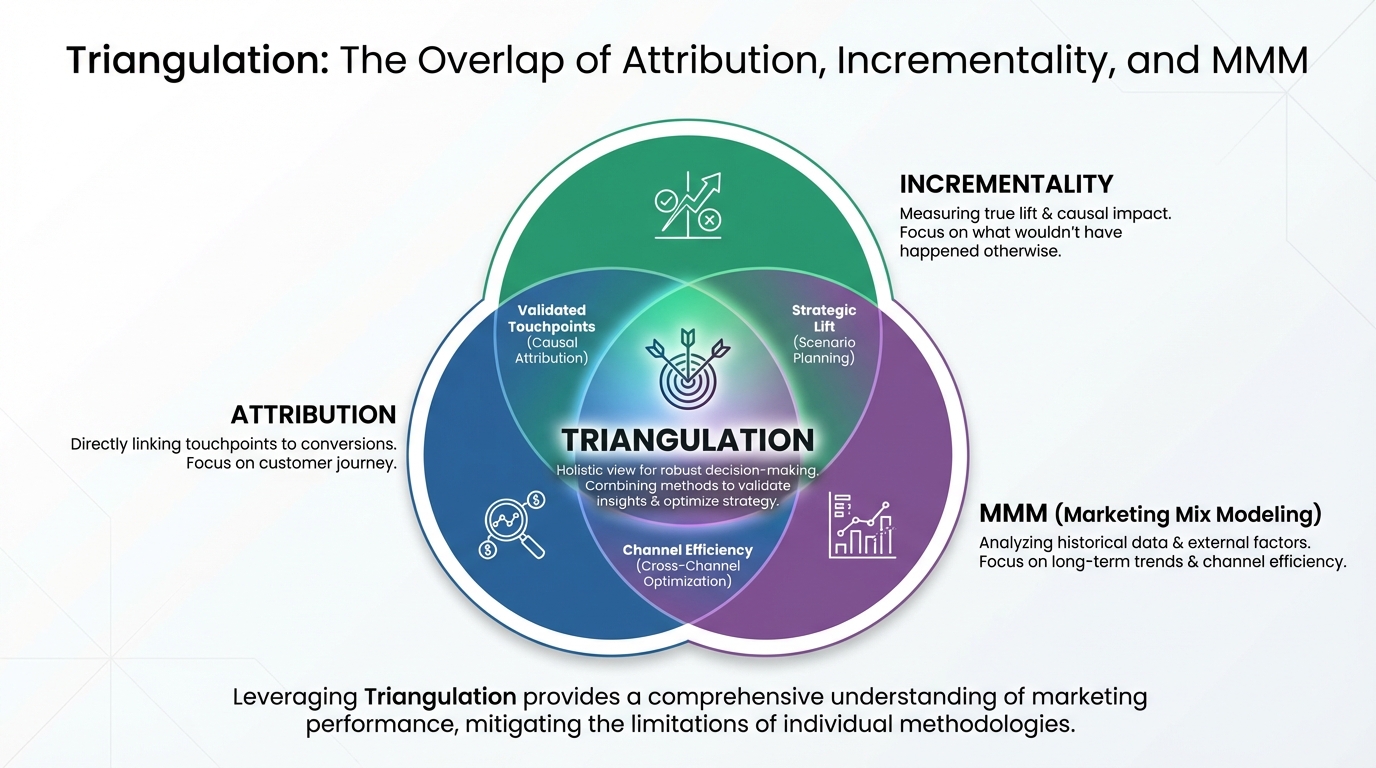
Instead, they triangulate. They use three distinct methods to find the truth:
- Attribution (MTA/GA4): Good for immediate, tactical optimization of digital channels.
- Incrementality Testing: Running "lift studies" (turn ads off in one region, keep them on in another) to see true causality.
- Media Mix Modeling (MMM): The strategic layer.
Why MMM is Winning
Media Mix Modeling (MMM) doesn't care about cookies or pixels. It uses statistical analysis of historical data (spend vs. revenue) to determine the impact of marketing.
It answers the big questions:
- "What happens if I double my TV spend?"
- "Did my Facebook ads actually drive sales, or did they just claim credit for people who were going to buy anyway?"
Historically, MMM was expensive and slow. Big agencies charged $100k and took three months to deliver a PDF.
That has changed. Platforms like BlueAlpha have democratized MMM, providing always-on, AI-driven analysis that provides actionable insights in days, not months. This allows mid-market brands to finally measure offline channels, walled gardens (like TikTok), and brand spend in near real-time without needing a data science degree.
By combining the granular data of attribution with the holistic view of MMM, you get media budget optimization that actually works.
To understand the mechanics behind this, check our media mix model marketing attribution guide.
Want to see triangulation in action? BlueAlpha combines attribution, incrementality, and MMM in one platform so you can stop guessing. See how it works
[IMAGE: Venn diagram showing the overlap of Attribution, Incrementality, and MMM, labeled "Triangulation".] Alt text: Venn diagram illustrating how modern marketing measurement requires three different methodologies. Caption: Triangulation is the only way to see the full picture.
There is no "best" model. There is only the model that fits your business goals.
For Aggressive Growth
If you are a startup trying to acquire new customers at all costs, lean towards First-Touch or Linear models. You need to incentivize top-of-funnel activity.
For Efficiency and Profitability
If you are optimizing for ROAS (Return on Ad Spend), Time Decay or Data-Driven models help you cut waste in the middle of the funnel.
For Complex Sales Cycles (B2B)
You need a custom model or U-Shaped attribution. You must value the lead generation and the deal closing. You also need to allocate budget across different stages of the funnel. Learn more in our funnel stage budget allocation guide.
For Omnichannel Brands
If you sell online and in-store, or advertise on TV and Facebook, click-based attribution will fail you. You absolutely need a media mix model.
Implementing this isn't as hard as it sounds. Check out our guide on how to deploy a media mix model.
Tools of the Trade
The software landscape is crowded, and choosing the wrong stack can set you back months.
1. Free Analytics
Google Analytics 4 is the standard. It uses data-driven attribution by default. It is essential, but it has limits regarding data privacy and cross-device tracking.
2. Specialized Attribution Platforms
Many e-commerce brands flocked to pixel-based attribution tools in recent years. These platforms promised to fix the data holes left by iOS14. However, because they still rely on tracking pixels, they suffer from the same degradation as Facebook or Google Ads.
If you are currently using one of these pixel-based tools and finding the data unreliable, you might be looking for alternatives to marketing data platforms that offer more robust modeling.
3. Modern MMM Platforms
This is where the industry is heading. Solutions like BlueAlpha use econometric modeling rather than user tracking. This makes them immune to privacy changes and allows you to measure the true lift of your spend.
Brands that previously relied on pixel-heavy dashboards are now looking for alternatives to e-commerce analytics that can actually account for offline spend and organic lift.
Don't just buy a tool because a guru recommended it. Look for alternatives to marketing attribution platforms if you need more than just pixel tracking.
FAQ
Q: Can I use multiple attribution models at once? A: Yes. In fact, you should. Use First-Touch to judge your brand awareness campaigns and Last-Touch to judge your retargeting. Comparing the two gives you a better view of the full funnel.
Q: Is Multi-Touch Attribution dead? A: It is not dead, but it is wounded. Privacy changes (GDPR, CCPA, iOS14) block the data MTA needs to stitch user journeys together. It is becoming less accurate every year. This is why the industry is pivoting toward privacy-safe measurement like MMM.
Q: How does Apple's App Tracking Transparency affect attribution? A: Apple's App Tracking Transparency (ATT) framework requires apps to ask users for permission to track them. Most users say no. This breaks the link between an ad view and a conversion, making traditional attribution blind to a large chunk of iOS traffic.
Q: What is the best marketing attribution model for e-commerce? A: For most e-commerce brands, data-driven attribution is the best starting point because it uses algorithms to weigh touchpoints based on actual conversion data. However, as you scale beyond $5M in revenue, you should layer in Media Mix Modeling to account for brand effects that click-based models miss.
Q: How much does marketing attribution software cost? A: It varies wildly. Google Analytics 4 is free. Mid-market pixel attribution tools often range from $500 to $2,000 per month. Enterprise-grade MMM solutions traditionally cost $20,000+ per quarter, but modern AI platforms like BlueAlpha have brought this cost down significantly, making advanced modeling accessible to scaling brands.
Q: What is the difference between attribution and incrementality? A: Attribution correlates a conversion to a touchpoint. Incrementality measures causality—did that touchpoint cause the conversion, or would it have happened anyway? McKinsey highlights that distinguishing between the two is critical for budget efficiency.
Conclusion
Marketing attribution models are not perfect truth machines. They are lenses.
If you look through a blue lens, everything looks blue. If you look through a First-Touch lens, your SEO and Social look great. If you look through a Last-Touch lens, your Branded Search looks like a hero.
The mistake isn't using the wrong model. The mistake is believing the model is the absolute reality.
To win in 2026, you need to move beyond simple pixel tracking. You need to triangulate your data. Combine the speed of data-driven attribution with the strategic accuracy of Media Mix Modeling.
Don't let data gaps dictate your strategy. Take control of your measurement.
Ready to see what's actually driving your revenue? BlueAlpha's AI-powered media mix modeling shows you the true impact of every channel—including the ones your attribution tools can't track. Start your free analysis
Stay in the loop
Get updates on new posts and resources.