Marketing Budget Pacing Without Last-Minute Cuts
Manage marketing budget pacing with daily targets, seasonality, performance guardrails, forecasts, and clear rules for intervention.
Marketing Budget Pacing Without Last-Minute Cuts
Marketing budget pacing is the practice of tracking spend against a planned rate across a period. This practice helps you find overspend or underspend early. You can then adjust spend with data instead of panic. Good pacing does not only watch a dollar total. It compares actual spend to a demand-weighted plan. It then checks the result against performance guardrails before any budget change.
This process stops two common failures:
- You do not force spend into weak demand near the end of the month.
- You do not starve proven opportunity when a campaign looks on budget but suffers blocks.
This article covers the math and the choice between straight-line and weighted pacing. It covers the guardrails that keep spend decisions honest. It also covers the schedule that catches problems before they become expensive.
Pacing Math
The core formulas are simple. Start with the ideal spend to date. Then compare that number against actual spend.
| Formula | Calculation | What it tells you |
|---|---|---|
| Ideal spend to date | monthly budget × (days elapsed ÷ days in month) | The spend you should have reached by today |
| Pacing percent | actual spend ÷ ideal spend to date | Whether you are ahead or behind plan (100% is on track) |
| Projected month-end spend | (actual spend ÷ days elapsed) × days in month | Where you land if the current rate holds |
| Remaining daily budget | (budget − spend to date) ÷ days remaining | The daily rate needed to land on plan |
This structure follows a widely used pacing calculator model. stackmatix.com describes this model in detail.
Worked example (hypothetical). Assume a monthly budget of $30,000 for a 30-day month. On day 15, the ideal spend to date is $15,000. Actual spend is $18,000.
Pacing percent is 120 percent, so the campaign runs ahead of plan. Projected month-end spend, at the current daily rate of $1,200, is $36,000. This result is $6,000 over budget. The remaining daily budget, to land on plan, is ($30,000 − $18,000) ÷ 15 days, or $800 per day.
These formulas match the approach that Google Ads uses internally for its budget pacing insights. The system flags campaigns as "limited by budget," having "budget remaining," or "on track." It bases these flags on monthly spending limits and forecasted cost, as documented by support.google.com.
Straight-Line vs Weighted Pacing
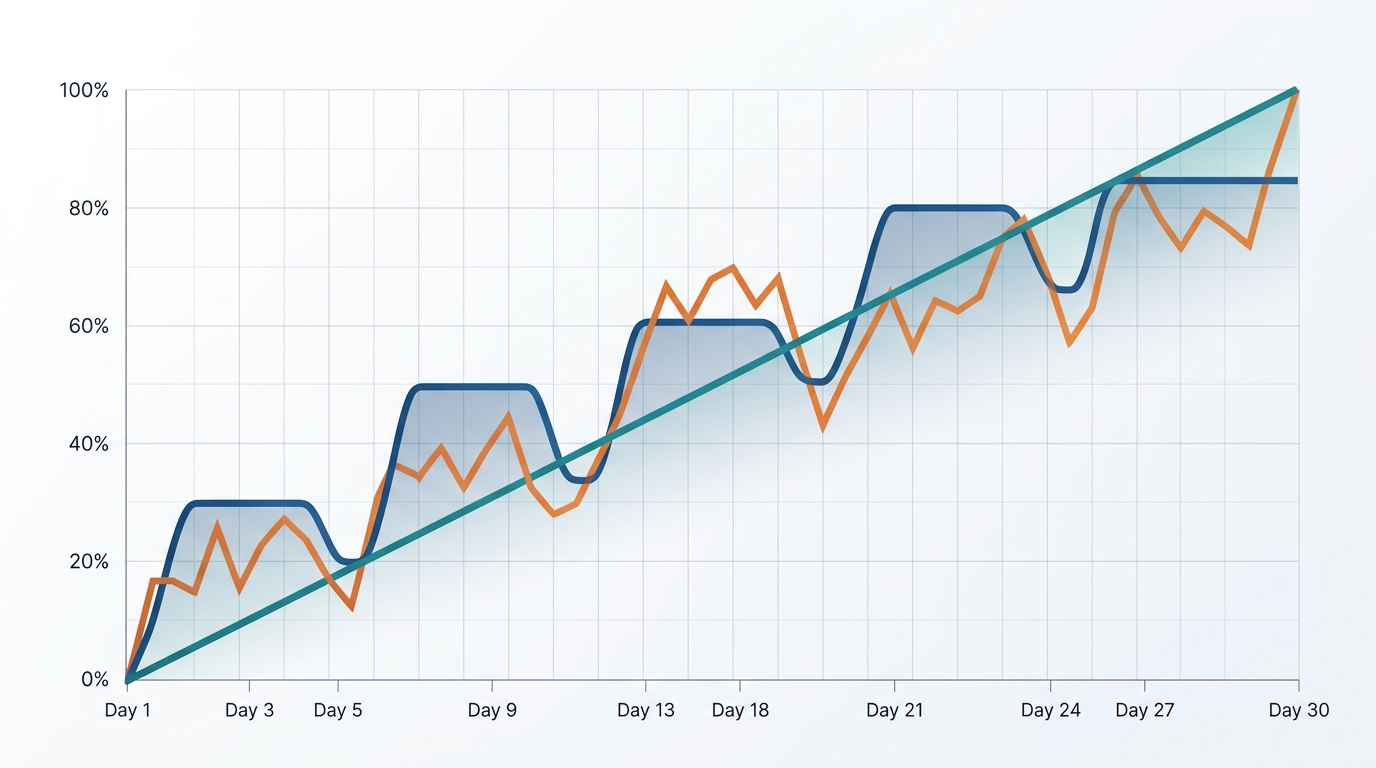
Straight-line pacing assumes spend must land evenly across every day of the period. It is easy to calculate and easy to explain. Uneven customer demand makes this straight-line model give false signals.
Weighted pacing assigns a demand weight to each day based on history. These patterns include stronger weekdays, weekend dips, or promotional spikes. The formula becomes:
Pacing Weight Elapsed = Cumulative Demand Weights to Date ÷ Total Demand Weights for Period
Then Target Spend to Date = Total Period Budget × Pacing Weight Elapsed, as outlined by convince.pro.
Use weighted pacing when your account has a stable, repeatable pattern. Examples include business-to-business campaigns that slow down on weekends, or ecommerce accounts with predictable promotion spikes. A stable historical pattern gives weighted pacing an advantage over a flat daily target, according to guidance from quick-ad.com. If your pattern is not stable, straight-line pacing is the safer default. A weighted model built on noisy history can send you the wrong signal.
Performance Guardrails
Spend variance alone does not tell you whether to act. A campaign can run ahead of plan and still produce profit. A campaign can run behind plan and still be the best use of the next dollar. For this reason, pacing needs an efficiency guardrail beside the spend check.
One method is an efficiency index. This index is actual cost per acquisition (CPA) or return on ad spend (ROAS) divided by target CPA or ROAS. Return on ad spend measures revenue earned per dollar spent. CPA measures cost per completed conversion. If spend is ahead of plan and efficiency is worse than target, make a firm correction. If spend is ahead of plan but efficiency is strong, the overpacing can be acceptable, as explained by convince.pro.
A related warning applies to average ROAS. Average ROAS blends your best and worst campaigns together. It tells you nothing about the return on your next dollar. The more useful guardrail is marginal ROAS. Marginal ROAS is the return on the next dollar spent at the current spend level, per admapix.com. This distinction matters because pacing decisions address the next dollar, not the average dollar already spent.
Guardrails also depend on the measurement method behind your performance numbers. Platform-reported conversions come from attribution, a method that assigns credit to touchpoints inside the view of a single platform. Incrementality tests isolate the causal lift of spend through holdouts or geographic experiments. Marketing mix modeling (MMM) estimates channel contribution with aggregate data across a long time frame. None of these three methods is a universal source of truth.
If your pacing guardrail relies only on last-click attribution, you can cut a channel that drives real incremental volume. The attribution model cannot see that volume. For a structured way to compare channels on marginal terms, see our guide to paid media budget allocation.
Forecasting Month-End Spend
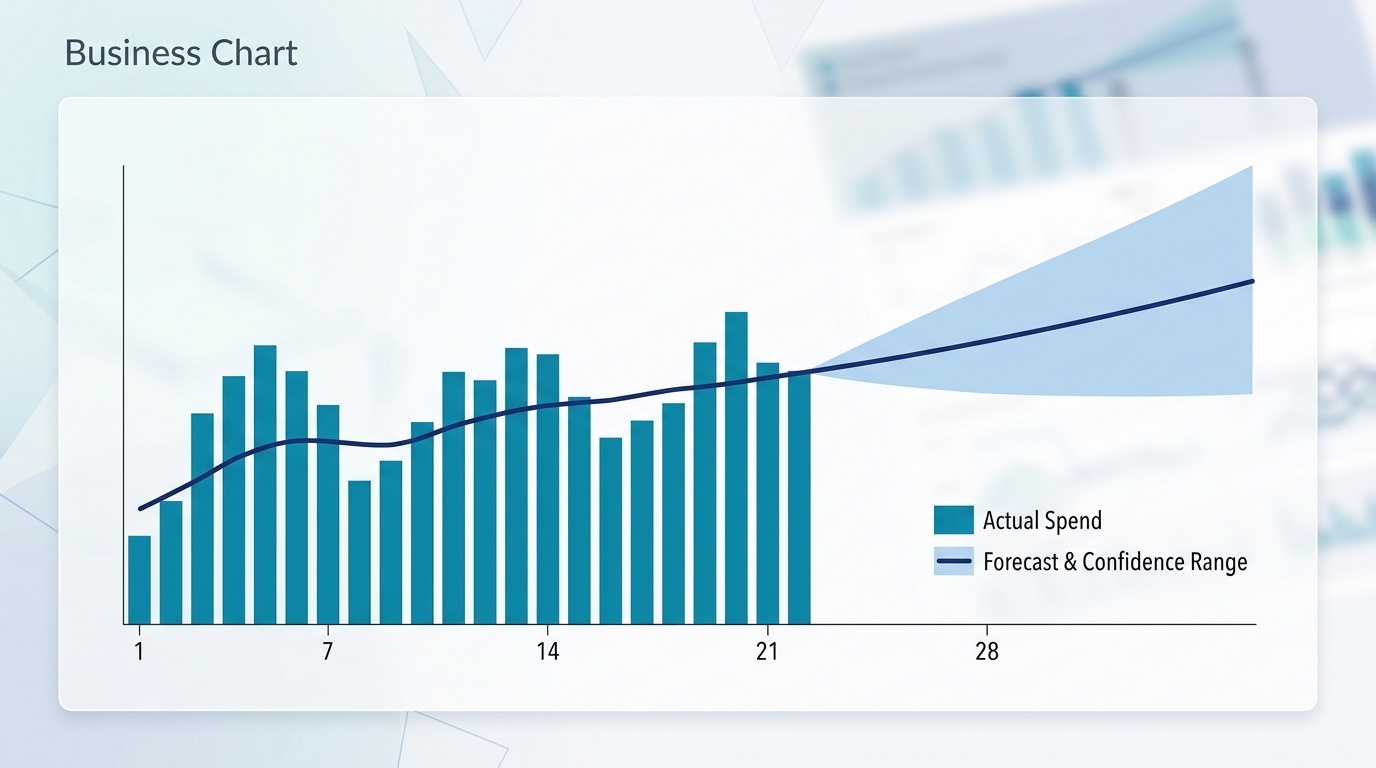
Forecasting month-end spend answers one question: where will you land if nothing changes? The simplest version is:
Forecast month-end spend = Average daily spend so far × Number of days in month
This method is direct, but early-month noise affects it easily, as noted by adcenter.online. A single high-spend day in the first week can distort the projection for the full month. To reduce that noise, use a moving average over the last five to seven days instead of the full month-to-date average.
Google Ads applies a related forecasting approach at the account level. Its budget pacing insights show monthly cost and performance forecasts. These forecasts use campaign historical performance, seasonality, and market trends, according to support.google.com. This platform-level forecast uses attribution data from inside that single platform. Treat it as one input, not the final word, especially for budget decisions across multiple channels.
When teams plan budgets across several channels or scenarios, a month-end forecast must feed into a broader planning process. Our marketing scenario planning guide covers how to test a forecast against demand shifts and channel constraints.
Intervention Rules
Not every variance needs action. When you react to every daily change, you create instability. You also reset learning periods on some ad platforms. Instead, set an allowable range of variance and use a tiered response.
A common framework uses three tiers:
- Variance within 10 percent of plan: monitor only, because no action is necessary.
- Variance between 10 and 25 percent: investigate the cause before you act. Check bid caps, budget caps, narrow audience targeting, or sudden changes in auction competition.
- Variance above 25 percent: act on the same day. Investigate structural issues such as tracking gaps, broken landing pages, or campaign setting errors.
This tiered structure matches the thresholds in the buyer agent guidance from the IAB Tech Lab. That guidance sets warning and critical thresholds at 10 percent and 25 percent deviation from expected pacing, as documented by iabtechlab.github.io.
Confirm the cause before you raise a budget to fix underspend. Underspend often results from a delivery limit, not a budget cap. Examples include low search volume, narrow targeting, or a restrictive bid target. In that case, raising the budget wastes effort and does not fix delivery, per quick-ad.com.
Before you cut an overspending campaign, check whether efficiency remains strong. Cutting a campaign that runs over budget but performs well can reduce impression share on terms that convert with profit. For a template that documents these thresholds and owners in advance, see our marketing budget allocation template.
Reporting Cadence
Pacing needs a fixed schedule instead of irregular checks. A workable schedule looks like this:
- Daily: check account-level spend against target and flag major variances.
- Twice weekly: review pacing by channel and campaign, not only the account total.
- Weekly: review efficiency guardrails, including CPA, ROAS, and cost per click.
- Monthly: refresh demand weights and tolerance bands with the most recent stable performance window.
This schedule mirrors the operating model described by convince.pro. A fixed schedule also gives you a written record. When someone questions a budget change later, you can show the pacing data, the guardrail check, and the date of the decision.
Conclusion
Marketing budget pacing works best as a two-part check. First, compare actual spend to a demand-aware plan. Next, confirm the move against a performance guardrail before you act. Straight-line pacing is a good default. Weighted pacing earns its complexity only when history is stable.
Neither method replaces a clear view of marginal return, which is the value of the next dollar spent. Attribution, incrementality tests, and MMM each estimate marginal return in different ways.
We can help connect your pacing dashboard to marginal-return decisions. This connection helps budget shifts reflect real incremental value instead of raw spend variance. We can review your current setup and identify the gaps.

Stay in the loop
Get updates on new posts and resources.