Paid Media Budget Allocation Is Not a Fixed Split
Allocate paid media budget across search, social, video, retail media, and tests using economics, marginal performance, and channel constraints.
Direct answer
A fixed percentage split across channels is not a good rule for paid media budget allocation. The right answer changes each month as channels reach different saturation points. A working method has six steps:
- Set a spend ceiling.
- Define the job of each channel.
- Fund the minimum spend that each platform needs to learn.
- Compare the return on the next dollar across channels.
- Apply real limits.
- Review the mix on a set schedule.
This article walks through each step. It gives a practical schedule that you can run without a large data team.
Set the economic ceiling
Before you split money between channels, decide the total spend that the business can support. This spend level is your economic ceiling. It comes from your target customer acquisition cost (CAC) and the customer lifetime value (LTV). It does not come from the budget of last year plus 10 percent.
Calculate a blended CAC target first. For example, your average customer has an LTV of $300. You need a 3:1 LTV to CAC ratio to keep the business healthy. In that case, your CAC ceiling is $100. Total paid media budget must not exceed the level where blended CAC crosses that ceiling. This rule applies even when individual channels look profitable in isolation.
This ceiling is important because channel return on ad spend (ROAS) can deceive you. Google and Meta both use last-click attribution by default. In attribution, you assign credit for a conversion to specific marketing touchpoints. This rule means each platform claims credit for conversions that the other channel helped cause, as one wevion.ai analysis explains.
A shopper can view a Meta ad on Tuesday and convert through a Google search on Thursday. That conversion appears as a Google win, but Meta did real work. Blended CAC across all channels is a better ceiling metric than platform ROAS. Our guide to marketing budget allocation shows how to build this ceiling from LTV data.
Map channel roles
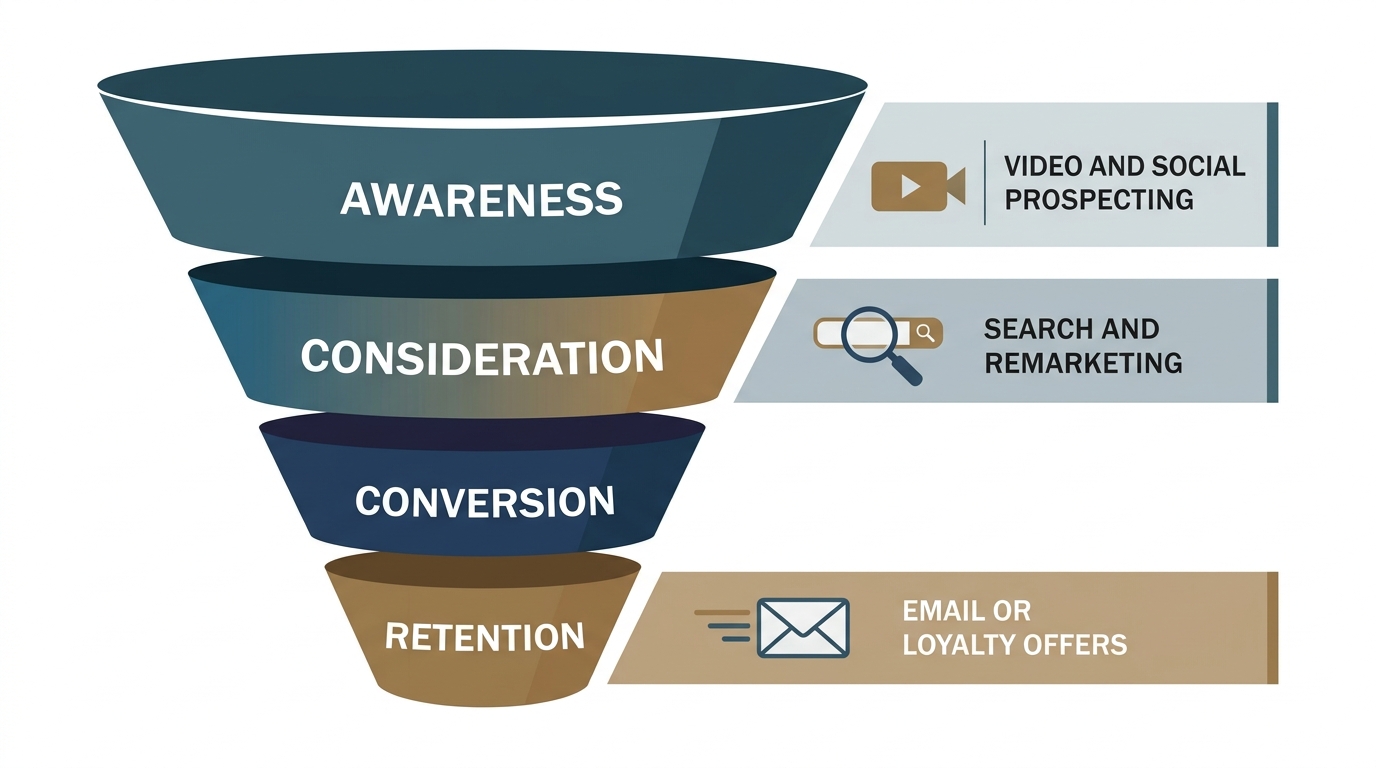
Channels do different jobs. A common mistake is to compare raw returns without accounting for role, according to elevarus.com. Search campaigns and Shopping campaigns mostly capture demand that exists now. A person enters a search query because they already want the product. Social channels and video channels mostly create new demand. They interrupt a feed and plant an idea that produces sales later, often on a different channel.
If you evaluate a demand-generation channel by last-click ROAS, you will likely cut its budget. Then, one quarter later, your search volume and search conversions drop because less demand exists to capture. Assign each channel a role first: awareness, consideration, conversion, or retention. Then evaluate the channel against that role, not against a generic revenue number.
For early growth brands, a funnel framework from weareqry.com suggests 60 to 70 percent of budget for awareness channels. It suggests 30 to 40 percent for performance channels. You adjust this split as brand search volume grows. This split is a starting point, not a permanent rule. Our funnel-stage budget allocation guide shows how to size each stage for your funnel.
Fund learning thresholds
Each ad platform needs a minimum spend and data volume before its optimization system works well. This minimum is a learning threshold. Below this threshold, the platform cannot collect enough signal to target well. You then waste money on inefficient ad delivery.
Learning thresholds vary by platform and campaign type. They change over time as platforms update their systems. Check current guidance directly from each platform before you set a minimum budget. We confirmed these thresholds for this article on the date of research, and platforms can change them. Treat the threshold as a floor, not as a target. Spend at the floor keeps a channel active, but it does not prove the channel deserves more budget.
If a channel cannot clear its learning threshold within your total budget, you have two choices:
- Stop spend on the channel and move the money to other channels.
- Accept a longer test period before you evaluate results.
Do not evaluate channel returns while spend remains below the learning threshold. The data does not show true channel performance during that period.
Compare marginal opportunity
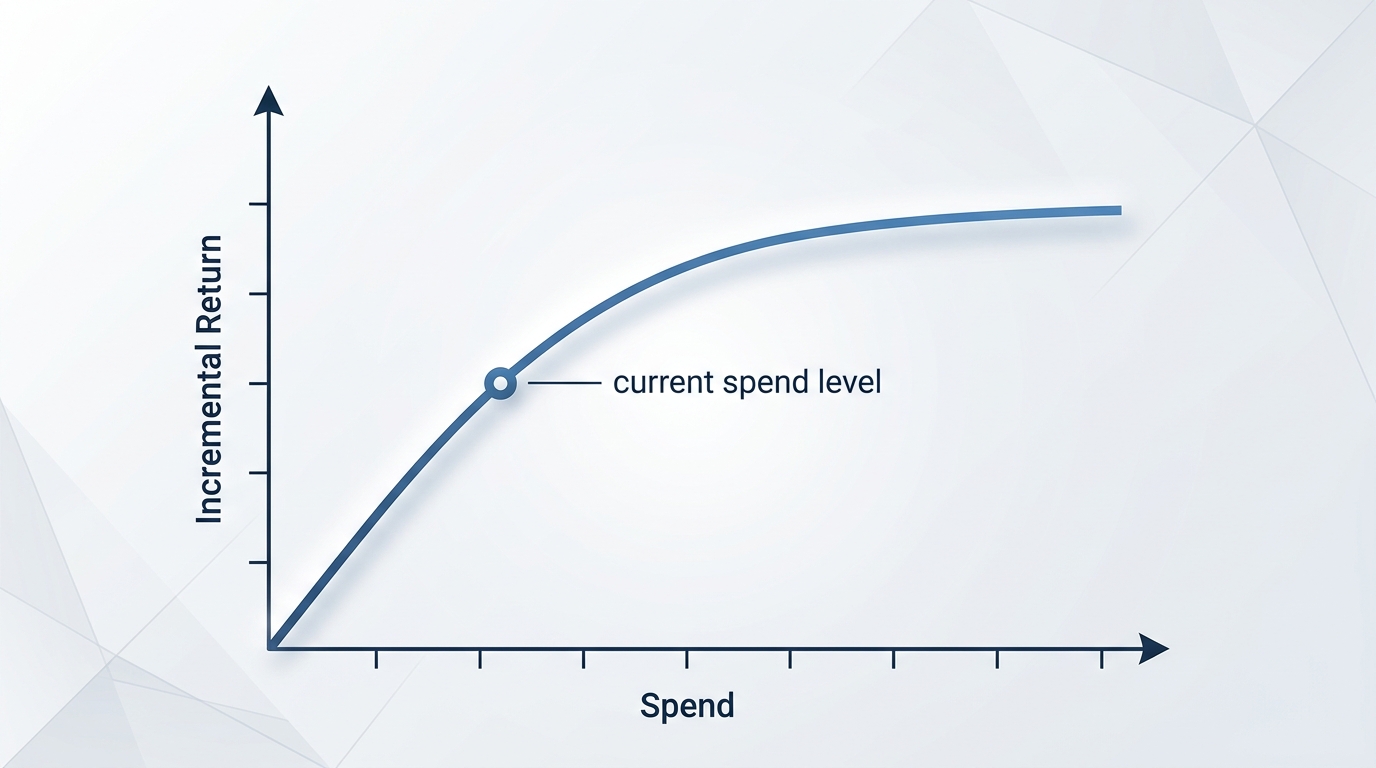
After you fund budget floors, determine where the next dollar works hardest. This step requires you to compare marginal return instead of average return. Marginal return is the return on the next unit of spend. Average return is the return on all spend to date. A channel with high average ROAS can produce a marginal ROAS near breakeven if the channel is near saturation.
Here is a hypothetical example. Assume a $50,000 monthly budget split across two channels:
| Channel | Current spend | Average ROAS | Marginal ROAS at current spend |
|---|---|---|---|
| Search | $30,000 | 3.5x | 1.2x |
| Paid social | $20,000 | 2.1x | 2.4x |
In this example, search looks better on average, but its marginal ROAS is near breakeven. Paid social has a lower average return, but it has a higher marginal return. You must give the next dollar to paid social until the two marginal numbers meet. Marketing mix modeling (MMM) uses this exact logic.
MMM is a statistical method that uses historical spend and sales data to estimate sales response across channels. As an MMM guide from aidigital.com states, a budget is most efficient when marginal return on the last dollar is equal across channels. Unequal returns mean that you can improve total results when you move spend between channels.
Identify the measurement method that produced each number. Attribution gives credit to touchpoints along a path of user visits, but it requires tracking that becomes harder to collect. Incrementality testing holds out part of your audience from ads to measure the real difference in sales. This test gives a causal read on channel contribution.
MMM uses weeks or months of aggregate spend and sales data to estimate response curves without user tracking. Each method answers a different question, and no single method is complete by itself. Our marginal ROAS guide explains how to calculate this metric from your own data.
Apply constraints
Marginal return calculations give direction, but real budgets face limits. Impression share limits search growth because you cannot buy more auctions than exist. Creative capacity limits paid social spend. A channel with high marginal ROAS still requires fresh creative assets to prevent audience fatigue. Frequency limits and ad inventory limits also apply to video and connected TV.
One rule set from adsx.com connects channel shifts directly to these limits:
- Shift budget to Google if Meta marginal ROAS falls below breakeven and Google impression share is below 65 percent.
- Shift budget to Meta if Google impression share is above 80 percent and Meta ad frequency remains under 2.5 per user.
These rules turn a marginal-return signal into an action that respects capacity limits.
Test budget is another limit. Most teams hold back 10 to 15 percent of total budget for new channels or formats, based on guidance from spendmix.com and barefoot-performance.com. Run these tests for six to eight weeks minimum before you judge results. A short test window rarely gives a channel time to clear its learning threshold or reveal true marginal return.
Rebalance cadence
Budget allocation is a continuous process, not a single event. A practical process uses three cycles that match signal speeds:
- Weekly: Review blended CAC by channel. Mark any channel with spend or cost that moves more than 25 percent from target, but do not change budgets on one week of data.
- Monthly: Adjust channel budgets by 10 to 20 percent based on a full month of marginal return data, following guidance from stackmatix.com. Weekly changes reset platform learning phases and obscure the true effect of each shift.
- Quarterly: Update channel roles and calculate a new economic ceiling. Search volume, competitor spend, and buyer behavior change across three months. A budget split from January can fail in April.
Follow this schedule with discipline. If you skip quarterly reviews, you return to a fixed budget split.
Conclusion
Paid media budget allocation works best as a regular operational process. Base your decisions on marginal return, channel roles, and real operational limits. Do not use a static formula from past quarters. Attribution, incrementality testing, and marketing mix modeling answer different parts of the allocation problem. You achieve the best view when you combine these methods.
Contact our team if you want an external review of your current channel mix. We offer a cross-channel allocation review to show where your next dollar of paid media spend works hardest.

Stay in the loop
Get updates on new posts and resources.