Not All Marketing Mix Modeling Companies Sell the Same Service
Compare types of marketing mix modeling companies and use a practical scorecard to select the right software, service, or consulting partner.
Marketing mix modeling (MMM) companies do not all sell the same product. Some sell software. Some sell a fully managed service. Some sell strategic advice built around a model. The right choice depends on your team.
Do you want to run the model yourself? Do you want to watch a vendor run it? Or do you want to make decisions from a vendor's output? This article groups marketing mix modeling providers by delivery model and buyer fit. It does not rank them.
Provider landscape
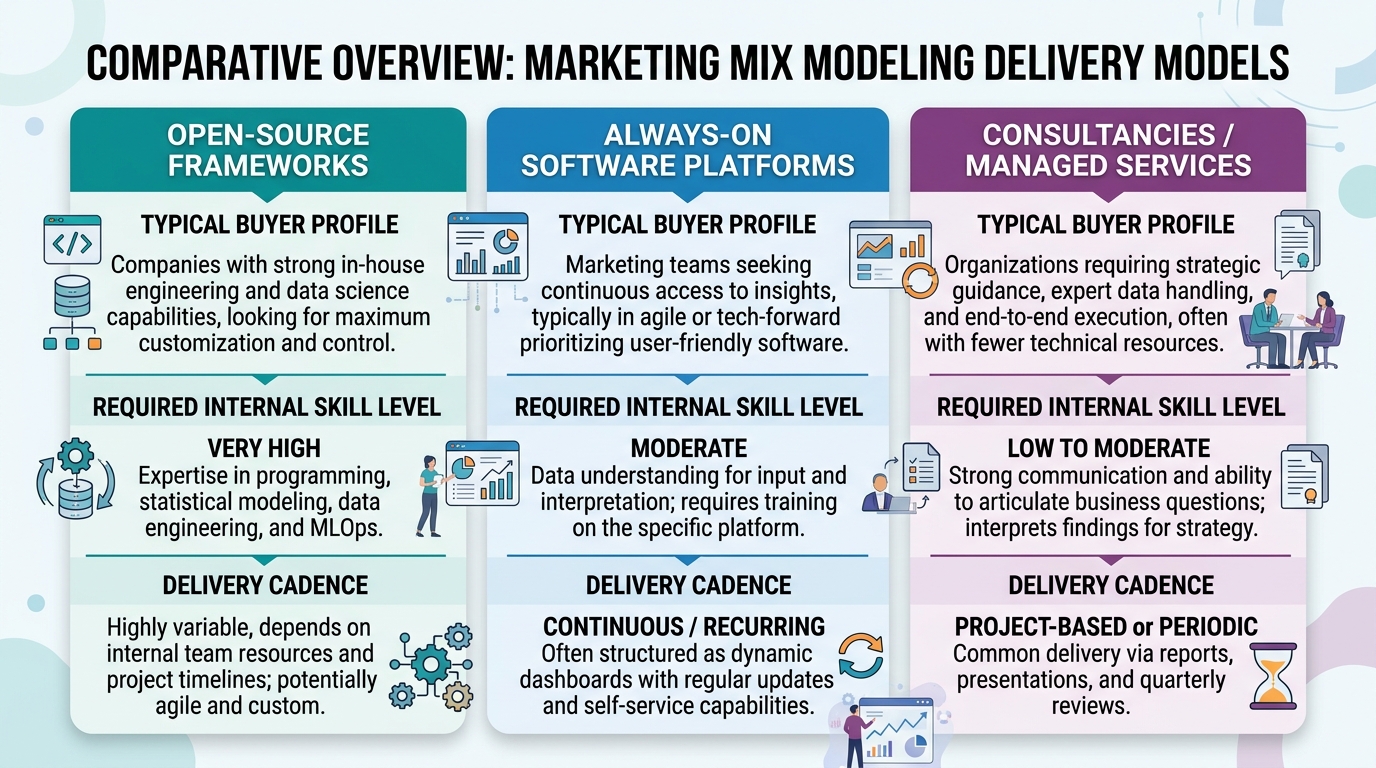
The marketing mix modeling market splits into three broad groups. Each group solves a different buyer problem. No group is better than the others in all cases.
The first group covers open-source frameworks. Google launched Meridian worldwide in January 2025. Google added a no-code Scenario Planner tool to Meridian in February 2026. Meta's Robyn continues to gain new community contributions.
You can also use PyMC Marketing to build a marketing mix modeling system in-house. These tools have no license fee. They suit organizations with strong data science teams that want to build and control their own MMM system.
The second group covers always-on software platforms. Some people call this group MMM SaaS. The leading companies in this group offer continuous measurement. They deliver value faster than traditional consulting projects. These vendors give you a login, a dashboard, and a model that refreshes on a schedule, instead of a one-time report.
The third group covers consultancies and managed services. Analytic Partners is one of the most established MMM consultancies. It often holds a prominent place in Gartner's Magic Quadrant, a report that ranks technology vendors. Enterprise consultancies such as Analytic Partners, Nielsen, Ipsos MMA, Kantar, and Ekimetrics bring deep research experience and broad data assets. These firms sell judgment and staff time, not only a model output.
A fourth, smaller group serves teams with limited spend history or smaller budgets. SMB-focused MMM tools serve small companies that want a simpler, lighter MMM with less optimization capability. Your data history matters here. If your organization has less than one or two years of clean spend data, ask the vendor a direct question. Ask whether your data volume can support a stable model. Organizations with less than $1 million in yearly spend, or less than two years of data, often lack enough data for stable MMM results.
Before you shortlist any vendor, read our guide on how to hire an MMM consultant. It covers scoping questions that apply to all three delivery models.
Software vs. service vs. consultancy
The main decision is not which vendor has the best model. It is which delivery model matches your team's staff and decision schedule.
Open-source software gives you full ownership but no built-in support. Open-source frameworks such as Meridian and Robyn use default prior values and built-in assumptions. A prior is a starting assumption the model uses before it sees your data. These defaults are not always visible to the team that uses them, and they can change the accuracy of the results.
Setting these values correctly requires deep experience in econometrics, the statistical study of economic data, and in MMM specifically. Data engineering skill alone is not enough. If you choose this path, budget for a skilled analyst, not only for server costs.
Managed and always-on platforms sit between full self-service and full outsourcing. Mid-tier SaaS platforms score moderately on portability. Portability means you can move your data and results to a new vendor. With these platforms, you can usually export summary data and coefficients, but not the underlying model code.
This matters if you ever want to change vendors. Some managed services score low on portability. With these, if you leave, you start over with a new vendor. Ask about data and coefficient portability before you sign a contract.
Consultancies trade speed for depth. Enterprise consultancy work goes deep, but it comes with a heavier service load and a slower work pace. This pace can be a poor match for buyers who want a fast, continuously refreshed planning system. Teams that need weekly or daily insight may find the pace too slow. If your planning cycle is quarterly or yearly, this tradeoff may not matter to you. If you need weekly budget changes, it will matter.
One point applies to every category. What you actually buy from a vendor is data engineering, calibration discipline, and priors informed by experience in your category. You also buy a person who is accountable when the model disagrees with the platform dashboards. Open source lowers the license cost, but it raises the need for internal statistical skill. It does not remove the work.
MMM is not the only measurement method, and some vendors blur the line between methods. Attribution assigns credit to individual touchpoints using tracked, detailed data. It works in real time, but it grows weaker as privacy rules limit tracking.
Incrementality testing uses controlled experiments, such as holdout groups, to isolate the true effect of one channel or campaign. MMM uses combined historical data across channels to estimate each channel's contribution to an outcome over time. MMM does not need individual-level tracking.
Think of these three methods as three tools that measure the same system at different levels of detail. Attribution gives detailed, immediate data, but loses accuracy as privacy rules grow stricter. No single method gives you the full truth.
A vendor that claims otherwise oversells its product. If you still need to decide between building this skill inside your company or buying it from a vendor, read our build vs. buy comparison for more detail on the tradeoffs.
Selection scorecard
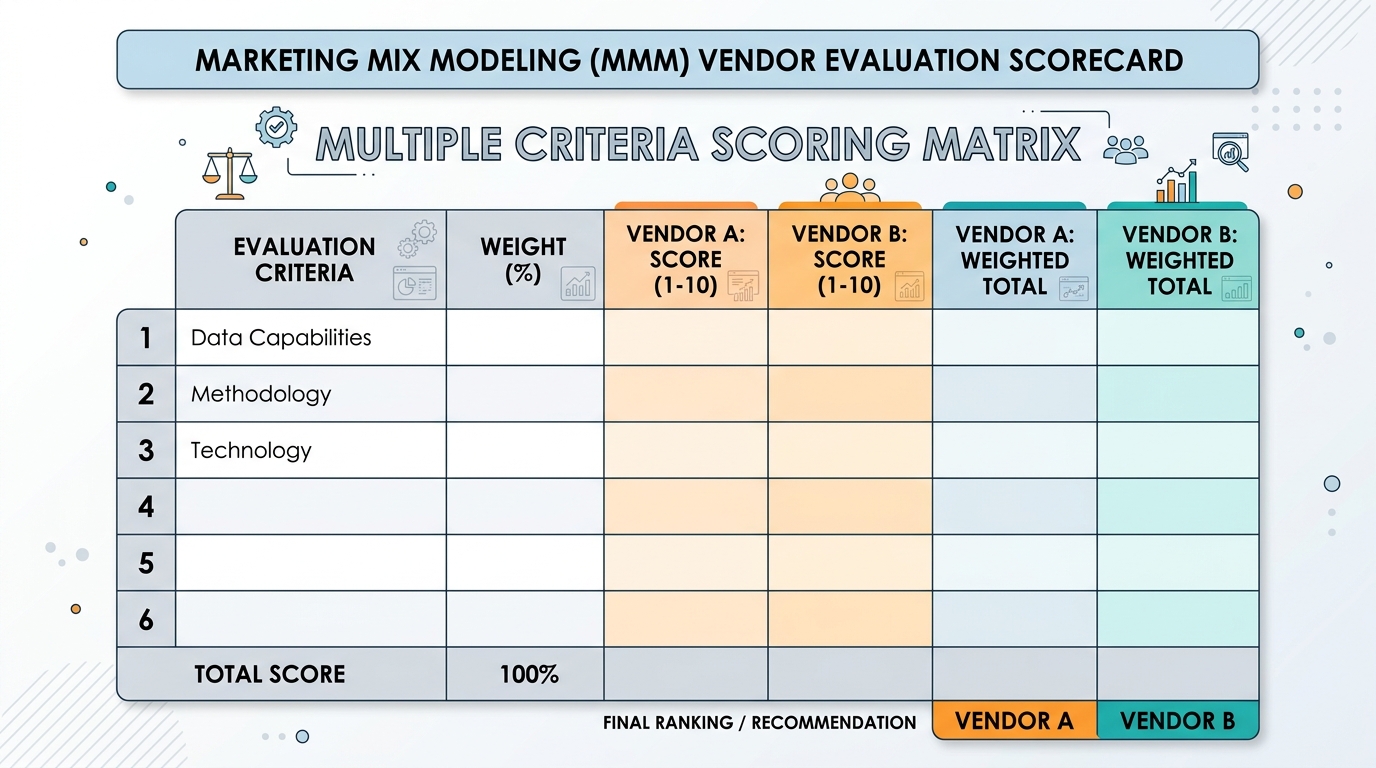
Use a simple weighted scorecard to compare vendors across delivery models on equal terms. This is a sample scoring template, not a set of fixed weights for every buyer. Adjust the weights to match your priorities before you score any vendor.
| Criterion | Weight | What to check |
|---|---|---|
| Data and coefficient portability | 20% | Can you export model coefficients and underlying data if you leave |
| Statistical transparency | 20% | Does the vendor disclose priors, assumptions, and confidence intervals |
| Decision cadence fit | 15% | Does refresh frequency match your planning cycle (weekly, monthly, quarterly) |
| Internal skill requirement | 15% | What staff do you need to operate or interpret outputs |
| Calibration method | 15% | Does the vendor validate the model against experiments or holdouts |
| Category and channel experience | 15% | Has the vendor modeled your channel mix and business type before |
Worked example (hypothetical). A mid-size retailer scores an open-source-based internal build at 8 out of 10 on portability. The same build scores 3 out of 10 on internal skill requirement, because the retailer lacks in-house econometricians. A managed platform scores 5 out of 10 on portability, but 8 out of 10 on skill requirement. The weighted totals may favor the managed platform once you count the skill gap as an internal cost, not only a vendor fee.
Review our marketing mix modeling cost guide along with this scorecard. Price alone should never carry more than a small share of the total weight.
Questions for vendors
Ask every vendor the same set of questions, no matter the delivery model. Consistent questions make your comparison fair.
- What statistical method powers your model? Is it Bayesian or frequentist, the two main statistical approaches?
- How do you set or disclose your priors and starting assumptions?
- How often does the model refresh, and what data delay exists before results are usable?
- Can we export raw data, coefficients, and model logic if we end the contract?
- How do you validate MMM output against incrementality tests or holdout experiments?
- What is the minimum spend and data history you require for a stable model?
- Who owns the model logic? Who is accountable when results disagree with platform-reported numbers?
- How many staff hours per month will our team need to commit?
The answers show whether your team has the statistical skill or data systems to run a self-service platform. They also show whether a managed model fits your team better.
Red flags
Watch for these warning signs during vendor conversations.
A vendor that will not disclose its underlying method, whether Bayesian or another regression approach, asks you to trust it blindly. A vendor that claims MMM alone can replace attribution and incrementality testing misstates how the three methods work together. A vendor that cannot explain how it checks model output against real experiments has skipped a basic calibration step. A vendor that locks your data and coefficients in a closed format, with no way to export them, raises your cost to switch later. Treat any vendor promise of a guaranteed return figure with caution. MMM is a statistical method, so its results carry uncertainty rather than certainty.
Shortlisting process
Follow a short, structured sequence. Do not request proposals from every vendor you find.
First, define your decision schedule. Decide if you need weekly, monthly, or quarterly budget guidance. This step alone will remove some vendors from consideration.
Second, assess your internal skill level honestly. Ask if you have a data scientist who can own an open-source model.
Third, score three to five vendors from different delivery groups, using the scorecard above.
Fourth, ask each finalist the vendor questions above, and compare their written answers, not their sales pitches.
Fifth, request a small pilot or sample model output before you sign a full contract. This lets you review real assumptions and outputs first.
Moving forward
Marketing mix modeling companies are not interchangeable. The right partner depends on your data, staff, and decision schedule, not on a published rank. Match the delivery model to your team first.
Then compare vendors within that group, using consistent questions and a weighted scorecard. If you want to work through your specific needs with a structured framework, we offer a structured MMM vendor evaluation conversation. It helps you compare providers against your real constraints, not a generic vendor list.

Sources
- Best marketing mix modeling software for 2026
- 30 Marketing Mix Modeling Tools for Accelerating Growth in 2026
- Best MMM Solutions for Retail Brands: Top Marketing Mix Modeling Platforms (2026)
- Marketing Mix Modeling Software: 2026 Guide | MASS Analytics
- 11 Best Marketing Mix Modeling Tools 2026 | Provider Guide
- Top Marketing Mix Modeling Platforms in 2026: A Buyer's Guide for CMOs and CFOs - Liftlab
- 20 Best Marketing Mix Modeling Agencies 2026 | Web Tonic™
- Google’s Meridian And Meta’s Robyn: A Gift To Measurement Or Trojan Horses? | AdExchanger
Stay in the loop
Get updates on new posts and resources.