More Marketing Mix Modeling Detail Can Reduce Model Quality
Choose the right MMM granularity across channels, campaigns, geographies, and time without outrunning the information in your data.

More detail in a marketing mix model is not automatically better. Added channels, regions, or days can raise noise faster than they raise signal. The correct level of detail depends on the decision the model must support. It does not depend on the detail available in your data.
Marketing mix modeling (MMM) is a statistical method. It estimates how marketing inputs and other factors drive an outcome, such as sales or revenue. It differs from attribution, which assigns credit to touchpoints in a user path. It also differs from incrementality testing, which measures causal lift through controlled experiments. Each method answers a different question. Granularity choices affect all three methods, but this article covers MMM only.
Four Dimensions of Granularity
Granularity in MMM is not one setting. It has four separate dimensions. Each dimension carries its own tradeoffs.
- Variables. This dimension is the count of marketing inputs, media types, or creative formats that get their own coefficient. A coefficient is a number the model estimates to show effect size.
- Regions. Whether the model runs at a national level or splits data into states, cities, or smaller areas.
- Time. Whether the data is daily, weekly, or monthly.
- Customer segments. Whether the model separates new customers from repeat customers, or splits data by product line.
These dimensions can combine. A model might use weekly, national, channel-level data. Another model might use daily, regional, segment-level data. Industry analysis calls this a "granularity trinity" of variables, regions, and segments. Time is a related fourth axis that analysts often overlook.
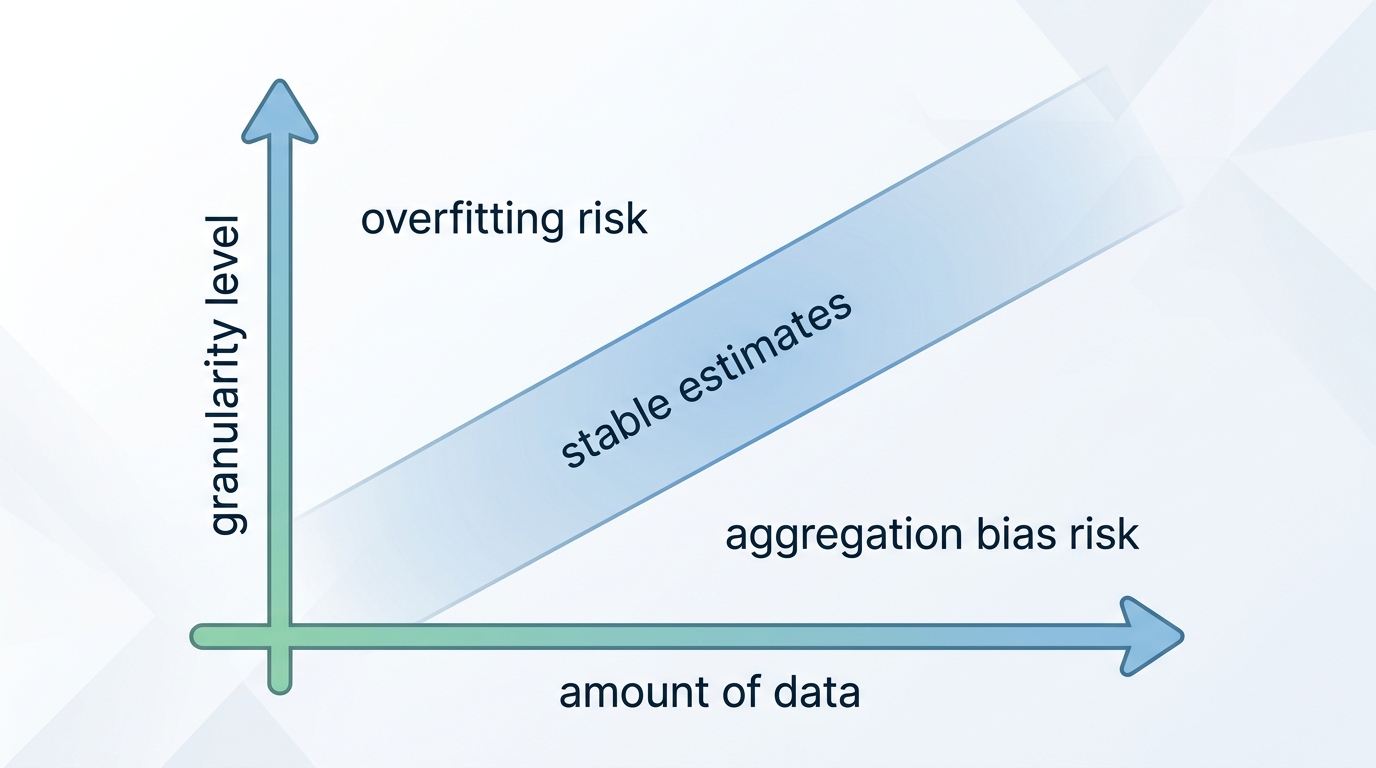
Each added dimension increases the number of parameters the model must estimate. More parameters need more data. Without enough data, the model produces unstable estimates. These estimates shift each time you refresh the model.
Signal-to-Noise Tradeoffs
Every granularity decision is a tradeoff between signal and noise. Splitting data finely can reveal real differences. It can also break a stable pattern into small, noisy pieces that show no clear relationship.
This problem has a name: aggregation bias. It occurs when you combine data from units that received different treatment levels. The combined average then hides the true effect. One explanation notes that aggregation bias appears whenever measurement units with different exposure levels get combined in an analysis. It adds that every MMM carries some amount of this bias, because full unit-level data is rarely available.
The reverse problem also exists. Splitting data too finely can cause overfitting. Overfitting is a failure where the model matches noise in the data instead of the true pattern. When a model has too many parameters relative to observation counts, it fits noise. One review of MMM granularity warns that breaking data into narrow segments increases the number of parameters and raises the chance that the model overfits. The model then fails to generalize to new data.
The practical goal is not maximum detail. It is the level of detail that matches how a decision will actually get made. One commentary tells marketers to ask a direct question before they split any variable. Will this split help make a decision that drives real business value? If the answer is no, the extra detail is cost without benefit.
Channel Grouping
Channel grouping is one of the most important choices in an MMM. If you group channels too broadly, the model cannot tell two different media types apart. If you group them too finely, the model runs out of independent variation to separate their effects.
For example, combining all paid social spend into one variable hides differences between platforms. But splitting paid social into ten creative variants across three platforms may leave each variable with too little spend variation. One guide states that channel grouping is one of the most consequential decisions in MMM. It notes that grouping too coarsely hides differences and grouping too finely causes overfitting.
A reasonable starting point is to group channels by how media actually gets bought and run. Then test whether splitting a group changes the model's conclusions in a meaningful way. Our guide on marketing mix modeling data requirements covers the minimum data volume needed to support a given number of channel groups.
Geo and Hierarchical Models
Splitting a national model into regions can improve accuracy, if the regions have enough data and enough different marketing conditions. Geo-level models let you compare regions with different media pressure. This comparison can sharpen estimates of media response.
But a plain regional split has a cost. Some regions have thin data. A model that estimates each region completely on its own will produce noisy, unstable coefficients for those regions.
Hierarchical modeling addresses this problem directly. It lets each region keep its own estimate. It pulls that estimate toward a shared average when local data is sparse. One explanation calls this method "partial pooling." The data itself sets the strength of this pull toward the group average.
As one guide notes, the noisier the local signal, the more the model relies on what the broader portfolio has learned. Google research on geo-level media mix models documented this effect. It found that hierarchical estimation produced tighter uncertainty ranges than a single national model alone.
| Approach | What it estimates | Risk |
|---|---|---|
| Complete pooling (one national model) | One coefficient for all regions | Averages away real regional differences |
| No pooling (separate model per region) | An independent coefficient per region | Overfits regions with thin data |
| Partial pooling (hierarchical model) | A coefficient per region, drawn from a shared distribution | Requires a correctly specified hierarchy |
Geo-level models also allow geo experiments. These experiments can validate or calibrate MMM estimates using controlled regional holdouts. See our page on geo experiments and MMM for how the two methods work together.
Time Resolution
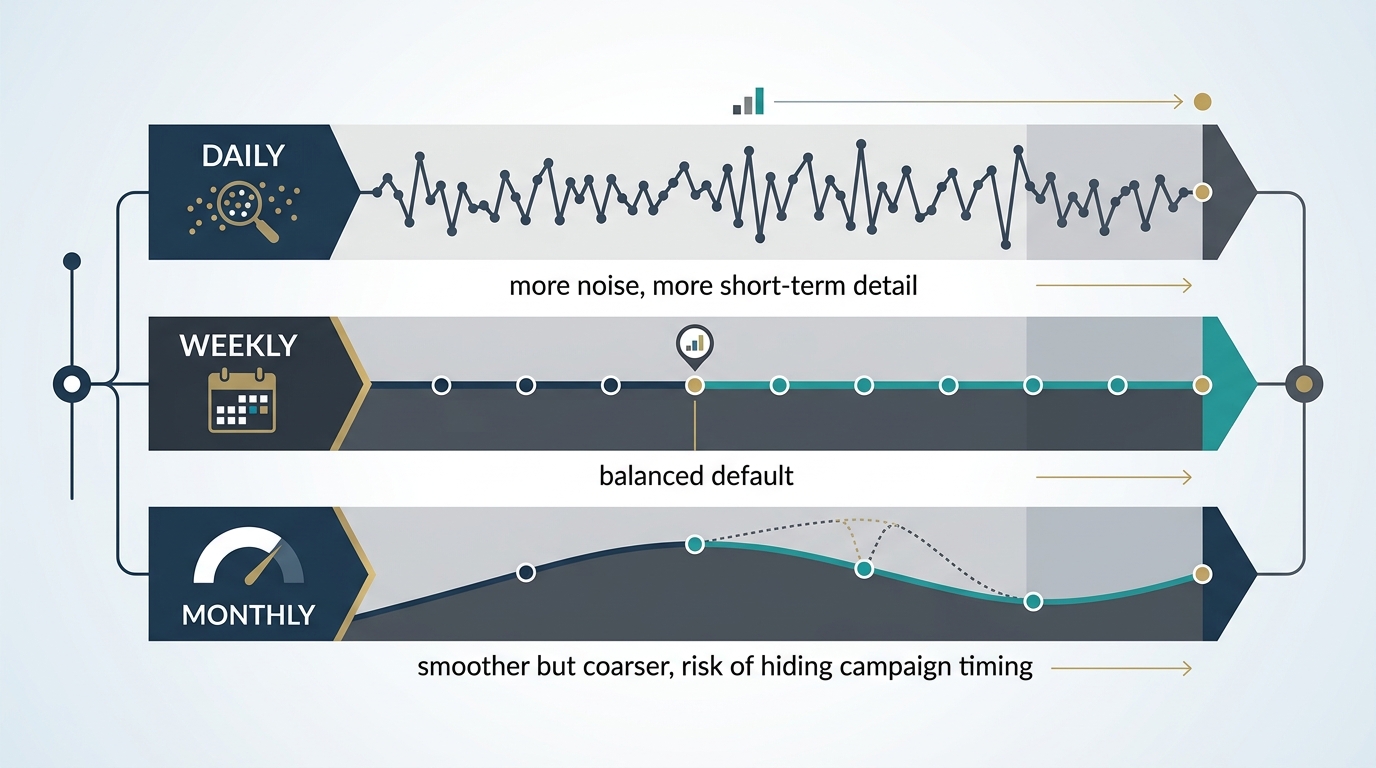
Analysts often make time their first granularity decision. It deserves the same scrutiny as channel or geo choices. Weekly data has long served as the default. Historically, vendors sold syndicated market data at a weekly grain in the United States, as the cited aggregation bias analysis notes.
Daily data captures short-term patterns, such as a two-day flash sale or the early days of a TV burst. But daily data also carries more noise relative to signal. This is especially true for slow-moving drivers like brand health or economic conditions. One direct comparison notes that daily granularity can lead short-term models to underestimate ROI. Here, ROI means return on investment, which measures profit relative to cost. This mistake produces flawed budget conclusions.
On the other hand, monthly data often provides too coarse a view for a modern MMM. It can blur the timing of digital campaigns and hide adstock effects. Adstock is the residual influence of advertising that decays over following periods. One MMM data guide notes that monthly data tends to over-fit external factors and hide execution detail.
Weekly data remains the common middle ground for most MMM work. It smooths short-term noise while it still captures meaningful adstock and campaign timing. Choose daily resolution only when the business decision is genuinely tactical, such as choosing which day of the week to run digital spend.
Decision Framework
Before you choose a granularity level, define the decision the model needs to support. A model built to guide channel-level budget shifts does not need creative-level detail. A model built to guide regional media weighting does need geo-level detail, ideally validated with geo experiments.
Use this sequence when you set granularity:
- State the specific budget or planning decision the model must inform.
- List the variables, regions, time grain, and segments that decision actually requires.
- Check whether the available data has enough variation at that level to support stable estimates.
- Test a coarser and a finer version of the model. Compare stability across refreshes.
- Validate the chosen model against holdout data or experiments before you rely on it.
One point of caution from MMM practitioners is worth repeating. Some argue that MMM should stay focused on estimating overall incrementality. Incrementality means sales lift caused directly by marketing. Other methods should handle granular sub-channel reporting, according to a discussion of overfitting risk in modern MMM practice.
This caution is not a rule to follow without question. It is a reminder that MMM has a natural resolution limit. Detail past that limit creates noise dressed as detail.
Once you have a candidate model, validate it before you trust its output for planning. Our guide on how to validate an MMM walks through the checks worth running before you act on any model's coefficients.
Conclusion
Granularity in marketing mix modeling is a tradeoff, not a virtue. Every added variable, region, segment, or time slice must earn its place by improving a real decision, not just a report. The right level of detail is the coarsest level that still answers your actual planning question with stable, trustworthy estimates.
If you are unsure whether your model's current resolution matches the budget decisions you need to make, we can help. We can review your channel groupings, geo structure, and time grain against your specific planning calendar.

Stay in the loop
Get updates on new posts and resources.