What Marketing Mix Modeling Cannot Prove
Understand marketing mix modeling limitations, including identification, data volume, granularity, changing markets, and causal uncertainty.
Marketing mix modeling (MMM) cannot prove that a channel caused a sales result. MMM is a statistical method. It uses past data to estimate the size of a relationship between spend and outcomes. This is an important difference. If you need proof of cause and effect, you need a controlled experiment. A model alone is not enough.
This article states what MMM can and cannot show. It also states how to close the gap.
What MMM estimates
MMM uses past data on spend, sales, and other factors. It estimates how much each channel likely added to results. The output looks precise. It can show a contribution percentage, a return on ad spend (ROAS) figure, or a saturation curve.
A saturation curve shows the point where extra spend on a channel adds less benefit. But these outputs are estimates, not direct measurements. The model infers what happened. It does not show what would have happened if you had spent differently (themarketingjuice.com).
This is the core difference between three measurement methods that people often confuse:
- Attribution tracks individual clicks or sessions. It assigns credit to touchpoints. It works in near real time, but it misses offline channels. It also favors activity that occurs late in the buying process.
- Incrementality testing (also called a lift test or geo-experiment) holds back a channel at random in some regions. It then compares results to a control group. This method gives a causal answer, but only for one channel, at one time, in one market.
- MMM looks across all channels over a long time period. It uses correlation and statistical control. It gives a comprehensive view, but it is not causal on its own.
For a longer comparison, see our guide on MMM vs MTA vs incrementality.
Identification limits
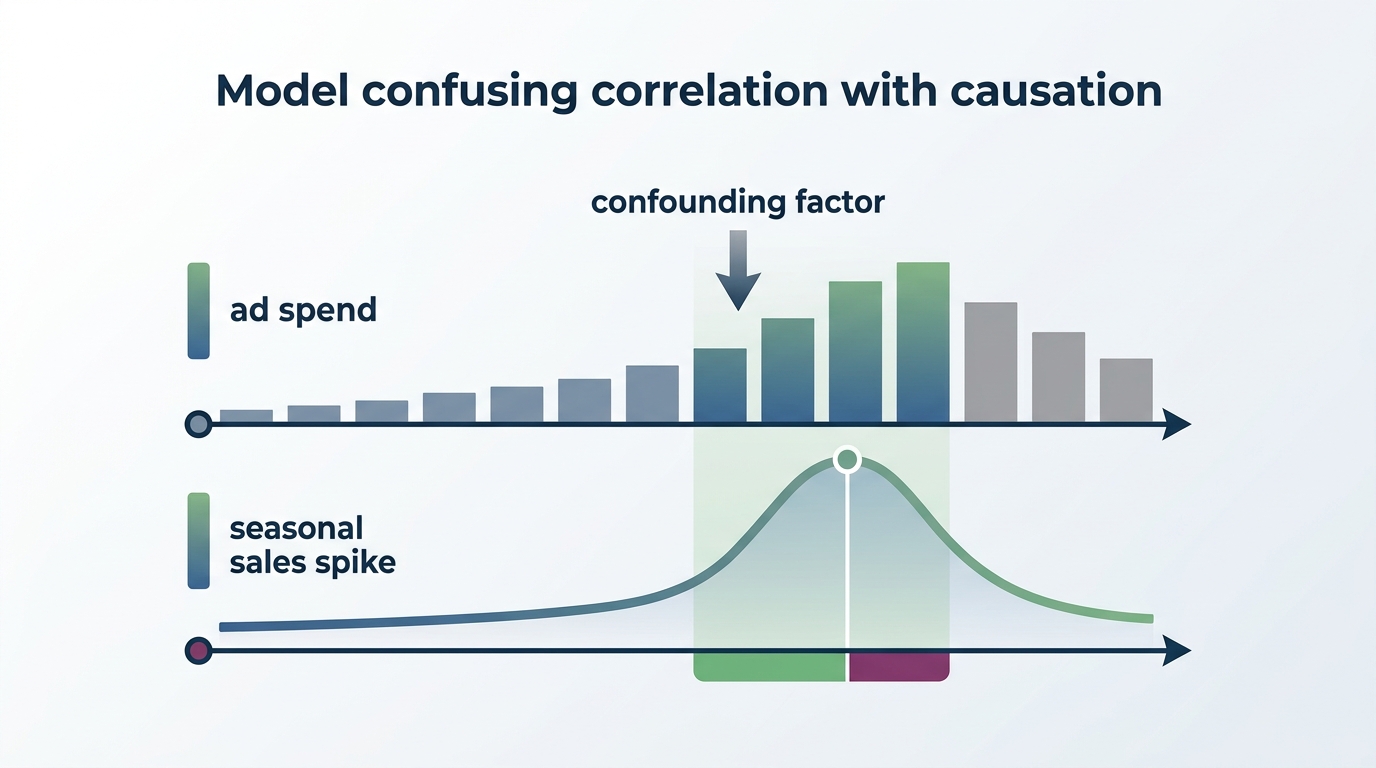
MMM's biggest weakness is identification. Identification means the ability of a model to separate one channel's true effect from everything else that changes at the same time. To estimate a channel's true effect, the model needs enough independent variation in spend. This condition is difficult to meet in practice.
Consider a simple case. If you always increase social spend and email spend at the same time, the model cannot cleanly tell you how much each channel added. If you spend more around the holidays, the model may credit your holiday sales bump to advertising, when the real driver was seasonal demand. Correlation, however carefully controlled, is not proof of causation (data-dive.com).
For a model to earn trust, several conditions must hold at the same time:
- There is enough data to estimate every parameter.
- Advertising and control variables show real, independent movement.
- The model includes every important driver of sales.
- The relationships in the data reflect true cause and effect, not coincidence (data-dive.com).
In practice, these conditions rarely all hold. Confounders can distort the numbers if the model does not account for them (epsilon.com). Examples of confounders include pricing changes, competitor actions, or a coincidental news event. A confounder is an outside factor that affects the result but is not part of the model. This limitation does not make MMM useless. It means the output is a directional estimate, not a final verdict.
Data and granularity
MMM needs a large, consistent dataset to work well. Most practitioners recommend two to three years of weekly data across all channels. This period should cover at least two full seasonal cycles (searchengineland.com). The model will struggle to isolate a channel's effect if tracking changes occur partway through. It also struggles if a channel ran for only a few months.
Granularity is a related problem. Granularity means the level of detail in the data, such as weekly totals versus single clicks. MMM shows how channels perform in total, over weeks or months. Analysts do not build it to answer campaign-level or keyword-level questions. If you push it down to that level of detail, the model's estimates lose reliability (funnel.io). If you need to know which creative or keyword drove a conversion, attribution is the better tool.
Channels with low spend or little variation pose a similar problem. The model has too little signal to draw a firm conclusion about them. This is a common weak point. Check for it before you trust any single-channel result (exactag.com).
Worked example (hypothetical). Suppose a company runs MMM on five channels: TV, paid search, paid social, email, and out-of-home. TV and paid search have run consistently for three years, with meaningful spend changes across that period. Out-of-home ran for only four months, at a single spend level.
The model can likely produce a reasonable estimate for TV and paid search. It cannot reliably estimate out-of-home, because there is no variation to learn from. Treat any out-of-home number the model returns as a rough guess, not a finding.
Structural change
A model built on old data describes an old market. Consumer behavior can shift. A competitor can exit the market. Your product mix can change. When this happens, the relationships the model learned may no longer hold. An MMM built two years ago does not necessarily tell you about the market today (themarketingjuice.com).
This is a structural problem, not a statistical one. No amount of tuning fixes a model that answers a question about a market that no longer exists. Regular refreshes help, but they do not remove the risk. When your business or market changes in a meaningful way, treat prior MMM outputs as provisional. Refresh the model and check its assumptions again.
Validation limits
Statistical checks and business logic checks matter, but they are not enough. A model can fit historical data very well and still fail to predict what happens next. Good in-sample fit statistics, such as R-squared or SMAPE, show that the model explains the past. In-sample fit statistics measure how closely a model matches the data used to build it. These statistics do not show that the model will predict the future correctly (analyticpartners.com).
An overfitted model is a particular risk. Overfitting happens when a model learns the noise in past data instead of the true pattern. Three years of data often give only around 150 weekly observations. With so few points, a model easily explains history well while learning noise instead of signal (soku.ai). Holdout validation tests the model against data it has not seen. This method helps, but it is a weak check on its own when the dataset is small.
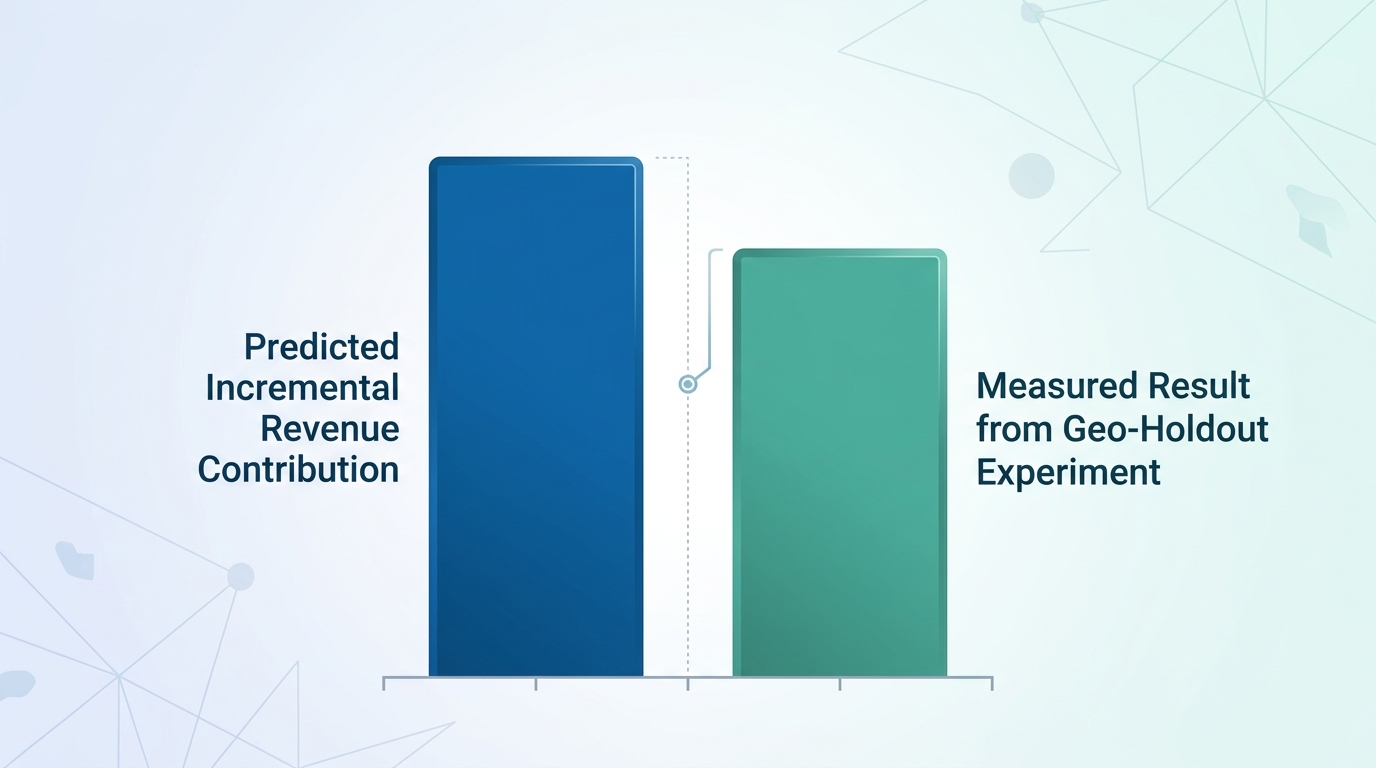
The controlled experiment is the only validation method that gives a true causal check. In a geo-holdout test, analysts randomly split similar regions into two groups. One group keeps a channel. The other group pauses it. This split produces a real answer.
In one documented example, a model predicted that a channel drove 22 percent of incremental revenue with a 3.4x return. A geo-holdout test found the true lift was 18 percent, a four-point gap between the model and the experiment (measured.com). This gap is normal. It is also exactly why the test matters.
For a full checklist on this process, see our guide to validating an MMM.
How to reduce risk
You cannot make MMM causal by definition. You can reduce the risk of acting on a wrong estimate. Four practices help.
| Practice | What it does |
|---|---|
| Run experiments | Geo-holdout tests give a causal check on specific channels (mmmpilot.com) |
| Calibrate the model | Use experiment results as priors or constraints on MMM coefficients |
| Check confidence intervals | A wide interval means the model is uncertain, not precise |
| Refresh regularly | Keep the model current with recent spend and market conditions |
When you have lift test results for a channel, use them to calibrate the model. Calibration means constraining the model's estimate for that channel to match the experimental evidence. This step improves confidence in the entire model, not just the tested channel (mmmpilot.com). Our guide to geo-experiments and MMM explains how to design and run this kind of test.
Also know when not to use MMM. If you need campaign-level detail, real-time answers, or a read on a channel with almost no spend or variation, MMM is the wrong tool. Attribution or a direct experiment will serve you better in these cases.
Conclusion
MMM gives a useful, comprehensive view of marketing performance over time. It is not a measurement of what actually happened, and it cannot prove causation on its own. Its value grows when you pair it with experiments, check its assumptions, and stay clear about what each method can and cannot answer.
If you weigh whether MMM fits your next budget decision, we offer a transparent assessment of your data, your channels, and your goals. This assessment shows you clearly where MMM helps and where another method is a better fit.

Stay in the loop
Get updates on new posts and resources.