MMM vs MTA vs Incrementality: The Complete Comparison
Stop guessing your marketing ROI. Discover the definitive guide to MMM vs MTA vs incrementality testing and find out how to save 20% of your budget today.
Marketing measurement used to be simple. You bought an ad. Someone clicked it. They bought your product. You tracked the pixel, claimed the credit, and high-fived your CFO.
Those days are gone.
Between iOS privacy updates, the death of third-party cookies, and the rise of "walled garden" ad platforms, the old playbook is burning. If you rely solely on click-based tracking today, you are looking at a mirage. You are optimizing for clicks, not revenue.
Modern marketing leaders face a complex alphabet soup of measurement methodologies. The debate of MMM vs MTA vs incrementality isn't just academic—it determines where you spend your next million dollars.
Choosing the wrong model doesn't just mess up your reporting. It drains your budget.
This guide breaks down the three pillars of marketing measurement. We will strip away the jargon, explain exactly how they differ, and show you how to combine them for a single source of truth.
The Three Pillars of Measurement
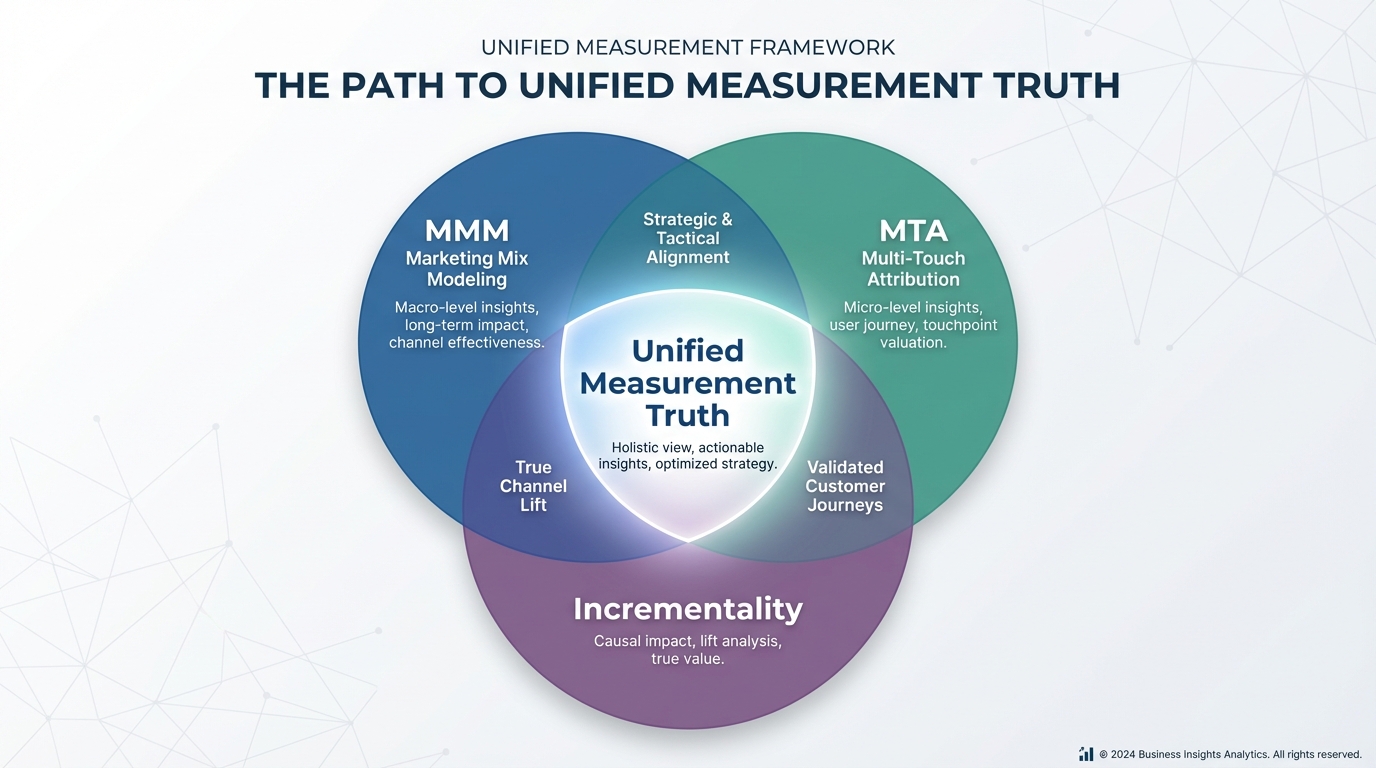
To understand the MMM vs MTA vs incrementality dynamic, you have to stop looking for a "winner." There isn't one.
Think of them as different lenses for the same telescope. This is the core concept of marketing measurement triangulation.
- MTA (Multi-Touch Attribution): The microscope. It looks at user-level paths and digital touchpoints.
- MMM (Media Mix Modeling): The wide-angle lens. It looks at macro trends, budget allocation, and offline impact.
- Incrementality: The reality check. It proves causality through scientific testing.
Relying on just one leaves blind spots big enough to hide a failing campaign in. To get the full picture, you need a comprehensive media mix model marketing attribution guide that explains how these pieces fit together.
1. Multi-Touch Attribution (MTA)
MTA attempts to track the entire journey of an individual user across devices and channels. It assigns credit to the different touchpoints (ads, emails, organic search) that led to a conversion.
How it works: MTA uses tracking pixels, cookies, and mobile IDs to stitch together a user's history. If a user clicks a Facebook ad, then a Google Search ad, then buys, MTA decides how much credit Facebook gets versus Google.
The Strengths:
- Detail: You can see exactly which creative or keyword is driving clicks.
- Speed: Data is available in near real-time.
- User-Centric: It attempts to map the actual human journey.
The Weaknesses: MTA is dying a slow death. Privacy regulations like GDPR in Europe and tech changes (iOS 14.5+, Chrome cookie deprecation) have blinded MTA. It cannot track users across apps or devices reliably anymore. It also fails completely at measuring offline channels or "view-through" impact where a user sees an ad but doesn't click.
If you are heavily investing in brand awareness, relying on MTA will force you to cut budget from channels that are actually working, simply because they don't generate immediate clicks.
For a deeper dive into the specific clash between these models, read our breakdown on MTA vs MMM marketing attribution comparison.
2. Media Mix Modeling (MMM)
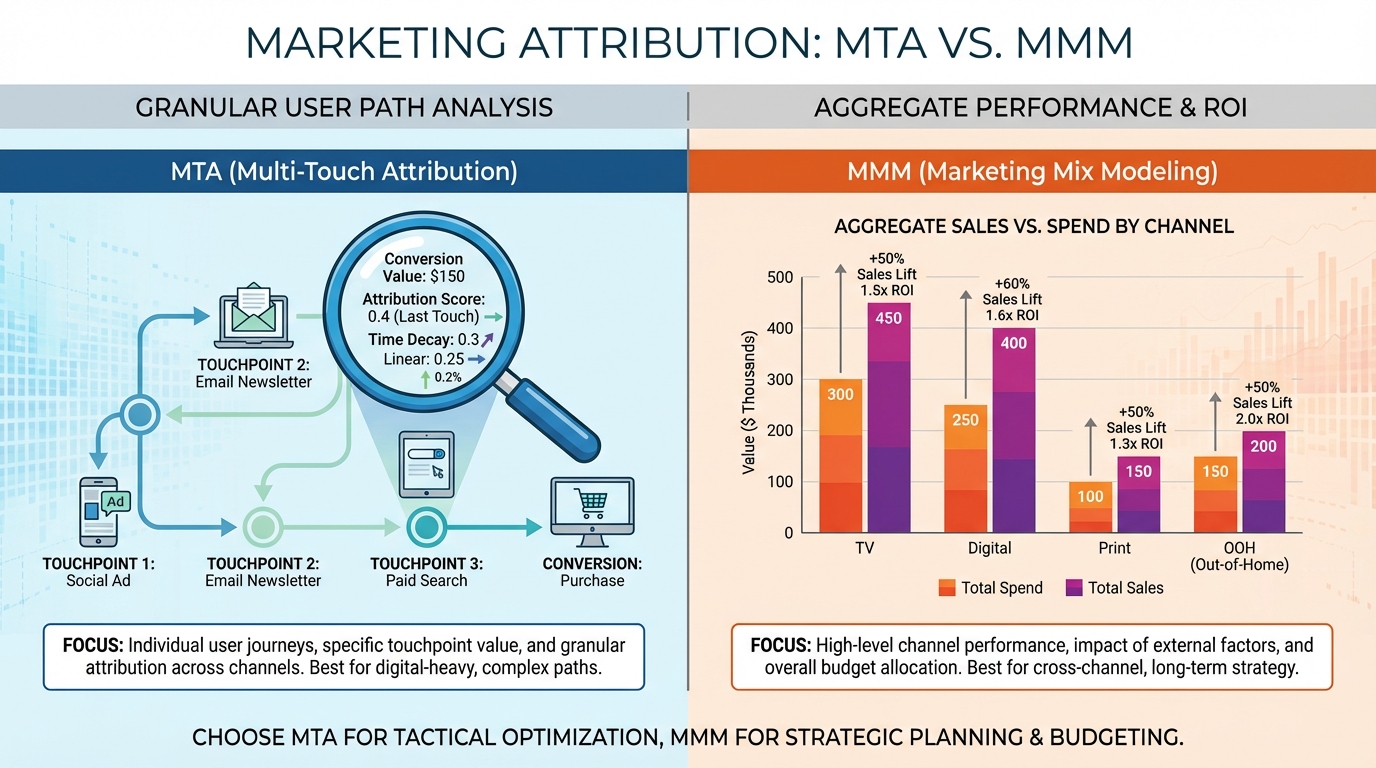
MMM is statistical analysis applied to historical data. It doesn't track users. It tracks variables. When discussing media mix modeling vs attribution, MMM is the top-down approach compared to MTA's bottom-up view.
How it works: MMM looks at spikes in your sales and correlates them with spikes in your marketing spend. It accounts for external factors like seasonality, price changes, or even the weather. Instead of tracking people, it uses math to find patterns in your data to calculate the ROI of each channel.
The Strengths:
- Privacy-Safe: It uses aggregated data, so it requires zero user-level tracking.
- Holistic: It measures everything—TV, Billboards, Podcasts, and Facebook.
- Resilient: It works perfectly in a post-cookie world.
The Weaknesses: Historically, MMM was slow and expensive. You hired a consultancy, gave them data, and got a PDF six months later.
However, modern platforms like BlueAlpha have revolutionized this process. Instead of waiting months, marketing teams can now access automated, privacy-safe insights in days. This allows brands to reallocate budgets in real-time rather than waiting for stale quarterly reports.
According to McKinsey & Company, companies that integrate MMM into their strategy can see marketing efficiency gains of 15-30%.
If you are trying to justify spend on non-digital channels, you need to understand the nuances of marketing effectiveness measurement.
[IMAGE: A split screen comparison graphic. Left side shows 'MTA' with a magnifying glass on a user path. Right side shows 'MMM' with a bar chart of aggregate sales vs spend.] Alt text: Visualizing the difference between user-level MTA tracking and aggregate MMM analysis. Caption: MTA tracks the person. MMM tracks the performance.
Incrementality is the scientific method applied to advertising. It answers the hardest question in marketing: "Would this person have bought anyway?"
How it works: You create a randomized control trial. You show ads to Group A (Test) and withhold ads from Group B (Control). The difference in conversion rate between the two groups is the incremental lift generated by the ad. This is the gold standard of incrementality testing methods.
The Strengths:
- Causality: This is the only method that proves cause and effect.
- Calibration: It acts as a "truth set" to calibrate your MMM and MTA models.
- Platform Independence: You aren't relying on Facebook telling you how good Facebook is.
The Weaknesses: It is expensive and difficult to scale. You cannot run a lift test on every single keyword every single day. You have to "go dark" (stop spending) in certain regions or on certain audiences, which can hurt short-term revenue.
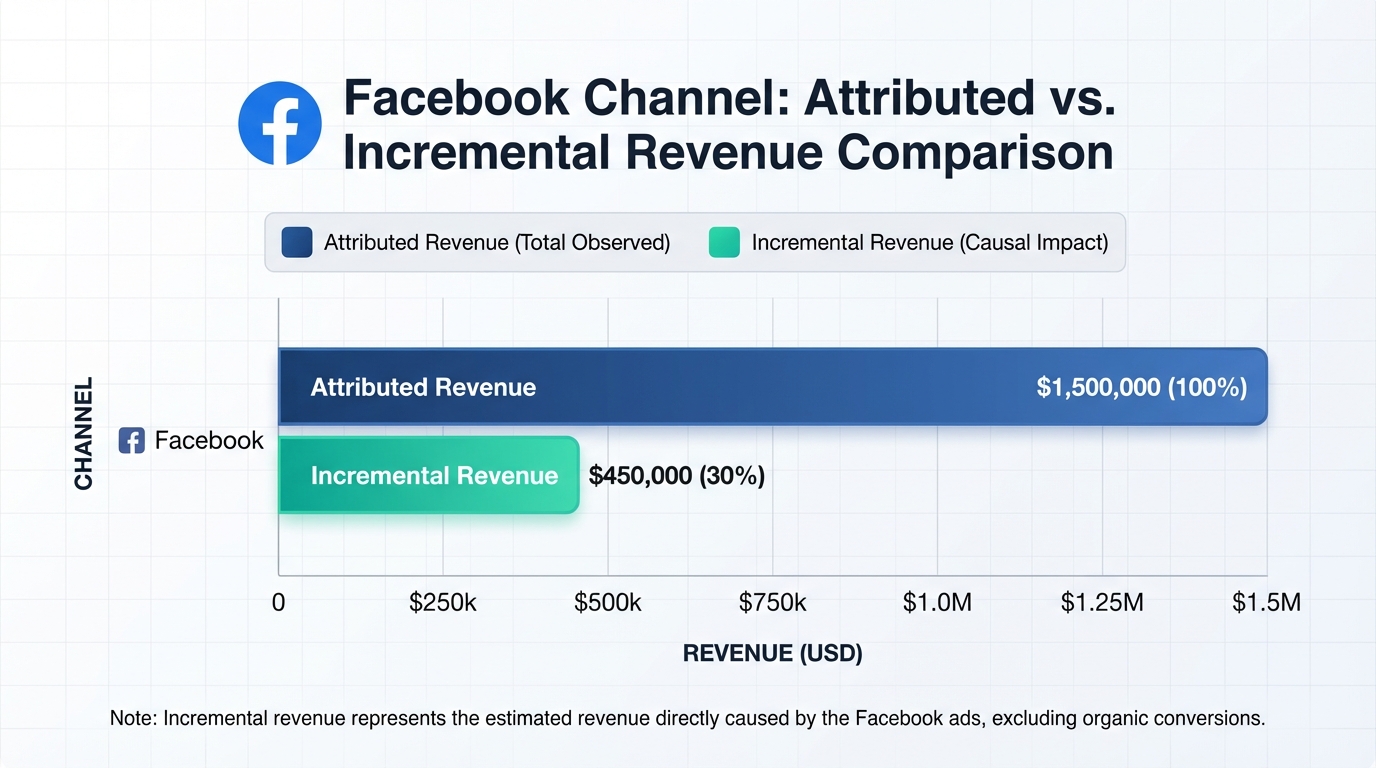
According to a study by Harvard Business Review, companies that fail to account for incrementality often overstate their advertising effectiveness by huge margins, sometimes up to 300%.
To fully understand your returns, you must go beyond basic metrics and conduct a proper marketing ROI analysis.
The Head-to-Head Comparison
Let's look at MMM vs MTA vs incrementality across the vectors that matter most to your bottom line. When weighing media mix modeling vs attribution, the differences become stark in a side-by-side view.
| Feature | Multi-Touch Attribution (MTA) | Media Mix Modeling (MMM) | Incrementality Testing |
|---|---|---|---|
| Data Source | User-level tracking (Cookies/IDs) | Aggregated time-series data | Randomized Control Trials |
| Privacy Risk | High (Vulnerable to regulation) | None (Privacy-by-design) | Low (Uses 1st party data) |
| Scope | Digital channels only | All channels (Online + Offline) | Specific campaigns/channels |
| Speed | Real-time | Weekly/Monthly (Real-time with AI) | Periodic (Weeks to Months) |
| Cost | Medium | Low to High (depending on vendor) | High (Media waste + fees) |
| Best Use | Tactical optimization (Creative/Bid) | Strategic Budget Allocation | Validating Causality |
Why You Need Triangulation (The Unified Approach)
The industry is moving toward marketing measurement triangulation. This means using all three methods to check and balance each other. Major research firms like Forrester emphasize that unified measurement is the only way to get a complete view of the customer journey.
Here is the workflow of a sophisticated marketing team:
- MMM sets the Strategy: Use Media Mix Modeling to determine your quarterly budget allocation across major channels (TV, Meta, Google, TikTok). This maximizes your overall efficiency.
- MTA guides the Tactics: Use attribution data for day-to-day optimizations within platforms. Which creative is working? Which time of day is best?
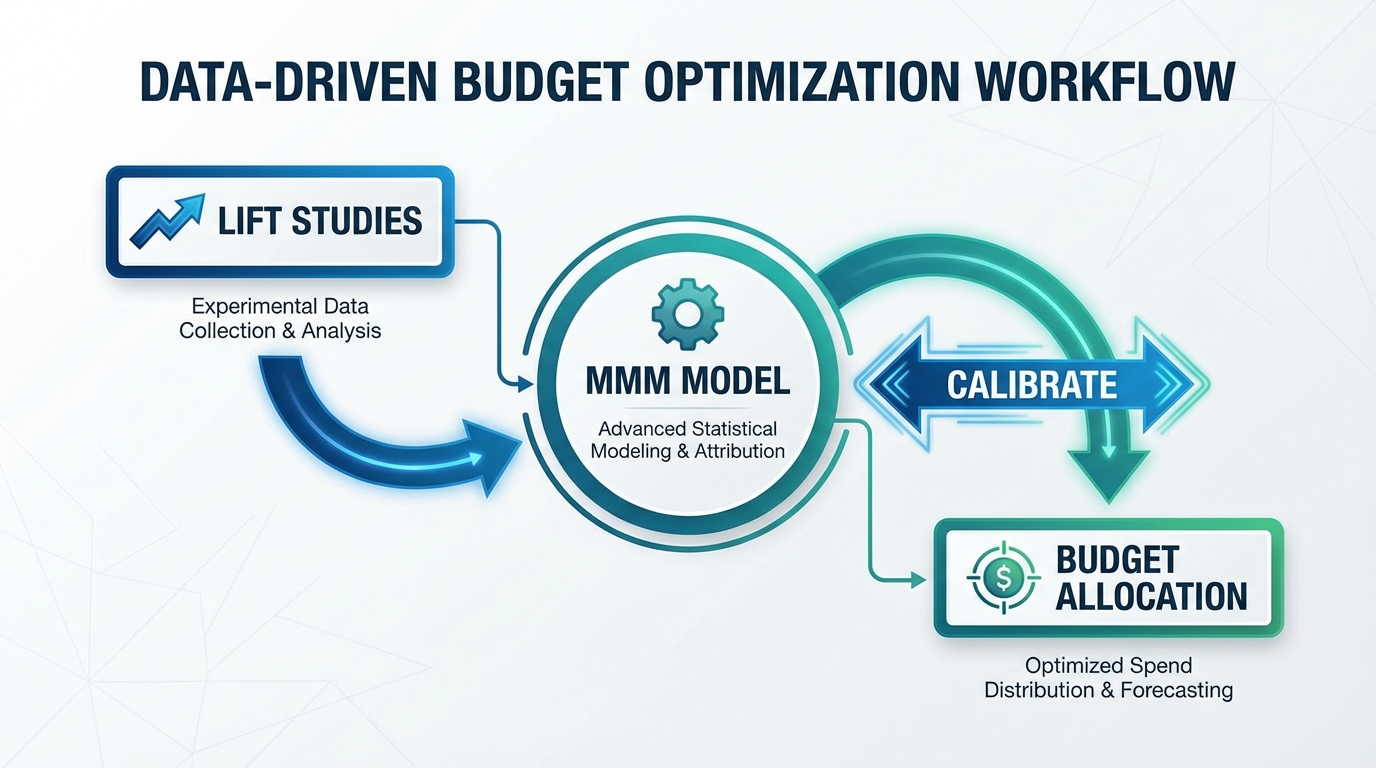
- Incrementality calibrates the Truth: Run quarterly lift tests on your biggest channels. If MMM says Facebook has an ROI of 4.0, but your lift test says it’s 2.5, you feed that lift data back into your MMM to "train" it.
This feedback loop is critical. Without it, your MMM is just a guess, and your MTA is a hallucination.
Modern MMM platforms are designed to ingest this data. For example, when comparing Google Meridian MMM against other open-source options, the ability to integrate lift studies is a key differentiator.
[IMAGE: A workflow chart showing data flowing from 'Lift Studies' into 'MMM Model' to calibrate 'Budget Allocation'.] Alt text: How incrementality testing calibrates media mix models for better budget allocation. Caption: Incrementality tests act as the 'ground truth' to correct your predictive models. Suggested dimensions: 1200x675px
Ten years ago, MMM was for Fortune 500 companies with million-dollar consulting budgets. Today, AI and machine learning have democratized it.
New platforms allow you to connect your data (Shopify, Meta Ads, Google Ads) and generate a model in days, not months. This speed allows for "Tactical MMM." You can now use MMM to make decisions on a weekly basis.
Key capabilities of modern MMM:
- Adstock & Lag Effects: Understanding that a TV ad seen today might drive a purchase next week.
- Saturation Curves: Knowing when the next dollar spent on YouTube will yield diminishing returns.
- Baseline Sales: Calculating how much revenue you would make if you turned off all marketing tomorrow.
If you are evaluating tools, you might look at open-source options like Meta Robyn. But be warned: they require heavy data science resources.
SaaS solutions like BlueAlpha handle the heavy lifting. They ingest data from your entire ecosystem to generate actionable models in days. This eliminates the need for expensive data science hires and puts the power back in the hands of the marketer.
For a direct comparison of tools in this space, looking at Lifesight vs BlueAlpha can clarify the difference between legacy attribution and modern measurement.
Addressing the "Blind Spots"
Every measurement strategy has holes. Here is how the triad plugs them. In the media mix modeling vs attribution debate, these offline channels are where attribution falls apart completely.
1. Influencer Marketing
MTA fails here because users rarely click the influencer's link immediately. They view the content, then search for the brand later. MMM picks up this correlation perfectly. Read more: Influencer marketing performance measurement guide.
2. Out of Home (OOH)
Billboards have no cookies. You cannot track a view. MMM is the only way to measure OOH effectiveness by correlating regional spend with regional lift. Read more: Out of Home advertising tracking guide.
3. Account Based Marketing (ABM)
B2B journeys are long and involve multiple stakeholders. MTA sees the last click, but misses the months of nurturing. Incrementality is hard because sample sizes are small. MMM can help, but you need specific attribution models for high-value accounts. Read more: Account based marketing attribution guide.
[IMAGE: A bar chart showing 'Attributed Revenue' vs 'Incremental Revenue' for a specific channel like Facebook.] Alt text: Chart demonstrating the gap between platform-reported revenue and actual incremental revenue. Caption: Platforms often claim credit for sales that would have happened anyway. Know the difference. Suggested dimensions: 1200x675px
Implementation: How to Start
Stick with your platform reporting (MTA) but treat it with skepticism. Set up a basic spreadsheet to track spend vs. total revenue (MER - Marketing Efficiency Ratio). Research from Nielsen suggests that simply tracking ROAS isn't enough; you need to understand the holistic impact of your spend.
Phase 2: Introduction of MMM Deploy a lightweight MMM solution. You need to understand your baseline sales and channel saturation. This will immediately flag if you are overspending on Facebook or Google. Guide: How to deploy media mix model.
Phase 3: Calibration Run a geo-lift test. Pick two similar cities. Stop spending in one. Measure the difference. Use this number to adjust your MMM targets. This is the practical application of incrementality testing methods.
Phase 4: Unified Optimization Use your calibrated MMM to dictate monthly budgets. Move money from low-incrementality channels to high-opportunity channels. Guide: Media budget optimization guide.
For specific strategies on how to split your budget across the funnel, consult our funnel stage budget allocation guide.
The Role of Privacy
We cannot discuss MMM vs MTA vs incrementality without mentioning privacy.
According to Gartner, by the end of 2026, 75% of the world's population will have its personal data covered under modern privacy regulations. Furthermore, the IAB Tech Lab highlights that the loss of identifiers is not a temporary glitch, but a permanent structural change to the internet.
MTA relies on surveillance. MMM relies on statistics.
As privacy laws tighten, MTA degrades. MMM remains stable. This is why the industry is shifting toward privacy-first marketing measurement. If your current stack relies on user IDs, you are building on a crumbling foundation.
Platforms like BlueAlpha are built on this privacy-first architecture. By analyzing aggregate signals rather than tracking individuals, you future-proof your analytics against the next iOS update or GDPR ruling.
For a deeper look at how privacy-first tools compare, check out our Measured.com vs BlueAlpha comparison.
FAQ
Q: Can I use MMM if I have a small budget? Yes. While historically for big brands, modern AI tools work with budgets as low as $10k/month, provided you have enough historical conversion data (usually 12-24 months) to model effectively.
Q: Does MMM replace Google Analytics? No. Google Analytics (MTA) is for tracking what happened on your website. MMM is for measuring why it happened and planning what to do next. When looking at media mix modeling vs attribution, remember they serve different purposes.
Q: How often should I run incrementality tests? Ideally, quarterly. Or, whenever you launch a major new channel. If you start spending heavily on TikTok, run a lift test immediately to verify the platform's reported numbers.
Q: Which is better for B2B? B2B often suffers from low data volume, which makes MMM harder. However, B2B journeys are complex, making MTA inaccurate. A hybrid approach focusing on pipeline data is usually best. You can learn more about this in our guide to pipeline attribution. We also recommend reading our ABM ROI measurement guide for specific B2B metrics.
Q: Is "Data-Driven Attribution" (DDA) the same as MMM? No. DDA is typically an advanced form of MTA offered by Google or other platforms. It still relies on user-level tracking within that specific ecosystem and misses offline or cross-platform impacts.
Conclusion
The debate of MMM vs MTA vs incrementality is resolved not by picking a winner, but by building a system.
- MTA tells you where to tweak the dial today.
- MMM tells you where to put the radio.
- Incrementality tells you if the radio is actually on.
If you are still allocating millions based on "Last Click ROAS," you are leaving money on the table. The technology exists to measure marketing accurately without invading user privacy.
The future belongs to the marketers who can synthesize these signals. It belongs to those who move beyond "claiming credit" and start measuring true business impact using privacy-first marketing measurement.
Ready to see what your media mix is actually doing? Book a free BlueAlpha demo today. See exactly where your budget is being wasted and where to reallocate for 20%+ efficiency gains—no data science team required.
Explore how modern measurement stacks up: Which MMM is best?
Stay in the loop
Get updates on new posts and resources.