Why Teams Compare Mutinex Alternatives
Compare Mutinex alternatives for marketing mix modeling, scenario planning, measurement services, and cross-channel budget optimization.
Why Teams Compare Mutinex Alternatives
Teams look for Mutinex alternatives when they need more transparency, a different service model, lower cost, or a better fit with their data. No single marketing mix modeling (MMM) platform suits every team. Marketing mix modeling is a statistical method that calculates how marketing channels drive sales. The correct choice depends on your ad spend, your data history, and how much control you want over the model.
This article maps common reasons for switching to specific alternative platforms. It sets out comparison criteria and gives a decision guide. An analyst checked facts about vendor pricing and features on 2026-09-04, and these details can change.
What Mutinex Is Built For
Mutinex sells GrowthOS. GrowthOS is an always-on marketing mix modeling platform. It targets marketing teams that want frequent, accessible outputs instead of a one-time study. The product includes budget scenario planning, which models different allocations and shows projected outcomes before you commit spend.
Mutinex is a hybrid platform. It combines an always-on model with calibration from experiments. Reported pricing runs from roughly $75,000 to $150,000 or more per year. Buyers must confirm current terms directly with the vendor. Independent comparisons list a range of $75K–$150K/yr with a 12–16 week implementation.
Mutinex also markets a faster onboarding option. One comparison describes this option as a 24-hour setup path launched in 2026. This claim comes from a third-party source. Buyers must verify it with Mutinex directly, per a feature comparison of implementation time across MMM vendors.
Reasons to Evaluate Alternatives
Teams usually switch or shop for one of five reasons.
Transparency. Some teams cannot get clear answers about model assumptions, priors, or transformations. Priors are initial statistical assumptions applied before the model processes new data. Open-source tools let you read the code and audit every step. This gives a real advantage to teams with in-house data science support, as noted in an independent buyer's guide comparing open-source and proprietary MMM tools.
Service model. Some teams want a managed service that runs experiments for them. Other teams want self-serve software that they control daily. Hybrid platforms sit in between. They combine experiment design with an ongoing model.
Modeling control. Teams with a data scientist on staff can choose to build and tune their own model. They do not have to depend on a black-box model from a vendor.
Integrations. The breadth of the data pipeline is important. Model output is weak when connectors do not support your channels, currencies, or offline data.
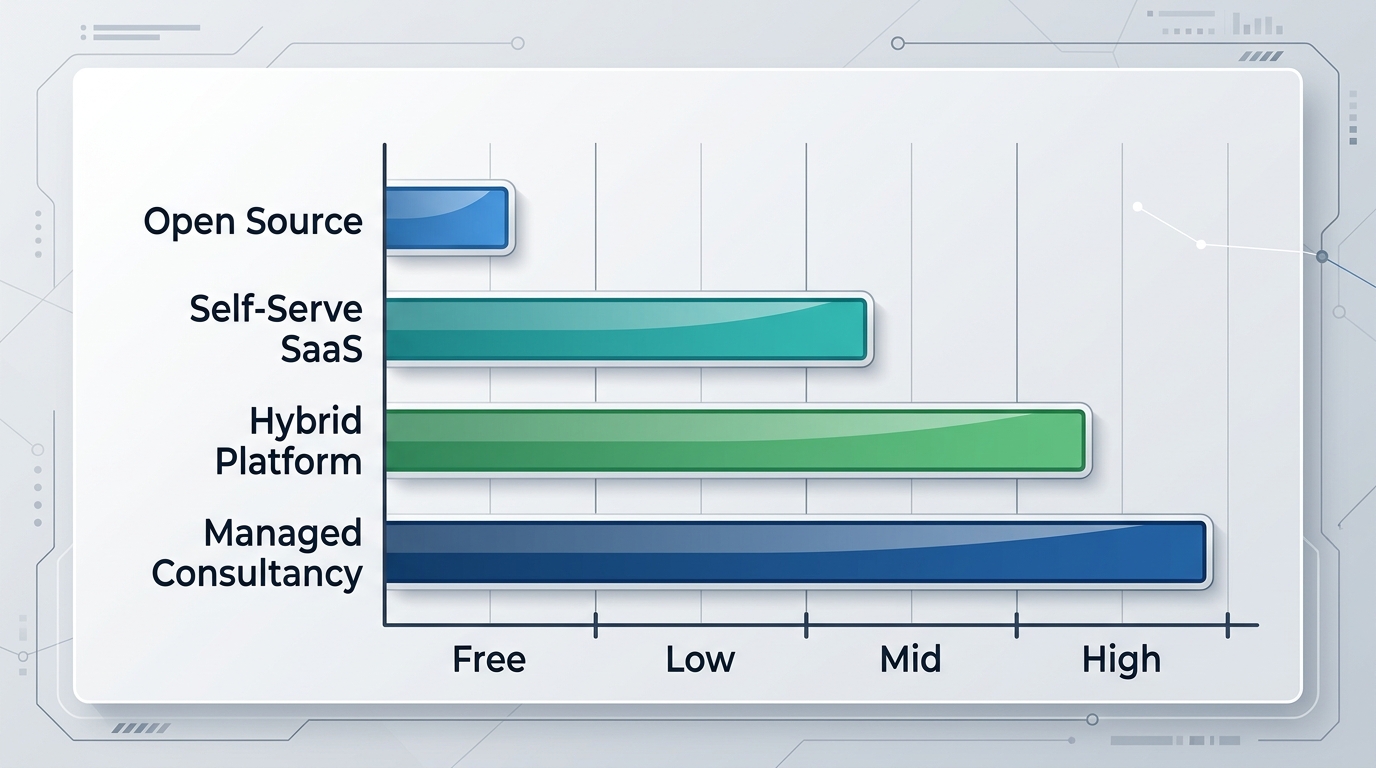
Cost. Price ranges across MMM tools vary widely. They range from free open-source frameworks to six-figure annual contracts. Your ad spend level must drive this decision, not brand preference. One buyer's guide emphasizes that tool selection depends almost entirely on ad spend and data history, not on features.
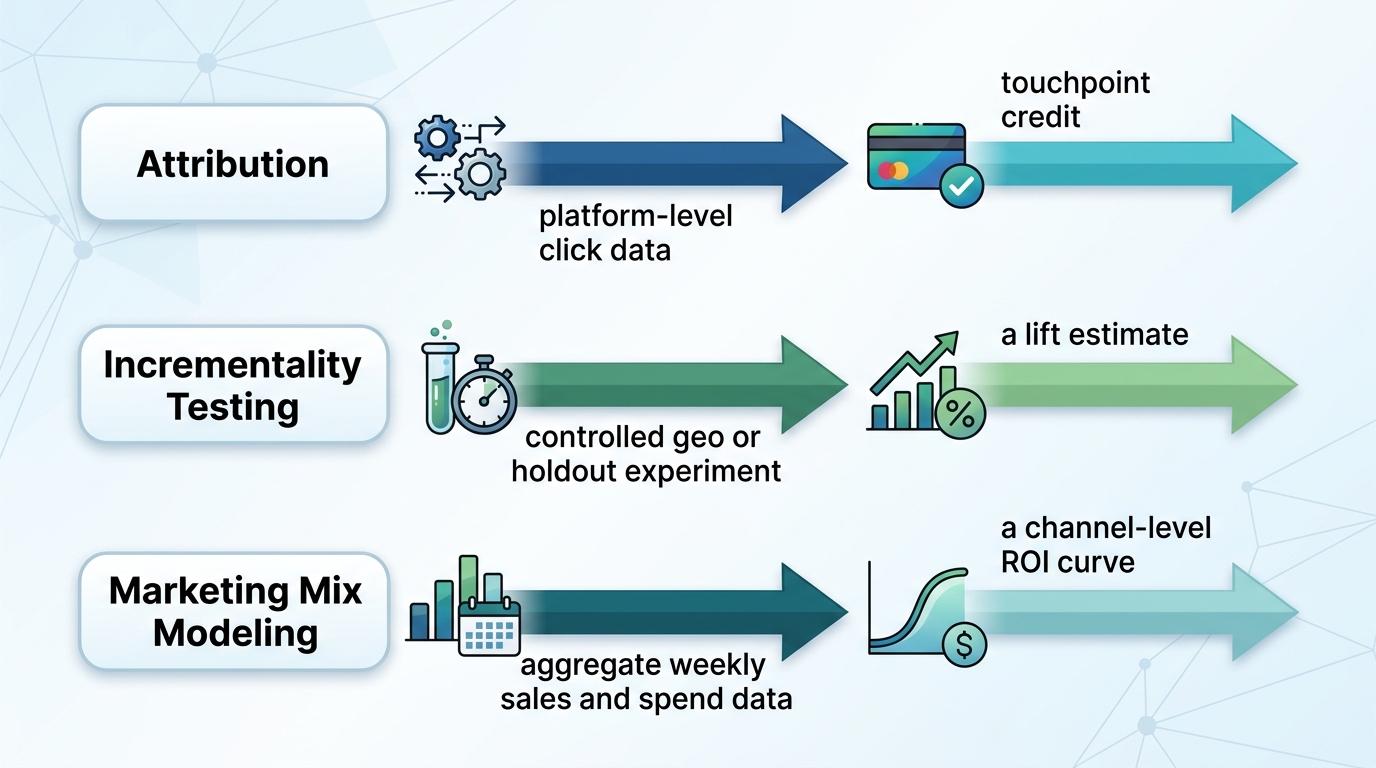
Before you compare specific platforms, separate three different evidence methods:
- Attribution assigns credit to touchpoints in a customer journey, usually from digital ad platform data.
- Incrementality testing measures the true lift from a channel with a controlled experiment, such as a geo holdout.
- MMM is a statistical model that separates sales into marketing and non-marketing drivers with aggregate data over time.
MMM is correlational by design. It approaches a causal estimate only when you calibrate it against experiment results. Our guide to best marketing mix modeling software covers this point in detail. Return on ad spend measures revenue earned for each dollar spent on ads. Marginal return measures the extra revenue generated by one additional dollar of spend.
Comparison Criteria
Use these criteria to score any Mutinex alternative on equal terms:
- Refresh cadence. Does the model update continuously, or do analysts rebuild it periodically as a one-time study? Continuous updates let you act on fresh data quickly. A buyer's guide on always-on versus periodic MMM refresh cycles highlights this distinction.
- Ownership and lock-in. Do you keep the model, the data pipeline, and the insights when the contract ends?
- Methodology transparency. Can the vendor show how the model reaches conclusions? You must explain the model clearly to finance teams and board members.
- Causal validation. Does the platform calibrate against geo-lift or conversion-lift experiments? Correlation alone does not prove true impact.
- Data integration breadth. Count the connectors for your actual channels, including offline media and retail media.
- Time to value and total cost. Count the days until the first usable output. Calculate the true annual cost, including the required internal staff time.
Alternative Platforms
The table below summarizes publicly reported facts about common Mutinex competitors. Confirm current pricing and features directly with each vendor, because terms change.
| Platform | Model | Reported Pricing | Best Fit |
|---|---|---|---|
| Google Meridian | Open source, Bayesian, geo-level | Free | Teams with a data scientist who want full model control, per Google's open-source Meridian documentation |
| Meta Robyn | Open source, ridge regression | Free | Teams with an in-house modeler and 2+ years of weekly data |
| Recast | Self-serve SaaS, Bayesian | Roughly $2,000–$8,000/month | Mid-market teams with $1M–$50M annual marketing budget who want weekly model rebuilds and calibration against lift tests, as described in a comparison of Recast's Bayesian calibration method |
| Measured | Managed service, incrementality plus decomposition | Roughly $50,000–$500,000+/year depending on source | Enterprise teams that want the vendor to run cross-channel experiments and align marketing with finance |
| Analytic Partners | Managed consultancy | Custom, enterprise scale | Large advertisers who want a full-service engagement rather than self-serve software |
| Neuralift | Managed engagement | Roughly $50,000+ per engagement | Teams without in-house statistics expertise running a first MMM test |
Two patterns matter here. First, open-source tools are free, but you must supply a modeler to build and defend the output. Second, the price gap between self-serve SaaS and hybrid platforms is not a markup on the same product. You pay for a bundled calibration program. This program uses real experiments to set priors on channel return on ad spend. Those experimental priors make the numbers defensible to finance teams.
For a broader view of these platforms, see our guide to marketing budget optimization software.
Switching Costs
Moving between MMM platforms is not free. The move costs money even when the new tool has a lower price tag. Plan for these costs before you sign a new contract:
- Data migration. You must move historical spend, sales, and experiment data into the format of the new platform. This task takes weeks, depending on your data warehouse setup.
- Model rebuild time. A new vendor needs time to rebuild and validate a model against your history. Implementation windows across vendors range from a few weeks to several months.
- Staff learning curve. Self-serve and open-source tools require your team to learn new assumptions and interfaces. Budget internal analyst hours for this training.
- Parallel run period. Most teams run the old and new models side by side for three months. This test confirms that the new output stays consistent.
- Contract overlap. Annual contracts on hybrid and managed platforms rarely align with a single cutover date. Plan for some overlapping subscription fees.
Our build versus buy guide for MMM covers the tradeoffs between building an internal model and buying a platform. It also explains the staffing requirements for each path.
Decision Guide
Use your monthly ad spend and data history as the primary filter. Do not rely on vendor marketing claims alone.
| Your Situation | What To Consider |
|---|---|
| Under $50,000/month spend, any data history | A geo holdout experiment, before buying any MMM tool |
| Any spend, under 12 months of history | Wait and collect data, or run a smaller experiment first |
| $50,000–$250,000/month, in-house modeler | Open-source Meridian or Robyn |
| $50,000–$250,000/month, no modeler | Self-serve SaaS such as Recast |
| $250,000+/month, want calibrated output | Hybrid platforms such as Mutinex or Measured |
| Large enterprise, bespoke requirements | A managed consultancy engagement |
Worked example (hypothetical). A retail brand spends $300,000 per month across paid search, paid social, and TV. It has 18 months of weekly data, but it has never run a controlled experiment. This team needs a hybrid platform that combines experiment design with model calibration. Its data history lacks causal evidence. A self-serve tool alone provides a correlational model that the team cannot defend to finance leaders.
Conclusion
There is no single best Mutinex alternative for every company. The correct platform depends on your spend level and your data history. It also depends on your internal modeling staff and your need for vendor-run experiments. Weigh transparency, service model, and total cost together.
Request a requirements and solution-fit review from our team. We provide an independent evaluation of your requirements and suggest platforms that fit your profile.

Stay in the loop
Get updates on new posts and resources.