A Paid Media Strategy Needs Clear Choices, Not More Metrics
Build a paid media strategy that connects business economics, channel roles, creative testing, measurement, and budget reallocation.
A paid media strategy is not a list of platforms and budgets. It is an operating system with clear rules for choice, structure, testing, and proof. This article gives the six parts of that system and shows how they connect.
Business objective and economics
Start with the outcome the business needs. Do not start with the channel mix. Define the target return, the acceptable cost per acquisition, and the margin you must protect. Every later choice, from channel selection to creative testing, must link back to these numbers.
Write down the unit economics before you write a media plan. What is the customer worth over time? What can you afford to pay to acquire one customer? These figures set the top limit on spend and the bottom limit on acceptable performance. A paid media strategy without this math is a set of guesses with a dashboard attached.
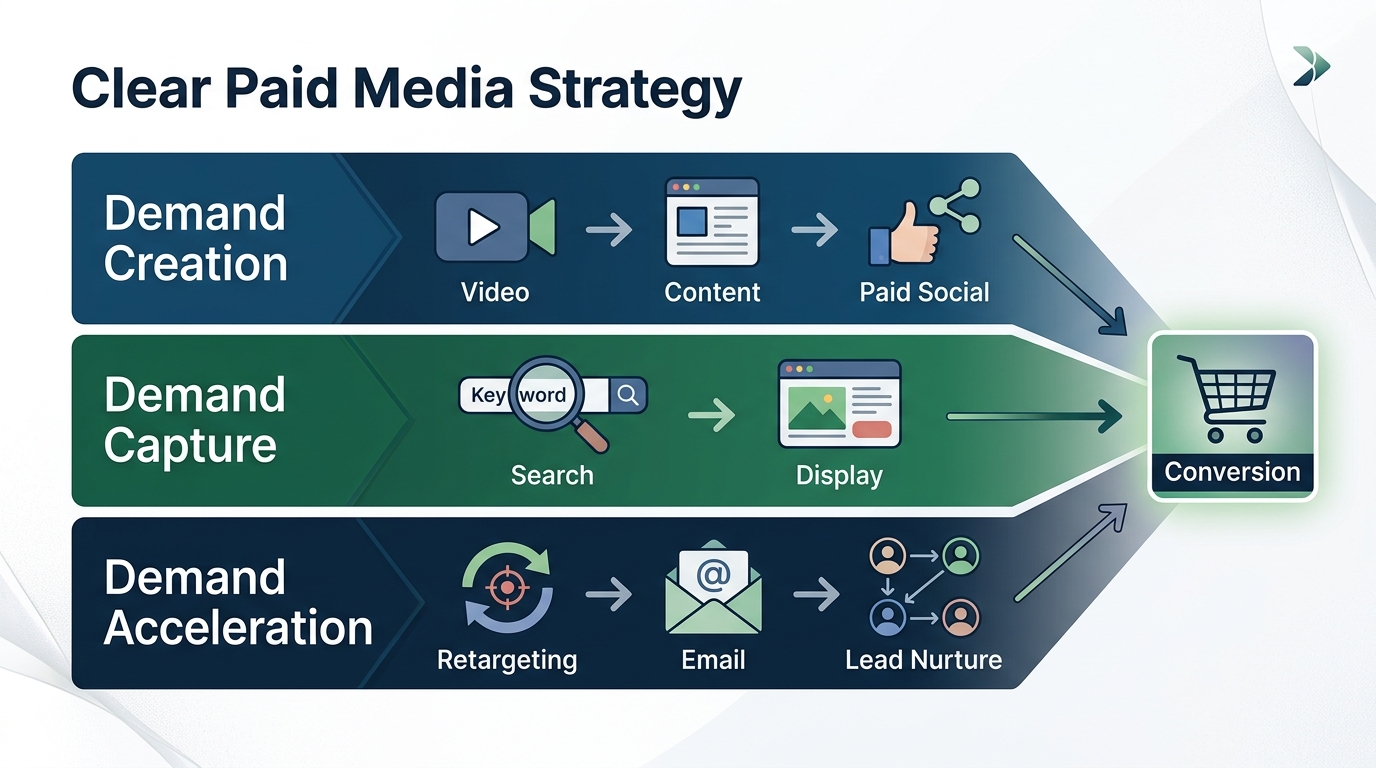
Journey economics also matter. Some channels create demand before a customer searches for a solution. Other channels capture demand that already exists. A useful framework splits channels into three roles: demand creation, demand capture, and demand acceleration. Each role has its own objective and its own evidence standard.
This channel role framework describes the split in more detail. When teams confuse these roles, they judge brand channels by last-click conversion. This mistake understates the true value of brand channels.
Audience and channel roles
Use channel selection as the most important choice in a paid media strategy. Each platform has a different intent model and a different creative format. Search captures people who already look for a solution. Social platforms interrupt users and create new interest.
Business-to-business platforms target by firmographic detail, meaning traits such as company size or industry. Video platforms reach audiences through entertainment-style content. The best plans start with two or three channels, master them, then expand. Do not spread budget thin across every option. This paid media strategy overview makes this point clearly.
Assign each channel one role: creation, capture, or acceleration. Give demand capture channels tighter efficiency targets, because the link to conversion is direct. Demand creation channels look weak in last-click reports. These channels need cohort tracking or lift tests, meaning controlled tests that measure the added effect of a campaign, to prove their value. Judge acceleration channels on both short-term progress and downstream value.
Build a one-page channel role map for your team. For each channel, note:
- The primary role
- The main objective metric
- The margin guardrail
- The evidence standard you require before you scale spend
- The levers you pull to improve results
This map keeps weekly reviews focused on decisions, not on channel-by-channel storytelling.
Campaign architecture
Campaign structure should reflect your economics, not habit. Keep brand and non-brand campaigns separate, because their cost and intent differ sharply. Segment major product categories when margin, conversion rate, or lifetime value differ between them. Use match types and negative keywords to protect relevance. Do not starve automated bidding systems of the data volume they need.
The goal is clarity, not complexity. Use enough structure to control quality. Keep enough volume in each campaign for platform automation to learn patterns. Too many small segments starve each one of data. Too few segments hide real differences in performance.
Worked example (hypothetical). Assume a retailer sells two product lines with different margins.
| Segment | Monthly clicks | Conversion rate | Margin per order | Target cost per acquisition |
|---|---|---|---|---|
| Brand search | 20,000 | 8% | $40 | $12 |
| Non-brand search, Line A | 15,000 | 3% | $60 | $25 |
| Non-brand search, Line B | 15,000 | 2% | $20 | $8 |
Line B cannot support the same cost per acquisition as Line A. Combining them into one campaign would hide this difference and misallocate bids. Separate structure protects margin.
Creative learning system
Creative is not a final product handed to a media team. On broad targeting systems, the algorithm uses creative signals, such as imagery, copy, and format, to find likely buyers. Creative strategy and media strategy are the same work, not two separate handoffs. This analysis of creative as targeting explains this link.
Run creative testing as a production process, not a single campaign. Generate many variants. Test each variant with one variable changed at a time. Set a clear rule for statistical significance before you name a winner. Scale winners fast and stop losers fast. Teams that treat this as routine production consistently outperform teams that treat it as occasional art direction.
A simple weekly creative test cycle:
- Produce five to ten new creative variants.
- Launch each variant with equal initial budget.
- Hold format and offer constant. Change only one variable, such as the opening frame or the headline.
- Set a minimum spend or impression threshold before you judge results.
- Scale the top performer, pause the rest, and record what changed.
Consistency in this cycle builds a library of proven patterns over time. It also gives your measurement stack cleaner signals, because fewer confounded changes happen at once.
Measurement stack
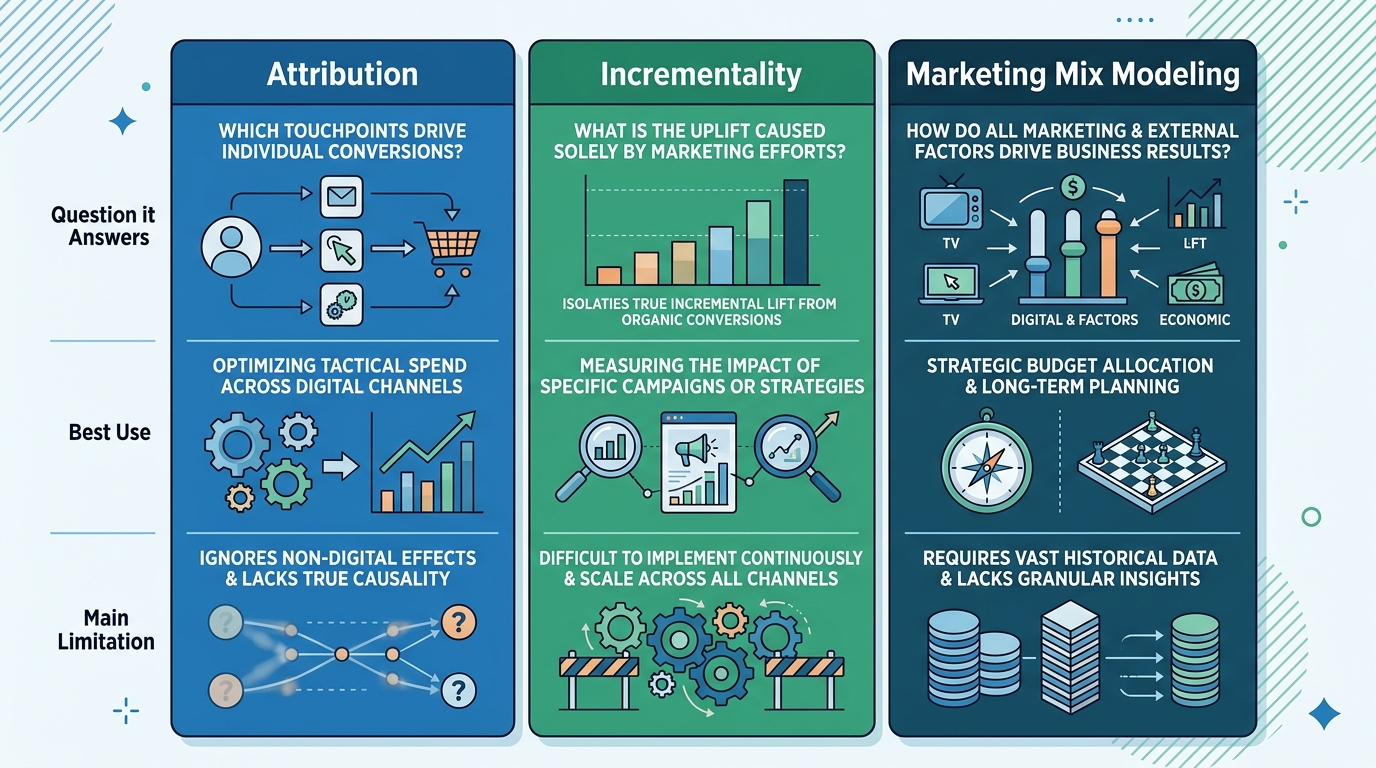
No single measurement method tells you the whole truth. Attribution, incrementality, and marketing mix modeling answer different questions. Each method fails in a different place.
Attribution answers a tactical question: which touchpoint gets credit for a conversion. It is useful for optimizing within one channel. It is a poor guide for cross-channel budget decisions, because platforms tend to overcount conversions. This measurement stack analysis explains the overcounting problem.
Incrementality answers a causal question: what would have happened without this campaign. It is the right tool to defend or cut a channel budget. It is slow and costly to run on every campaign at once, so most teams rotate which channel they test each quarter.
Marketing mix modeling, or MMM, answers a structural question. Given diminishing returns, meaning each added dollar earns less than the last, and delayed effects, how much of total revenue traces to each marketing input. MMM needs many months of steady weekly history to produce a stable answer. It does not tell you which ad set to adjust this Friday, as this guide to MMM for paid teams notes.
These three methods will disagree at times. Teams must expect these differences. MMM guides the quarterly split across channels. Incrementality tests decide whether a channel earns its budget. Attribution guides daily tuning inside one channel.
This unified measurement framework sets out this layered approach. Platform-reported numbers alone should never drive a strategic budget decision. Attribution has also weakened as a signal since privacy changes reduced tracking accuracy across mobile and web browsers. Server-side conversion tracking, meaning tracking that runs on a company server instead of only in the user's browser, helps recover some accuracy. It does not replace the need for incrementality tests and MMM. For a deeper walkthrough of how these methods fit together, see our guide to unified marketing measurement.
Budget governance
Budget governance is the discipline that ties the other five parts together. Separate steering evidence from scaling evidence. Steering evidence refers to the fast signals you use to tune spend week to week. Scaling evidence refers to the stronger proof you need before you commit new budget to a channel. Steering evidence can be imperfect.
Scaling evidence should rely on holdout tests, geographic tests, and reconciliation to actual revenue and retention data. Holdout tests withhold spend from part of the audience. Review budget as one portfolio. Do not manage five separate channel budgets in isolation.
Send each dollar where the next dollar earns the highest marginal return, regardless of which platform earns the credit. Marginal return means the added revenue from one more dollar of spend. Our guide to paid media budget allocation covers this allocation process in more depth. Our marketing ROI analysis guide explains how to connect spend to return across a full portfolio.
Set a governance calendar. Decide when you refresh MMM, when you run each incrementality test, and when you review platform attribution for tactical tuning. Write down which evidence wins when two methods disagree. A written rule prevents a debate every time the numbers do not match.
Conclusion
A paid media strategy works as a system of connected choices, not a stack of platform tactics. Clear economics set the target. Channel roles guide where to spend. Campaign structure protects margin. A creative testing habit produces steady improvement.
A layered measurement stack gives honest evidence instead of platform-reported credit. Budget governance turns that evidence into disciplined action. If you want to check how your own measurement and allocation system holds up, review it against these six parts. Find where evidence and budget decisions do not yet connect.

Stay in the loop
Get updates on new posts and resources.