Server-Side Attribution Improves Data, Not Causal Proof
Understand server-side attribution architecture, event quality, consent, deduplication, and why better collection does not guarantee causal measurement.

Server-side attribution does not prove that an ad caused a sale. It improves the delivery and shape of event data. It moves event collection from the user browser to a server that you control. This change reduces data loss without adding proof of cause. Teams that treat it as proof of impact make a measurement error. Teams that treat it as better data plumbing use it well.
This article explains how server-side collection works. It covers identity, consent, and deduplication (the removal of duplicate event records). It also separates attribution from incrementality and marketing mix modeling (MMM). These are three different methods of evidence.
Browser vs server collection
A browser event starts when a script on the user device fires a tag. The script runs in the user browser. It can fail because of ad blockers, script errors, or a closed tab before the event sends.
A server event starts on infrastructure that you control. Your web server, commerce platform, or customer relationship management (CRM) system sends the event. The server confirms an order, a lead stage, or another outcome after the browser interaction ends.
Most working setups use both paths. The browser records interaction context, such as a click identifier. The server confirms the outcome later and sends the permitted event to an ad platform. This pattern recovers events lost to page exits and browser delivery limits. See this server-side tracking and attribution guide for more detail. The pattern does not create identifiers that you never collected.
Browser restrictions matter here. Intelligent Tracking Prevention (ITP) in Safari limits the life of some cookies. Research on server-side tracking data quality shows that a server-set first-party cookie can last far longer than a browser-set cookie. However, click-tagged visits still get shorter limits. Sending the event from a server changes the transport method. It does not remove the browser policy that limits cross-site tracking.
Reference architecture
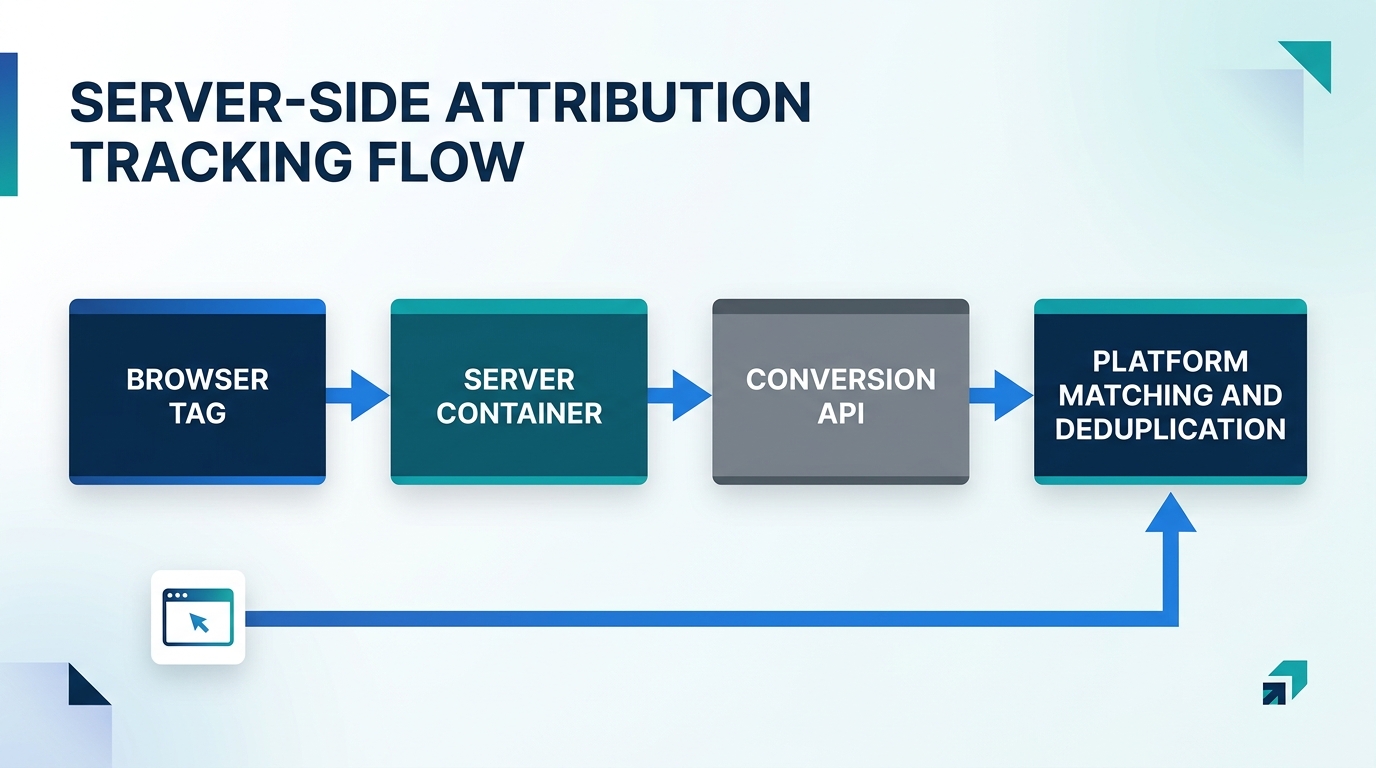
A common server-side setup has four parts. Each part has one job.
- A browser tag captures the click identifier, consent state, and interaction context.
- A server container, or tagging layer, receives the event and adds backend facts, such as verified revenue.
- A conversion application programming interface (API), such as Meta Conversions API or Google Enhanced Conversions, sends the event to the ad platform. A server-side event tracking guide for marketers names this process.
- A matching and deduplication process on the platform side joins the browser copy and the server copy of one event.
This architecture improves data capture. It does not change what the platform can prove about cause. For a broader view of how this fits with cookie loss, see our guide to cookieless marketing measurement.
Identity and consent
Server-side collection does not solve identity on its own. Platforms match events with signals they already use. These signals include click identifiers, hashed first-party data, device context, and platform account data. One analysis of server-side attribution limits notes that cross-device identity still needs a shared login or a captured email address. No server method can link a phone session to a laptop session without a shared identifier.
Consent travels with the event. It does not disappear because the event moved to a server. Google documents a consent mode implementation that needs a default consent state and an update when the user changes that choice. You still need a recorded consent choice, an approved default setting, and clear rules for each destination.
Hashing a value protects it in transit. Hashing does not make the data anonymous. It does not create permission to use the data. Treat hashing as a security step, not a consent step.
Deduplication
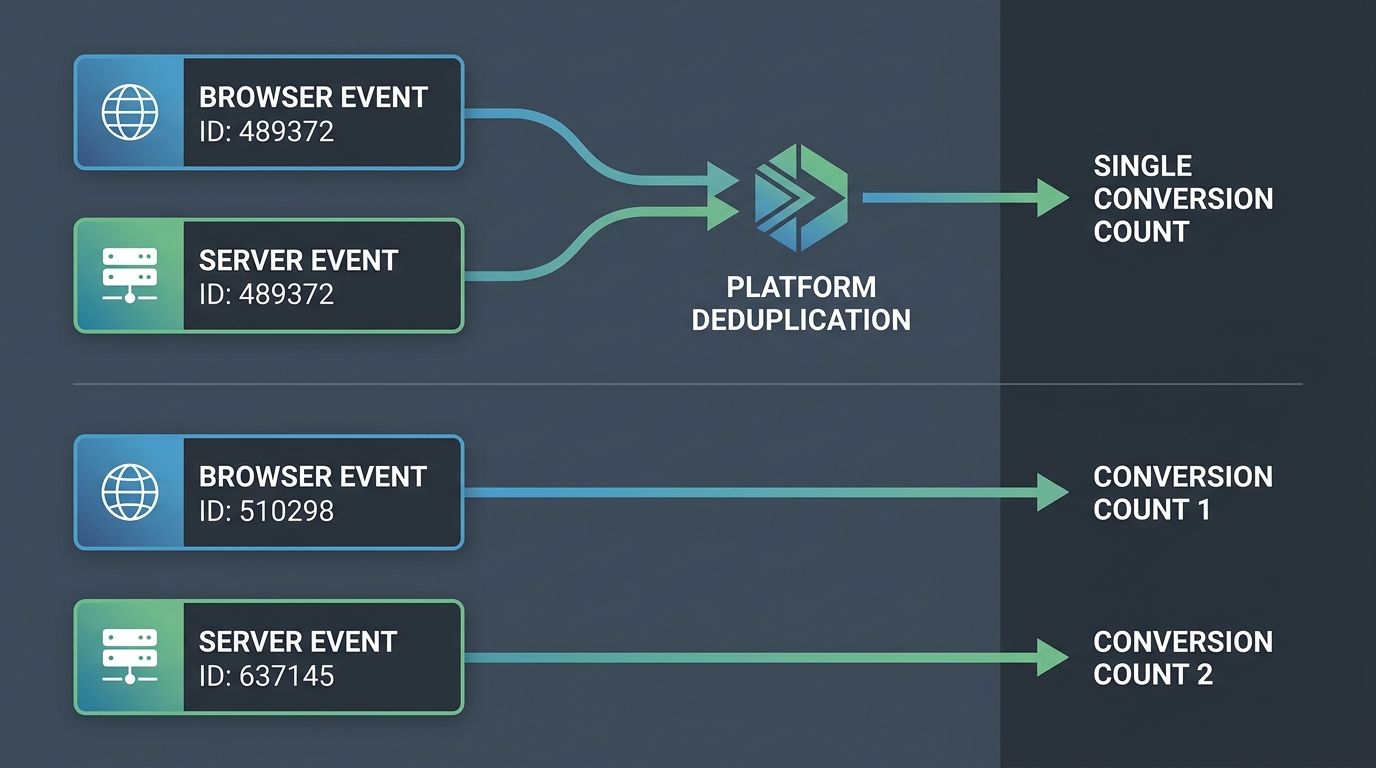
If you run a browser event and a server event for one transaction without a plan, you will count the sale twice. The fix is a shared business event identifier. Generate the identifier once, at the point of transaction or lead-stage change. Use the same value in both the browser copy and the server copy.
Meta's Conversions API documentation describes matching browser events and server events by using the event name and event identifier together. A first-party data activation playbook summarizes this process. Events that share an identifier within a time window get merged into one conversion record. Google asks for a unique order identifier for the same reason when you import offline conversions.
Test the setup before you trust it. Use this checklist:
- Send one browser event and one server event with the same event identifier.
- Confirm that the platform accepts both requests.
- Confirm that the platform counts one conversion, not two.
- Retry the server event and confirm that the count does not change.
- Send a new event identifier and confirm that the platform counts it as a separate conversion.
An accepted request is not proof of a match. A successful response from the platform server tells you that the platform received the data. It does not tell you that the platform matched, deduplicated, or used the event in bidding.
Benefits and blind spots
Server-side collection delivers real, specific benefits. This list states them plainly.
- Fewer events get lost to ad blockers and script failures.
- Delayed outcomes, such as a CRM-confirmed lead, can join the event stream later.
- You gain one controlled place to strip or format personal data before it leaves your systems.
- First-party cookies set on your own domain can persist longer than script-written browser cookies. See the server-side tracking data quality notes for more detail.
The blind spots are just as real. Server-side collection cannot do the following:
- Reconstruct an identifier that you never captured at the click.
- Match every event to a platform account. Anonymous sessions, shared devices, and deletion requests remain standing limits.
- Prove that the ad caused the outcome. It only improves the quality of the input data.
- Replace consent. The legal duty to get consent does not change because the event moved to a server.
Hypothetical example: a retailer adds server-side tagging and a shared event identifier. Reported conversions in the ad platform rise by a measurable amount over the prior month. This rise likely reflects recovered events, not new causal lift. Without a holdout test, the retailer cannot separate "we now see sales that already happened" from "the ad caused more sales." For a deeper look at this reconciliation problem across channels, see our page on cross-channel attribution.
MMM and experiments
Attribution, incrementality, and marketing mix modeling answer different questions. Keep these methods separate.
| Method | What it measures | Typical question answered |
|---|---|---|
| Attribution (with or without server-side collection) | Which recorded touchpoint a platform credits for a conversion | "Which ad interaction does the platform link to this sale?" |
| Incrementality testing (holdouts, conversion lift) | Causal lift from a controlled comparison | "Did this campaign cause sales beyond what would have happened anyway?" |
| Marketing mix modeling (MMM) | Aggregate, model-based estimate across channels and time | "How should we allocate budget across channels?" |
Research on inefficiencies in digital advertising markets traces MMM back to time-series sales and advertising models from the 1960s. MMM produces a correlational estimate, improved by good prior assumptions. It does not replace a controlled experiment. A cookieless attribution stack analysis treats MMM and incrementality testing as answers to different questions.
For a question about budget allocation, use a calibrated MMM. For a question about whether one channel causes incremental sales, run a geo holdout test or a conversion lift study. Server-side attribution feeds cleaner data into both methods. It does not substitute for either one. Our page on unified marketing measurement describes how these methods fit into one measurement program.
Conclusion
Server-side attribution is a collection method, not a system of proof for cause. It reduces data loss from ad blockers, script failures, and some browser limits. It keeps business event identifiers intact across systems. It does not bypass consent requirements. It does not turn platform-reported conversions into evidence of causal impact. Treat each method, attribution, incrementality testing, and MMM, as a tool with its own job.
If your team wants a clear view of what your current setup can and cannot prove, invite us to run a privacy-aware measurement architecture review.

Stay in the loop
Get updates on new posts and resources.