Cookieless Marketing Measurement: Why MMM Is the Answer
Discover why cookieless marketing measurement matters in 2026. Learn how Media Mix Modeling provides accurate attribution without privacy risks. Get a demo.
The third-party cookie is dead. It didn’t die quietly. It was a slow, painful demise. It stretched over years of privacy regulations, browser updates, and changing consumer expectations. Yet, many marketing teams are still holding a wake. They wonder how to track performance without their favorite crutch.
You don’t need a funeral. You need a new calculator.
In this guide, you’ll learn why pixel tracking failed and how probabilistic models restore your visibility. Cookieless marketing measurement isn't just a compliance requirement. It is a superior way to understand business growth. The era of tracking every single user click across the internet is over. We have entered the era of probabilistic modeling.
If you rely on pixel-based attribution to decide where to spend budget, you are flying blind. The data is incomplete. The attribution is wrong.
There is a better way. It’s called Media Mix Modeling (MMM). It is the only viable path forward for modern brands.
The Great Signal Loss
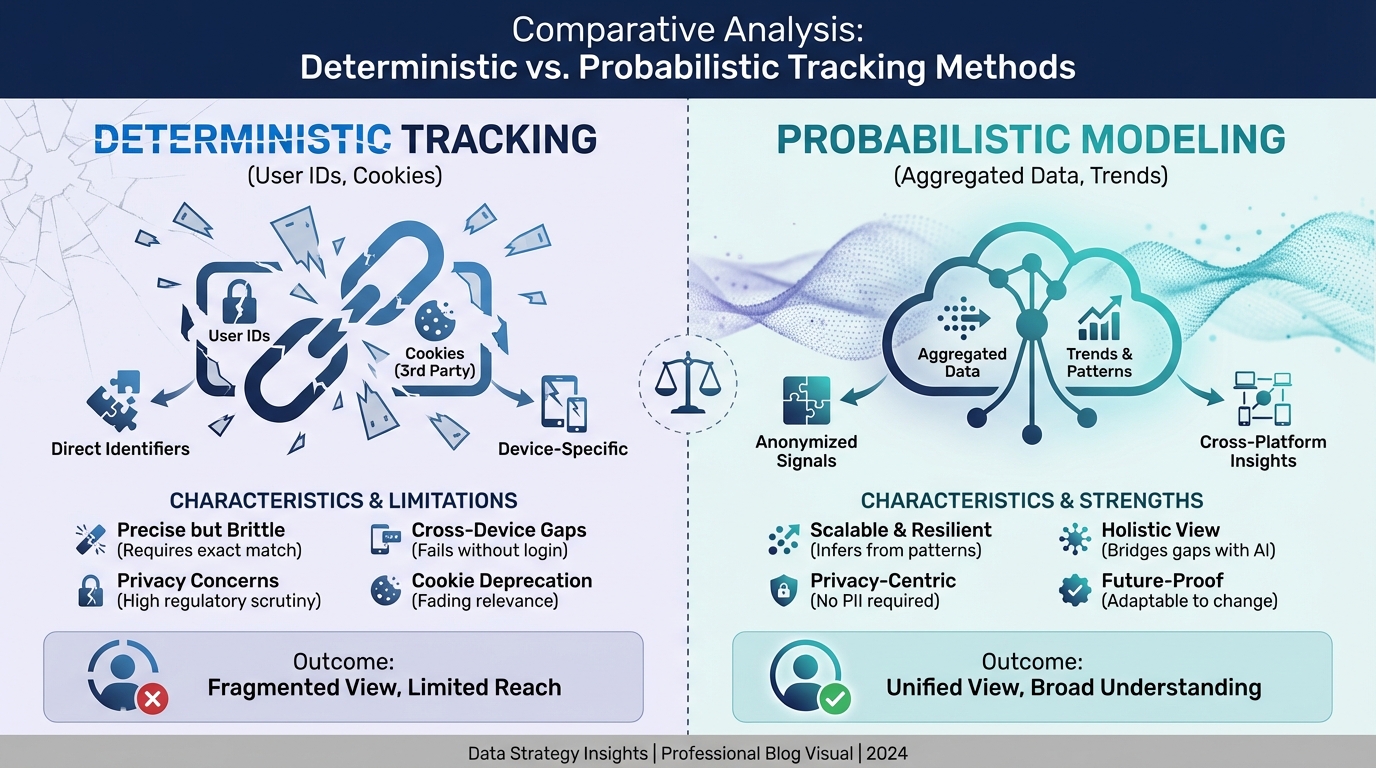
For a decade, digital marketing relied on deterministic tracking. You ran an ad. A user clicked. A pixel fired. You got a sale. It felt precise.
It was also an illusion.
Multi-Touch Attribution (MTA) always struggled with cross-device behavior. It missed offline impact too. Then, privacy laws like GDPR and CCPA arrived. They tightened the screws further. Now, with iOS tracking transparency and the deprecation of cookies in Chrome, the "signal loss" is catastrophic.
Platforms like Meta and Google can no longer see everything that happens after a click. This creates a massive gap. Your Facebook Ads Manager might claim 50 conversions. Your backend sees 80. Or worse, it sees 20.
To bridge this gap, you need a methodology that avoids spying on individual users. You need a top-down approach. You must look at correlation and causation at a macro level. This is where we turn to a comprehensive marketing effectiveness measurement guide. It helps us rethink how we define success.
For a deeper understanding of these regulatory shifts, review the information on the Google Privacy Sandbox. It explains the technical changes driving this new reality.
What Is Cookieless Marketing Measurement?
Cookieless marketing measurement evaluates campaign performance without unique user identifiers. It does not use third-party cookies. Instead of tracking Who bought the product, you analyze Why sales happened. You use aggregated data to find the answer.
This approach respects user privacy by design. It doesn't care about "John Doe from Chicago." It cares that you spent $5,000 on YouTube. It cares that you saw a 15% lift in revenue three days later.
This solves the issue of signal loss by bypassing the need for user-level data entirely. If the signal isn't required, losing it doesn't hurt your math.
The primary vehicle for this measurement is Media Mix Modeling (MMM).
Why MMM is the Natural Successor
MMM uses statistical analysis. It quantifies the impact of various marketing tactics on sales. It ingests data from all your channels—spend, impressions, clicks. It correlates this data with your business outcomes.
It uses aggregated data. Therefore, it is immune to browser restrictions. Apple can lock down iOS. They cannot hide the fact that you spent money and your revenue went up.
For a deeper dive into the mechanics, read our media mix model marketing attribution guide. It breaks down the statistical regression techniques that power these insights.
You can also reference the official GDPR text to understand why aggregated data is the safest path forward for compliance.
The Core Benefits of Moving Away from Cookies
Switching to MMM isn't just a defensive move. It offers strategic advantages. Pixel-based tracking never could match these benefits.
1. True Privacy Compliance
You stop worrying about the next privacy regulation. MMM works with data you already own. It uses aggregated spend data from platforms. It is the foundation of privacy-first analytics.
2. Holistic View (Online + Offline)
Cookies never tracked billboards. They were terrible at tracking TV. They couldn't account for the "halo effect" of brand awareness. MMM ingests everything. If you run a podcast ad or a direct mail campaign, MMM measures it alongside your TikTok ads.
This is crucial for brands with diverse spending. If you struggle to track non-digital channels, check out our out-of-home advertising tracking guide.
3. Measuring Incrementality
The biggest lie in marketing is "last-click attribution." A user might click a Google Search ad before buying. That doesn't mean Google generated the demand. They might have seen three Instagram ads first.
Cookieless marketing measurement focuses on incrementality. This is the additional revenue generated by a specific channel that wouldn't have happened otherwise.
According to a study by Gartner, marketing leaders who utilize advanced analytics like MMM are significantly more likely to exceed their revenue goals than those relying solely on last-click models.
The Evolution of MMM: From Excel to AI
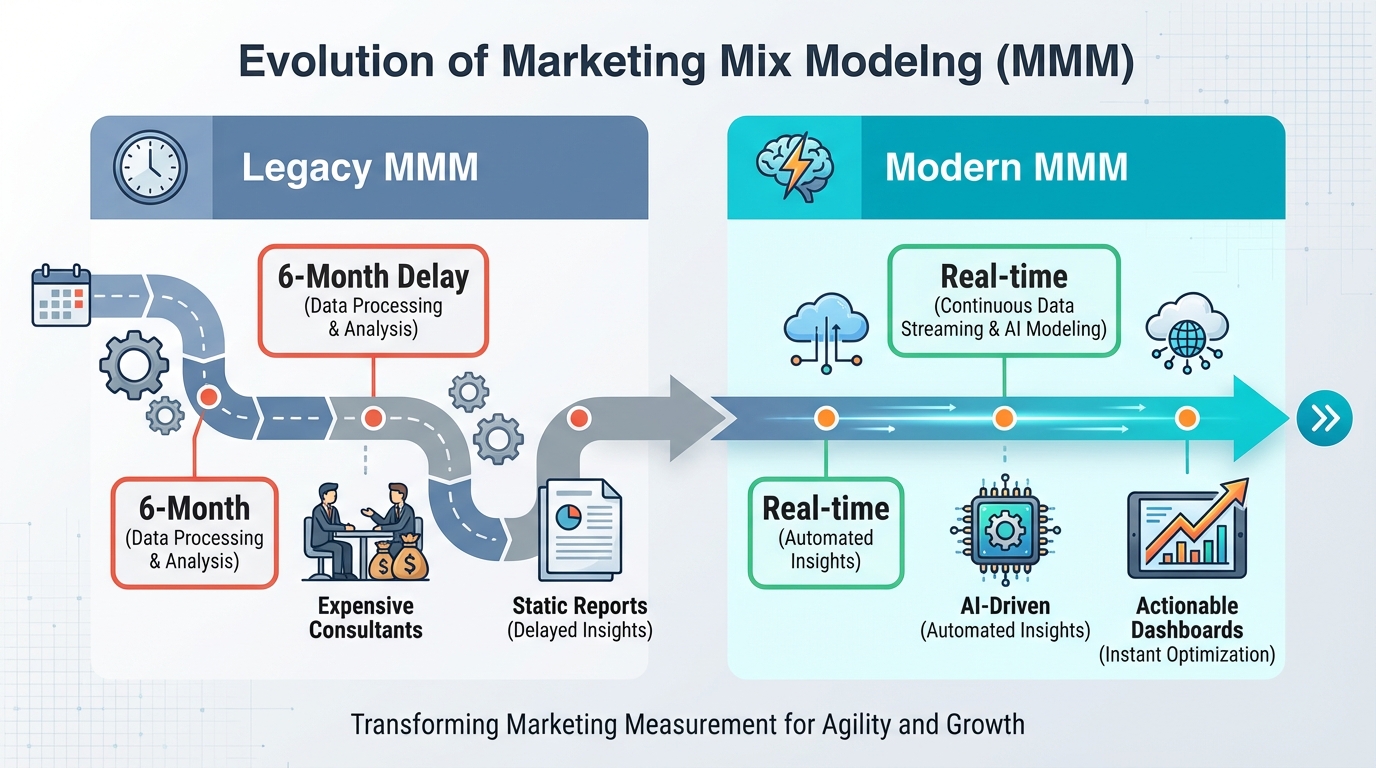
Historically, MMM had a reputation problem. It was slow. It was expensive. It was reserved for Fortune 500 companies. You hired a consultancy. You gave them data. Six months later, they gave you a PowerPoint deck. It told you what you should have done last quarter.
That is "Legacy MMM." It doesn't work for agile brands.
"Modern MMM" is different. It is powered by AI and machine learning. It updates in near real-time.
Leading platforms like BlueAlpha have revolutionized this space. They process complex data in days, not months. This speed is critical. It allows brands to run models weekly or even daily. You get the accuracy of a consultancy with the speed of a SaaS tool.
This shift allows for rapid media budget optimization. You can spot a trend on Tuesday. You can shift budget by Thursday. You aren't waiting for a quarterly audit.
[IMAGE: A timeline graphic. Left side: "Legacy MMM" (6-month delay, expensive consultants). Right side: "Modern MMM" (Real-time, AI-driven, actionable dashboards).] Alt text: Timeline showing the evolution from slow legacy MMM to fast modern AI-driven MMM.
To understand why cookieless marketing measurement is superior, you have to look at the alternatives.
MTA (Multi-Touch Attribution)
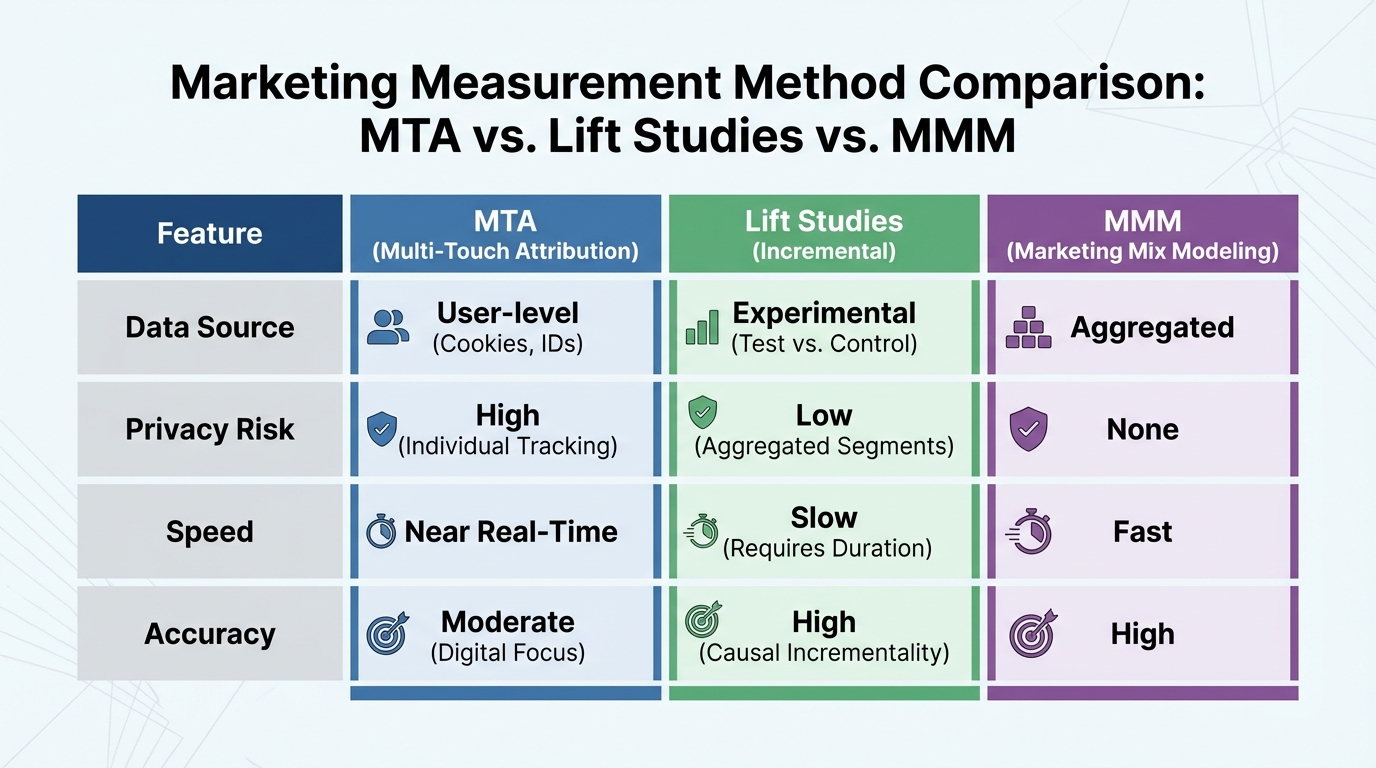
MTA attempts to assign value to every touchpoint in a user's journey. In theory, it's perfect. In practice, it's broken. Without cookies, MTA suffers significantly from signal loss. It sees the first click. It sees the last click. Everything in between is a black hole.
We’ve detailed this battle in our MTA vs MMM marketing attribution comparison. The conclusion is clear. MTA requires data that no longer exists.
Lift Studies
Lift studies (Geo-lift or Conversion Lift) are great for validating data. You turn off ads in California. You keep them on in New York. You watch the difference. However, they are expensive. They are disruptive. You can't run a lift study every week without hurting your growth.
The Hybrid Approach
The smartest brands use a "Triangulation" method. They use MMM as their source of truth for budgeting. They use MTA (what's left of it) for day-to-day tactical tweaking. And they use lift studies to calibrate their MMM.
This triangulation is often discussed when comparing tools. For instance, when looking at Measured.com vs BlueAlpha, you see different approaches to how incrementality is validated.
[IMAGE: A comparison table listing MTA, Lift Studies, and MMM. Rows include "Data Source," "Privacy Risk," "Speed," and "Accuracy." MMM should show "Aggregated," "None," "Fast," and "High."] Alt text: Comparison table of MTA, Lift Studies, and MMM attribution models. Caption: Comparing the strengths and weaknesses of modern attribution models.
So, how do you actually build this? It’s not as hard as it sounds. It requires data discipline.
Step 1: Data Unification
You need all your data in one place. Spend data from Facebook, Google, TikTok, TV, and influencers. You also need clean first-party data from your CRM or e-commerce platform to track actual sales.
If you use tools to aggregate this data, you might look at connectors. Many brands start with simple pipelines. Eventually, you need analysis, not just storage. This is a key point in our Funnel.io vs BlueAlpha comparison guide.
Step 2: Choose Your Model
You have options. You can build in-house using open-source libraries. Google and Meta have released their own libraries to help with this transition.
- Google Meridian: A robust option for those with data science teams. Read our Google Meridian MMM complete guide. You can also view the official Google Meridian documentation for technical specs.
- Meta Robyn: Another strong open-source contender. Check out the Meta Robyn open source MMM guide. The Meta Robyn GitHub repository offers the code directly.
However, open-source requires maintenance. Most brands prefer a managed solution like BlueAlpha. It handles the heavy lifting and calibration automatically.
Step 3: Calibration and Testing
A model is only as good as its inputs. You need to test it. Run a small experiment. If the model predicts a 10% drop in sales when you cut YouTube spend, and you cut YouTube spend and sales drop 10%, your model is calibrated.
For a step-by-step walkthrough, refer to our guide on how to deploy a media mix model.
[IMAGE: A flowchart showing the data pipeline. Input sources (Ads, CRM, Macro factors) -> Processing Layer (MMM Engine) -> Output Dashboard (ROI, Budget Recommendations).] Alt text: Flowchart illustrating the data processing pipeline for media mix modeling. Caption: A clean data pipeline is the backbone of accurate cookieless measurement.
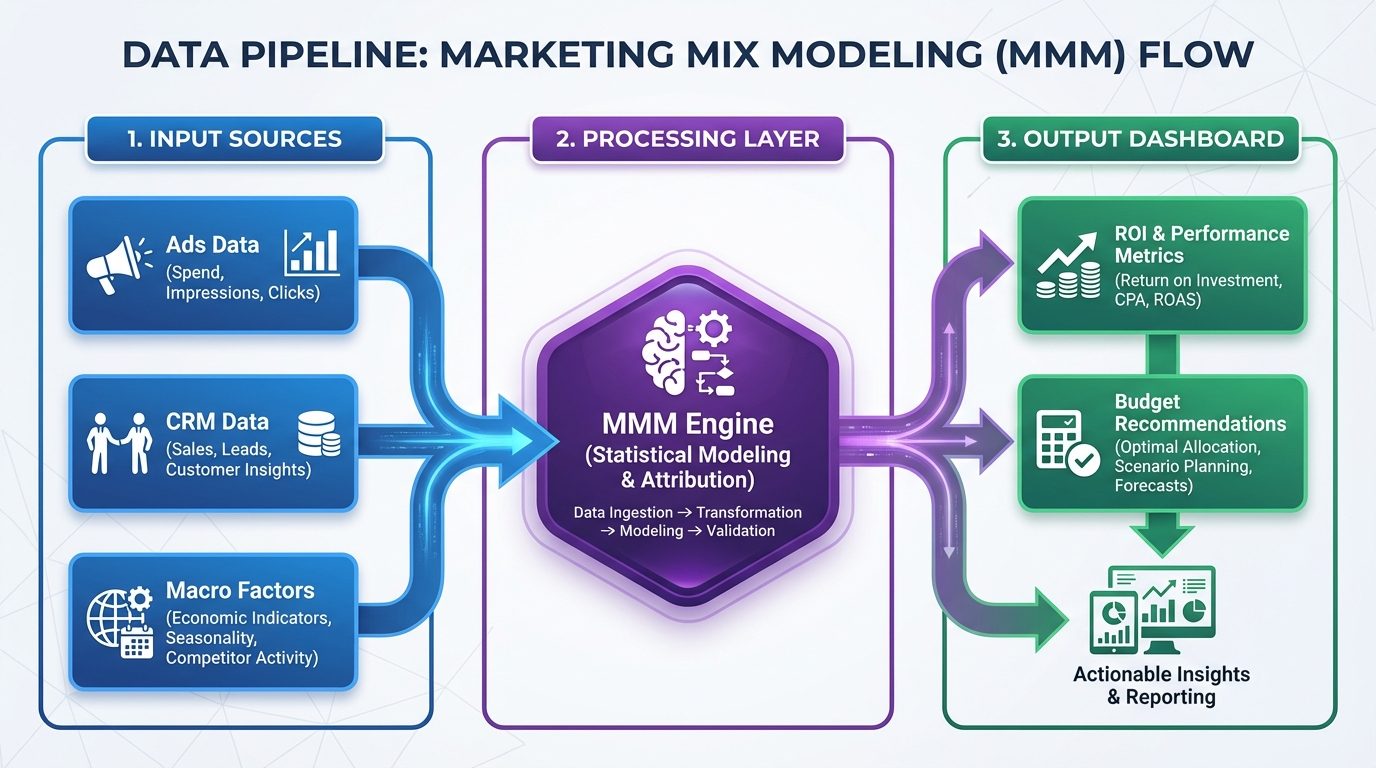
MMM shines where pixels fail. Let's look at two specific areas where cookieless marketing measurement is the only valid option.
Influencer Marketing
Influencer marketing is notoriously hard to track. A user sees an influencer's post. They don't click the link. They open a new tab and buy the product. Pixel attribution gives the influencer zero credit. MMM sees the spike in baseline sales. It correlates that spike with the post date.
This ensures you aren't underpaying your best creators. For more on this, read our influencer marketing performance measurement guide.
Account-Based Marketing (ABM)
In B2B, the sales cycle is long. Cookies expire before the deal closes. MMM works over longer time horizons. It allows you to correlate marketing activity with closed-won revenue months later.
This connects directly to account-based marketing attribution. It ensures marketing gets credit for the pipeline they generate.
The Role of AI in Cookieless Measurement
Artificial Intelligence has transformed MMM. It moved from a statistical exercise to a predictive engine.
Legacy models were descriptive. They told you what happened. AI models are prescriptive. They tell you what will happen.
By analyzing historical patterns, AI can simulate future scenarios. "What happens if I move $50k from Facebook to Connected TV?" The AI runs the simulation. It gives you a forecasted ROI.
This AI-driven measurement capability is essential for marketing ROI analysis. It turns the marketing department from a cost center into a profit generator.
Harvard Business Review recently noted that companies integrating AI into their marketing operations realize a substantial increase in marketing efficiency within the first year.
Choosing the Right Platform
The market is flooded with tools. They all claim to solve the attribution crisis. It is vital to distinguish between "dashboarding tools" and "modeling engines."
Dashboarding tools just visualize the data you already have. We established that data is flawed. Modeling engines use math to fill in the blanks.
When evaluating platforms, you will encounter names like Triple Whale or Northbeam. These started as pixel-first attribution tools. Now they are pivoting to include modeling.
- Triple Whale: Strong for Shopify. Check our Triple Whale vs BlueAlpha comparison to see where the modeling differs.
- Northbeam: Another popular choice. See the Northbeam vs BlueAlpha comparison for a breakdown of methodology.
There are also specialized modeling platforms like Recast. We’ve analyzed the differences in our Recast vs BlueAlpha comparison.
The goal is to find a platform that offers transparency. You don't want a "black box." You want to understand the logic behind the attribution.
[IMAGE: A checklist graphic titled "Choosing an MMM Platform." Items include: Transparency, Speed to Insight, Data Integration, Scenario Planning, and Support.] Alt text: Checklist for selecting the right media mix modeling platform. Caption: Don't settle for black boxes. Look for transparency and speed in your measurement tools.
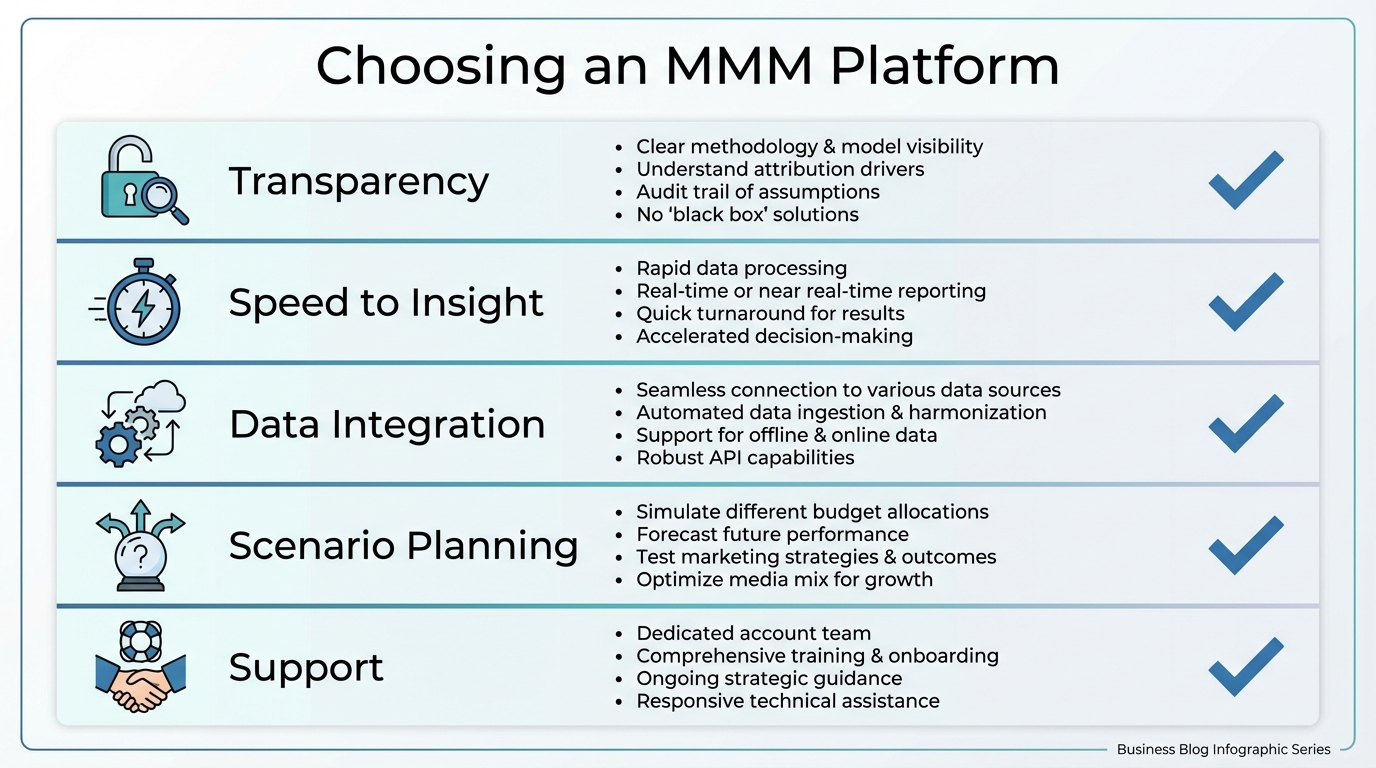
The move to cookieless marketing measurement is not a temporary fix. It is the new standard.
Privacy regulations will only get stricter. Browsers will lock down further. The "walled gardens" of Amazon, Google, and Apple will build higher walls. Leading firms like McKinsey & Company consistently advise that first-party data strategies are the only way to survive this shift.
Furthermore, industry bodies like the IAB (Interactive Advertising Bureau) are setting new standards for measurement that prioritize privacy-safe frameworks like MMM over individual tracking.
To survive, you must own your measurement.
- Build First-Party Data: Collect emails, phone numbers, and purchase history directly.
- Adopt Privacy-First Analytics: Implement meaningful, privacy-safe measurement like MMM.
- Test Constantly: Use the model to run scenarios and validate with lift tests.
If you are looking for alternatives to legacy platforms that haven't kept up, explore our guide on Lifesight alternatives or Keen Decision Systems alternatives. The market is moving fast. Sticking with outdated tools is a liability.
Conclusion
The cookie is gone. Good riddance.
It made us lazy. It made us focus on vanity metrics. We chased short-term clicks rather than long-term brand growth.
Cookieless marketing measurement forces us to be better marketers. It forces us to look at the big picture. It aligns marketing metrics with finance metrics.
By adopting Media Mix Modeling, you aren't just complying with privacy laws. You are upgrading your entire operating system. You are moving from guessing to knowing.
The brands that win in 2026 won't be the ones with the best tracking pixels. They will be the ones with the best models.
Ready to stop guessing? Schedule a demo with BlueAlpha today to see how AI-driven MMM can transform your marketing data.
FAQ
What is the difference between MMM and MTA?
MTA (Multi-Touch Attribution) relies on tracking individual user paths using cookies or IDs. MMM (Media Mix Modeling) uses aggregated statistical data to find correlations between spend and sales. MMM does not require user-level tracking, making it privacy-safe.
Can MMM track social media ads accurately?
Yes. In fact, MMM is often more accurate for social media than pixel tracking. Pixels often miss view-through conversions (people who see an ad but don't click immediately). MMM captures the incremental lift in total sales that correlates with social ad spend.
Do I need a data science team to run MMM?
Not anymore. While legacy MMM required data scientists, modern platforms like BlueAlpha use AI to automate the complex regression analysis. This makes it accessible to marketing teams without a technical background.
How much historical data do I need for cookieless measurement?
Generally, you need at least 12 to 24 months of historical data to build a reliable model. This allows the model to understand seasonality, trends, and baseline sales performance.
Is cookieless measurement compliant with GDPR and CCPA?
Yes. Because MMM uses aggregated data (e.g., "total spend on Facebook" vs. "total sales in California") and does not process Personally Identifiable Information (PII), it is inherently compliant with global privacy regulations.
Stay in the loop
Get updates on new posts and resources.