How to Explain MMM to Executives: The CMO-Ready Guide
Learn how to explain MMM to executives without the jargon. A complete guide to pitching Marketing Mix Modeling, securing budget approval, and proving ROI.
Your CMO cares about one thing: revenue.
They want to know if the money they poured into Facebook, TV, and TikTok actually moved the needle. For years, they relied on tracking pixels and click-based attribution. But the world has changed. Privacy regulations and the death of third-party cookies have turned those dashboards into guessing games.
You know the solution is Marketing Mix Modeling (MMM). But when you try to explain MMM to executives, you face a challenge: statistical methods feel like "black box math" to leadership.
If you walk into the boardroom talking about Bayesian priors and regression coefficients, you will lose them. You need to speak their language: efficiency, scale, and competitive advantage.
This guide breaks down exactly how to pitch MMM, secure buy-in, and position your team for data-driven success.
The Problem: Why Their Current Dashboard is Lying
Before you pitch the solution, you have to expose the problem. Most executives are still clinging to Multi-Touch Attribution (MTA) or platform-specific reporting (like Facebook Ads Manager).
Here is the brutal truth: those numbers are wrong.
Since iOS14 and the tightening of privacy laws, "signal loss" has blinded traditional tracking. Platforms can no longer see what happens after a user clicks an ad. To compensate, ad platforms model (guess) conversions. This leads to double-counting, where Google and Meta both claim credit for the same sale.
According to a report by the Harvard Business Review on digital privacy, the erosion of tracking capabilities is forcing companies to rethink how they measure success entirely.
When you explain MMM to executives, start here. Tell them that relying on click-based data today is like driving a car using a map from 2015. The roads have changed.
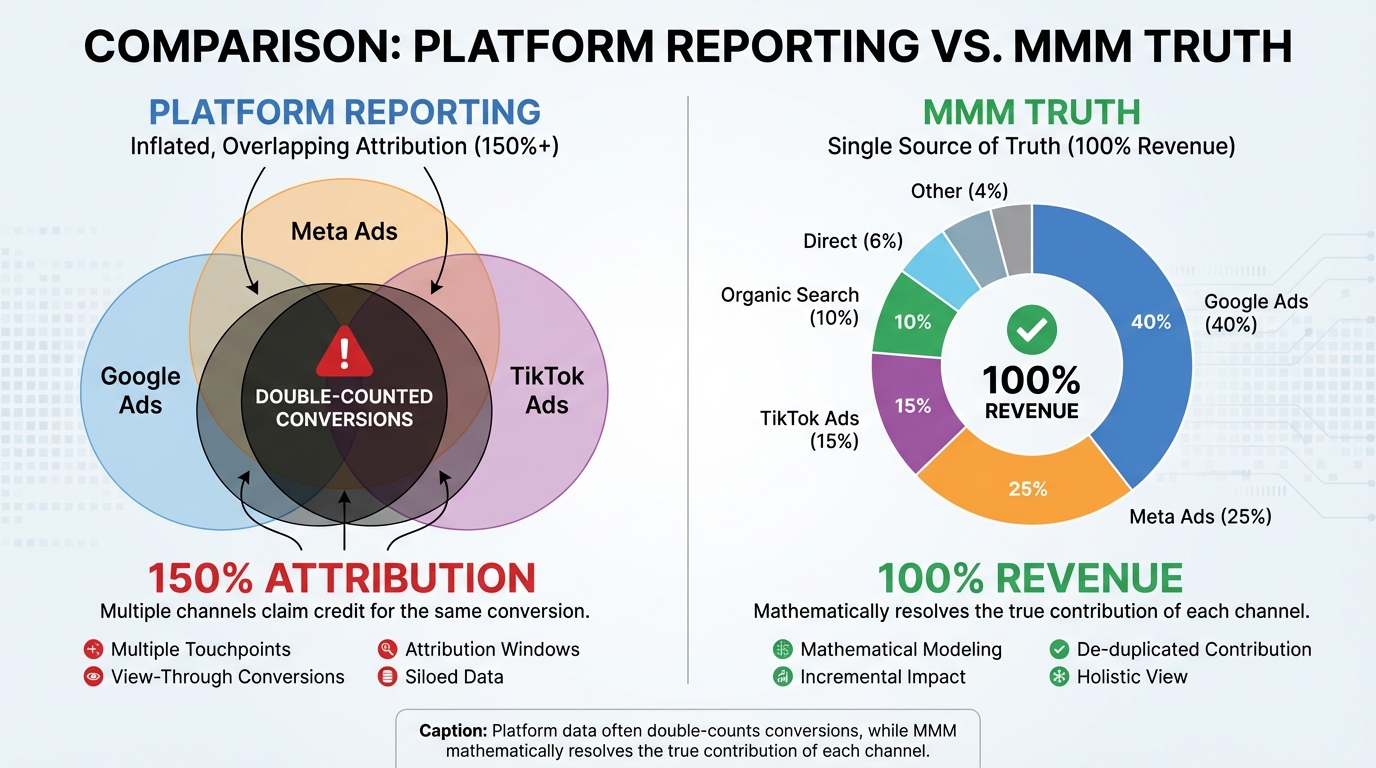
You need a measurement framework that doesn't rely on spying on individual users. You need a top-down approach that looks at correlation and causation across the entire business. That is where MMM steps in.
For a deeper dive on the technical differences, review our guide on MTA vs. MMM marketing attribution.
The Elevator Pitch: MMM for the C-Suite
You have 30 seconds to define it. Do not use the word "econometrics."
Try this analogy:
"Imagine we are baking a cake. We put in flour (Google Ads), sugar (Meta), eggs (TV), and butter (Email). The cake tastes great. Attribution tries to ask the customer which ingredient made the cake taste good. They don't know. They just liked the cake.
Marketing Mix Modeling is the chemistry. It analyzes hundreds of cakes we've baked in the past. It tells us exactly how much the taste improves when we add 10% more sugar or switch from butter to oil. It separates the ingredients from external factors like the oven temperature (seasonality) or the brand of mixer (economic trends)."
This shifts the conversation from "tracking users" to "analyzing business drivers."
Why This Resonates with Leadership
Executives deal with resource allocation. MMM is fundamentally a tool for media budget optimization. It tells them where the next dollar should go to generate the highest return.
According to a study by McKinsey & Company on marketing efficiency, companies that integrate data-driven marketing techniques can improve marketing efficiency by 15-30%. That is the kind of stat that wakes up a CFO.
Speaking the Language of ROI
Once they understand the concept, they will ask about the output. What do they actually get?
Do not show them a regression line. Show them the answers to their burning questions using a clear marketing ROI analysis guide.
1. "Are we wasting money?"
Every CMO worries about saturation. At what point does the next $10,000 on YouTube stop bringing in new customers? MMM plots saturation curves for every channel. You can show them exactly where diminishing returns set in.
2. "What about the stuff we can't track?"
This is your ace in the hole. If your brand does Out-of-Home (billboards), Podcasts, or TV, digital attribution ignores it. MMM loves it.
If you are running significant offline campaigns, use our Out-of-Home advertising tracking guide to structure this part of your pitch. It explains how MMM correlates spend spikes in specific regions with sales lift, requiring zero digital clicks.
3. "What happens if we cut the budget?"
This is the fear-based motivator. MMM allows for forecasting. You can run scenarios: "If we cut brand spend by 20% in Q3, our model predicts a 12% drop in baseline sales in Q4."
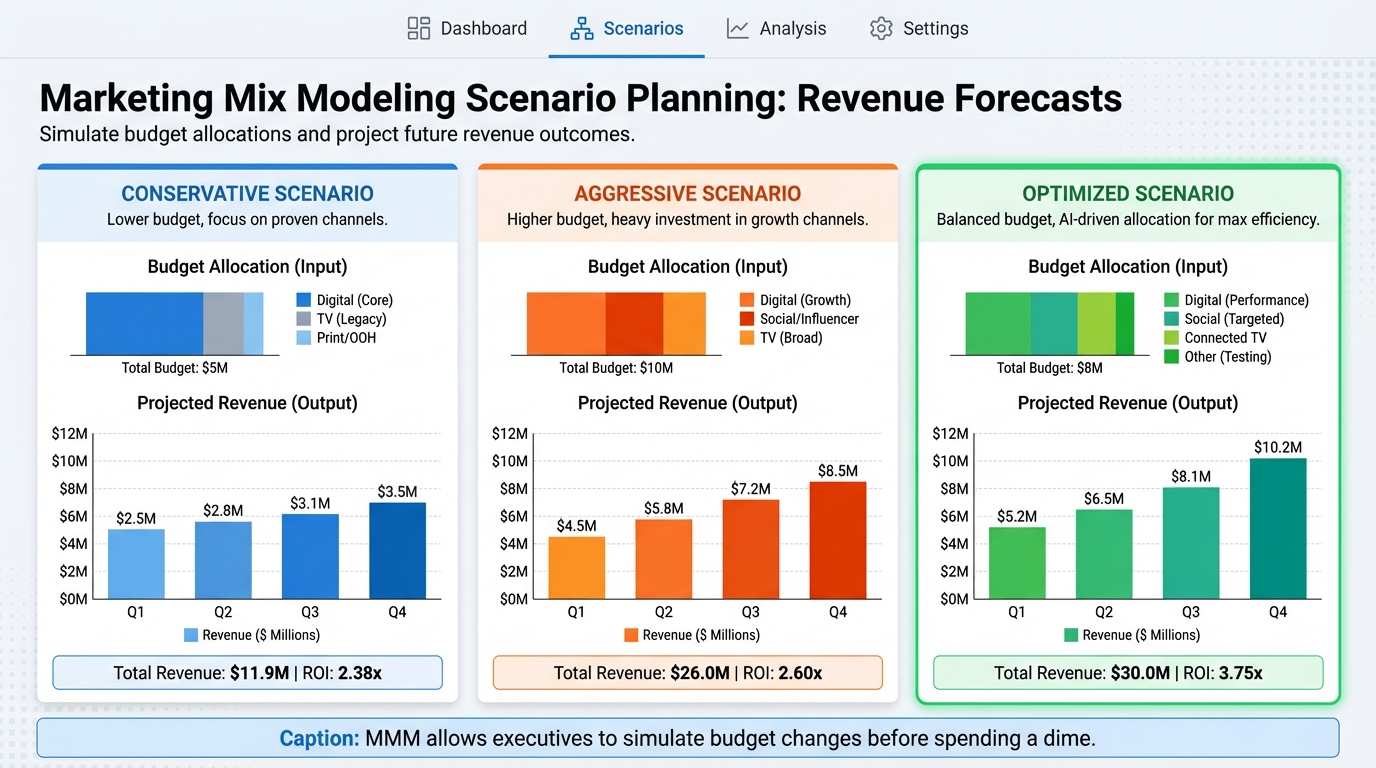
Research from Gartner on marketing data analytics suggests that predictive modeling is the single biggest differentiator between high-performing and low-performing marketing teams.
The "Black Box" Objection
When you explain MMM to executives, you will inevitably face skepticism. "How do we know the math is right?"
In the past, MMM was done by expensive consultants who disappeared for three months and returned with a PDF. It was slow, expensive, and opaque.
Today, the landscape has shifted. Modern platforms like BlueAlpha and open-source libraries have democratized the tech.
Transparency is Key
You don't need to trust a black box. Leading methodologies are now open for inspection.
- Google Meridian: A Bayesian framework that is transparent about how it handles priors and geo-level data. Read our Google Meridian MMM guide for details. You can also reference Google's official documentation on Meridian to show it's a standardized approach.
- Meta Robyn: Another open-source option that uses machine learning to automate model selection. Check out our Meta Robyn guide or point them to the Meta Open Source Robyn project.
By citing these major tech players, you validate the methodology. If Google and Meta are building MMM tools, it is clearly the industry standard for the privacy-first era.
Strategic Implementation: The Timeline
Executives hate open-ended projects. You need a roadmap.
Transitioning to MMM doesn't happen overnight, but it also doesn't take a year anymore. Here is a realistic timeline to present:
- Data Collection (Weeks 1-3): Gathering historical spend, sales data, and external variables (competitor price, inflation, holidays).
- Model Training (Weeks 4-5): The algorithm learns the relationships between your spend and your revenue.
- Validation (Week 6): Testing the model against holdout groups to prove accuracy.
- Optimization (Week 7+): The model starts outputting budget recommendations.
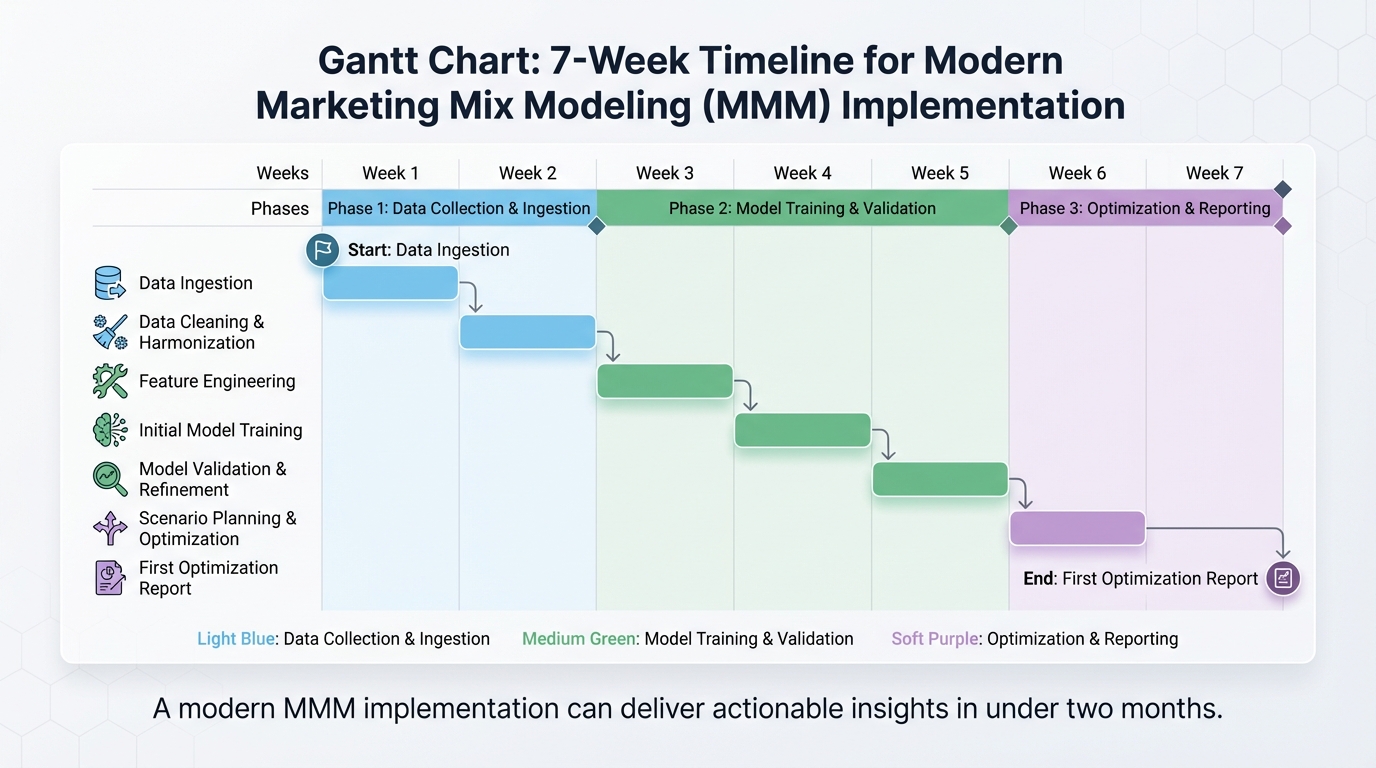
For a detailed breakdown of the technical requirements, reference our guide on how to deploy a media mix model.
Addressing Specific Business Models
Your pitch must be tailored to your company's specific funnel.
For B2B and SaaS
If you have long sales cycles, click-based attribution is notoriously bad. A lead clicks an ad in January but doesn't close until June. Attribution loses that thread. MMM connects the marketing pressure from Q1 to the revenue in Q2.
Forrester's B2B marketing reports often highlight that complex buyer journeys require correlation-based measurement rather than simple touchpoint tracking.
If you are in this sector, review our Account-Based Marketing attribution guide to see how MMM handles complex B2B journeys. You can also look at specific funnel stage budget allocation strategies.
For Ecommerce and DTC
Here, the speed of data matters. You cannot wait for quarterly reports. You need a platform that updates weekly or daily.
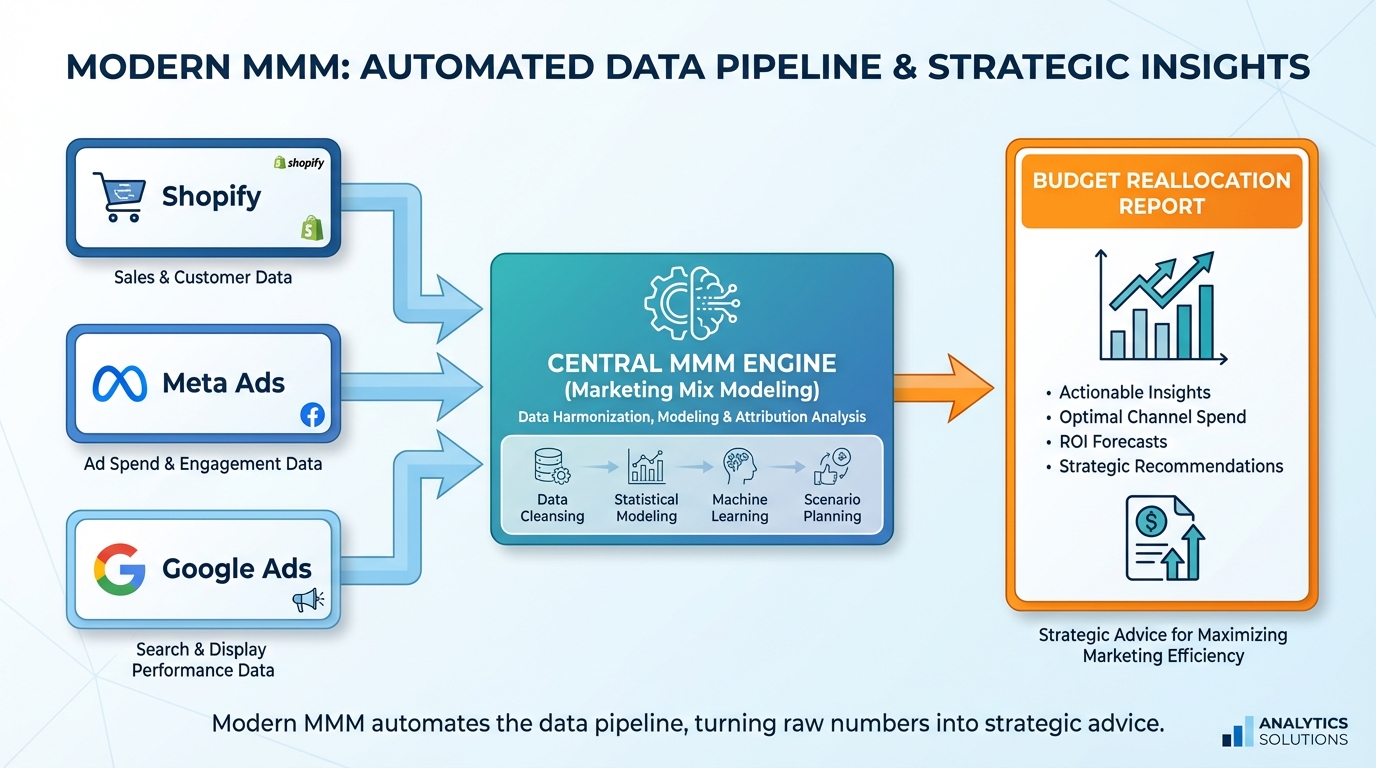
Mention that modern tools can integrate with Shopify and Amazon data streams. If you are currently using tools like Triple Whale or Northbeam, you might be looking for more robust modeling capabilities. We have compared these platforms extensively. For instance, see our Triple Whale vs. BlueAlpha comparison to understand the difference between analytics dashboards and true econometric modeling.
The "Build vs. Buy" Decision
Your CTO might ask, "Can't our data science team just build this?"
Technically, yes. But practically, it is a trap. Building a production-grade MMM requires:
- Advanced Bayesian statistics expertise.
- Constant maintenance to handle API changes.
- UI development so marketers can actually use it.
Most internal builds end up as "zombie projects"—technically alive but never used. Harvard Business Review's analysis on software procurement consistently warns that non-core competencies should be bought, not built.
It is usually more efficient to use a dedicated platform. Whether you look at BlueAlpha for its AI-driven insights or explore Recast alternatives, buying a specialized solution accelerates time-to-value.
How to Close the Meeting
You have explained the problem (signal loss), the solution (MMM), and the benefit (higher ROI). Now you need the "ask."
Do not ask for "budget for a tool." Ask for budget for an experiment.
Propose a 90-day pilot.
- Run the model alongside your current attribution.
- Identify one channel the model says is undervalued.
- Shift 10% of the budget to that channel.
- Measure the incremental lift.
This low-risk approach removes the fear of a massive overhaul.
Summary Checklist for Your Presentation
- Hook: "We are currently flying blind on 30% of our ad spend due to privacy changes."
- Definition: "MMM is an economic analysis of what drives our revenue, independent of tracking cookies."
- Benefit: "It will help us cut waste in saturated channels and double down on what works."
- Proof: "Industry leaders like Google are shifting to this framework."
- Action: "Let's run a pilot to validate our Q3 budget allocation."
Common Questions Executives Will Ask
You need to be ready for the Q&A session. Here are the curveballs they will throw when you explain MMM to executives.
"Does this replace our Google Analytics?" No. They serve different purposes. Google Analytics is for tactical, day-to-day checking of website traffic. MMM is for strategic marketing effectiveness measurement. You use GA4 to see if a link is broken; you use MMM to decide if you should spend $1M on TV next year.
"Is it accurate for small budgets?" Historically, no. But modern AI has made MMM viable for brands spending as little as $20k-$30k per month. However, the more data (spend and history) you have, the better the model performs.
"How does it handle brand awareness?" This is MMM's superpower. It detects the "base lift" provided by brand campaigns that don't generate immediate clicks. If you are running influencer campaigns, this is essential. See our influencer marketing performance measurement guide for more on this specific channel.
The Future is Modeled
The days of perfect tracking are over. They aren't coming back.
When you explain MMM to executives, you aren't just pitching a new tool. You are pitching a maturity upgrade for the marketing department. You are moving from "guessing based on clicks" to "investing based on incrementality."
Companies that make this shift now will have a massive competitive advantage. They will bid smarter, scale faster, and waste less. Those that don't will continue to argue about which dashboard is correct while their CPA skyrockets.
Ready to see what a modern MMM looks like? BlueAlpha is built specifically to bridge the gap between complex data science and executive decision-making. Unlike legacy consultants that take months, BlueAlpha provides AI-driven insights in weeks, giving your CMO the speed and transparency they demand. It’s time to turn your marketing data into a boardroom asset.
FAQ
What is the main difference between MMM and Attribution?
Attribution tracks individual user paths (clicks/views) to assign credit. MMM uses statistical analysis of aggregate data (total spend vs. total sales) to determine causation. MMM works without cookies; Attribution requires them.
How much historical data do I need for MMM?
Ideally, you need at least two years of historical data to account for seasonality and year-over-year trends. However, some modern models can provide directional insights with as little as 6-12 months of high-quality data.
Can MMM measure creative performance?
Generally, MMM measures performance at the channel or campaign level (e.g., "Facebook Prospecting"). It is less effective at measuring specific creative assets (e.g., "Image A vs. Image B") unless those assets have significant distinct spend over time.
How often should we update the model?
Traditional MMMs were updated annually. Modern SaaS solutions like BlueAlpha allow for continuous or weekly updates, enabling agile decision-making based on recent performance.
Is MMM expensive?
Legacy MMM consulting projects often cost $50k-$100k per quarter. Modern SaaS platforms have significantly reduced this cost, making it accessible for mid-market brands. For a comparison of cost-effective options, check our guide on Measured.com alternatives.
Stay in the loop
Get updates on new posts and resources.