LightweightMMM Deprecated: Migration Guide to Meridian
LightweightMMM is deprecated. Migrate to Google Meridian with our technical guide covering data prep, priors, and strategy. Start your transition today.
The notification hit GitHub, and the data science community scrambled.
LightweightMMM deprecated.
For years, Google’s LightweightMMM (LMMM) was the standard. It was the go-to open-source library for brands that wanted speed in their attribution modeling. It ran fast using JAX. It was easy to deploy. It got the job done.
But "good enough" doesn't cut it anymore.
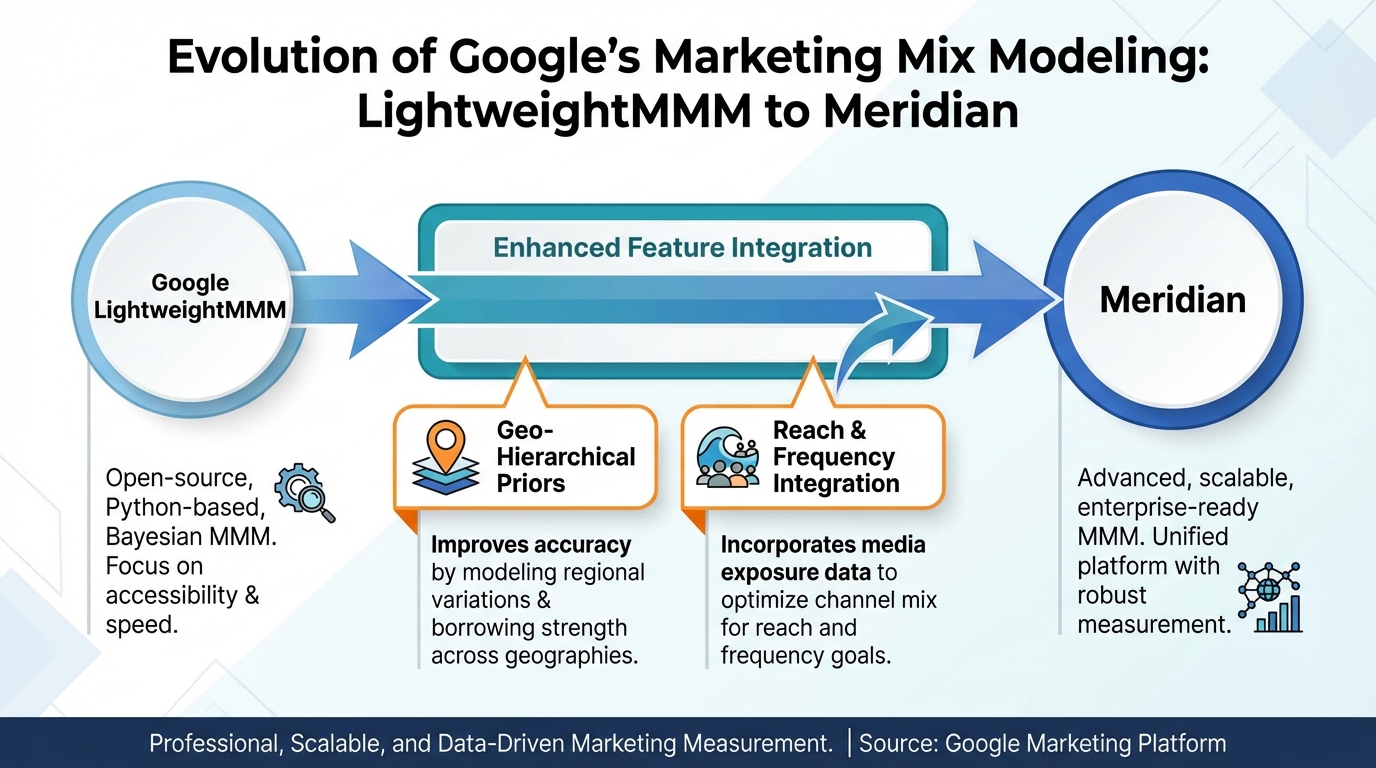
Google has officially pushed everyone toward Meridian. This is their next-generation Bayesian Media Mix Modeling (MMM) framework. This isn't just a rebrand. It is a total rebuild. It fixes the limitations of LMMM, specifically regarding geo-level data, calibration with experiments, and reach-and-frequency integration.
If you are still running LMMM in production, you are running on borrowed time.
This guide isn't a eulogy for the old library. It is a tactical manual for migrating your measurement stack to Meridian. We will cover the structural differences, the data preparation shifts, and how to regain your modeling velocity. You can read more about the official announcement on the Google Meridian GitHub repository.
Why Was LightweightMMM Deprecated?
Google didn't kill LMMM because it was broken. They killed it because it hit a ceiling.
LightweightMMM was excellent at national-level modeling. It used Bayesian methods to estimate adstock (lag effects) and saturation (diminishing returns). However, modern marketing measurement requires more nuance.
The primary driver for the shift to Meridian is Geo-level Hierarchical Modeling.
LMMM struggled to model national and regional data at the same time. It required complex workarounds. Meridian treats geo-level data as a priority. This allows the model to learn from differences across regions. It provides significantly more data points than a simple time-series model.
Furthermore, Meridian uses prior knowledge much more effectively. In measurement, you rarely start from zero. You have business logic. You have previous lift studies. You have industry benchmarks. Meridian allows you to inject these priors to constrain the model. This prevents it from producing results that are mathematically possible but realistically absurd. For example, it stops the model from showing a negative ROI on branded search.
For a deeper dive into the foundational concepts of these models, check out our guide on media mix modeling and marketing attribution.
The Architecture Shift: LMMM vs. Meridian
Before you rewrite your pipelines, you need to understand the structural differences. The "lightweightmmm deprecated" status implies a need for a more robust engine.
1. The Engine
Both libraries utilize JAX for high-performance numerical computing. However, Meridian introduces a more modular approach. It utilizes TensorFlow Probability (TFP) on top of JAX more explicitly. This defines distributions clearly. It gives advanced users more control over the posterior sampling.
2. Data Structure
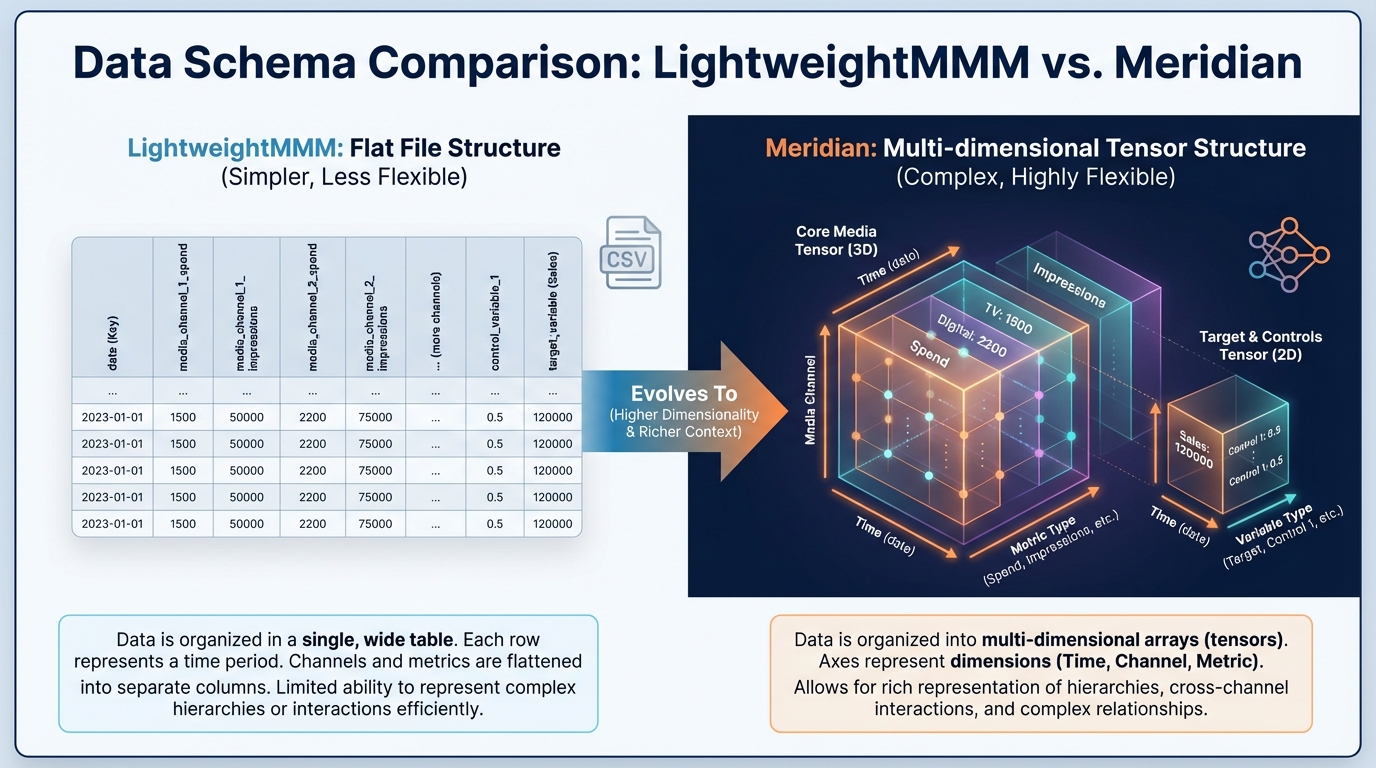
LMMM was forgiving with dataframes. You fed it a matrix of media data and a target variable.
Meridian is strict. It utilizes a specific InputData coordination object. You cannot just pass raw arrays. You must map your data to specific dimensions. These include Time, Geo, Media Channel, and Control. This strictness ensures that the hierarchical solving engine functions correctly.
3. Calibration
In LMMM, calibrating with lift tests was often a post-processing step. It was a "soft" constraint. Meridian embeds calibration directly into the Bayesian priors. If you have a lift test result for Facebook Ads, Meridian treats that result as the "truth." It forces the regression to align with it.
This shift is critical for accuracy. According to research from the Harvard Business Review, integrating experimental calibration into attribution models allows companies to measure causality rather than just correlation.
For a comprehensive look at the new framework, read our Google Meridian MMM complete guide.
Step 1: Data Preparation and Transformation
The biggest friction point in this migration is your ETL (Extract, Transform, Load) pipeline.
In the LMMM era, you likely aggregated everything to a national level. You probably used weekly or daily data. With the "lightweightmmm deprecated" notice, your data strategy must evolve. You now need to support Geo-level data.
Granularity is King
You need to split your data by Designated Market Area (DMA) or state/province.
- Old way:
Date | FB_Spend | TV_Spend | Sales - New way:
Date | Geo_ID | FB_Spend | TV_Spend | Sales
This requires mapping. You need to ensure your ad platforms report spend by region. Most platforms like Meta and Google Ads support this natively. However, mapping TV or Out-of-Home (OOH) might require third-party data. You can reference Nielsen's DMA maps to understand standard market definitions.
If you are a B2B company, this might involve mapping accounts to regions. For more on B2B nuances, read our account-based marketing attribution guide.
The Control Variables
Meridian demands better control variables. You can no longer just throw in "seasonality" and hope for the best. You need specific controls for:
- Macroeconomic indicators (CPI, Unemployment)
- Competitor activity
- Holidays (specific to the Geo)
If you are struggling to gather this data, platforms like BlueAlpha automate the ingestion of these external signals. This saves weeks of data engineering time and ensures your control variables are always audit-ready.
[IMAGE: A data schema diagram comparing the flat file structure of LightweightMMM against the multi-dimensional tensor structure required for Meridian.]
Step 2: Defining Priors and Distributions
This is where the math gets heavy.
In LightweightMMM, you often relied on default priors. Meridian expects you to have an opinion. It uses TensorFlow Probability to define these distributions.
Media Priors
You must define the ROI_prior and mROI_prior (Marginal ROI).
If you used beta_geo models in LMMM, you need to translate those assumptions. Meridian uses a specific distribution language. This is often LogNormal or HalfNormal.
Pro Tip: Do not set your priors too tight. If you tell the model that TV ROI is exactly 2.0 with zero variance, the model will ignore the actual data. Give it room to breathe. Allow the data to shift the prior.
Reach and Frequency
One of Meridian's killer features is the ability to model Reach and Frequency (R&F) data. This replaces simple Impressions or Spend.
LMMM treated impressions as a linear input. Meridian understands that the 10th impression to the same person is worth less than the 1st. You can now input R&F curves directly.
If you are tracking offline channels, this is vital. See our out-of-home advertising tracking guide for how to structure this data.
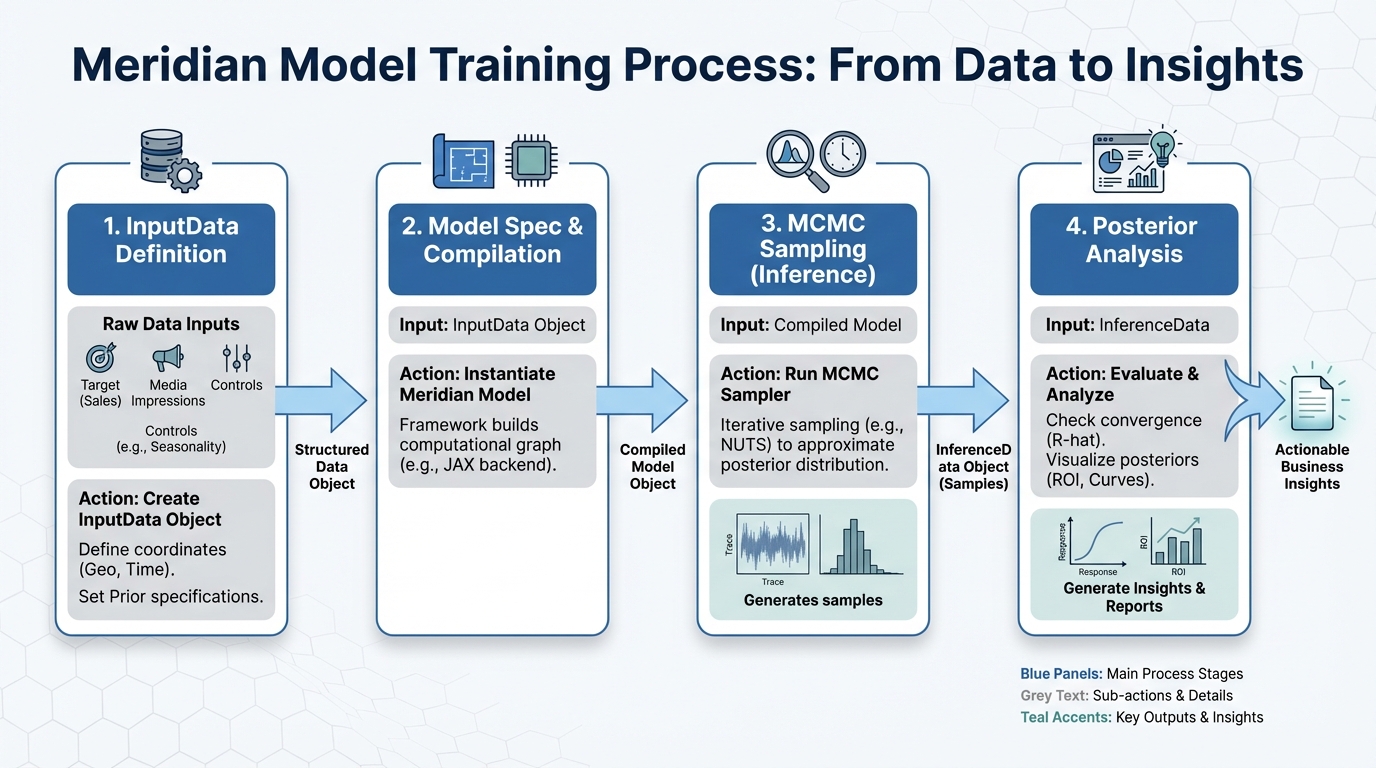
Step 3: Model Specification and Training
Writing the code for Meridian looks different. The syntax has changed significantly.
The Old LMMM Code:
# LightweightMMM (Deprecated)
mmm = lightweight_mmm.LightweightMMM(model_name="hill_adstock")
mmm.fit(media=media_data, target=target_data, total_costs=costs)
The New Meridian Code:
# Meridian
model_spec = meridian.ModelSpec(
    prior_roi=prior_roi_dist,
    prior_beta=prior_beta_dist
)

# The InputData object is crucial
data_input = meridian.InputData(
    time=time_tensor,
    geo=geo_tensor,
    media=media_tensor,
    controls=controls_tensor
)

meridian_model = meridian.Meridian(model_spec=model_spec)
meridian_model.fit(data_input)
The training time will increase. Meridian is solving a hierarchical model across potentially hundreds of geos. The compute requirement jumps significantly. You might need to move from a local laptop CPU to a GPU-enabled cloud instance.
As noted by Gartner, the shift toward complex AI models requires robust infrastructure modernization. You cannot run these next-gen models on legacy hardware.
For teams that don't want to manage GPU clusters, this is where SaaS solutions make sense. We have compared several options in our comparison of which MMM is best.
Step 4: Validation and Calibration
You ran the model. It converged. Now what?
In the LMMM days, you looked at MAPE (Mean Absolute Percentage Error) and R-squared. Those metrics still matter. But Meridian emphasizes predictive validity via holdout samples.
The Holdout Test
Meridian makes it easier to slice your data for out-of-time validation. You should reserve the last 4-8 weeks of data. Use this to test the model's forecasting ability. If the model cannot predict the holdout period, it cannot predict the future.
Integrating Experiments
This is the most critical step. If you ran a geo-lift test on YouTube, you must feed that result back into Meridian.
- Define the experiment dates and geos.
- Input the incremental lift and standard error.
- Re-run the model.
Meridian will shift the coefficients for YouTube to align with your experiment. This moves your model from "correlation" to "causality."
For a broader look at how to measure success, refer to our marketing effectiveness measurement guide.
Strategic Implications of the Migration
Technically, you are changing libraries. Strategically, you are changing how you budget.
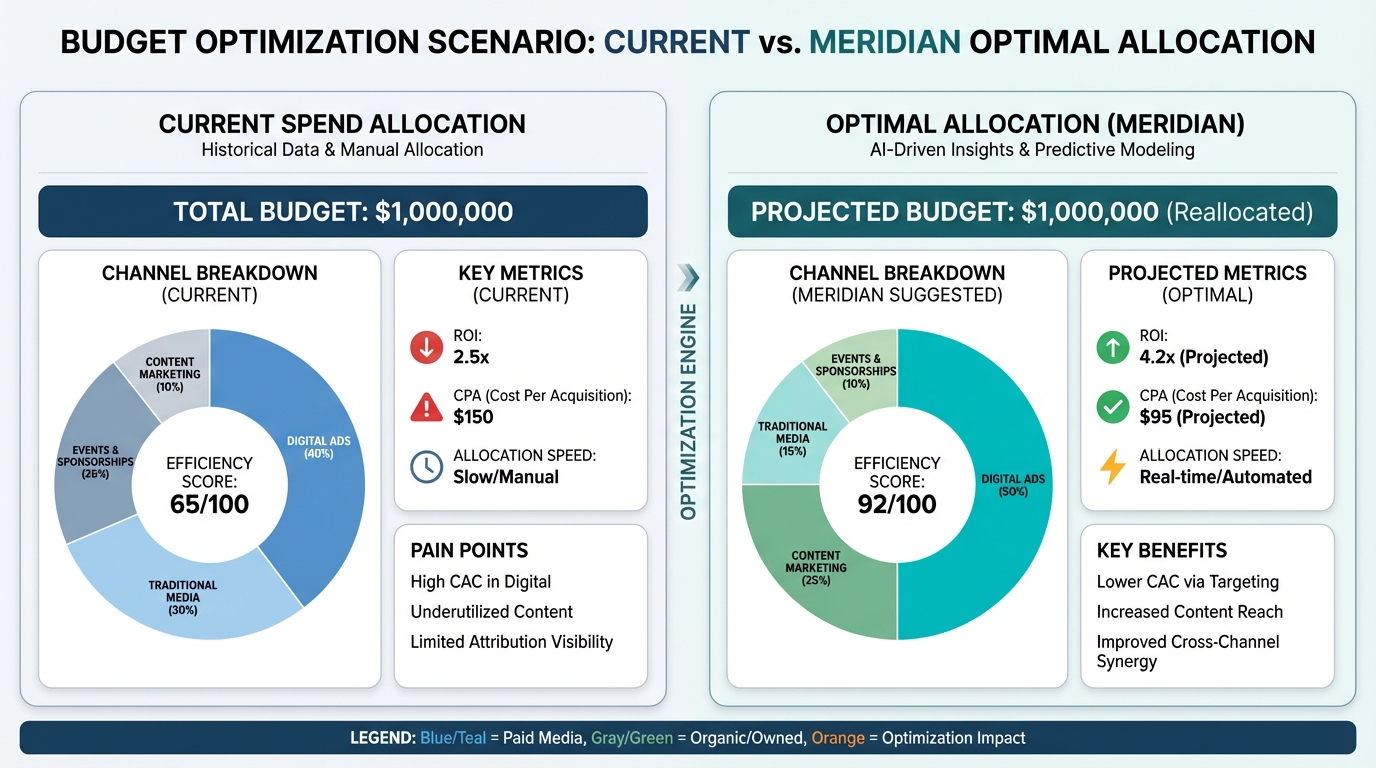
LightweightMMM was often used for "post-mortem" analysis. You looked back at what happened. Meridian is built for Budget Optimization.
Because Meridian understands the diminishing returns curves (saturation) at a granular level, its budget allocator is far more aggressive. It might tell you to cut Facebook spend by 20% in California while increasing it by 10% in New York. LMMM could never offer that level of specificity.
This directly impacts how you handle your finances. You need to read our media budget optimization guide to understand how to act on these granular recommendations.
The "Black Box" Problem
With increased complexity comes decreased interpretability. Your stakeholders might ask, "Why did the model say this?"
In LMMM, the answer was simple. In Meridian, the answer involves hierarchical priors and geo-variance. You must invest time in visualizing the posterior distributions. You need to explain the range of outcomes, not just the point estimate.
[IMAGE: A dashboard view of a budget optimization scenario, comparing current spend allocation vs. optimal allocation suggested by Meridian.]
Alternatives to Building It Yourself
Now that "lightweightmmm deprecated" is a reality, you have a choice.
Option A: Hire two more data engineers. Spin up GPU clusters. Spend 3 months migrating to Meridian in-house. Option B: Use a platform that has already done this work.
While Meridian is open-source, it is not "free." The cost of implementation is high.
BlueAlpha manages the complex GPU clusters required for Meridian's hierarchical solving engine, so you don't have to. We handle the data ingestion, the geo-mapping, and the prior definitions. This allows your team to focus on strategy rather than DevOps, reducing migration time by up to 80%.
If you are evaluating vendors, it is worth looking at how they stack up. We have detailed comparisons of the landscape:
- Recast vs. BlueAlpha – For those looking at other Bayesian options.
- Measured.com vs. BlueAlpha – For incrementality focus.
- Funnel.io vs. BlueAlpha – If data aggregation is your main bottleneck.
For a broader look at the tool landscape, check out our guide on Recast alternatives.
Common Migration Pitfalls
1. Ignoring the "LightweightMMM Deprecated" Warnings
Some teams are forking the old LMMM repo to keep it alive. This is a mistake. The JAX dependencies will eventually break. You will be left with a zombie model that no one supports.
2. Over-complicating the Geo Data
You don't need zip-code level data. Start with DMA or State. If you go too granular, your data becomes too sparse. You will have too many zeros. The model will fail to converge.
3. Neglecting Funnel Stages
Meridian is powerful, but it's not magic. If you feed it top-of-funnel impressions and bottom-of-funnel revenue without accounting for the middle, you will get weird results. Review our funnel stage budget allocation guide to structure your channel inputs correctly.
4. Forgetting ROI Analysis
The goal isn't a perfect model fit; it's profit. Always tie your model outputs back to financial metrics. Our marketing ROI analysis guide covers how to translate model coefficients into CFO-ready reports.
FAQ
Q: Can I still use LightweightMMM? Technically, yes, if you freeze your environment. But with "lightweightmmm deprecated" officially, you will receive no security updates. You get no bug fixes. It is a business risk.
Q: How long does a typical migration take? For a mid-sized team, migrating from LMMM to Meridian typically takes 8-12 weeks. This includes data re-formatting, learning the new TFP syntax, and calibrating priors. Using a managed platform can cut this down to 2-3 weeks.
Q: Is Meridian slower than LightweightMMM? Yes. Hierarchical Bayesian modeling requires significantly more computational power than the simpler time-series approach of LMMM. Expect training times to increase by 2x to 5x depending on data volume.
Q: Does Meridian support Meta's Robyn features? Meridian and Robyn are converging in methodology. Both use calibration and ridge regression/Bayesian methods. However, they are different codebases. For a comparison, read our Meta Robyn guide.
Q: Do I need a PhD to use Meridian? It helps. Meridian assumes a strong understanding of Bayesian statistics. If your team lacks this expertise, consider a managed solution like BlueAlpha or consult our guide on deploying media mix models.
Q: How does Meridian handle Influencer Marketing? Meridian's "Reach and Frequency" input is excellent for influencer campaigns. In these campaigns, reach is often capped but frequency varies. See our influencer marketing measurement guide for data formatting tips.
Final Thoughts
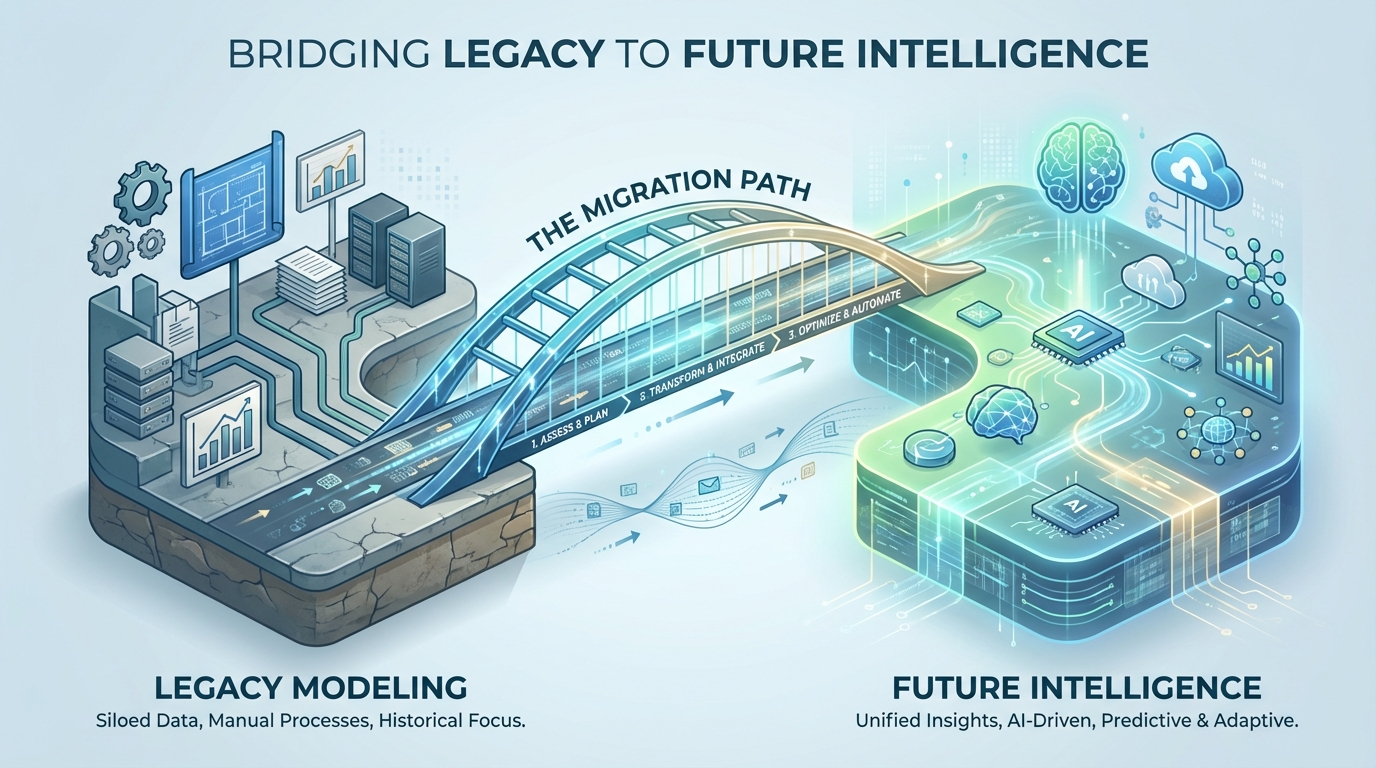
The deprecation of LightweightMMM is not a setback. It is a graduation.
The industry has moved beyond simple correlation engines. We are now in the era of Causal AI and hierarchical modeling. Leading firms like McKinsey & Company emphasize that granular, calibrated measurement is the only way to truly optimize spend in a fragmented media landscape.
Google Meridian offers the power to measure marketing with unprecedented accuracy. But it demands respect for the underlying math and data engineering.
You have three months before your old models become liabilities. Start your migration today.
If the technical overhead of Meridian feels overwhelming, you don't have to go it alone. Platforms like BlueAlpha exist to bridge the gap between cutting-edge open-source science and day-to-day marketing decisions, giving you the power of Meridian without the engineering burden.
Stop guessing. Start measuring.
Read Next:
Stay in the loop
Get updates on new posts and resources.