Marketing Mix Modeling Pharma: The ROI Guide for 2026
Discover how marketing mix modeling pharma solutions solve attribution challenges in a privacy-first world. Optimize DTC and HCP budgets—read the guide.
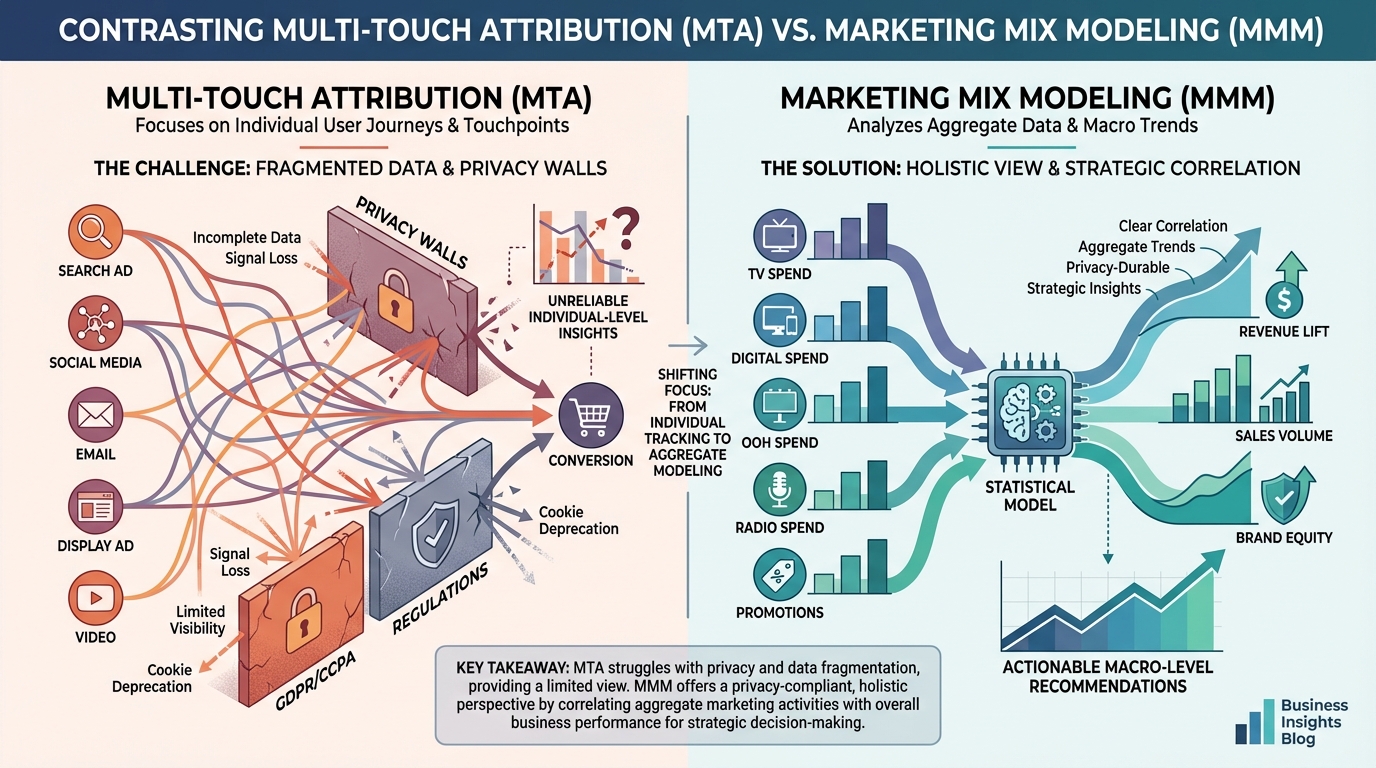
Pharmaceutical marketing faces a data crisis. Privacy laws are strict. Third-party cookies are gone. Old ways of tracking patient journeys, like multi-touch attribution (MTA), are failing.
HIPAA compliance and "walled gardens" make it hard to see what works.
Marketing mix modeling pharma strategies are not just an option anymore. They are the only safe path to measure success.
You spend millions on Direct-to-Consumer (DTC) TV spots. You pour money into Healthcare Professional (HCP) sales visits. But connecting that spend to actual prescriptions is hard.
This guide cuts through the noise. We will explore how modern MMM solves the attribution puzzle in life sciences. We will show you how to ensure compliance and drive profit.
For a broader look at how these models work generally, check our media mix model marketing attribution guide.
The Broken State of Pharma Attribution
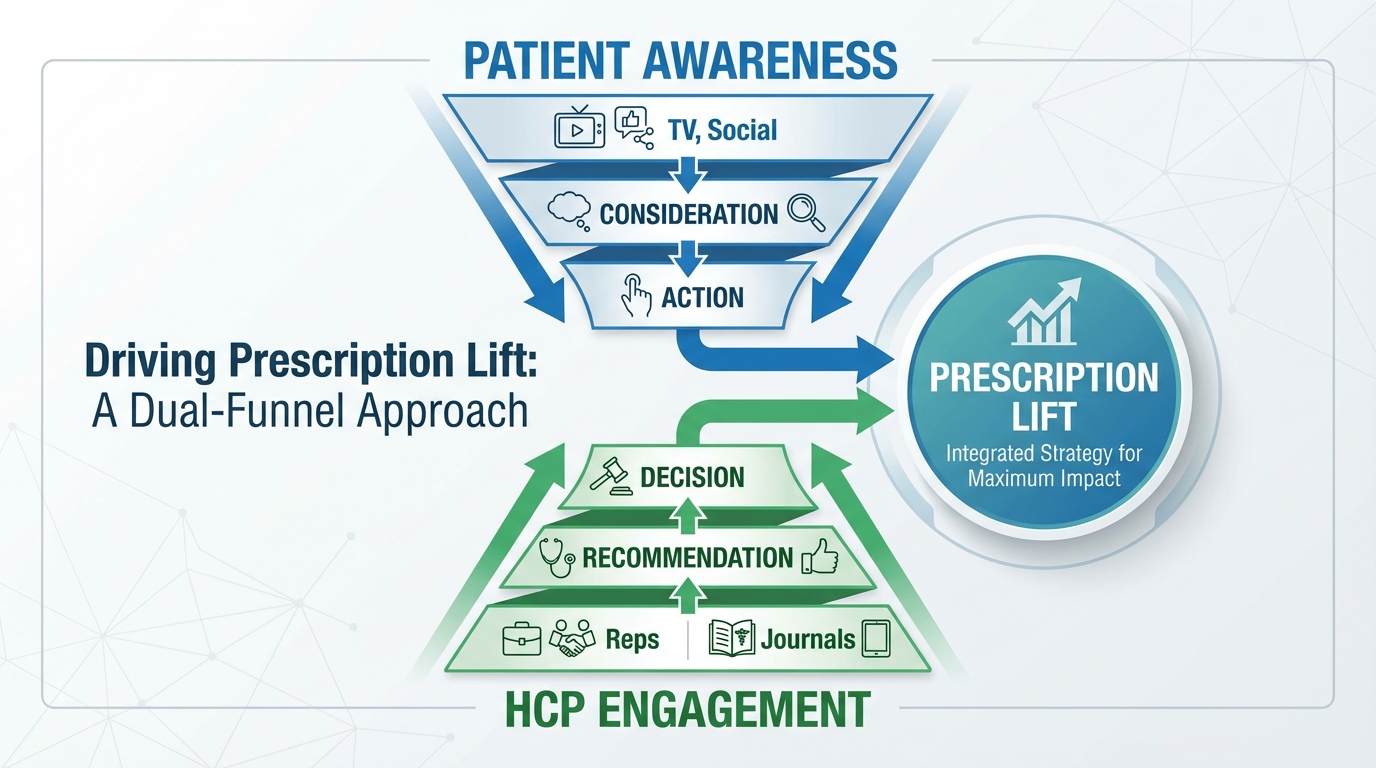
The pharmaceutical industry has two funnels. You have the patient funnel (DTC). You have the prescriber funnel (HCP).
These two worlds interact. Yet, most healthcare marketing analytics frameworks treat them as separate silos.
Brands used to rely on tracking specific users. You dropped a digital pixel. You tracked a user. You hoped they converted. In healthcare, this is dangerous. HIPAA and GDPR make this kind of tracking risky.
Plus, prescription data often lags by weeks or months. You can't wait that long to know if an ad worked.
This is where marketing mix modeling pharma solutions step in.
MMM uses aggregate data. It does not look at individuals. It looks at trends. It sees a spike in marketing. It compares that to a spike in sales. It finds the correlation.
It respects privacy because it doesn't care who bought the drug. It only cares that marketing activity $X$ caused sales lift $Y$.
To understand why tracking users is failing, read our MTA vs MMM marketing attribution comparison.
Why Pharma Needs Specialized MMM
You cannot use a retail model for pharma. The variables are too different.
Retail moves fast. A customer sees a shoe ad. They buy the shoes that day.
In pharma, a patient sees a TV ad. They wait two weeks for an appointment. They talk to a doctor. They get a script. They fight with insurance. Finally, they pick up the medicine.
That lag time breaks standard models. You need MMM for life sciences that understands this delay.
1. The Regulatory Shield
Privacy drives MMM adoption. MMM analyzes time-series data. For example, it looks at weekly spend versus weekly prescriptions. It does not use user IDs.
This makes it safe by design. You can measure sensitive campaigns without touching PII (Personally Identifiable Information).
For more on the legal landscape, the U.S. Department of Health & Human Services provides clear guidelines on de-identified data.
2. The Offline Reality
Pharma still relies heavily on offline channels. You use linear TV. You go to conferences. You send sales reps to offices.
Digital-only tools miss 60% of your marketing mix. To measure these non-digital channels, check out our marketing effectiveness measurement guide.
3. The Sales Rep Factor
The sales rep is a massive variable. A specialized model must account for "Share of Voice" in the doctor's office. It is not just about ads on TV.
According to McKinsey & Company, leading pharma companies that use advanced analytics see a 5-10% revenue uplift. This isn't just about saving money. It is about spending it where it matters.
Modeling the Dual Funnel: HCP vs. DTC
Successful marketing mix modeling pharma implementations separate the effects. They look at HCP marketing and DTC marketing separately. But they also look at how they help each other.
The HCP Engine
Marketing to doctors is like Account-Based Marketing (ABM). You target high-value accounts, like hospitals or practices.
Your model needs to ingest data on:
- Sales force detailing (calls/visits)
- Medical conferences
- Professional journal advertising
- Email campaigns to NPI lists
This behaves like B2B marketing. You can apply principles found in our account-based marketing attribution guide.
The DTC Engine
This is the mass market side. TV, Connected TV (CTV), and social media drive awareness. The goal is to prompt the "ask." Did the patient ask their doctor about the brand?
The model must measure how DTC spend lifts prescriptions in a territory. It must do this independently of sales rep activity.
This dual approach is critical for accurate HCP marketing attribution.
[IMAGE: A dual-funnel chart. Top funnel shows "Patient Awareness" (TV, Social). Bottom funnel shows "HCP Engagement" (Reps, Journals). Both funnels merge into "Prescription Lift" at the center.] Alt text: Dual funnel marketing diagram showing how DTC and HCP marketing channels converge to drive pharmaceutical sales. Caption: Effective pharma models must account for the interaction between patient demand and prescriber willingness.
Overcoming Data Challenges in Pharma
Data quality is the biggest hurdle in marketing mix modeling pharma projects.
The Lag Problem
Prescription data is rarely real-time. Providers like IQVIA often provide data with a lag. You might wait 4 to 8 weeks.
The Fix: Use leading indicators. Incorporate "Zero-Party Data." Look at website visits. Track usage of "find a doctor" tools. Count copay card downloads. These metrics bridge the gap between seeing an ad and filling a script.
The Granularity Issue
National data is too broad. You need more detail. State-level data is better. But Designated Market Area (DMA) data is the gold standard.
Modeling at the DMA level gives you more data points. Instead of 52 weeks of national data, you get thousands of data points across 210 DMAs. This improves accuracy.
For a deeper dive on setting up your data, read our pipeline attribution guide.
Selecting the Right Model Methodology
Not all models are the same. In the past, companies used linear regression. It was rigid. It required years of history.
Today, Bayesian inference is the standard. It is vital for pharma ROI measurement.
Why Bayesian Wins
Bayesian models allow you to input "priors." These are prior assumptions.
For example, maybe you have a controlled lift study. It shows TV ads have a 2% conversion rate. You can tell the model this. It doesn't have to guess from scratch.
This is crucial for new drug launches. You have no sales history. You can use data from similar drugs to start.
There are open-source options. Google and Meta have released libraries. You can read about them in our Google Meridian MMM complete guide and our Meta Robyn open source MMM guide.
The BlueAlpha Advantage
Open-source requires a big data science team. It takes time.
BlueAlpha offers a different path. It is a streamlined platform built for speed. Its purpose-built healthcare compliance features help pharma marketers reduce model deployment time by 70%. It ensures automatic HIPAA-compliant data handling.
BlueAlpha handles the heavy lifting. It allows you to run models in weeks, not months. You get the power of Bayesian modeling without the technical headache.
For more on the math behind this, Harvard Business Review discusses how advanced analytics are reshaping sales.
Advanced Tactics: Synergies and Halo Effects
A basic model tells you TV drove $5M in sales. An advanced marketing mix modeling pharma analysis tells you more. It shows that TV made your Sales Rep visits 20% more effective.
The Halo Effect
Does marketing for a big drug boost sales for a smaller drug? Often, brand equity spills over. MMM can measure this halo effect. It helps you value your portfolio correctly.
Channel Synergy
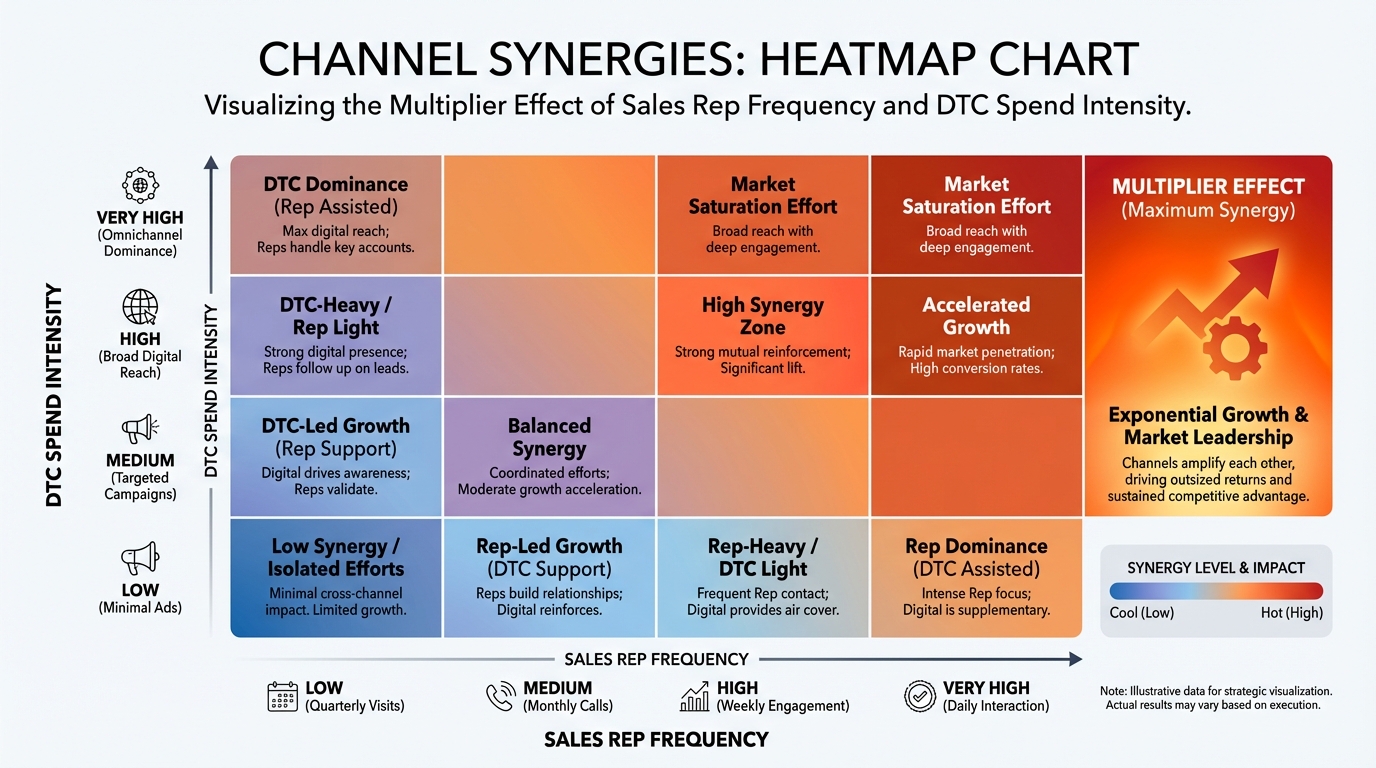
DTC drives patients into the office. A sales rep visits that doctor. The script is more likely to be written. The combination of DTC + Rep is powerful.
If you ignore synergy, you undervalue your channels. You might cut TV spend. Then you see Rep efficiency drop.
Understanding these dynamics is key to HCP marketing attribution. See our marketing ROI analysis guide for the formulas.
[IMAGE: A heatmap chart showing channel synergies. The X-axis is "Sales Rep Frequency" and Y-axis is "DTC Spend Intensity." The hottest (reddest) area is where both are high, indicating a multiplier effect.] Alt text: Heatmap visualization demonstrating the synergistic effect between sales rep visits and direct-to-consumer advertising. Caption: Synergy analysis reveals that Rep visits convert at a higher rate when supported by heavy DTC air cover. Suggested dimensions: 1200x675px
Pharma budgets are often rigid. But agile brands are moving to quarterly forecasting.
Saturation Curves
Every channel has a limit. Doubling TV spend won't double prescriptions. You hit diminishing returns.
MMM plots these curves. It might show you have maxed out Linear TV. But your CTV efforts might still be efficient.
The Strategy:
- Find saturated channels.
- Move budget from the inefficient "flat" part of the curve.
- Put it into unsaturated channels.
According to Forrester, adaptive budgeting is a key trait of high-growth marketing teams.
For a step-by-step process, refer to our media budget optimization guide.
Measuring Innovation: OOH and Influencers
Pharma is changing. It's not just reps and TV anymore.
Out of Home (OOH)
Billboards near hospitals are popular. Digital screens in waiting rooms work well. These are hard to track digitally.
MMM excels here. It correlates the location of OOH with regional prescription lift. Learn more in our out-of-home advertising tracking guide.
Patient Influencers
Patient advocacy is huge on social media. But what is an Instagram post worth? You can't click a link to "buy" a prescription.
MMM measures the lift in the weeks following influencer campaigns. We cover this in our influencer marketing performance measurement guide.
According to Deloitte's Life Sciences Outlook, digital engagement and patient centricity are top priorities for the coming year.
Choosing the Right Platform
When selecting a partner for marketing mix modeling pharma, you have three choices:
- Consultancies: High touch. Very slow. Very expensive. Reports take months.
- Open Source: Flexible. Free code. But you need expensive talent.
- SaaS Platforms: Automated. Real-time. Scalable.
Leading platforms streamline data ingestion. Tools like BlueAlpha are designed for this complexity. They reduce implementation time from months to weeks.
BlueAlpha specifically addresses the MMM for life sciences need for speed and security.
For a direct comparison, look at our Lifesight vs BlueAlpha comparison or our Measured.com vs BlueAlpha comparison.
If you use a generalist dashboard tool, it may lack predictive power. See why in our Funnel.io vs BlueAlpha comparison guide.
Implementation Roadmap
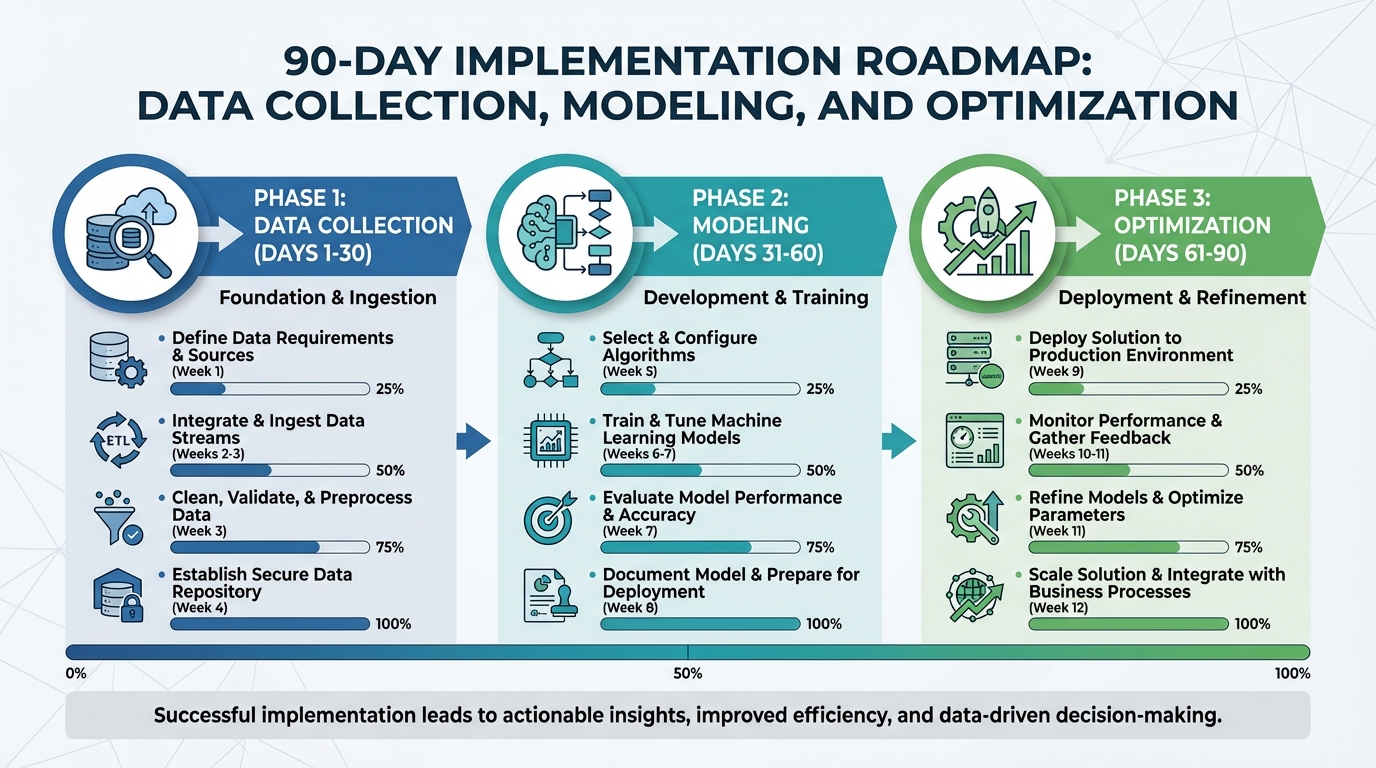
Deploying MMM in pharma takes discipline. Here is a 90-day roadmap.
Days 1-30: Data Discovery
Gather your historical data. You need at least two years.
- Sales: TRx, NRx, NBRx (New to Brand) by week/DMA.
- Marketing: Spend, impressions, GRPs by channel.
- Context: Competitor spend, price changes, formulary status changes.
Ensure your data handling aligns with guidance from the FDA regarding data integrity.
Days 31-60: Modeling and Validation
Feed the data into the model. This is where you tune parameters.
- Check for fit (R-squared).
- Validate against known lift studies.
- Ensure the "priors" make business sense.
Days 61-90: Optimization and Strategy
The model outputs the ROI. Now you build scenarios.
- "What happens if we cut TV by 10% and boost digital?"
- "What if we focus only on the top 20 DMAs?"
This process improves your pharma ROI measurement. For a technical walkthrough, read how to deploy a media mix model.
[IMAGE: A timeline infographic showing the 90-day implementation roadmap: Data Collection, Modeling, and Optimization.] Alt text: 90-day roadmap for implementing marketing mix modeling in a pharmaceutical company. Caption: A structured approach ensures your model delivers actionable insights within a quarter. Suggested dimensions: 1200x675px
FAQ: Marketing Mix Modeling Pharma
Can MMM measure the impact of sales reps?
Yes. In marketing mix modeling pharma, sales rep detailing is a media channel. You input the number of details or calls. The model calculates the incremental lift generated by reps compared to other channels.
Is MMM compliant with HIPAA and GDPR?
Absolutely. MMM uses aggregated data. It looks at total prescriptions in a city per week. It does not use individual patient data. It does not require cookies or PII. It is the safest measurement method for healthcare.
How often should we update the model?
Old models were updated annually. Modern SaaS platforms allow monthly updates. In a volatile market, quarterly updates are the minimum.
Can we use MMM for rare disease products?
It is harder, but possible. MMM relies on volume. Rare diseases have low prescription volumes. A hybrid approach using patient-level claims data is often better. Specialized platforms can integrate these datasets to find signal where generalist tools see only noise.
Conclusion
The era of blind budget allocation in pharma marketing is over. The "spray and measure later" era is also dead. Privacy regulations killed it.
Marketing mix modeling pharma is the standard for the future. It bridges the gap between the patient and the prescriber. It respects privacy.
Most importantly, it tells you the truth about your healthcare marketing analytics.
Don't let data lag dictate your strategy. Move to a model that predicts outcomes. Platforms like BlueAlpha make it possible to implement these sophisticated models without building an internal data science team.
If you are ready to modernize your measurement stack, explore our Which MMM is Best comparison to find the right fit for your organization.
Stay in the loop
Get updates on new posts and resources.