Top Marketing Mix Modeling Trends 2026: AI & Privacy
Discover the top marketing mix modeling trends 2026 offers. Learn how AI, privacy-first measurement, and real-time data reshape ROI analysis. Read now.
The era of "set it and forget it" analytics is dead.
If you are still relying on quarterly PDF reports to tell you where to spend your budget, you aren't just behind. You are losing money.
By 2024, we knew the cookie was crumbling. In 2025, privacy regulations tightened the noose around user-level tracking. Now, the marketing mix modeling trends 2026 is delivering have shifted the landscape entirely. The "black box" of marketing measurement has been pried open by artificial intelligence, and the results are faster, sharper, and more granular than ever before.
Marketing mix modeling (MMM) used to be a luxury for Fortune 500 companies with massive data science teams. Today, it is the operational backbone for agile brands.
This isn't about guessing anymore. It's about mathematical certainty in an uncertain world.
Here is your comprehensive look at the trends reshaping the industry, and how you can use them to dominate your market share.
1. The Shift to "Always-On" Real-Time Optimization
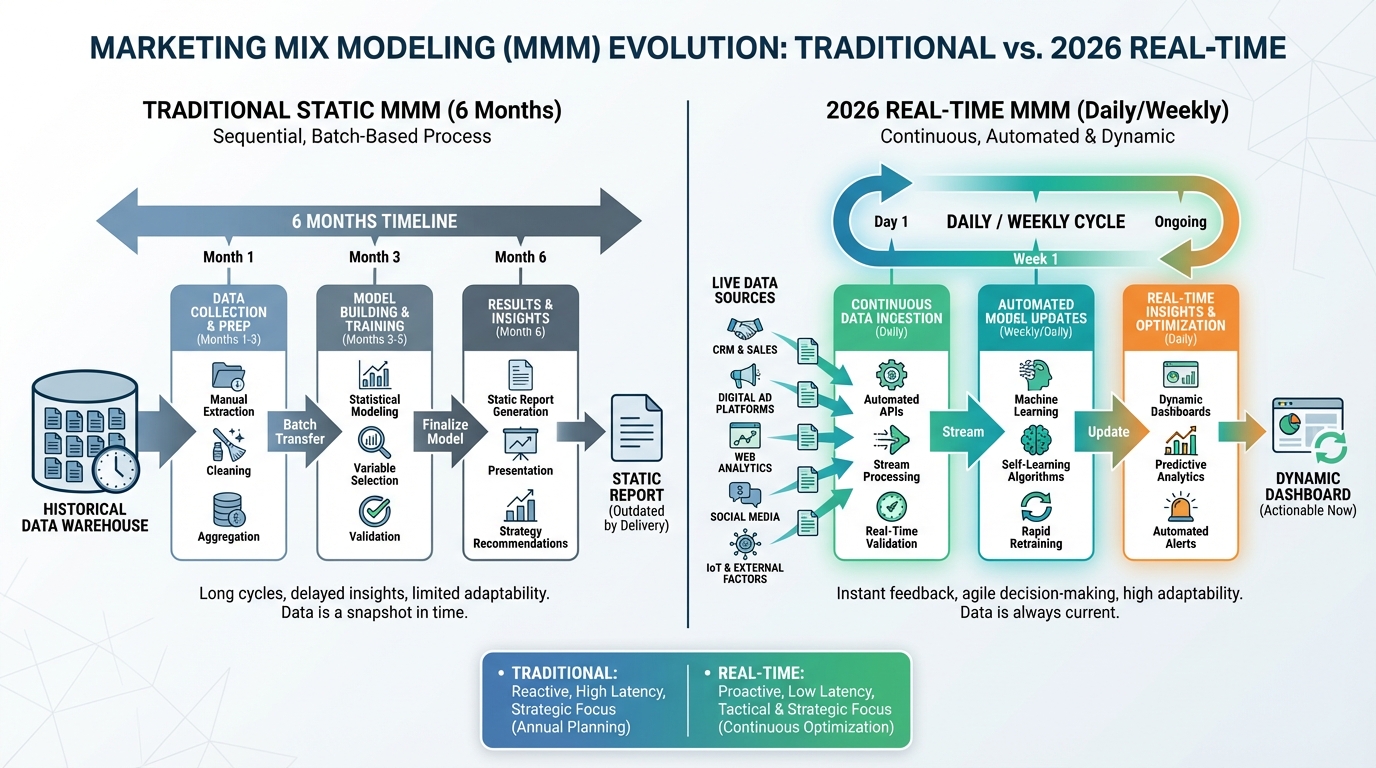
Historically, MMM was slow. Painfully slow.
You would gather data for six months. You would clean it for a month. You would hand it to a consultant. Three months later, they would tell you that you overspent on TV ads last year.
That doesn't work today. The market moves too fast. According to McKinsey, the speed of data processing is now the primary differentiator between market leaders and laggards.
The biggest trend in 2026 is the democratization of real-time processing. Modern platforms ingest data daily. They recalibrate models overnight. They give you actionable insights over morning coffee, not at the end of the quarter.
Continuous Calibration
Static models degrade the moment they are built. Consumer behavior changes. Competitors launch new products. Algorithms on ad platforms shift.
We are seeing a massive surge in brands adopting continuous calibration. This means the model learns from yesterday’s performance to predict tomorrow’s outcome. It turns a static snapshot into a living, breathing navigation system.
If you are looking to modernize your stack, you need to understand the fundamentals of how these systems operate. Check out our media mix model marketing attribution guide to understand the baseline requirements for these high-velocity systems.
2. AI and Synthetic Data Fill the Privacy Gap
Privacy laws didn't kill marketing measurement. They just forced it to evolve.
With GDPR, CCPA, and the total deprecation of third-party cookies, "signal loss" became the buzzword of the mid-2020s. Marketers lost the ability to track users across the internet. Multi-touch attribution (MTA) collapsed because the click-path data simply didn't exist anymore.
Enter Generative AI and synthetic data.
In 2026, we don't just analyze existing data. We use AI to generate synthetic populations that model consumer behavior without violating privacy.
The Role of Bayesian Priors
This might sound technical, but it’s crucial. Modern models use Bayesian statistics. This allows the model to have "priors"—educated guesses based on past experiments or industry benchmarks.
AI helps refine these priors. It looks at macroeconomic factors, weather patterns, and competitive density to fill in the blanks where user-level data is missing.
According to a recent report by Gartner, over 60% of marketing analytics teams will rely on synthetic data to augment their models by the end of this year. This allows for high accuracy without tracking a single individual.
For a deeper dive into how this compares to older tracking methods, read our breakdown of MTA vs MMM marketing attribution.
3. Marketing Mix Modeling Trends 2026: Extreme Granularity
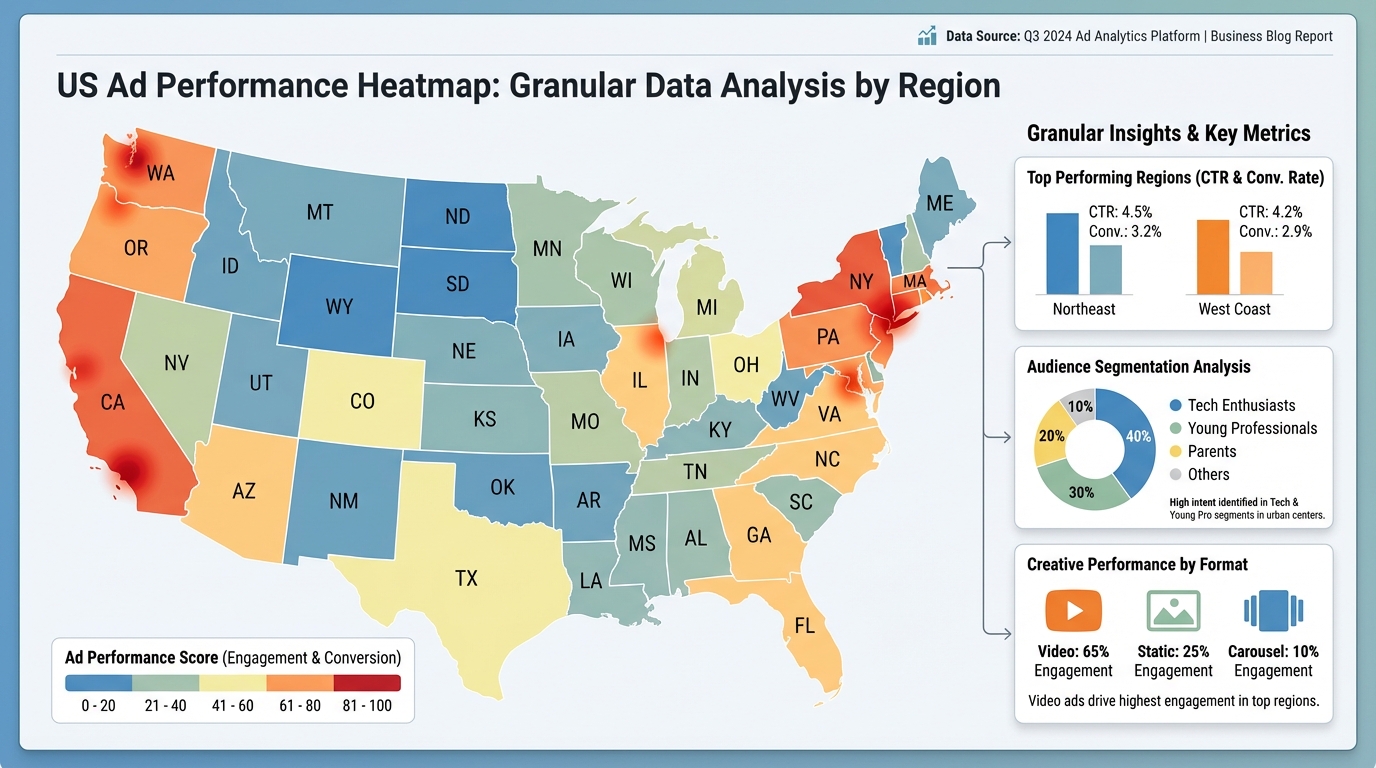
One of the historic complaints about MMM was that it was too high-level. Knowing that "Facebook worked" is helpful. Knowing which creative format worked in which region is profitable.
The marketing mix modeling trends 2026 has popularized are defined by this extreme granularity.
Computing power is cheap now. We can run thousands of models simultaneously. This allows brands to break down performance by:
- Geography: State, city, or DMA level.
- Creative: Video vs. Static vs. Carousel.
- Customer Cohort: New vs. Returning customers.
Geo-Lift Testing at Scale
The gold standard for proving causality is the geo-lift test. You turn off ads in Kansas, keep them on in Missouri, and measure the difference.
In the past, this was a manual nightmare. Now, platforms like BlueAlpha automate this process, integrating the results directly into the MMM. This creates a feedback loop where the model proposes a test, the platform executes it, and the results refine the model.
If you are struggling to justify spend across different regions, you need a solid strategy. Our media budget optimization guide covers the tactical steps to implementing geo-specific allocations.
[IMAGE: A map visualization showing heatmaps of ad performance by specific US states or regions, highlighting granular data analysis.] Alt text: Heatmap visualization demonstrating granular geographic marketing performance. Caption: 2026 models allow for state-by-state and city-by-city ROI analysis.
2024 and 2025 saw major tech giants release open-source MMM libraries. This changed the landscape essentially overnight.
- Google Meridian: Google's entry into the space brought Bayesian modeling to the masses. It is powerful, but it requires a heavy data science lift to implement correctly. You can read more in the official Google Meridian documentation or check our full analysis in the Google Meridian MMM complete guide.
- Meta Robyn: Meta's open-source code focuses on automating the modeling process to reduce human bias. It is excellent for developers who want to build custom solutions. Visit the Meta Robyn GitHub for the source code, or we break it down in our Meta Robyn open source MMM guide.
The "Build vs. Buy" Dilemma
While these tools are free, the talent required to run them is not.
This has led to a split in the market. Enterprise brands with 50-person data teams are building on top of Meridian or Robyn. Everyone else is turning to specialized SaaS platforms.
Platforms like BlueAlpha ingest these methodologies but wrap them in a user-friendly interface. They handle the data cleaning, the pipeline maintenance, and the visualization.
You don't need to be a data scientist to use a car; you just need to know how to drive. The same applies here. Most marketers want the insights, not the code.
For a head-to-head comparison of the methodologies, check out our article on which MMM is best.
5. Offline and B2B Attribution Finally Maturing
For years, MMM was seen as a B2C ecommerce tool. If you sold software or services with long sales cycles, you were out of luck.
That has changed.
One of the most significant marketing mix modeling trends 2026 brings to the table is the accurate measurement of long-tail conversions and offline channels.
Account-Based Marketing (ABM)
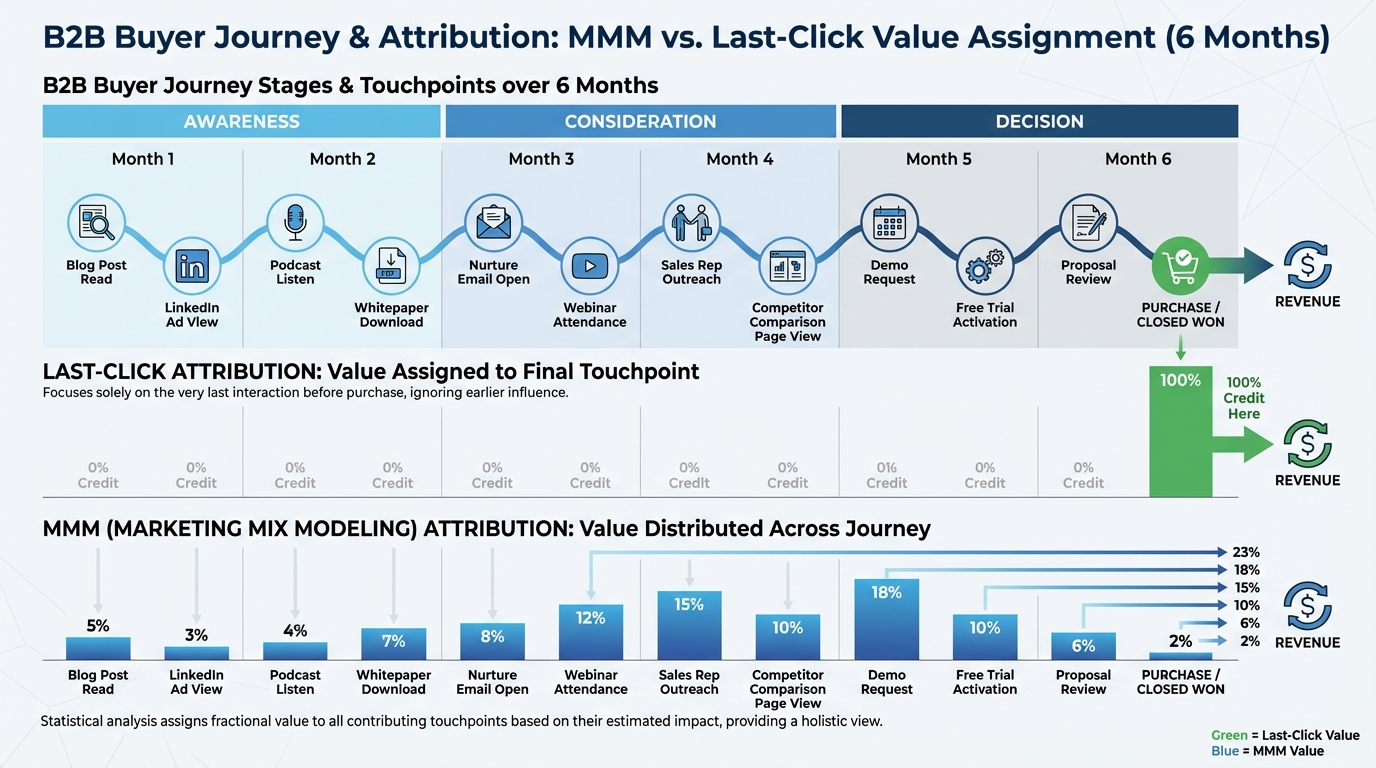
B2B journeys are complex. They involve multiple stakeholders and months of nurturing. Traditional attribution fails here because it overvalues the "demo request" click and ignores the six months of content consumption that preceded it.
Modern MMM creates a time-lagged model that accounts for these long cycles. It can attribute revenue closed in December to a LinkedIn campaign ran in August. This aligns with findings from Forrester regarding the lengthening of B2B buyer journeys.
If you are in the B2B space, you cannot afford to ignore this. Read our account based marketing attribution guide to see how to structure your data for this.
Out-of-Home (OOH) and Influencers
Billboards and podcasts were notoriously hard to track. Did that $50,000 spot on the highway actually drive sales?
By correlating localized spikes in traffic with OOH placement schedules, 2026 models can finally assign a real ROI to these channels. The same applies to influencer drops.
- Learn more about influencer marketing performance measurement.
- See how to track physical ads in our out of home advertising tracking guide.
[IMAGE: Infographic showing the B2B buyer journey with touchpoints over 6 months, highlighting where MMM assigns value compared to last-click.] Alt text: B2B buyer journey timeline showing multi-month attribution modeling. Caption: MMM connects the dots between early awareness and closed revenue, even months apart. Suggested dimensions: 1200x675px
In 2026, the wall between the CMO and the CFO is coming down. MMM data is being piped directly into financial planning and analysis (FP&A) tools.
This means marketing budgets aren't static pots of money. They are dynamic investment portfolios. If the model sees that TikTok is generating a higher marginal ROI than Google Search, the budget shifts automatically (or with a single click approval).
This financial fluidity requires rigorous measurement of effectiveness. It’s not just about "return on ad spend" (ROAS) anymore; it’s about incremental profit.
Harvard Business Review recently noted that companies integrating marketing data with finance workflows grow 1.5x faster than their siloed competitors.
To get your finance team on board, you need to speak their language. Start with our marketing effectiveness measurement guide.
7. The Rise of "Hybrid" Measurement
We mentioned that MTA is dead. That is mostly true for deterministic tracking. However, the concept of tracking user journeys isn't gone—it's just different.
The leading trend in 2026 is Triangulation.
Smart brands use three distinct methodologies to find the truth, a concept supported by measurement authorities like Nielsen.
- MMM: Top-down strategic view (The Anchor).
- Incrementality Testing: Geo-lifts and holdouts (The Validator).
- Attribution (First-party): Direct customer data (The Signal).
You cannot rely on just one.
If your MMM says Facebook is great, but your lift tests say it's zero, you have a problem. Platforms are now built to ingest all three signals and resolve the conflicts mathematically.
We explore this concept of validating data in our marketing ROI analysis guide.
Navigating the Platform Landscape
With these trends comes a crowded software market. Choosing the right tool is critical. You need a platform that handles the complexity of 2026 data without requiring a PhD to operate.
The Problem with Legacy Players
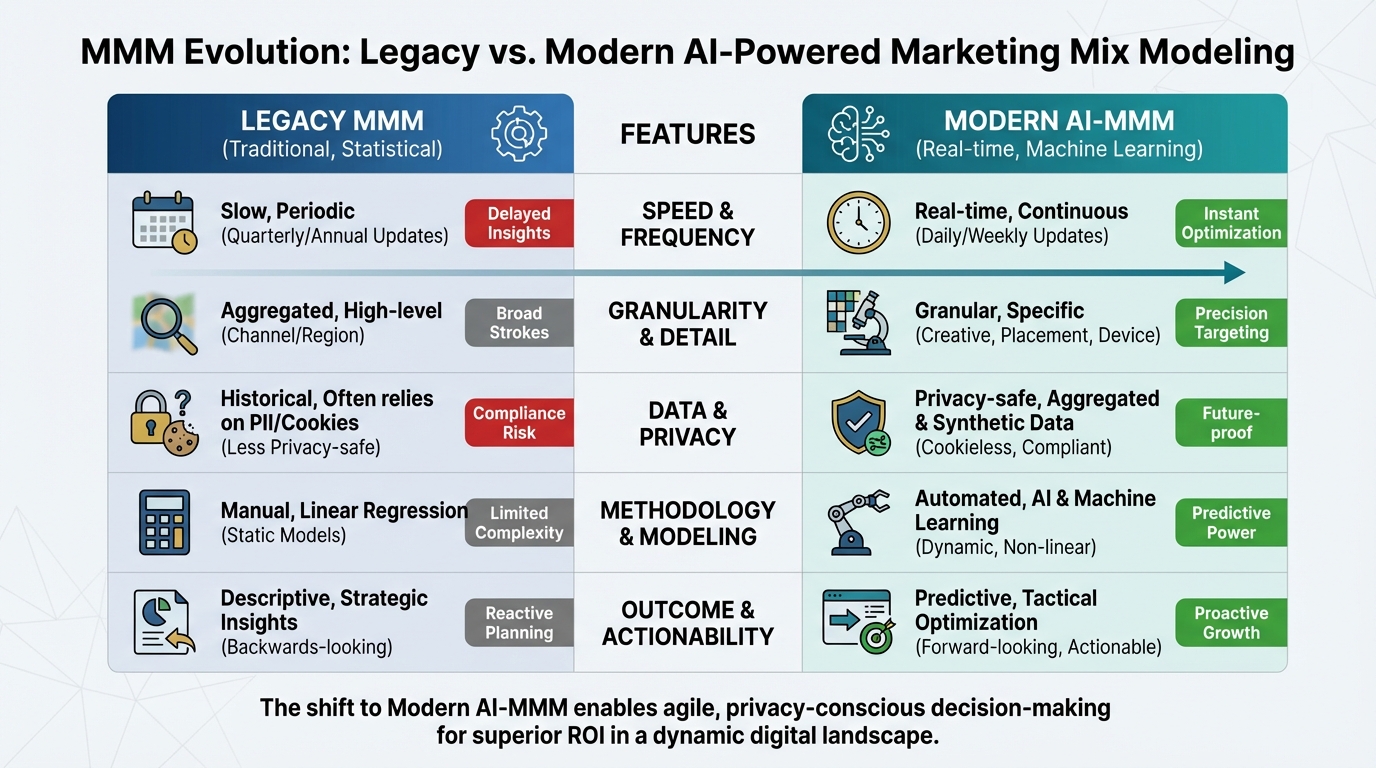
Legacy platforms often rely on outdated linear regression models that can't handle the speed of modern media. They are often expensive "black boxes" where you send data and hope for the best.
The Modern Contenders
Newer platforms prioritize transparency and speed.
- Recast: Known for its Bayesian focus. See our Recast vs BlueAlpha comparison.
- Northbeam: Originally an attribution tool, now pivoting to MMM. See Northbeam vs BlueAlpha.
- Triple Whale: Heavy focus on Shopify stores. See Triple Whale vs BlueAlpha.
BlueAlpha sits at the intersection of these trends. Unlike competitors that may struggle with data latency, BlueAlpha's automated geo-lift testing and real-time calibration make it particularly well-suited for the demands of 2026's privacy-first environment. It offers the depth of an enterprise tool like Google Meridian but with the usability of a modern SaaS dashboard.
[IMAGE: A comparison chart listing features of Legacy MMM vs. Modern AI-MMM (Real-time, Granular, Privacy-safe, etc.).] Alt text: Feature comparison chart between legacy marketing mix modeling and modern AI-driven solutions. Caption: The gap between legacy tools and modern solutions has never been wider. Suggested dimensions: 1200x675px
Conclusion: Adapt or Overspend
If your measurement strategy is based on methodologies from 2022, you are flying blind. You are likely overspending on low-performing channels and missing opportunities in emerging ones.
The future belongs to the agile. It belongs to the marketers who treat data as a continuous stream of intelligence, not a static report.
It is time to deploy a model that works as hard as you do.
Ready to get started? Read our step-by-step how to deploy media mix model guide and take control of your data today.
Frequently Asked Questions (FAQ)
What is the biggest difference between MMM in 2026 vs 2024?
The biggest difference is speed and granularity. In 2024, MMM was often a quarterly exercise providing high-level insights. In 2026, AI-driven MMM provides real-time or daily insights at a granular level (geo, creative, cohort), allowing for immediate budget optimization.
Can MMM really replace Multi-Touch Attribution (MTA)?
Yes, and it has to. With the loss of cookies and user-level tracking signals, MTA has lost its accuracy. MMM does not rely on tracking individuals, making it privacy-compliant and immune to signal loss. It is now the primary source of truth for marketing measurement.
Is Marketing Mix Modeling expensive to implement?
It used to be. However, the rise of SaaS platforms and automation has drastically lowered the cost. While enterprise custom solutions still exist, platforms like BlueAlpha and others have made MMM accessible to mid-market brands. For a look at alternatives, check our Measured.com alternatives guide.
How much historical data do I need for MMM in 2026?
Ideally, you want at least 12-24 months of historical data to account for seasonality. However, modern Bayesian models can start providing value with less data by using industry priors and continuously learning as new data flows in.
Does MMM work for B2B companies?
Absolutely. Modern models are sophisticated enough to handle long sales cycles and offline conversion data. By integrating CRM data, MMM can attribute revenue to marketing activities that happened months prior. See our ABM ROI measurement guide for details.
Stay in the loop
Get updates on new posts and resources.