Meridian vs Robyn vs PyMC: Open Source MMM Showdown 2026
We compare Google Meridian vs Robyn vs PyMC Marketing to find the best open-source MMM for 2026. Discover key differences and find your ideal tool today.
The cookie didn't just crumble. It disintegrated.
It's 2026. The era of deterministic tracking is a distant memory. If you are still relying on click-based attribution to allocate your budget, you aren't just flying blind—you’re flying without an engine.
Enter the renaissance of open source MMM.
For the last three years, data scientists have been locked in a debate over which framework reigns supreme. The battle of Meridian vs Robyn has defined marketing data science, with PyMC Marketing carving out a massive niche for the Python purists.
These aren't just statistical libraries. They are the financial rudders for billion-dollar ad budgets.
But which one should you actually use?
We are going to strip away the marketing fluff. No buzzwords. No "paradigm shifts." Just a brutal look at code, capability, and cost among the leading media mix modeling tools.
The State of MMM in 2026
Before we dive into the code, let's set the stage.
Three years ago, MMM was a "nice to have." Today, it is the baseline for measuring marketing effectiveness.
The shift happened because privacy regulations (GDPR, CCPA, and their 2025 updates) killed the signal marketers used to rely on. You can't track users across the internet anymore. You have to model them. This shift has made the media mix model marketing attribution guide essential reading for every modern CMO.
According to Forrester, 70% of enterprise advertisers have now transitioned to probabilistic modeling as their primary source of truth.
This forced giants like Google and Meta to open-source their internal tools. They needed advertisers to keep spending, and advertisers wouldn't spend what they couldn't measure.
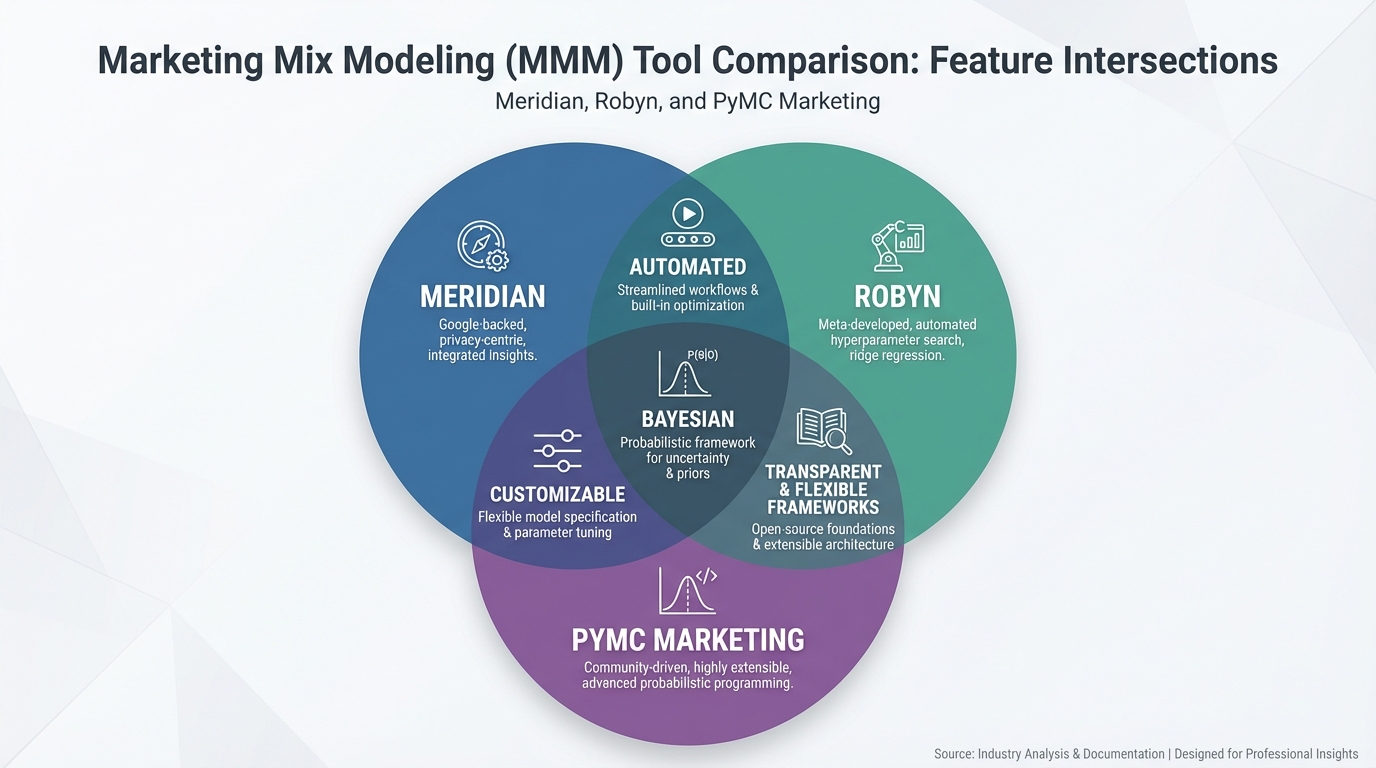
Now, you have three heavyweights:
- Google Meridian: The Bayesian powerhouse.
- Meta Robyn: The automated veteran.
- PyMC Marketing: The developer’s toolkit.
Choosing the wrong one costs you months of development time and potentially millions in wasted ad spend.
Contender 1: Google Meridian
Google arrived late to the open source MMM party, but they arrived heavy.
Google Meridian is built on top of TensorFlow Probability and JAX. It is designed to handle the complexity of modern media buying, specifically tackling the nuances of reach and frequency that older models ignored.
The Core Philosophy
Meridian is opinionated. It believes in Bayesian priors.
It allows you to inject business knowledge into the model. If you know that TV ads have a lag effect of three weeks, you can tell the model that. You don't have to hope the data finds it on its own.
For a deeper dive into the mechanics, check out our Google Meridian MMM guide.
Pros
- Geo-Level Hierarchical Models: Meridian excels at stitching together national and local data. If you have data at the DMA (Designated Market Area) level, Google Meridian is a beast.
- Reach & Frequency: It natively understands that the 10th impression is worth less than the 1st.
- Speed: Thanks to JAX, it compiles faster than older Stan-based models, allowing for rapid iteration.
Cons
- Technical Overhead: It requires a solid understanding of Bayesian statistics. You cannot just click "run."
- Google Ecosystem Bias: While open source, it plays nicest with Google’s data structures.
According to a 2025 report by Gartner, organizations adopting Bayesian MMM frameworks saw a 15% improvement in budget efficiency compared to frequentist models.
Contender 2: Meta Robyn
Meta Robyn was the first major player to democratize MMM. Back in the early 2020s, it changed the game by automating the "art" of modeling.
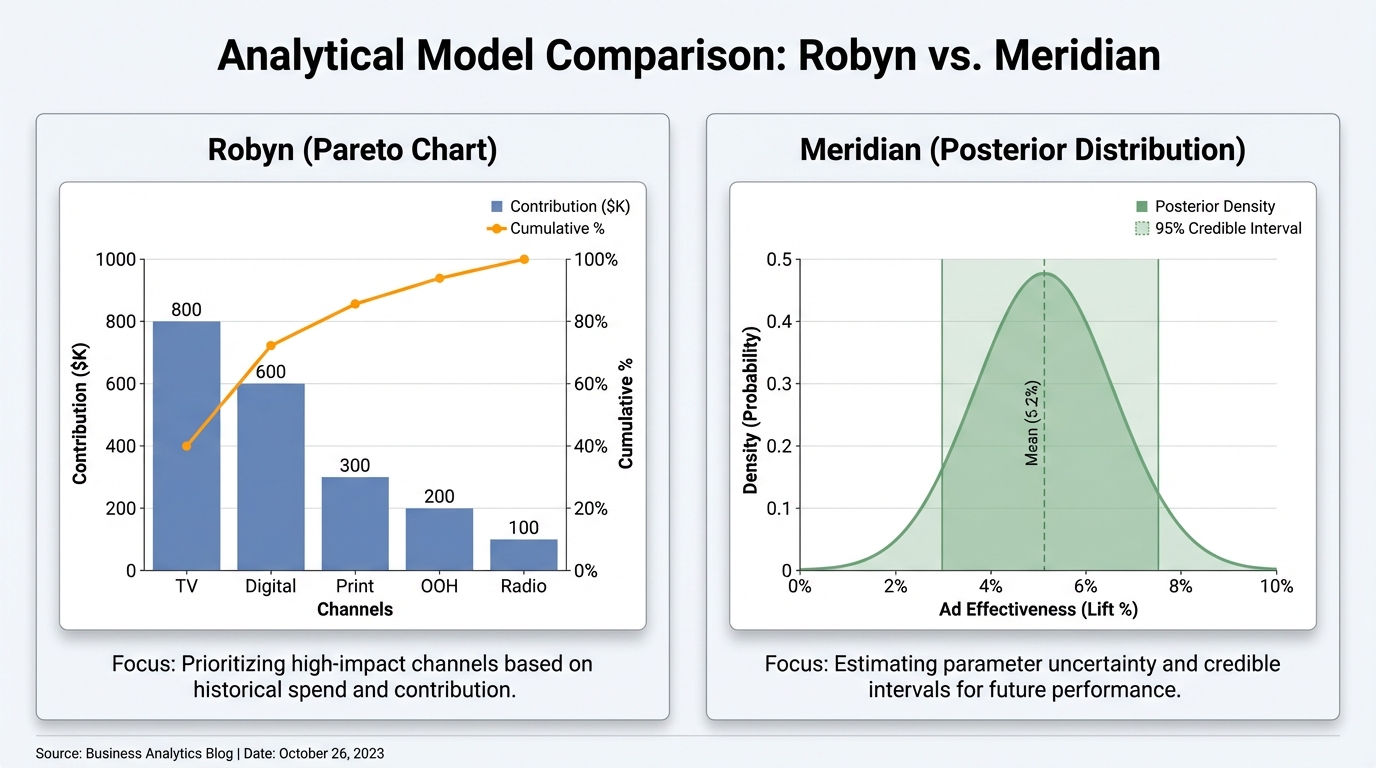
Robyn uses evolutionary algorithms (genetic optimization) to produce thousands of models, then asks you to pick the best one based on a Pareto front of error vs. decomposition distance. It remains one of the most popular media mix modeling tools for teams that prefer automation over manual tuning.
The Core Philosophy
Robyn is about volume and automation. It doesn't want you to manually tune every hyperparameter. It wants to brute-force the solution using computing power.
Read our full breakdown in the Meta Robyn guide.
Pros
- Automated Hyperparameter Tuning: It tries thousands of combinations of adstock and saturation for you.
- Prophet Integration: It seamlessly handles seasonality and trend decomposition using Meta’s Prophet library.
- Visual Output: The "one-pager" output is legendary for explaining results to CMOs.
Cons
- R-Based Legacy: While a Python wrapper exists now, the core logic was built in R. If your stack is pure Python, this is friction.
- Resource Heavy: Running 10,000 iterations takes serious compute time.
- "Black Box" Feel: Because it automates so much, junior analysts often accept results they don't understand.
[IMAGE: A screenshot comparison of a Robyn Pareto chart next to a Meridian posterior distribution graph.]
Contender 3: PyMC Marketing
If Meridian is a scalpel and Robyn is a factory, PyMC Marketing is a box of Lego bricks.
Built by the PyMC labs team, this is for data science teams that want total control. It isn't a "product" as much as a framework for building your own MMM.
The Core Philosophy
Transparency and flexibility. PyMC Marketing allows you to swap out saturation functions, change likelihood distributions, and build custom priors for specific channels. It relies heavily on the robust PyMC probabilistic programming library.
Pros
- Python Native: It fits perfectly into modern MLOps stacks.
- Community Driven: It moves faster than the corporate-backed tools. New features drop weekly.
- Customization: You can model unique business constraints that Robyn or Meridian might not support out of the box.
Cons
- High Barrier to Entry: You need to know Python and Bayesian stats intimately.
- Less "Out of the Box": You have to build the visualization and reporting layers yourself.
This flexibility makes it a favorite for teams comparing MTA vs MMM because you can code custom logic to bridge the gap between the two.
Meridian vs Robyn: The Head-to-Head
This is the comparison that keeps data leads awake at night. When we look at Meridian vs Robyn, the choice usually comes down to your data granularity and your team's skillset.
1. Methodology
- Meta Robyn uses Ridge Regression with evolutionary optimization. It is fantastic at fitting historical data but can sometimes overfit if you aren't careful with the Pareto selection.
- Google Meridian uses Hierarchical Bayesian regression. It is better at handling uncertainty and incorporating "priors" from experiments.
If you run a lot of lift tests, Meridian’s ability to ingest those priors gives it the edge. We discuss this synergy in our marketing ROI analysis guide.
2. The "Human in the Loop"
- Robyn asks the human to choose the best model after the machine generates options.
- Meridian asks the human to guide the model before it runs (via priors).
3. Speed to Insight
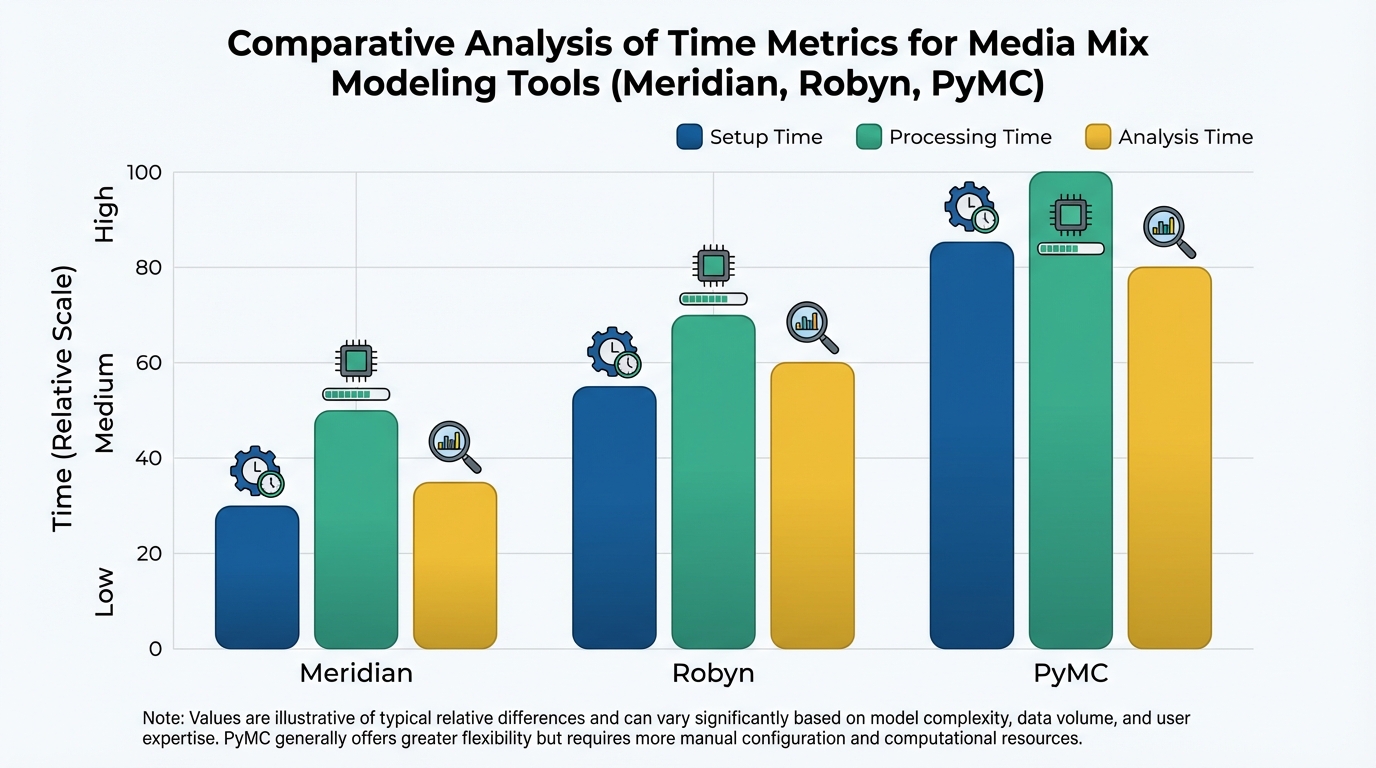
Robyn is faster to get a "first draft" model because of its automation. Meridian takes longer to set up but often produces a more robust model for forecasting.
Research from McKinsey suggests that companies that successfully integrate human intuition with AI modeling outperform peers by 85% in sales growth. This supports the argument for Meridian's prior-heavy approach if you have the domain expertise.
The Hidden Cost: Engineering and Maintenance
Here is the truth nobody puts in the GitHub README.
Open source software is free. Implementing it is expensive.
To run Meridian vs Robyn effectively in production, you need:
- Data Engineering: Pipelines to clean and format data daily.
- Compute: Cloud resources to run these heavy models.
- Talent: A data scientist ($150k+/year) to interpret the results.
Many companies start with open source MMM, realize they are spending 80% of their time fixing data pipelines, and eventually look for a managed solution.
This is where the "Build vs Buy" conversation happens. You need to understand how to deploy a media mix model before you commit to the code.
According to Harvard Business Review, 85% of AI and data science projects fail to deliver ROI, often due to the complexity of deployment rather than the quality of the model.
The BlueAlpha Advantage
At BlueAlpha, we respect the open-source community. We monitor the Meridian vs Robyn battle closely.
But we also know that CMOs don't care about Ridge Regression vs. Bayesian priors. They care about where to put the next dollar for maximum ad spend optimization.
BlueAlpha leverages the best methodologies from these open-source frameworks but wraps them in an AI-powered engine that handles:
- Automated Data Ingestion: No more broken CSVs.
- Continuous Calibration: The model updates as market conditions change.
- Actionable Insights: We translate "coefficients" into "budget recommendations."
If you are comparing platforms, you might look at other tools. We have detailed breakdowns of Lifesight vs BlueAlpha and Recast vs BlueAlpha. The difference is that we focus on the decision, not just the dashboard.
We allow you to focus on media budget optimization rather than debugging Python environments.
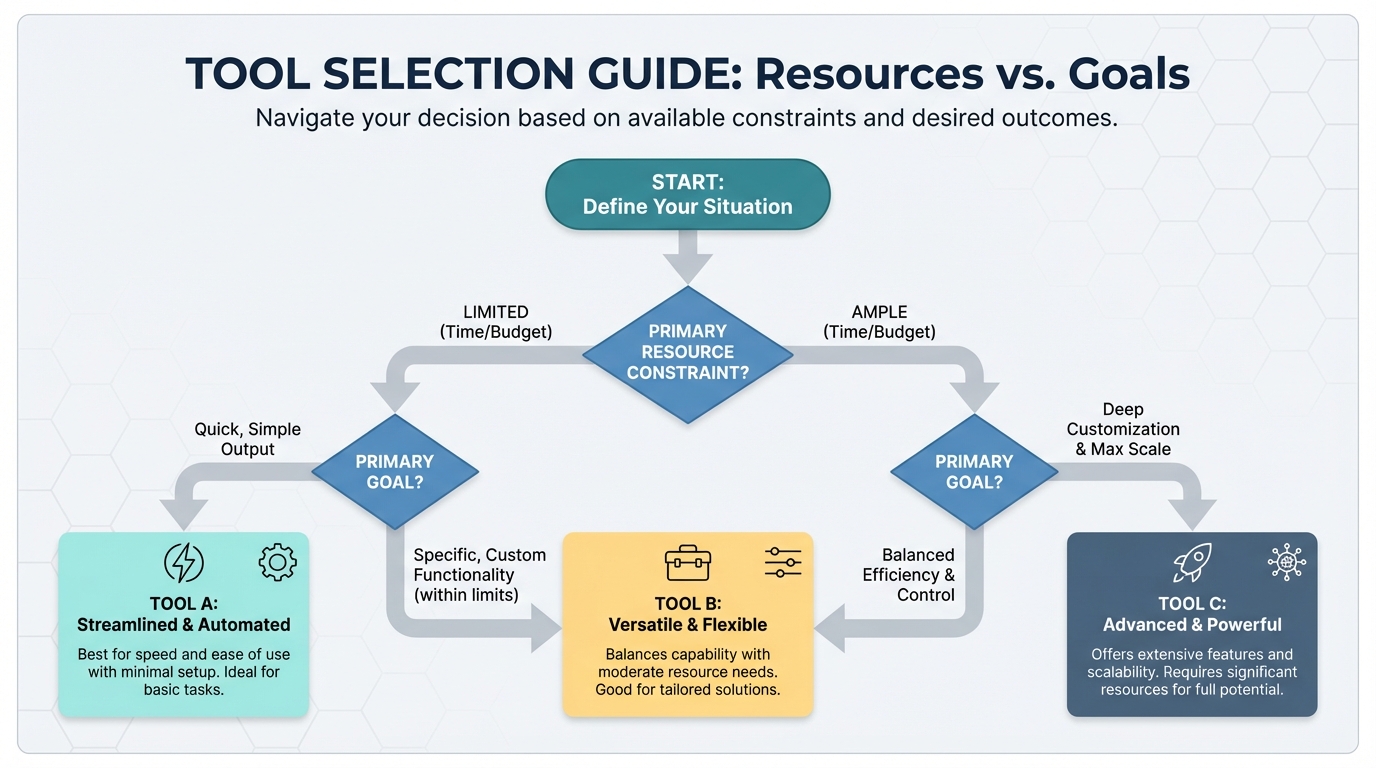
Decision Matrix: Which Tool is For You?
If you are determined to build in-house, here is your cheat sheet.
Choose Meta Robyn if:
- You have a strong analyst team but limited data engineering resources.
- You want automated hyperparameter tuning to do the heavy lifting.
- You need excellent visualization out of the box.
- You are heavily invested in the Meta ecosystem (Facebook/Instagram).
Choose Google Meridian if:
- You have strong Bayesian statistics knowledge in-house.
- You have granular geo-level data (DMA/State).
- You run frequent lift tests and want to use those results as priors.
- You are comparing Which MMM is best for a Google-heavy ad stack.
Choose PyMC Marketing if:
- You are a Python-native shop.
- You need to build highly custom model structures.
- You want to integrate MMM into a larger custom ML pipeline.
- You are comfortable using libraries like ArviZ for exploratory analysis of Bayesian models.
Choose BlueAlpha if:
- You want the accuracy of these models without the engineering headache.
- You need results in weeks, not months.
- You want AI to help interpret the data, not just display it.
- You need specific guidance on funnel stage budget allocation.
[IMAGE: A flowchart helping the user decide between the three tools based on their resources and goals.]
Integrating with Other Attribution Models
A common mistake is thinking MMM replaces everything. It doesn't.
MMM is your strategic compass. Multi-Touch Attribution (MTA) is your tactical map.
Even if you choose Meridian or Robyn, you still need to understand how they fit with your tracking data. For B2B companies, this gets even harder. You need to look at account-based marketing attribution alongside your MMM to truly understand deal velocity.
If you are heavy on offline channels, MMM is non-negotiable. You can't track a billboard with a cookie. Check out our Out of Home advertising tracking guide to see how MMM solves this.
FAQ
Q: In the Meridian vs Robyn debate, can I use both together? A: Yes, this is called an "ensemble" approach. Some advanced teams run both models and average the results to reduce bias. However, this doubles your compute and maintenance costs.
Q: How much data do I need for these tools? A: Generally, you need at least two years of historical data to capture seasonality. If you have less, the models will struggle to differentiate between a seasonal spike and ad performance.
Q: Is open source MMM free? A: The code is free. The implementation is not. Expect to spend significant resources on data cleaning, server costs, and analyst salaries.
Q: How does this compare to SaaS tools like Northbeam? A: SaaS tools provide convenience and UI. Open source provides transparency and control. For a direct comparison of a SaaS leader against our approach, read Northbeam vs BlueAlpha.
Q: Does Meridian work for B2B? A: It can, but B2B sales cycles are long. You will need to adjust the lag parameters significantly.
Conclusion
The Meridian vs Robyn debate isn't about which tool is "better." It's about which trade-offs you are willing to make.
Robyn offers automation at the cost of transparency. Meridian offers precision at the cost of complexity. PyMC Marketing offers flexibility at the cost of development time.
In 2026, the winner is the marketer who stops debating frameworks and starts modeling. The data is there. The media mix modeling tools are ready.
If you have the engineering team to support it, download the repo and get to work. If you want to skip the build and get straight to the revenue, BlueAlpha is ready to deploy.
Don't let analysis paralysis kill your marketing ROI. Pick a path and start measuring.
Stay in the loop
Get updates on new posts and resources.