Top 7 Workmagic Alternatives for AI Marketing in 2025
Discover the best Workmagic alternatives for AI marketing. Compare features, pricing, and capabilities across leading platforms for attribution and optimization.
Workmagic built its reputation on AI-powered content generation—product photography, marketing copy, and campaign automation for e-commerce brands. But content creation is only part of the marketing puzzle. The harder question remains: How do you know which channels actually drive results?
That's where many organizations hit Workmagic's limitations. The platform excels at producing marketing assets, but measuring their effectiveness requires different capabilities. If you're looking for platforms that go deeper on attribution, optimization, or strategic measurement, you've come to the right place.
This guide covers the top Workmagic alternatives worth evaluating in 2025. Each platform approaches marketing challenges differently—some prioritize analytics, others focus on measurement methodology, and several offer hybrid approaches combining content and data.
Why Consider Workmagic Alternatives?
Before exploring alternatives, let's acknowledge what Workmagic does well. The platform automates time-consuming tasks: generating product images without photoshoots, writing marketing copy at scale, and managing campaigns across channels. For e-commerce businesses drowning in content production costs, that's genuine value.
But several factors might push you toward alternatives:
Measurement depth limitations. Workmagic includes attribution features, but they're secondary to content generation. Organizations needing sophisticated marketing mix modeling or incrementality testing won't find that depth in a content-first platform.
Privacy challenges. Attribution platforms dependent on pixel-based tracking face growing headwinds. iOS privacy changes and cookie deprecation have fundamentally altered what's measurable through traditional methods.
Strategic optimization needs. Knowing what content to create is one thing. Knowing which channels deserve your budget is another. According to Gartner's marketing technology research, organizations increasingly separate content production from measurement strategy.
Media mix complexity. If you're running TV, radio, podcasts, or out-of-home alongside digital, Workmagic can't measure that contribution. You need platforms built for cross-channel measurement.
The reality: many organizations need different tools for different jobs. Let's explore what's available.
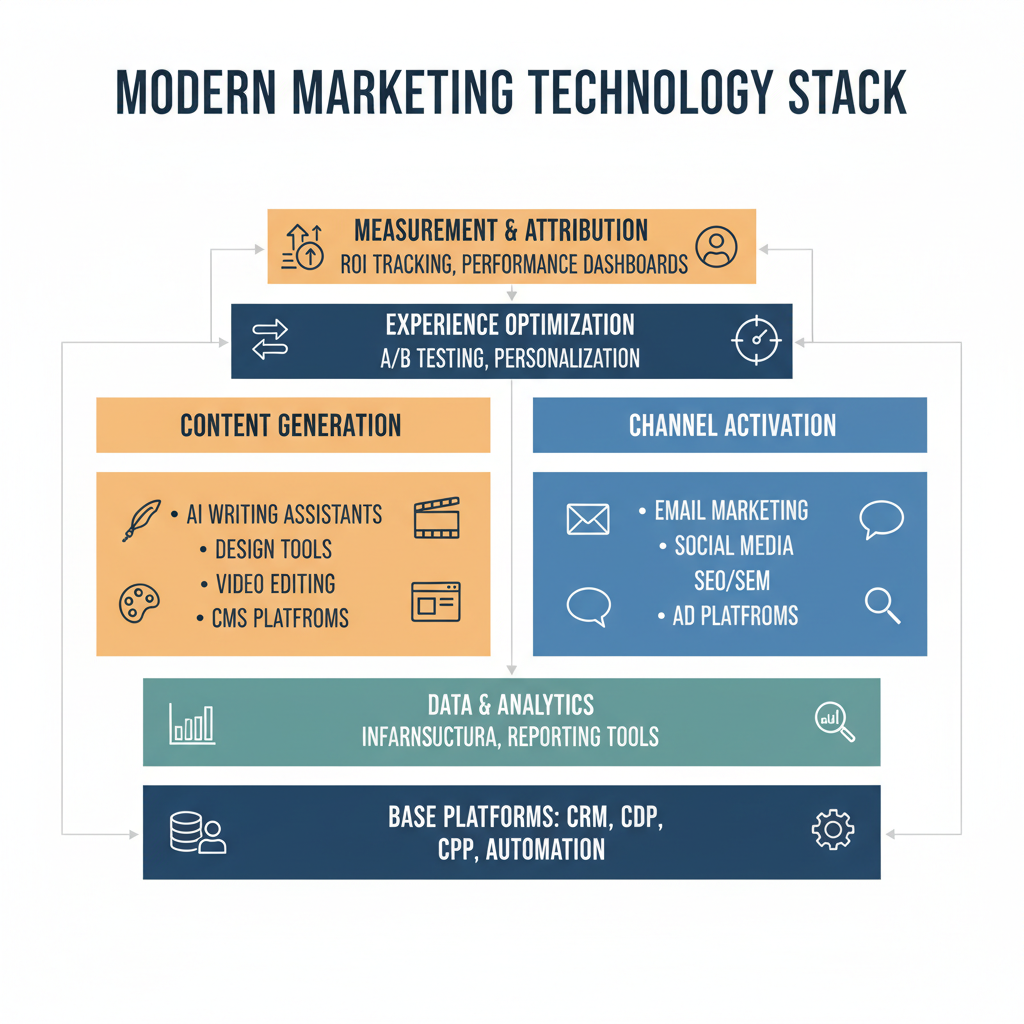
Content generation and marketing measurement often require specialized platforms
Top 7 Workmagic Alternatives
1. BlueAlpha.ai
Best for: Organizations needing strategic marketing measurement and budget optimization
BlueAlpha.ai approaches marketing from the opposite direction of Workmagic. Instead of starting with content, it starts with measurement—using marketing mix modeling to determine which investments actually drive results.
Key capabilities:
- Bayesian marketing mix modeling that quantifies each channel's incremental contribution
- Budget optimization recommendations with expected ROI projections for different allocation scenarios
- Saturation curve analysis showing exactly where diminishing returns kick in
- Cross-channel synergy detection identifying combinations that amplify results
- Offline media measurement including TV, radio, print, and sponsorships
The platform answers strategic questions Workmagic can't: "Should we shift budget from Facebook to TikTok?" or "What's the true incremental value of our YouTube investment?"
BlueAlpha.ai's consultative approach means you get expert guidance—not just software access. This matters because marketing measurement implementation determines accuracy. A misconfigured model produces misleading recommendations.
Considerations: Marketing mix modeling requires historical data (typically 2+ years) and works best at scale. Organizations spending under $300K monthly may not achieve statistical significance across all channels. Our comparison of Workmagic vs BlueAlpha.ai explores these tradeoffs in detail.
2. Triple Whale
Best for: E-commerce brands on Shopify needing first-party attribution
Triple Whale built its position serving direct-to-consumer brands, particularly those on Shopify. If you're evaluating Workmagic alternatives within the e-commerce ecosystem, Triple Whale deserves attention.
Key capabilities:
- First-party pixel tracking more resilient than third-party cookies
- Creative performance analysis identifying which ads drive conversions
- Profit and loss reporting at the customer and campaign level
- AI-powered insights surfacing optimization opportunities automatically
Triple Whale's "Triple Pixel" provides tracking that survives iOS restrictions better than platform-reported metrics. For brands struggling with post-iOS 14 attribution accuracy, this matters.
The platform integrates deeply with Shopify, Klaviyo, Meta, Google, and TikTok—the standard DTC tech stack. Implementation is straightforward if you're already in this ecosystem.
Considerations: Triple Whale's e-commerce focus means B2B companies, lead generation businesses, and brands with significant offline presence will find limited applicability. The platform tracks digital touchpoints but can't measure TV, radio, or other offline channels. See our Triple Whale vs BlueAlpha.ai comparison for deeper analysis.
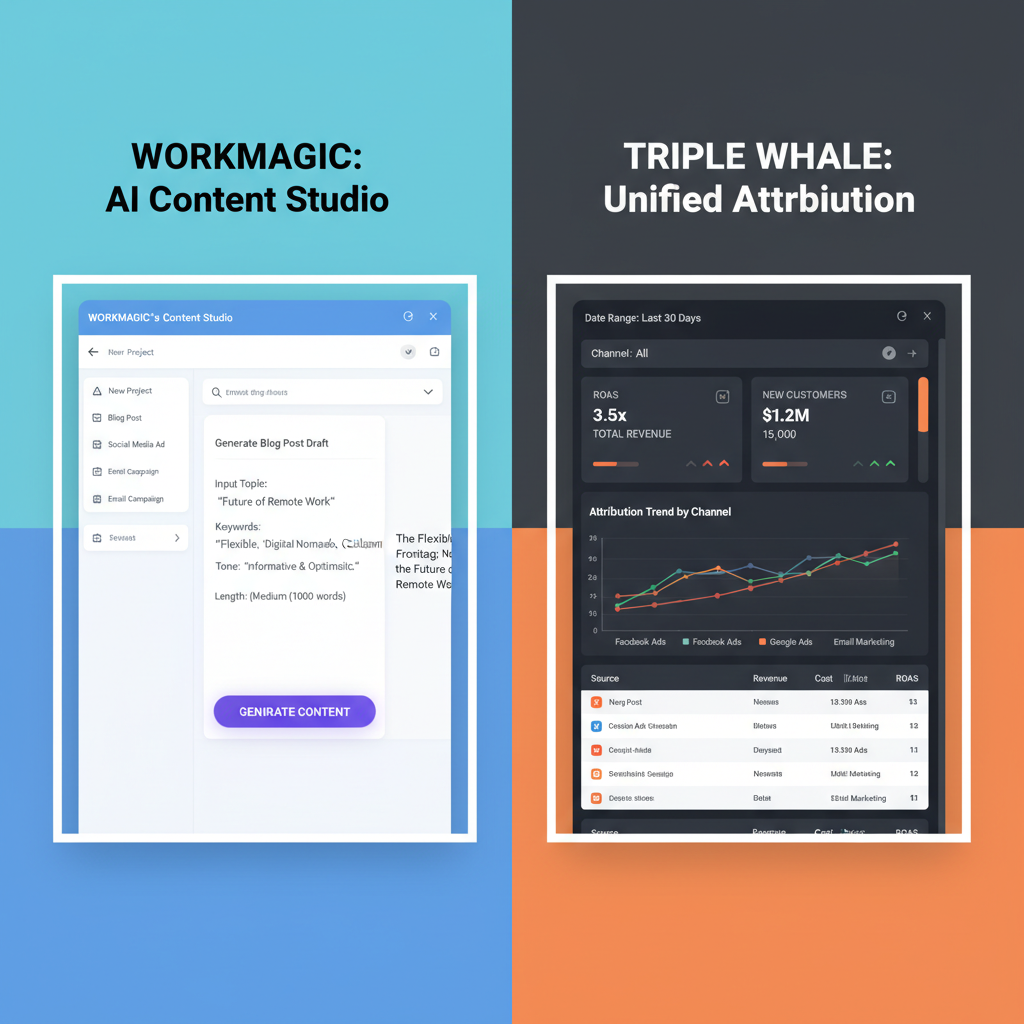
Content-first platforms and measurement-first platforms serve different needs
3. Northbeam
Best for: Multi-channel DTC brands needing real-time attribution data
Northbeam positions itself as the "attribution platform for modern growth teams." The platform emphasizes speed—getting attribution data fast enough to inform daily campaign decisions.
Key capabilities:
- Multi-touch attribution with customizable models
- Real-time dashboards for tactical optimization
- Marketing mix modeling lite for strategic planning
- Cross-device tracking using probabilistic methods
- Creative-level attribution showing which specific ads drive results
Northbeam sits between tactical attribution tools and strategic MMM platforms. You get faster feedback than traditional marketing mix modeling but more sophistication than last-click attribution.
The platform integrates well with media budget optimization workflows, providing data at the pace campaign managers need.
Considerations: Like most attribution platforms, Northbeam works best for digital-heavy media mixes. Offline measurement capabilities are limited. For detailed comparison, read our Northbeam vs BlueAlpha.ai analysis.
4. Measured.com
Best for: Enterprise brands requiring experimental proof of marketing impact
Measured.com takes a fundamentally different approach: instead of modeling what marketing might do, it runs experiments to prove what marketing actually does. If your CFO demands scientific evidence, not model outputs, Measured delivers.
Key capabilities:
- Automated geo-testing running controlled experiments across markets
- Cross-channel incrementality including walled garden measurement
- MMM calibration grounding models in experimental reality
- Privacy-compliant architecture without user-level tracking
Research from Nielsen suggests geo-testing delivers 30-40% more accurate ROI estimates than correlation-based attribution. The tradeoff is time—tests require 4-8 weeks to generate results.
For organizations that need to defend marketing budgets to skeptical finance teams, experimental evidence carries more weight than modeled estimates. Our Measured.com alternatives guide and Measured.com vs BlueAlpha.ai comparison explore these methodological differences.
Considerations: Geo-testing requires scale and patience. You need enough geographic diversity for valid holdout groups and enough time for statistical significance. This isn't a platform for quick tactical decisions.
5. Lifesight
Best for: Mid-market brands wanting unified measurement in one platform
Lifesight attempts to combine attribution, marketing mix modeling, and optimization in a single environment. For organizations that want one platform instead of assembling multiple tools, this approach appeals.
Key capabilities:
- Unified marketing measurement combining multiple methodologies
- Scenario planning for budget allocation decisions
- AI recommendations for optimization opportunities
- Customer journey analytics with path analysis
The platform aims to make sophisticated analytics accessible to teams without deep data science resources. That democratization has value when internal capabilities are limited.
Considerations: "All-in-one" platforms make tradeoffs. Dedicated solutions often go deeper in their specific area than platforms trying to do everything. Our Lifesight vs BlueAlpha.ai comparison examines where each approach excels.
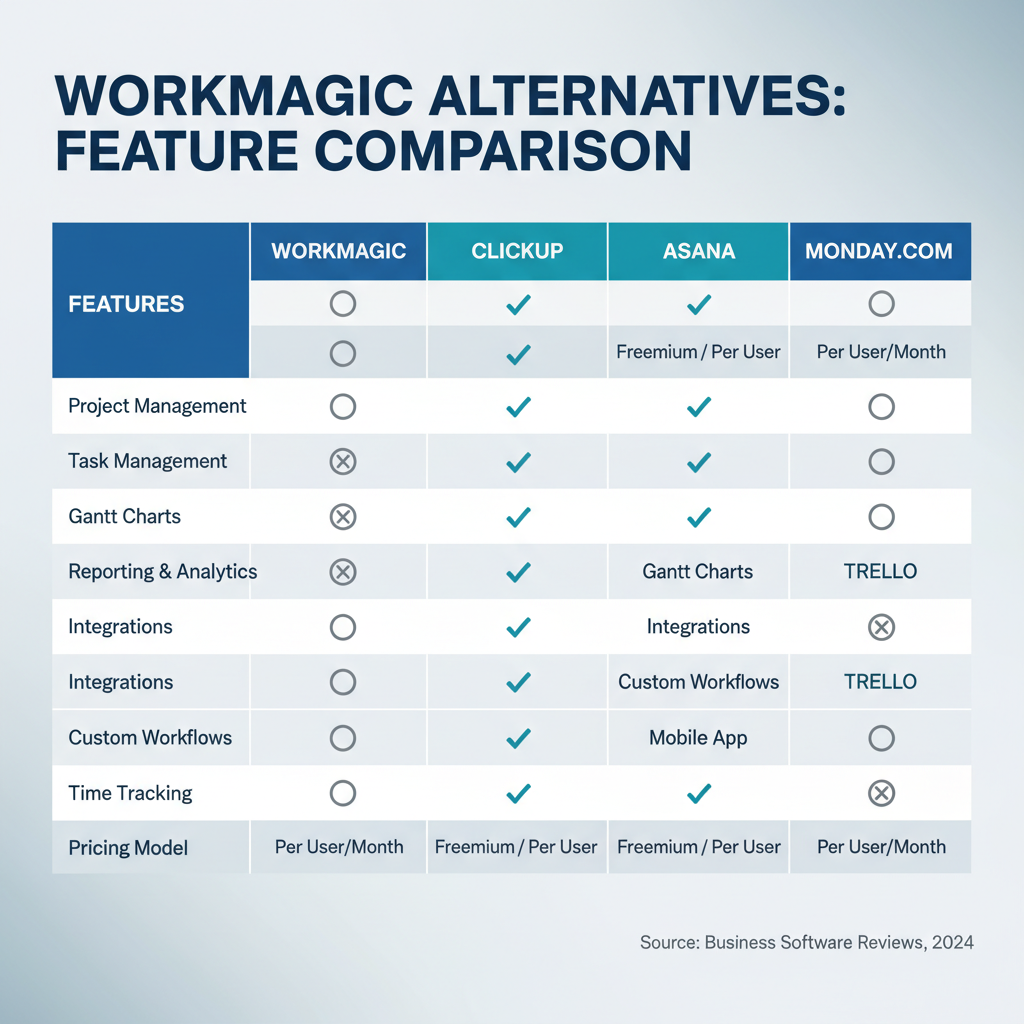
Each alternative prioritizes different aspects of marketing measurement
6. Funnel.io
Best for: Organizations needing data integration before analytics
Funnel.io solves a different problem than Workmagic or most alternatives on this list. Where others focus on attribution or content, Funnel.io focuses on data collection and normalization—the plumbing that feeds your analytics stack.
Key capabilities:
- 500+ data connectors for marketing platforms and ad networks
- Automated data transformation and normalization
- Flexible export destinations to any BI tool or data warehouse
- No visualization layer—it's infrastructure, not analytics
For organizations drowning in manual data exports and spreadsheet reconciliation, Funnel.io solves immediate operational pain. The platform pairs well with measurement tools that need clean, consolidated data inputs.
Considerations: Funnel.io tells you what happened but not why. You'll need separate tools for actual attribution and optimization. Our Funnel.io alternatives guide and Funnel.io vs BlueAlpha.ai comparison explore complementary use cases.
7. Roadway.ai
Best for: Growth-stage companies wanting full-funnel attribution
Roadway.ai built its platform around full-funnel attribution—understanding how users move from first touch through conversion. The platform offers self-serve analytics with guided automation.
Key capabilities:
- Full-funnel attribution tracking complete customer journeys
- Multi-model attribution letting you compare methodologies
- Automated insights surfacing optimization opportunities
- Growth analytics designed for marketing teams, not data scientists
The self-serve approach suits organizations that want to explore data without heavy implementation. Roadway.ai makes sophisticated attribution accessible.
Considerations: Like most attribution platforms, Roadway.ai works best for digital channels. If your media mix includes significant offline investment, you'll need marketing mix modeling capabilities beyond what attribution provides. See our Roadway.ai alternatives guide for additional options.
How to Choose the Right Alternative
Selecting from these Workmagic alternatives depends on your specific situation. Work through these questions:
What's your primary challenge?
"We need better attribution accuracy." Look at first-party tracking solutions (Triple Whale, Northbeam) or aggregate modeling (BlueAlpha.ai).
"We need to optimize budget allocation." Marketing mix modeling platforms provide prescriptive recommendations, not just reports.
"Our data is fragmented everywhere." Start with data integration (Funnel.io) before adding analytics layers.
"We need to prove marketing ROI to executives." Incrementality testing (Measured.com) or MMM provides defensible evidence. Our marketing ROI analysis guide covers best practices.
What's your media mix?
Primarily digital channels: Attribution platforms work well for digital-heavy mixes where tracking exists.
Significant offline media: You need MMM to measure TV, radio, print, and out-of-home. Digital attribution can't help here.
Both digital and offline: Look for platforms handling both, typically MMM solutions with digital integrations.
What's your scale and team?
Under $100K monthly spend: Self-serve platforms with lighter pricing. Complex MMM may not provide enough value at this scale.
$100K-500K monthly: Mid-market solutions balancing capability with complexity.
$500K+ monthly: Enterprise solutions with dedicated support. The percentage improvement from better measurement compounds significantly at higher spend levels.
According to Harvard Business Review research, measurement sophistication should match organizational complexity.
Comparing Key Features
| Feature | Workmagic | BlueAlpha.ai | Triple Whale | Northbeam | Measured.com | Funnel.io |
|---|---|---|---|---|---|---|
| Primary Focus | Content generation | Marketing measurement | E-commerce attribution | Multi-touch attribution | Incrementality testing | Data integration |
| AI Content Creation | ✅ Core feature | ❌ | ❌ | ❌ | ❌ | ❌ |
| Marketing Mix Modeling | ⚠️ Basic | ✅ Advanced | ❌ | ⚠️ Light | ✅ Calibrated | ❌ |
| Budget Optimization | ⚠️ Limited | ✅ Prescriptive | ⚠️ Limited | ⚠️ Limited | ✅ Informed | ❌ |
| Offline Media | ❌ | ✅ Full | ❌ | ❌ | ✅ Full | ⚠️ Data only |
| Self-Serve | ✅ | ⚠️ Guided | ✅ | ✅ | ⚠️ Managed | ✅ |
| Privacy-Resilient | ⚠️ | ✅ | ⚠️ | ⚠️ | ✅ | N/A |
For additional platform comparisons, explore our complete MMM comparison guide.
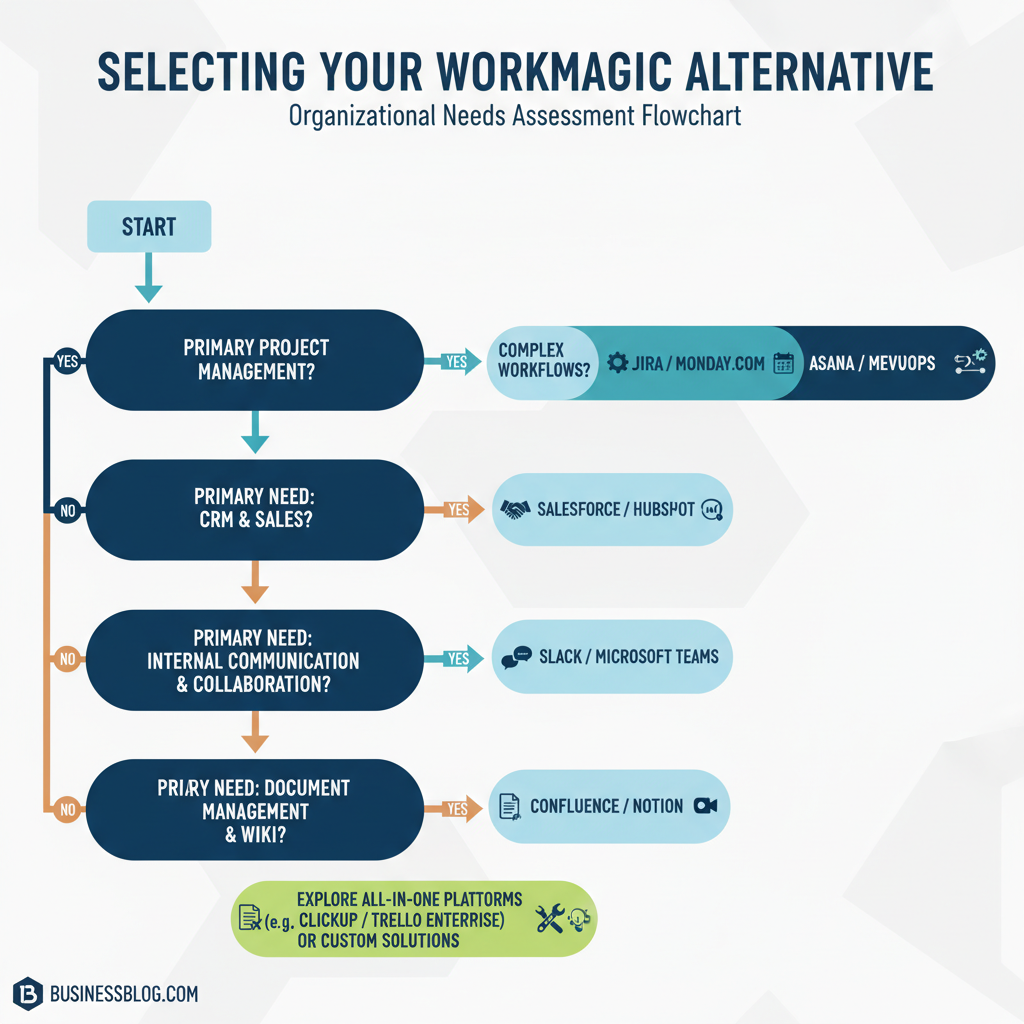
Your primary challenge determines which alternative fits best
Frequently Asked Questions
What is Workmagic best used for?
Workmagic excels at AI-powered content generation for e-commerce—creating product images, marketing copy, and campaign assets without traditional production processes. The platform also includes incrementality-based attribution, though content automation is its primary strength. Businesses with high-volume content needs and limited creative resources benefit most.
Why are marketers looking for Workmagic alternatives?
Common reasons include: needing deeper marketing measurement capabilities beyond basic attribution, wanting marketing mix modeling for strategic budget allocation, requiring offline media measurement that content-focused platforms can't provide, and seeking privacy-resilient measurement as tracking restrictions increase.
Can I use Workmagic alongside these alternatives?
Yes—many organizations use complementary platforms. Workmagic handles content production while a measurement platform like BlueAlpha.ai determines where to deploy that content for maximum impact. The key is ensuring platforms serve distinct purposes rather than duplicating functionality.
What's the difference between content generation and marketing measurement platforms?
Content generation platforms (Workmagic) create marketing assets—images, copy, videos. Marketing measurement platforms analyze which channels and campaigns actually drive business results. Both solve real problems, but they're fundamentally different functions. Organizations often need both, either combined or from separate specialized providers.
How do privacy changes affect these platforms?
Content generation features (AI images, copy) are unaffected by privacy regulations. Attribution features vary significantly. Pixel-based attribution (Triple Whale, Northbeam) faces ongoing challenges from iOS restrictions and cookie deprecation. Aggregate statistical modeling (BlueAlpha.ai, Measured.com) provides more privacy-resilient alternatives since it doesn't require individual user tracking.
How long does implementation typically take?
Timelines vary dramatically by platform type. Content automation tools can be operational within 1-2 weeks. Self-serve attribution platforms typically take 2-4 weeks. Marketing mix modeling solutions require 6-12 weeks for proper model development and validation—but that investment delivers more reliable strategic insights.
Conclusion
The Workmagic alternatives landscape reflects a broader truth: content creation and marketing measurement are different disciplines. A platform excellent at generating product photography won't necessarily help you understand which channels deserve your budget.
Key takeaways:
- Content production bottleneck? Workmagic or similar content automation tools solve this efficiently
- Measurement and optimization bottleneck? Look at dedicated measurement platforms like BlueAlpha.ai, Measured.com, or Northbeam
- E-commerce on Shopify? Triple Whale integrates deeply with your existing stack
- Complex media mix (digital + offline)? Marketing mix modeling is the only methodology that measures everything
- Data fragmentation issues? Solve integration first (Funnel.io) before adding analytics
According to Forrester's marketing technology research, leading organizations increasingly use specialized tools rather than all-in-one platforms. The most sophisticated marketers combine content production with rigorous measurement—using each for its intended purpose.
Before committing to any platform, honestly assess your primary challenge. Is it producing enough content, or understanding which marketing actually works? That answer points you toward the right solution.
Ready to improve your marketing measurement? Take our readiness quiz to assess your current capabilities, or explore how media mix modeling can transform your budget allocation decisions.
Stay in the loop
Get updates on new posts and resources.