Marketing Mix Modeling Ecommerce: The 2026 DTC Guide
Stop relying on broken pixels. Learn how marketing mix modeling ecommerce strategies restore truth to your data and optimize budget allocation. Read the guide.
Your Facebook Ads Manager is lying to you.
If you run a Direct-to-Consumer (DTC) brand, you already know this. You see a 4.0 ROAS in the dashboard, but your bank account tells a different story. Since the privacy changes of the early 2020s, pixel-based tracking has crumbled.
Cookies are disappearing. Attribution windows are shrinking. The customer journey is darker than ever.
Yet, you still need to know where to spend your next marketing dollar.
This is where marketing mix modeling ecommerce strategies come into play. It’s not new tech. It’s actually old math, revitalized for the modern data stack. It doesn't rely on tracking individual users across the internet. Instead, it uses statistical analysis to reveal the truth about your marketing performance.
Here is how to stop guessing and start measuring.
The Data Crisis in DTC Marketing
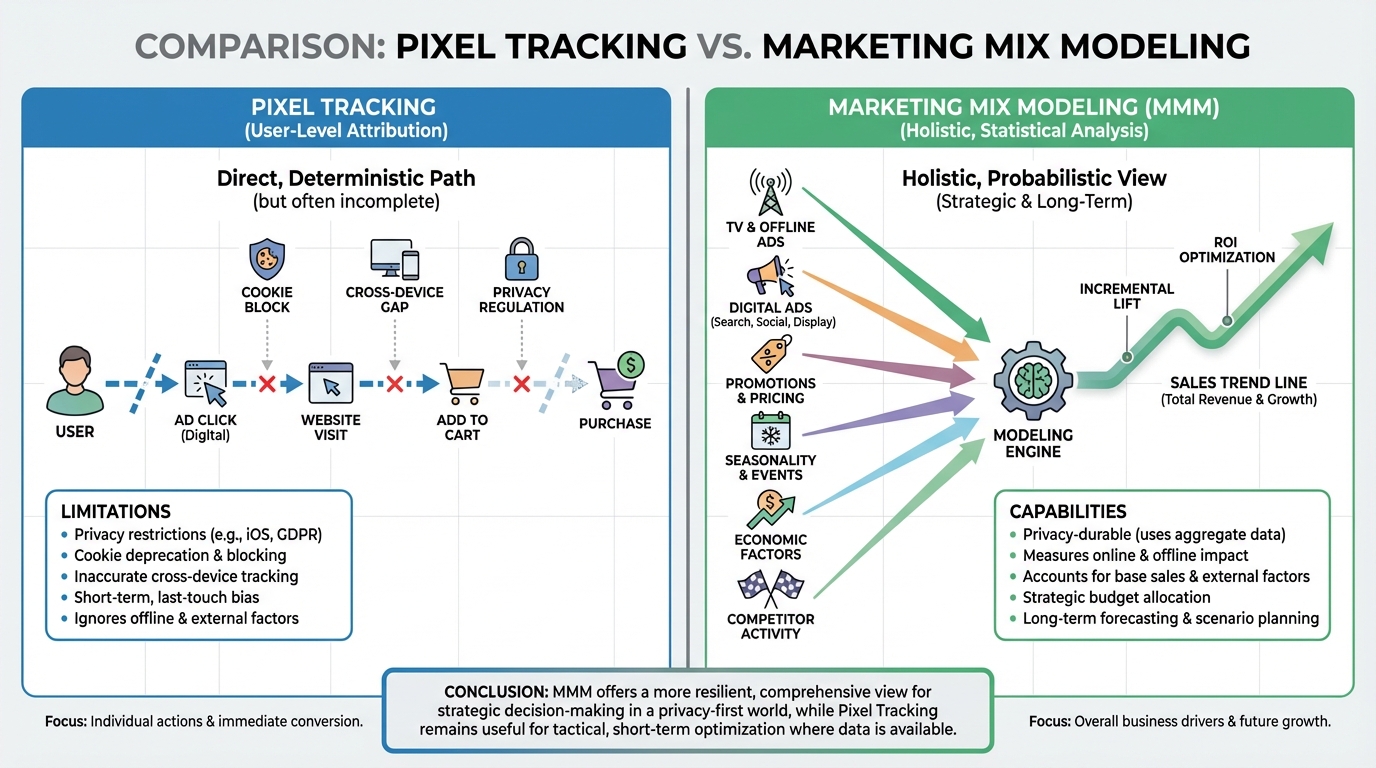
For a decade, ecommerce marketers relied on Multi-Touch Attribution (MTA). You clicked an ad, you bought a shirt, and the pixel reported exactly which ad got the credit.
That world is gone.
Signal loss from iOS updates and browser privacy restrictions has created gaps in your data. Platforms like Meta and Google now model conversion data to fill those gaps, but their models are biased toward their own platforms. According to a report by the Interactive Advertising Bureau (IAB), signal loss is the number one challenge facing digital marketers today, costing the industry billions in inefficiencies.
You need a source of truth that is platform-agnostic.
This is why brands are shifting to a holistic view of measurement. To understand the full picture, you need to look beyond click-based tracking. A comprehensive guide to media mix model marketing attribution explains how statistical regression offers a privacy-safe alternative to tracking pixels.
Why MTA Fails for Modern Ecommerce
MTA assumes it sees every touchpoint. It doesn't.
It misses:
- View-through conversions (someone sees an ad, doesn't click, but buys later).
- Offline impact (billboards, podcasts, TV).
- Cross-device behavior (mobile to desktop).
If you rely solely on click-based data, you will inevitably underinvest in top-of-funnel awareness and overinvest in bottom-of-funnel retargeting. This destroys growth. This is the core issue of DTC marketing attribution today—mistaking correlation for causation.
For a deeper dive into the technical differences, read this comparison of MTA vs MMM marketing attribution. It breaks down why deterministic tracking is failing and why probabilistic modeling is winning.
As noted by Gartner, marketing leaders are increasingly abandoning user-level attribution in favor of unified measurement approaches that blend MMM and experimentation.
What is Marketing Mix Modeling (MMM)?
Think of your revenue as a cake.
You have many ingredients: Facebook spend, Google spend, email marketing, seasonality, price changes, and the economy.
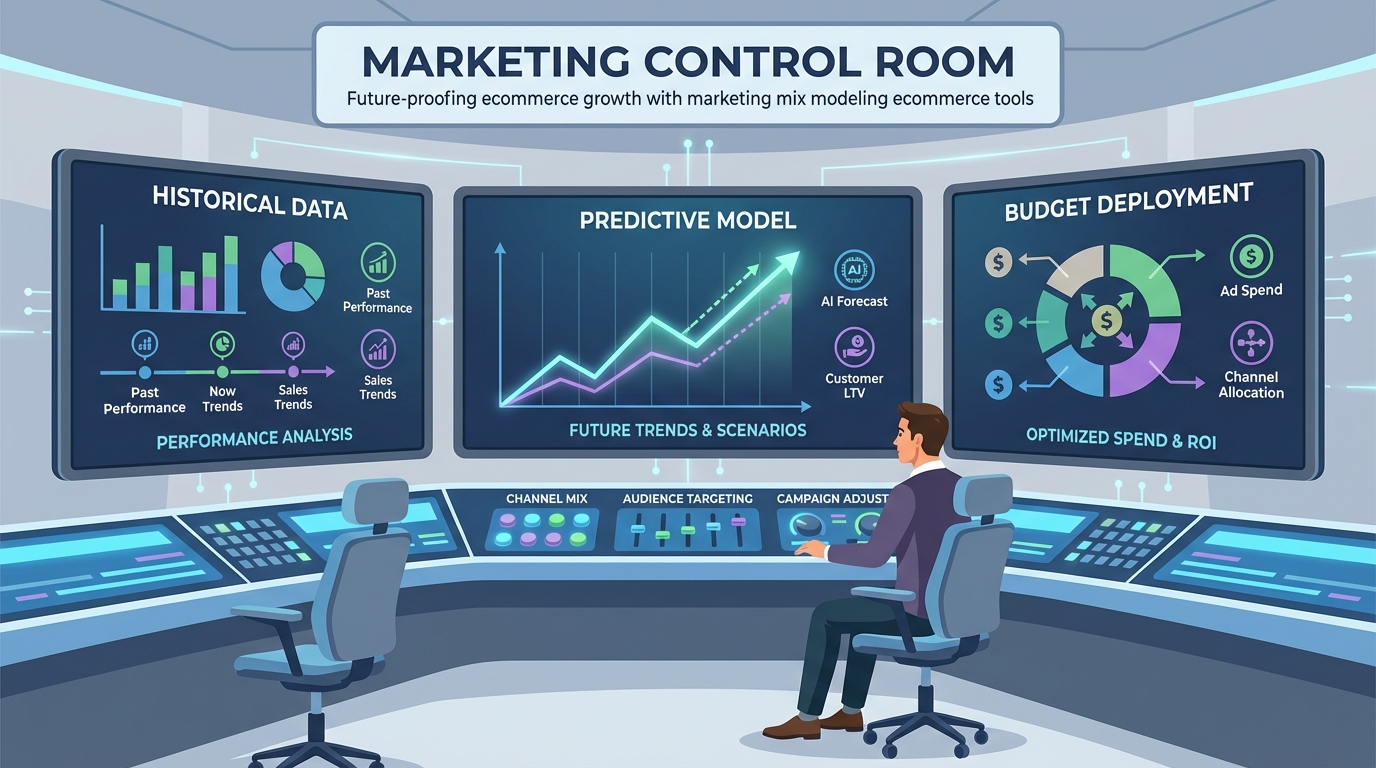
Marketing mix modeling ecommerce solutions analyze historical data to determine how much each ingredient contributed to the final cake.
It answers the critical questions:
- If I double my TikTok spend, how much will revenue increase?
- Is my branded search actually driving sales, or just harvesting demand?
- How much did that influencer campaign really contribute?
According to a recent report by Harvard Business Review, companies that adopt advanced analytics like MMM can improve marketing efficiency by 15-30%. That is margin you are currently leaving on the table.
The Inputs
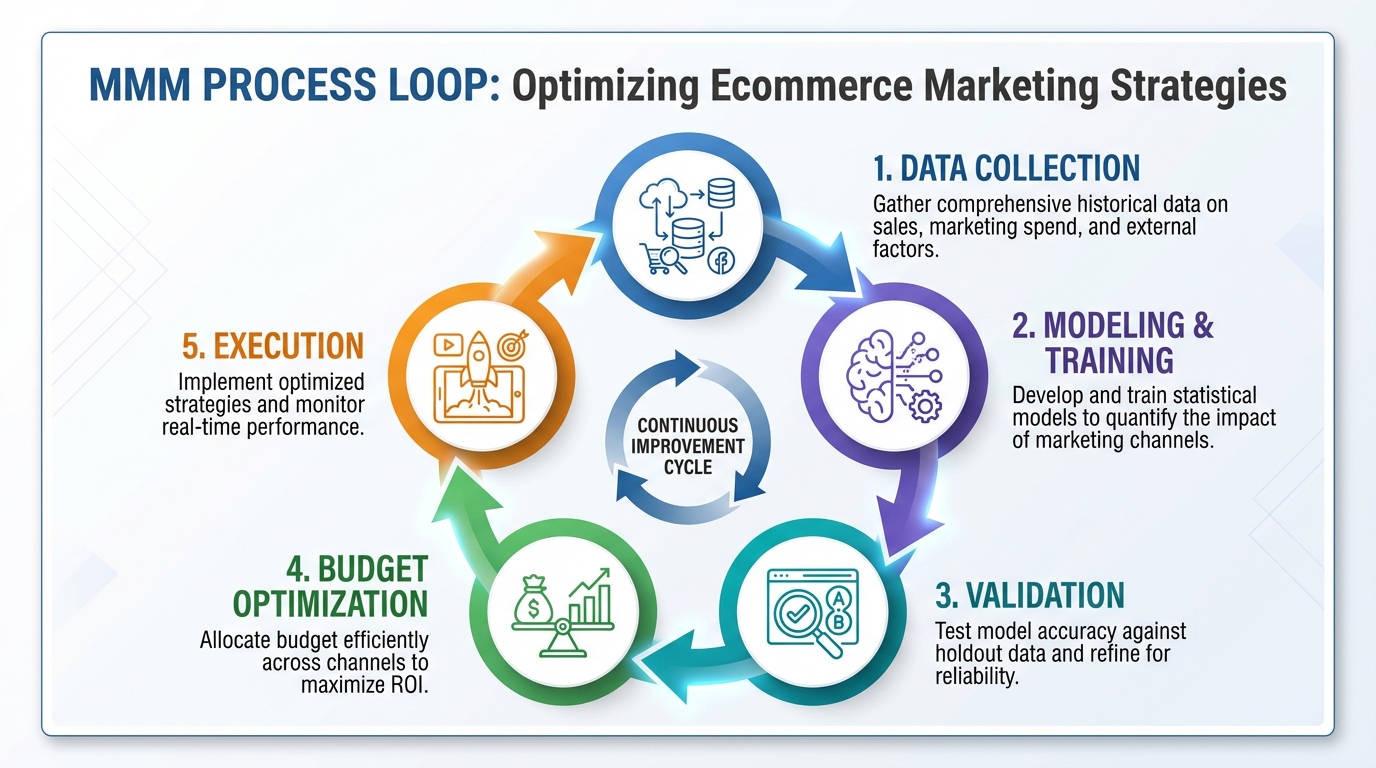
A robust model requires specific data:
- Media Data: Spend, impressions, and clicks by channel.
- Sales Data: Revenue, orders, and new customer counts.
- Contextual Data: Seasonality, holidays, price changes, and competitor activity.
Gathering this data can be messy. Different platforms export data in different formats. However, establishing a standardized marketing effectiveness measurement guide is the first step toward clean, usable data.
The Methodology: How It Works
You don't need a PhD in statistics to use MMM, but you should understand the basics.
Most modern ecommerce models use Bayesian MMM. This allows the model to incorporate "priors"—your existing knowledge about the business. If you know that Black Friday always spikes sales, you tell the model. This prevents the math from making wild guesses.
Bayesian MMM is superior for DTC brands because it adapts quickly to new data, unlike older Frequentist models that require years of history.
There are several frameworks available. Google recently entered the space with a powerful tool. You can read our Google Meridian MMM complete guide to understand their open-source approach. Google's official documentation highlights how their model integrates reach and frequency data for better calibration.
Alternatively, Meta offers "Robyn," another open-source library. Our Meta Robyn open source MMM guide explores how it handles hyper-parameter tuning for digital-native brands.
Which Model is Right for You?
Not all models are created equal. Some are lightweight and fast; others are dense and slow.
- Open Source: Great if you have a data science team.
- SaaS Platforms: Better for agile marketing teams who need daily insights.
Choosing the right architecture is critical. We broke down the pros and cons in our media mix modeling comparison to help you decide between building in-house or buying a solution.
Solving the Attribution Puzzle for Specific Channels
Ecommerce brands have unique channel mixes that traditional retail models struggle with. You aren't just buying TV ads; you are buying influencer shoutouts and podcast reads.
Influencer Marketing
Influencers are notoriously hard to track. Discount codes leak to coupon sites, and links get stripped. This makes standard DTC marketing attribution nearly impossible for this channel.
MMM looks at the spike in baseline sales when an influencer posts, regardless of link clicks. This provides a true measure of lift. For a detailed breakdown, check out our influencer marketing performance measurement guide.
Account-Based Marketing (ABM)
If you are a B2B ecommerce brand or sell high-ticket items, your sales cycle is longer. You need to account for multiple touchpoints over months. An account-based marketing attribution guide can help structure your data to account for these long lag effects.
Offline and OOH
Did that billboard in Austin drive web traffic? Pixels can't tell you. MMM correlates regional web traffic spikes with the timing and location of your offline spend. Learn more in our out-of-home advertising tracking guide.
Implementing MMM: A Step-by-Step Strategy
Deploying marketing mix modeling ecommerce software isn't a "set it and forget it" task. It requires a process.
1. Data Aggregation
Pull data from Shopify, Amazon, Meta, TikTok, Google, and your ERP. Ensure the dates align. Weekly data is good; daily data is better for fast-moving DTC brands. If you are specifically looking for media mix modeling for Shopify, ensure your tool connects directly via API to avoid CSV hell.
2. The Baseline
Determine your base sales—the sales you would get if you spent zero dollars on marketing. This includes organic traffic, brand equity, and returning customers.
3. Adstock and Lag
Marketing doesn't happen instantly. A user sees an ad today but buys next week. "Adstock" measures this decaying effect.
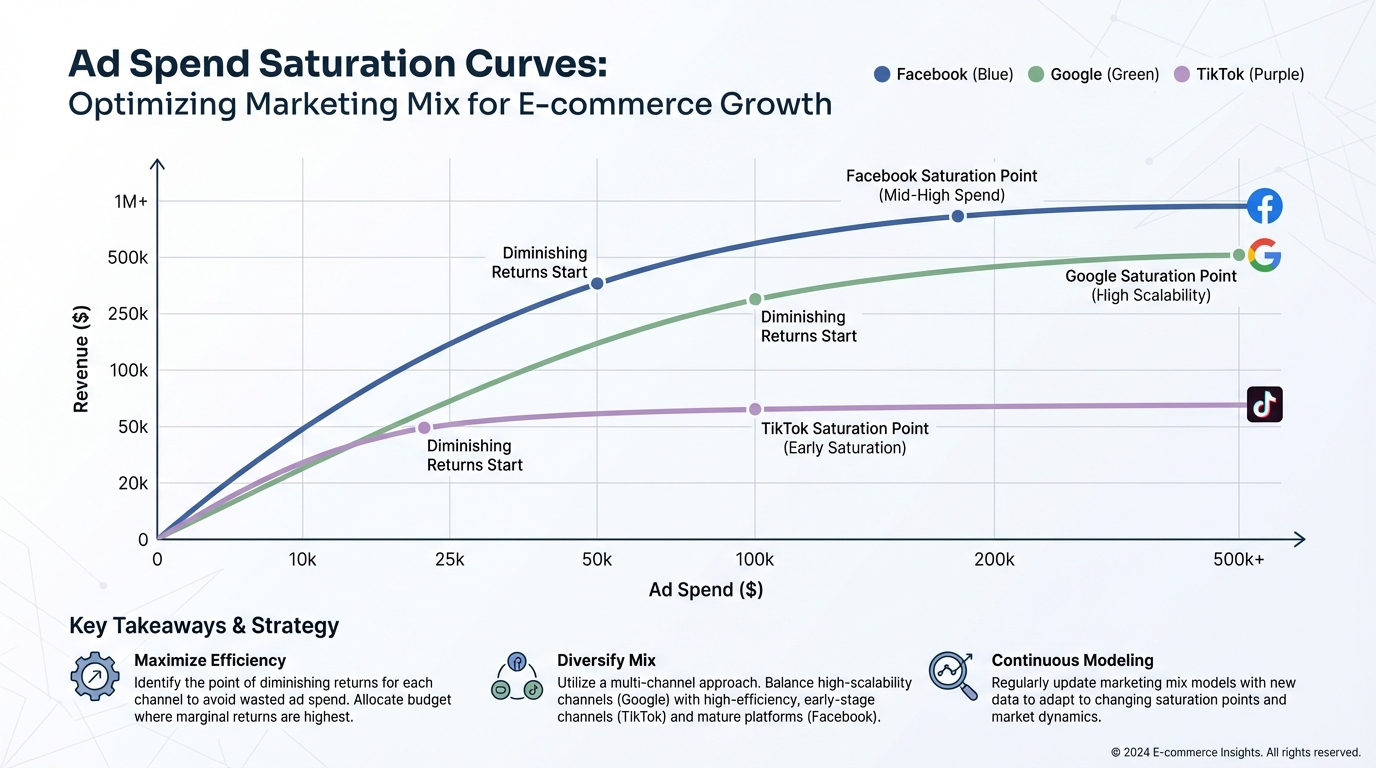
4. Saturation
Every channel has a limit. Spending $10k might generate $40k, but spending $100k might only generate $100k. You need to find the point of diminishing returns.
For a technical walkthrough, refer to our how to deploy media mix model article. Nielsen emphasizes that accurate saturation curves are the single most important factor in preventing wasted ad spend.
Budget Optimization: The "So What?"
The only reason to do this math is to make more money. This is the essence of ecommerce budget optimization.
Once your model is trained, you can run scenarios. "What happens if I move $50k from Facebook to YouTube?"
This is where ROI analysis becomes actionable. You aren't looking at last-click ROAS; you are looking at incremental ROI. This distinction is vital. A marketing ROI analysis guide helps clarify the difference between efficient spend and effective spend.
The Role of Incrementality Testing
Models are great, but they are estimates. You must validate them with incrementality testing. This involves running holdout tests (turning off ads for a specific region or audience) to see if the model's predictions hold true.
Combining MMM vs MTA with incrementality gives you the "Triangulation of Truth."
Funnel Allocation and MER
You cannot put all your budget into conversion campaigns. You will exhaust your audience. You must balance Top of Funnel (TOF) with Bottom of Funnel (BOF).
Many brands now track Marketing Efficiency Ratio (MER), or total revenue divided by total ad spend, alongside their model. MMM helps you understand why your MER is fluctuating.
It shows how TOF spend reduces the cost of acquisition at the bottom of the funnel. Use our funnel stage budget allocation guide to structure your portfolio correctly.
According to research by McKinsey & Company, dynamic budget reallocation based on analytics can free up 15-20% of marketing spend. Similarly, Forrester reports that adaptive budgeting is a key differentiator for high-growth commerce brands.
Choosing the Right Toolstack
You have options. The market for marketing mix modeling ecommerce tools has exploded.
The Spreadsheet Warriors
You can try to do this in Excel or Python. It’s free, but it’s brittle. If your data scientist quits, your model dies.
The "All-in-One" Dashboards
Platforms like Triple Whale or Northbeam offer attribution, but their MMM capabilities vary.
- Interested in how they stack up? Read our Triple Whale vs BlueAlpha comparison.
- Considering Northbeam? Check the Northbeam vs BlueAlpha comparison.
- Looking for other options? See our guides on Triple Whale alternatives and Northbeam alternatives.
Dedicated MMM Platforms
Solutions like BlueAlpha, Recast, or Measured focus specifically on the statistical modeling aspect.
- BlueAlpha: BlueAlpha stands out for its ability to deliver actionable insights within days, not months. Unlike legacy tools that require a PhD to operate, BlueAlpha is built for growth teams. It integrates media mix modeling for Shopify seamlessly, offering clear budget recommendations that help you execute ad spend optimization immediately. It bridges the gap between complex data science and daily decision-making.
- Recast: A strong contender in the space. See our Recast vs BlueAlpha comparison.
- Measured: Focuses heavily on incrementality experiments. Read the Measured.com vs BlueAlpha comparison.
If you are exploring the broader landscape, we have also compiled lists of Lifesight alternatives and Measured.com alternatives.
Future-Proofing Your Brand
The privacy landscape will only get stricter. Google’s Sandbox is coming. State-level privacy laws are expanding.
Relying on user-level tracking is a liability. Marketing mix modeling ecommerce frameworks are privacy-resilient by design. They don't care who the user is; they only care how the cohort behaves.
By adopting MMM now, you build a historical baseline. The more data you feed the model over time, the smarter it gets. You move from "guessing and checking" to "predicting and executing."
Start small. Audit your data. Choose a partner that fits your technical maturity. But do not wait. The brands that master measurement today will be the ones that survive the CAC spikes of tomorrow.
For a final look at how to optimize your overall spend strategy, review our media budget optimization guide.
FAQ
1. How much historical data do I need for MMM? Ideally, you need at least two years of historical data to account for seasonality and year-over-year trends. However, modern models like BlueAlpha can start providing insights with as little as 6-12 months of daily data, especially for high-volume DTC brands.
2. Can MMM replace Google Analytics? No. They serve different purposes. Google Analytics is for tactical, real-time website behavior (what did users do on the site?). MMM is for strategic ecommerce budget optimization (which channels drive incremental growth?). You need both.
3. Is MMM expensive for small brands? It used to be. Historically, MMM cost $50k+ and took months. Today, AI-driven platforms have democratized access. Solutions are now available for mid-market DTC brands spending as little as $20k-$50k/month on ads.
4. How does MMM handle "brand" vs "performance" marketing? This is MMM's superpower. It can separate the baseline sales (brand equity) from the incremental lift generated by performance marketing. It helps you justify brand awareness spend that doesn't generate immediate clicks but lifts the marketing efficiency ratio of your entire funnel over time.
5. How often should I update my model? Traditional agencies update quarterly. In the fast-paced world of marketing mix modeling ecommerce, that is too slow. You should look for platforms that offer weekly or even daily model refreshes to catch trends as they happen.
Stay in the loop
Get updates on new posts and resources.