MMM for Apps: The Subscription Growth Guide (2026)
Stop flying blind with broken attribution. Learn how MMM for apps restores visibility, optimizes subscription LTV, and scales growth. Discover the strategy.
The pixel is dead. The IDFA is gone. If you are still relying on deterministic tracking to scale your mobile app, you aren’t just losing data. You are losing money.
For years, mobile app marketers lived in a golden age of perfect visibility. You ran an ad, a user clicked, they installed, and you knew exactly how much that user was worth. Then came iOS 14.5, Google’s Privacy Sandbox, and a wave of regulation that turned the lights off.
Now, subscription businesses and app developers face a brutal reality: Customer Acquisition Cost (CAC) is rising, but your ability to measure it is falling.
This is why MMM for apps (Marketing Mix Modeling) has moved from a "nice-to-have" enterprise tool to a survival requirement for growth teams. It doesn't rely on tracking individual users. It doesn't care about cookie consent. It uses advanced statistics to tell you what’s actually working.
Here is how you build a measurement engine that survives the privacy apocalypse.
The Broken State of App Attribution
Before we fix the problem, let's define it. Most mobile apps still rely on Multi-Touch Attribution (MTA) or Last-Click models provided by Mobile Measurement Partners (MMPs).
These tools are failing.
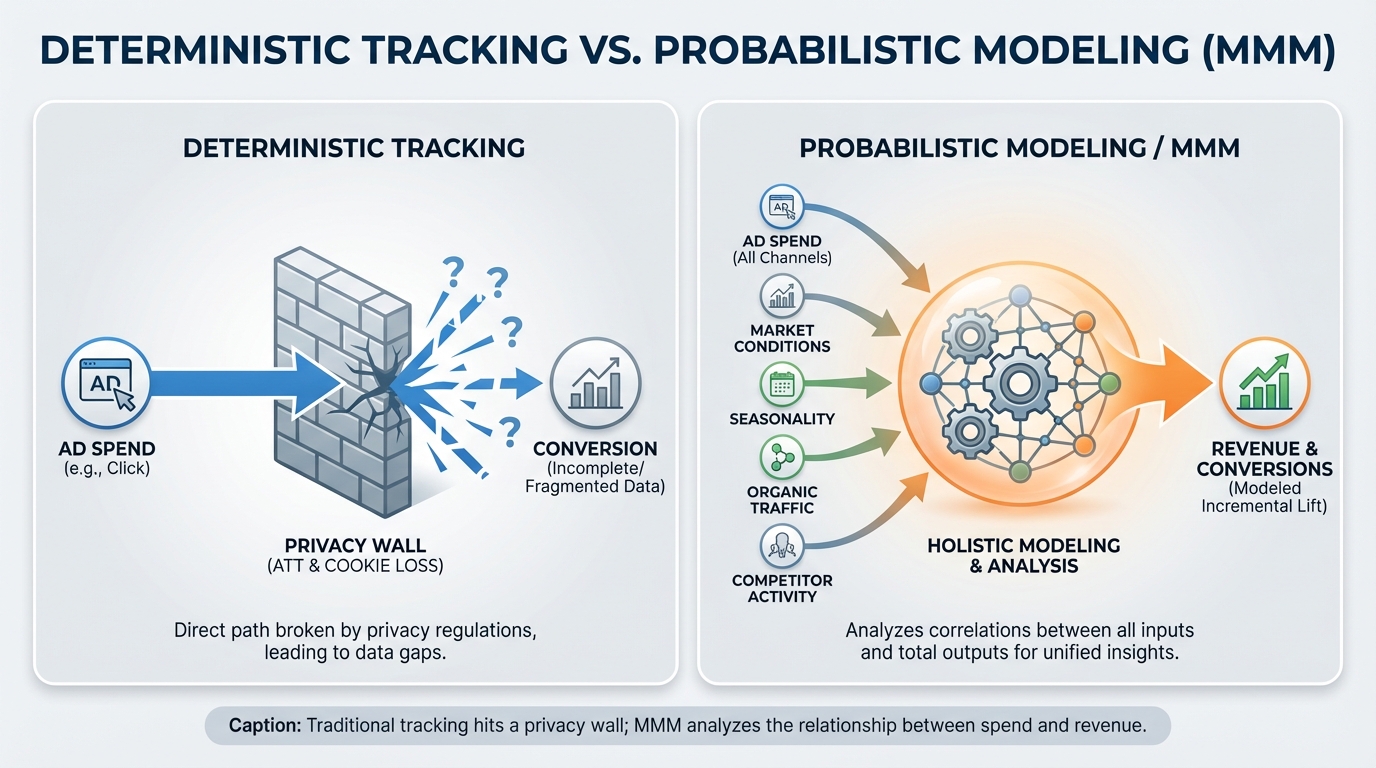
When a user sees a YouTube ad on their TV, searches for your app on their phone, and subscribes three days later, your MMP sees organic traffic. It assigns zero credit to the YouTube ad. You pause the ad because it looks inefficient. Your organic signups tank. You scratch your head.
This is the "signal loss" crisis. Platforms like Facebook and TikTok now model conversions rather than observing them directly. The data you see in their dashboards is a guess.
To understand the difference between the old way and the new way, you need to understand the fundamental shift in attribution philosophy. You can read more about the mechanics of this shift in our media mix model marketing attribution guide.
According to Apple's official documentation on SKAdNetwork, the framework deliberately delays postbacks and limits conversion values to protect user privacy. This feature, while good for consumers, creates a massive blind spot for marketers who need real-time data.
Furthermore, a recent forecast by eMarketer indicates that despite signal loss, mobile ad spending continues to break records, meaning competition is fiercer than ever while visibility is lower.
You can read more about the specific mechanics of this shift in our MTA vs. MMM marketing attribution comparison.
Why MMM for Apps is Different
Marketing Mix Modeling isn't new. CPG giants have used it for decades to measure TV and billboards. But MMM for apps requires a different breed of modeling.
Traditional retail MMM moves slowly. You get a report once a quarter. In the mobile app world, that speed kills. You need to adjust bids weekly, sometimes daily. You deal with cohort-based revenue, not one-time purchases.
The Subscription Latency Problem
If you sell a $5 coffee, you know your return immediately. If you sell a subscription app, your revenue realizes over months or years.
A user installs today (Day 0). They start a trial. They convert to paid on Day 7. They renew on Day 37. They churn on Day 120.
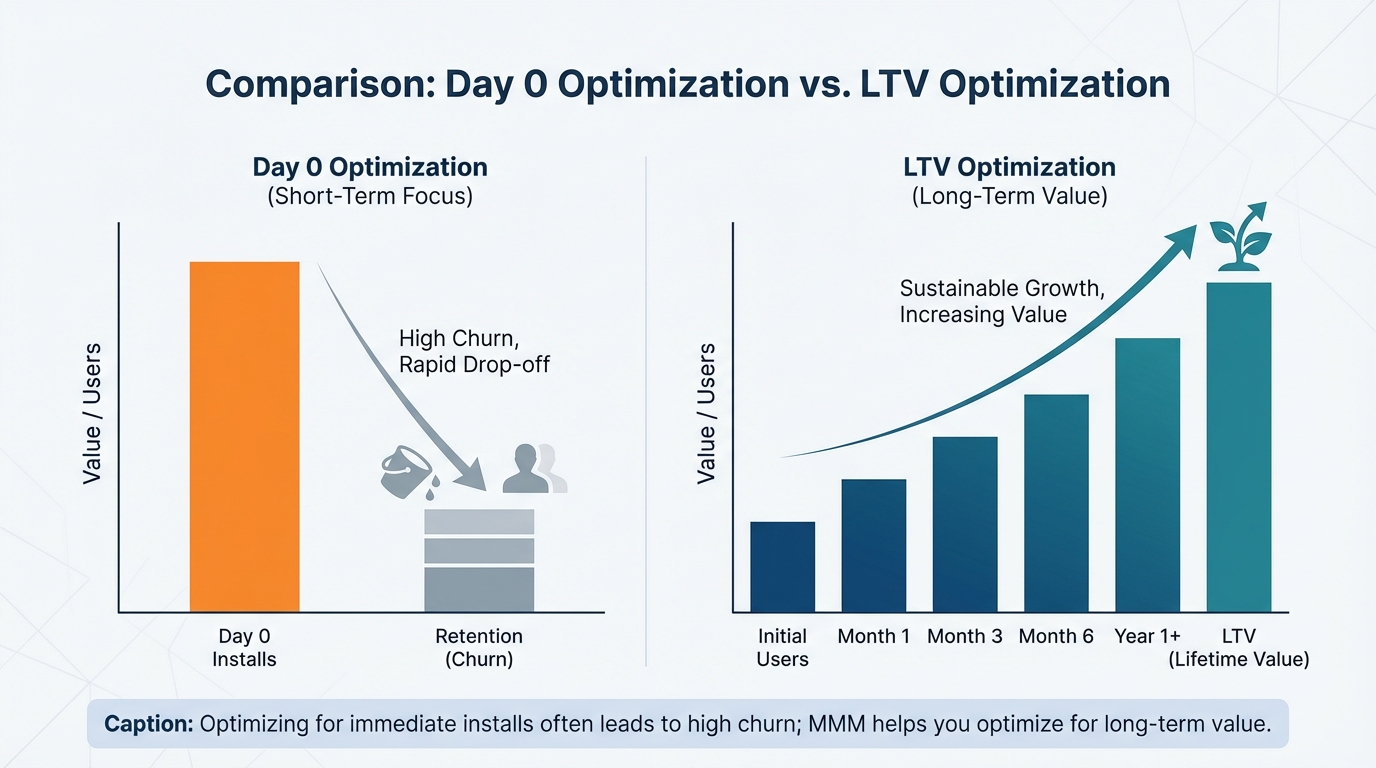
If your model only looks at Day 0 revenue, it undervalues every channel that brings in high-quality, long-term users. You need a model that accounts for projected Lifetime Value (LTV).
According to a recent report by Harvard Business Review, companies that integrate long-term metrics into their attribution models see a 15-20% improvement in marketing efficiency compared to those focused solely on immediate acquisition.
To get this right, you need to look beyond simple installs. You need to measure the effectiveness of your marketing across the entire funnel. For a deep dive on setting this up, check out our marketing effectiveness measurement guide.
Core Components of an App-First MMM
To build a model that actually predicts growth, you need to feed it the right ingredients. A standard regression model won't cut it for the complexities of the App Store and Play Store ecosystems.
1. The Data Ingestion Layer
Your model is only as good as your data. For apps, this means aggregating three distinct buckets:
- Marketing Spend: Facebook, Google, TikTok, Apple Search Ads, Influencers, TV, OOH.
- Business Outcomes: Installs, Trials, Subscriptions, Renewals, Reactivations.
- External Factors: Seasonality (Q1 fitness boom), Competitor price changes, App Store featuring.
Getting this data clean is the hardest part. You need a unified view of marketing effectiveness. This often involves complex calculations to determine the true return on investment. For a detailed breakdown on calculating these complex returns, refer to our marketing ROI analysis guide.
2. Adstock and Lag Effects
Mobile users don't always convert instantly. A podcast ad might trigger an install two weeks later.
Think of it like a hangover. You drink on Friday night (the ad spend), but you feel the headache on Saturday morning (the install). That delay is the Lag.
And just like a catchy song stuck in your head, the memory of an ad fades slowly over time—that’s Adstock.
If your MMM assumes all conversions happen on the day of spend, you will over-invest in direct response (Google UAC) and under-invest in brand awareness (Podcasts, YouTube).
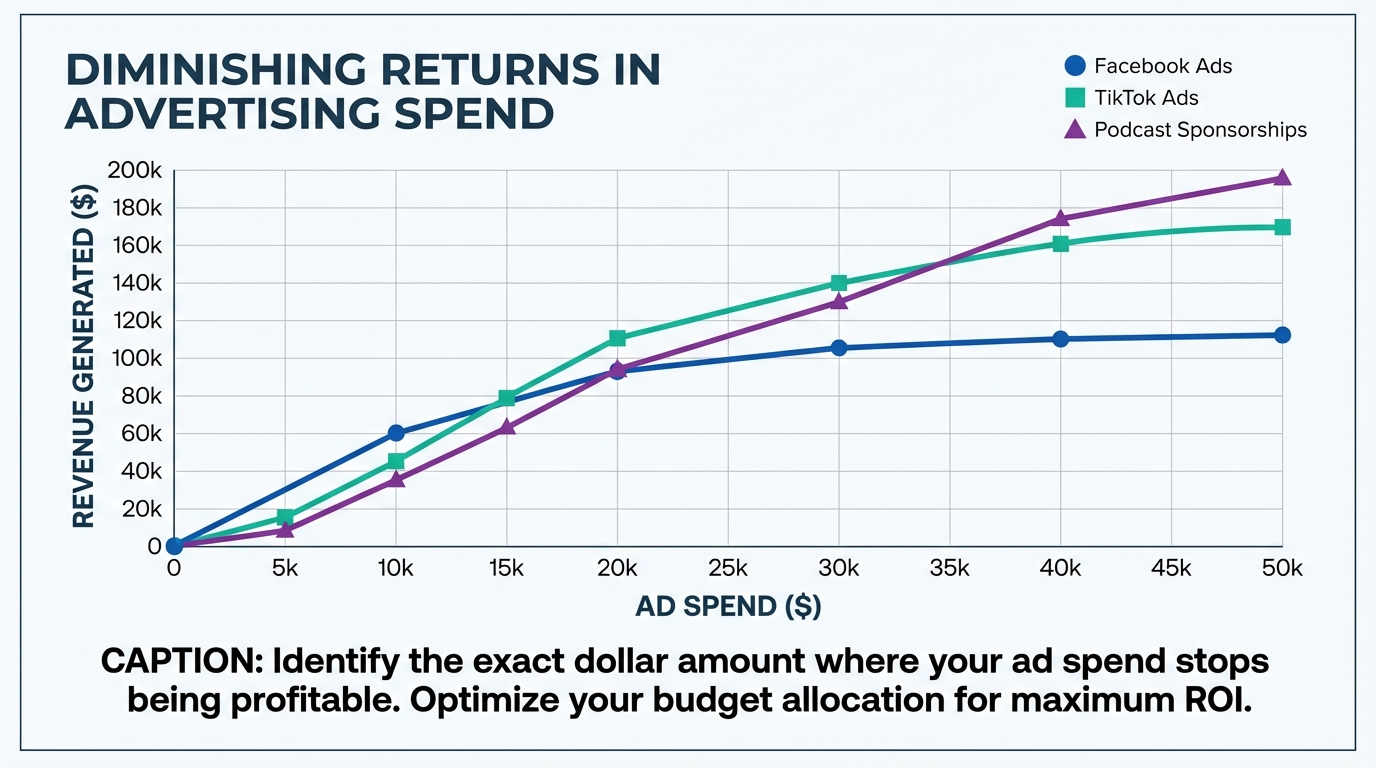
3. Saturation Curves
Every channel has a ceiling. Spending $10,000 on TikTok might yield a $20 CAC. Spending $100,000 might drive that CAC up to $60.
MMM for apps plots these saturation curves. It tells you exactly when to stop spending on Facebook and move that budget to a new channel like Connected TV.
4. Baseline Sales and Brand Equity
One concept app marketers often overlook is the "Baseline." Even if you turned off all ads tomorrow, you would still get some installs. These come from word-of-mouth, organic search, and brand equity built over years.
Bad models attribute these baseline installs to your paid media, inflating your ROAS. Good models separate the baseline from the incremental lift. This is critical when you are trying to determine which specific media mix is best for your current stage of growth. You can explore different modeling approaches in our media mix modeling comparison.
The Build vs. Buy Dilemma
Once you decide to adopt MMM, you have two paths: build an in-house model using open-source libraries, or buy a SaaS solution.
The Open Source Route
Tech-heavy teams often start here. It gives you total control but demands significant resources.
- Google Meridian: A robust, Bayesian framework that handles geo-level data well. It requires significant data science resources to tune, but it offers deep customization. Read our Google Meridian MMM complete guide.
- Meta Robyn: Another powerful contender, using machine learning to automate some of the modeling decisions. It’s particularly strong for Facebook-heavy advertisers looking to understand cross-channel impact. Check out our Meta Robyn open source MMM guide.
The downside? Maintenance. Data pipelines break. Models drift. Your data scientist quits. Suddenly, you're flying blind again.
The SaaS Route
For most growth teams, speed is the priority. SaaS platforms automate the data ingestion, modeling, and reporting.
Platforms like BlueAlpha handle the heavy lifting. They connect directly to your ad networks and MMPs, normalize the data, and run continuous models. This allows you to check your media mix daily, not quarterly.
If you are currently using simple dashboarding tools, you might be looking for more robust analytics. We've compared several options. For instance, see how advanced modeling stacks up in our Triple Whale vs. BlueAlpha AI comparison to understand the difference between e-commerce analytics and true MMM. Similarly, if you are evaluating attribution platforms, our Northbeam vs. BlueAlpha AI comparison highlights the shift from click-based to model-based measurement.
Furthermore, some platforms market themselves as analytics solutions but lack the predictive backbone of MMM. For a detailed look at these differences, review our Lifesight vs. BlueAlpha AI comparison guide.
Integrating Influencers and Offline Channels
One of the biggest advantages of MMM is its ability to measure channels that don't click.
Influencer marketing is huge for apps. But if a user sees an influencer's story and downloads the app later without using a promo code, attribution fails. MMM picks up the spike in baseline installs that correlates with the influencer post.
According to a survey by Gartner, nearly 60% of CMOs report that they lack the tools to measure the ROI of influencer campaigns effectively, leading to wasted budget.
With MMM, you can correlate the flight dates of your influencer campaigns against your organic lift.
- Learn more about influencer marketing performance measurement.
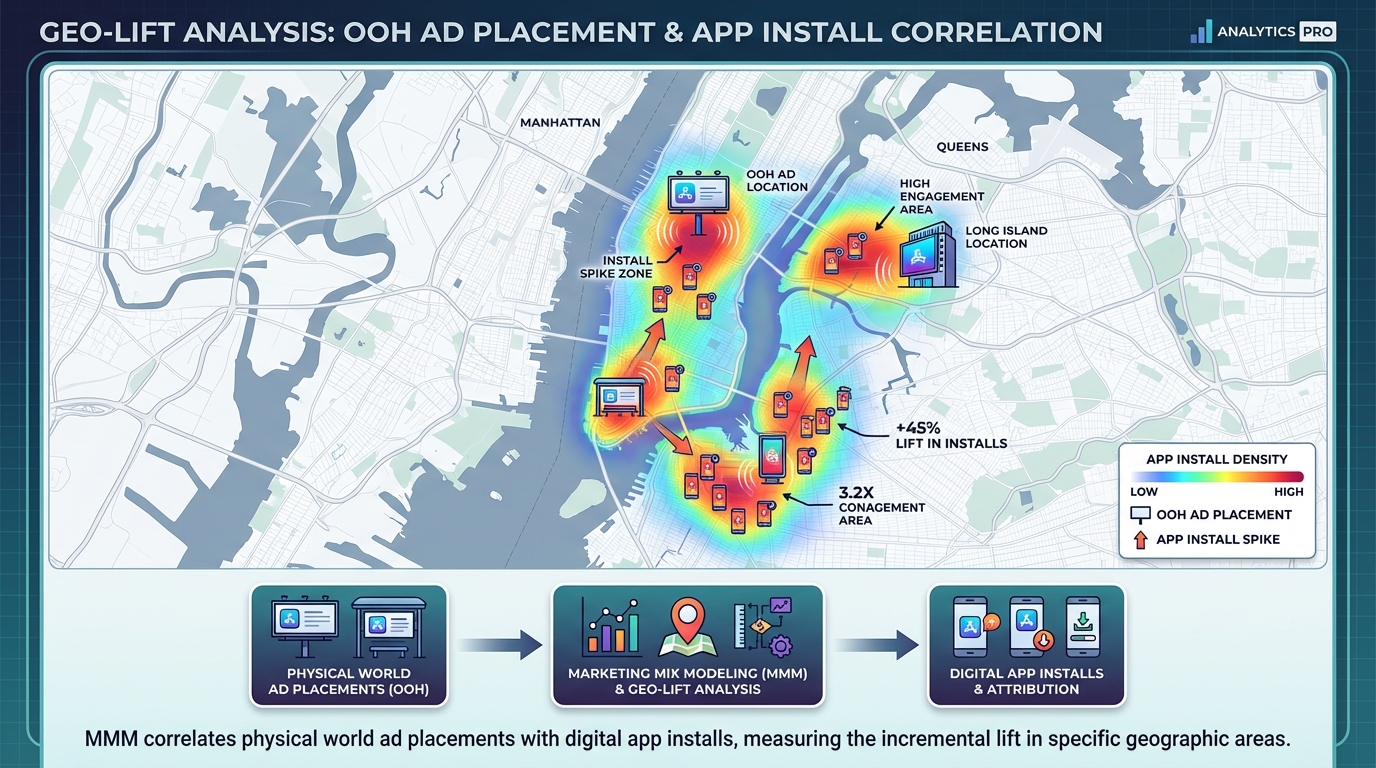
The same applies to Out-of-Home (OOH) advertising. If you wrap a subway train in NYC, you can't track clicks. But you can measure the lift in installs in the NYC geo-region during the campaign.
- Learn more about out-of-home advertising tracking.
How to Deploy MMM for Your App
You don't flip a switch and have a working model. It’s a process.
Step 1: Data Audit
Gather at least 12-24 months of historical data. You need variance in your spending. If you spent exactly $5,000/day on Facebook for two years, the model can't learn anything. It needs peaks and valleys.
Step 2: The Calibration Phase
Run your model alongside your existing MMP data. They won't match. That’s expected.
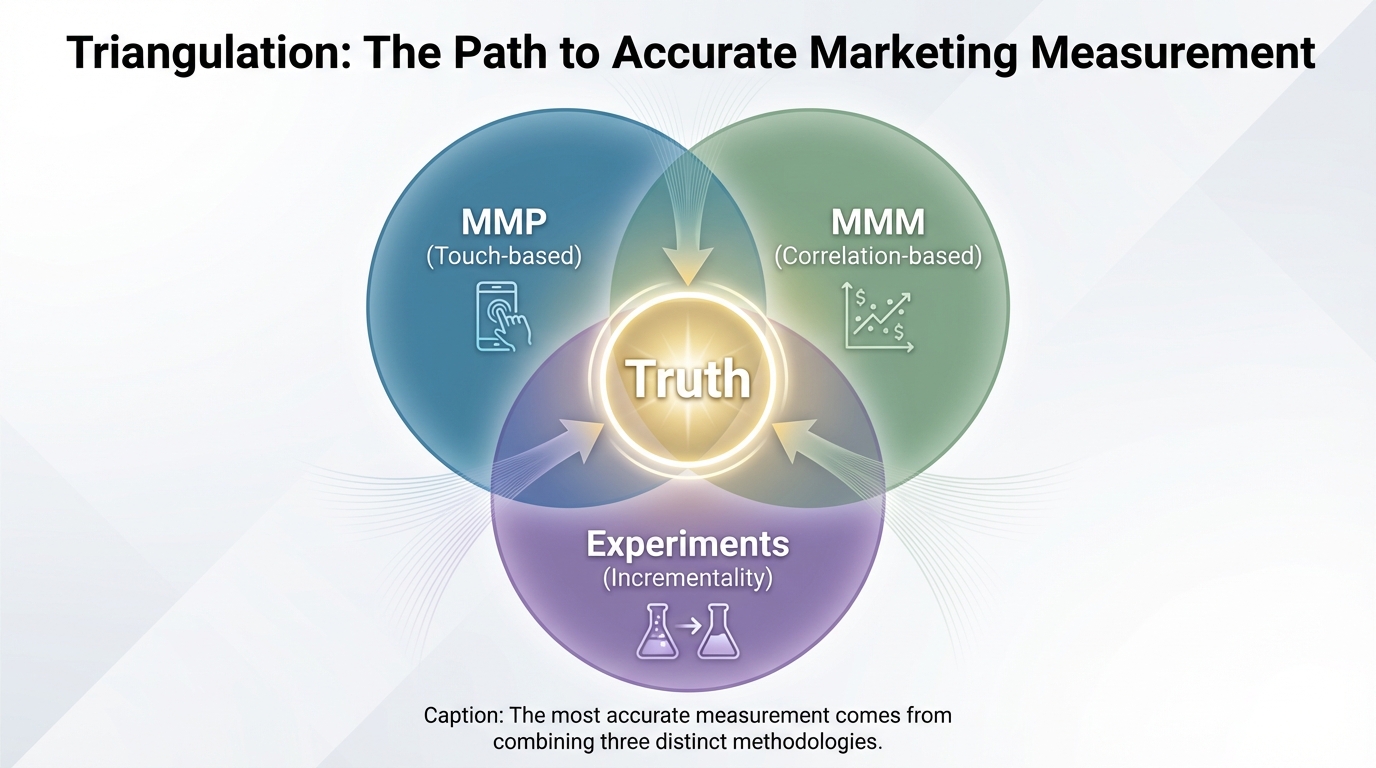
Use incrementality testing (lift studies) to calibrate. Turn off a channel for a week in a specific geo. Did sales drop? By how much? Use that truth set to tune your MMM.
According to McKinsey & Company, companies that combine MMM with incrementality testing (triangulation) achieve the highest accuracy in budget allocation.
Step 3: Operationalize
Don't leave the insights in a PDF. Integrate the model outputs into your budget planning cycles. For a step-by-step walkthrough, read our guide on how to deploy a media mix model.
The First 90 Days
Expect the first month to be noisy. Your model is learning. By day 60, you should start seeing trends that contradict your MMP. By day 90, you should be confident enough to make your first major budget reallocation based on MMM data.
Budget Allocation: The End Game
The goal of MMM for apps isn't just to report numbers; it's to change where you put your money.
Your model might reveal that:
- Apple Search Ads is saturated; spending more there increases CAC without adding volume.
- TikTok is highly incremental; scaling it up won't hurt efficiency yet.
- Your "Brand Awareness" YouTube campaign is actually driving 15% of your organic search volume.
You take these insights and shift the budget. This is media budget optimization. It’s the difference between linear growth and exponential growth. Read more about executing these shifts in our media budget optimization guide.
Furthermore, understanding where to place budget within the funnel is just as critical as channel selection. You might find that upper-funnel video ads are driving lower-funnel search conversions. For strategies on balancing this, check our funnel stage budget allocation guide.
Navigating the Tool Landscape
The market is flooded with tools claiming to solve attribution. It is vital to distinguish between data visualization platforms, incrementality tools, and true MMM.
Data Connectors vs. Modeling Engines
Some tools focus purely on aggregating data into a clean dashboard. Funnel.io, for example, is excellent for collecting data but doesn't perform the predictive modeling required for MMM. If you need alternatives that offer more analytical depth, check our list of Funnel.io alternatives for marketing data platforms.
For a direct comparison of capabilities between data aggregation and AI-driven modeling, check our Funnel.io vs. BlueAlpha AI comparison guide.
Incrementality vs. MMM
Other platforms focus heavily on incrementality testing. Measured.com is a leader in this space, offering geo-lift experiments. However, pure incrementality tools can sometimes miss the holistic "always-on" view that MMM provides.
- Explore our Measured.com alternatives guide.
- See how they stack up in our Measured.com vs. BlueAlpha AI comparison.
MMM Competitors
There are also dedicated MMM platforms like Recast. While they offer powerful modeling, the implementation time and cost structure can vary significantly compared to AI-first solutions.
- Read our Recast vs. BlueAlpha comparison.
- If you are shopping around, review our Recast alternatives list.
Emerging Players
The landscape is shifting fast. Tools like Keen Decision Systems and Fusepoint are also vying for market share.
- See our Keen Decision Systems vs. BlueAlpha analysis.
- Check out our Fusepoint vs. BlueAlpha comparison.
- For a broader look, we have compiled a guide on Keen Decision Systems alternatives and Fusepoint alternatives.
As noted by Forrester, the future of marketing measurement lies in "Unified Marketing Measurement" (UMM), which blends the granularity of MTA with the strategic oversight of MMM.
Common Pitfalls to Avoid
1. The "Granularity" Trap
Don't try to model every single ad creative. MMM works best at the channel or campaign level. If you try to see if "Creative A" beat "Creative B" using MMM, the data becomes too noisy. Leave creative testing to the platform algorithms.
2. Ignoring Seasonality
Apps have rhythms. Fitness apps peak in January. Education apps peak in September. If your model doesn't account for this, it will attribute organic seasonal spikes to your ad spend, making your marketing look better than it is.
3. Short-Termism
If you optimize purely for Day 0 installs, you will destroy your business. You will attract low-quality users who churn immediately. Always optimize for predicted LTV.
Research from Nielsen consistently shows that long-term brand building provides better ROI than short-term activation, yet many app marketers still over-index on the latter.
This is particularly relevant for B2B apps or high-ticket subscriptions where account value matters more than user volume. In these cases, you need to align your metrics with account-based principles. You can learn more in our account-based marketing attribution guide or our ABM ROI measurement guide.
Conclusion: The New Normal
The era of lazy tracking is over. The "black box" of the App Store is here to stay.
MMM for apps restores the visibility you lost. It allows you to respect user privacy while still making ruthless, data-driven decisions about your capital.
You can keep guessing with your MMP’s broken dashboard, or you can start modeling the truth. The Google Privacy Sandbox is already rolling out on Android, signaling that the signal loss we saw on iOS is coming to every device.
The apps that win in 2026 won't be the ones with the most data. They will be the ones with the best models.
Stop burning cash on channels that don't convert. It's time to connect your marketing spend to real revenue pipeline. Read more about pipeline attribution to see how the best teams do it.
Ready to see the truth about your ad spend? Book a demo with BlueAlpha today and start optimizing for profit, not just clicks.
FAQ
What is the difference between MMP and MMM?
An MMP (Mobile Measurement Partner) tracks individual user actions using deterministic identifiers (like IDFA or GAID) or probabilistic matching. It tells you "User X clicked Ad Y." MMM (Marketing Mix Modeling) is a top-down statistical analysis that looks at aggregate data. It tells you "When we spent $X on Channel Y, total sales went up by Z." MMM works without user-level data, making it privacy-safe.
Can MMM work for small apps?
Generally, MMM requires a certain volume of data to be statistically significant. If you are spending less than $10k-$20k per month or have very few conversions, the model may struggle to find correlations. However, modern AI-driven MMM tools are lowering this threshold, making it accessible to mid-sized apps earlier than before.
How does MMM handle iOS 14.5 and SKAdNetwork?
MMM is immune to iOS 14.5 changes because it doesn't rely on tracking individual users across apps. It doesn't need the IDFA. It simply looks at how much you spent and how many conversions occurred, regardless of device type or privacy settings.
How often should I update my Media Mix Model?
Historically, MMMs were updated quarterly or annually. Today, for mobile apps, that is too slow. Modern "Continuous MMM" solutions update weekly or even daily, allowing for near real-time budget optimization.
Does MMM replace my attribution provider?
No. They work together. Use your MMP for day-to-day tactical decisions (creative testing, audience management) and immediate feedback. Use MMM for strategic budget allocation, cross-channel measurement, and understanding the true incremental value of your marketing.
Stay in the loop
Get updates on new posts and resources.